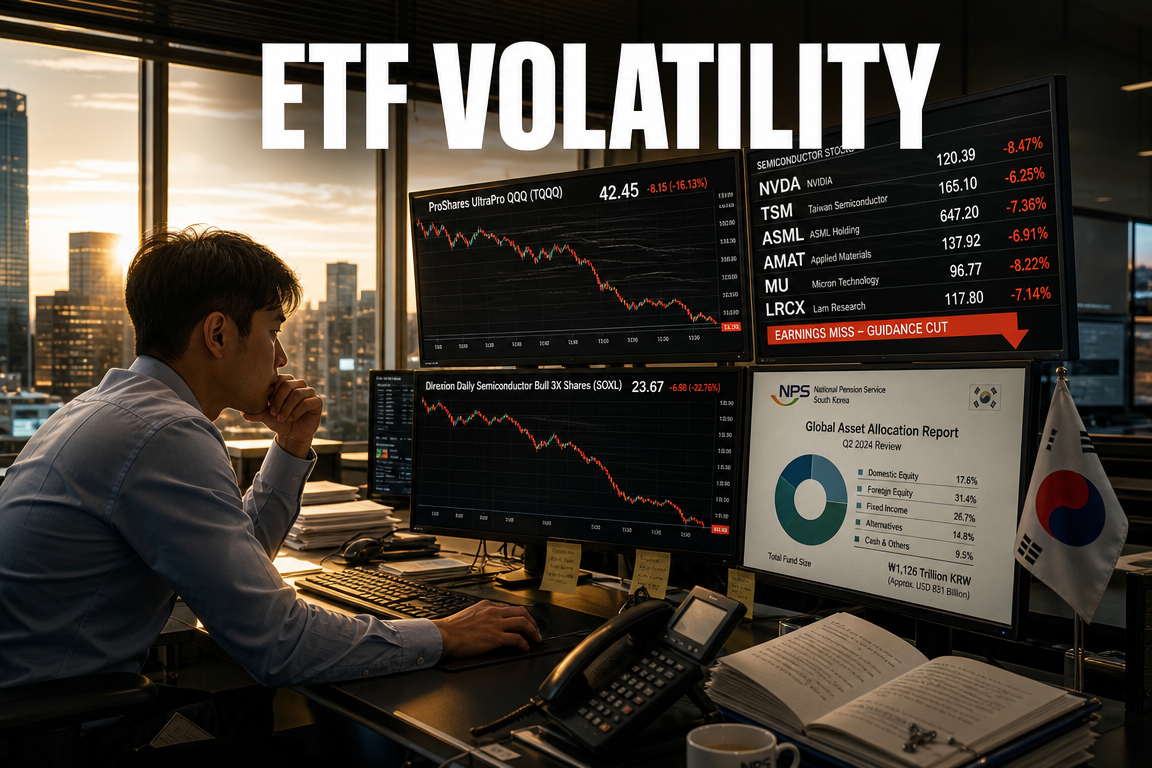
● Shock,Surge,Crash
The real reason semiconductor stocks fell despite earnings surprises: leverage ETFs, pre-pricing, and volatility must be viewed together
The core issue is not simply, “Why did stock prices fall when earnings were strong?”
The key point is that record earnings, a sharp rally in semiconductor stocks, the launch of single-name leveraged ETFs, an increase in the National Pension Service’s domestic equity allocation, and market pre-pricing all occurred at the same time.
Many reports describe the move as profit-taking after an earnings surprise. In practice, leveraged ETFs may have acted as a structural factor that amplified gains on the way up and losses on the way down.
This report summarizes, from the perspective of tax accountant Lee Jeong-yoon, the negative compounding effect of leveraged ETFs, the reasons for the correction in semiconductor stocks, why stronger earnings did not lead to higher share prices, and the investment implications for individual investors.
1. Why leveraged ETFs are risky: the key is negative compounding
The first concept to understand in leveraged ETFs is negative compounding.
In simple terms, a decline followed by the same percentage rebound does not restore principal.
For example, if an asset priced at 10,000 falls by 20%, it becomes 8,000.
If it then rises by 20% from 8,000, it reaches 9,600.
To return to 10,000, it must rise by 25%, not 20%.
This effect is stronger in leveraged ETFs.
When a regular asset falls 20%, a 2x leveraged ETF would, in theory, fall 40%.
If it then rises 40%, it still does not return to its original level.
Leveraged ETFs therefore appear to be directional products, but in practice they can work against investors when volatility rises.
This is why Lee Jeong-yoon described them as “melting like ice cream.”
They can generate large gains if the direction is correct in the short term, but in a sideways or choppy market, losses can accumulate over time.
2. Why single-name leveraged ETFs are even riskier
The product at issue is not a broad index leveraged ETF, but a single-name leveraged ETF based on names such as Samsung Electronics and SK hynix.
The problem is that the underlying stocks are already volatile, and a 2x leverage structure is added on top.
Some products may also include futures and derivative structures, making the risk difficult for ordinary investors to assess intuitively.
Lee Jeong-yoon argues that if an investor only wants directional exposure, buying the common stock is the more appropriate choice.
If Samsung Electronics is expected to rise, buying Samsung Electronics shares is sufficient.
If the stock appears to have risen too far, the investor can sell.
Single-name leveraged ETFs and inverse ETFs are not simple “up or down” instruments.
They require consideration of volatility, time decay, compounding, and derivative structure.
Inverse leveraged products are particularly risky because directional exposure is reversed and volatility drag is added.
3. Why investors who do not understand the product should not use leveraged ETFs
The central message repeated in the discussion is clear.
Investors who do not understand the product should not use leveraged ETFs.
Those who knowingly invest have at least accepted the risk.
They were seeking short-term gains and understood that losses could compound over time.
Investors who enter without understanding the structure face a different problem.
Although the product may look like a stock and trade easily, it can carry risks similar to futures and options.
There is also concern that the structure resembles earlier issues with bank-sold derivative-linked products.
Banks claimed disclosure was provided, but customers understood the products as principal-protected, only to later suffer substantial losses.
Leveraged ETFs raise similar questions about investor protection and disclosure obligations.
4. Regulatory controversy: why was the entry barrier low from the start?
The discussion also noted comments attributed to Financial Supervisory Service Governor Lee Chan-jin, who suggested that authorities should have intervened more forcefully after the fact.
This indicates that controversy over allowing single-name leveraged ETFs has intensified.
By comparison, futures and options markets now have significantly higher entry barriers.
Education requirements, professional investor criteria, initial deposits, and tax rules were introduced because futures and options are considered too risky for unrestricted retail access.
However, leveraged ETFs, despite carrying similar risks, could be traded like ordinary stocks.
This is seen as the most significant regulatory gap.
Stricter education and deposit requirements were later discussed, but only after the market had already experienced significant volatility.
5. The relationship between equity market support policy and leveraged ETFs
One of the government’s major policy directions has been to suppress property markets while supporting equity markets.
In such an environment, securities firms and asset managers have stronger incentives to launch more ETF products.
More ETF products can increase trading volume and fee income for managers, brokers, and market participants.
The issue is that while these products may support markets in an uptrend through capital inflows, they can amplify volatility during declines.
Lee Jeong-yoon noted that single-name leveraged ETFs may have helped push semiconductor stocks higher during the rally.
When retail demand flows into such ETFs, the fund must increase exposure to the underlying stocks, typically at about twice the notional level.
This can intensify upward pressure on the underlying names.
The same structure can increase selling pressure during downturns.
6. Semiconductor stocks rose and then corrected: the simplest explanation is that they had already risen too much
The simplest explanation for the correction is that prices had already risen substantially.
The discussion noted that from April last year through June this year, the broader index rose sharply, while Samsung Electronics and SK hynix also recorded strong gains.
When prices rise too far in a short period, even minor negative news can trigger strong profit-taking.
Movements in the Philadelphia Semiconductor Index also contributed.
Domestic semiconductor stocks are unlikely to remain strong independently if global semiconductor equities are correcting.
If expectations for AI semiconductors, memory cycles, and data-center investment have already been reflected in prices, the market begins to focus on the next phase of growth.
Even if absolute earnings improve, stocks can still correct if the pace of growth is expected to slow.
7. Why the stock price fell despite an earnings surprise: the answer is pre-pricing
The most important point in the discussion is pre-pricing.
Most investors already expected strong results from Samsung Electronics and SK hynix.
Media coverage, brokerage reports, and market forecasts had all pointed to record earnings.
As a result, the stock price does not necessarily rise simply because strong numbers are reported on earnings day.
If the expectation had already been reflected in the share price, the announcement can become a sell-the-news event.
This is similar to the “buy the rumor, sell the news” pattern.
An earnings surprise means more than good earnings.
The results must exceed market expectations.
The problem arises when investors’ actual expectations are far above consensus.
If brokers expected 100 but investors had already priced in 120 or 130, then a result of 120 may not lift the stock.
It may appear to be an earnings surprise, but psychologically it can still fall short of what the market wanted.
8. Efficient market hypothesis and information parity in the AI era
Lee Jeong-yoon also referred to the efficient market hypothesis.
The hypothesis states that historical information, current information, and even expectations about the future are already reflected in prices.
In the past, this theory often seemed inconsistent with reality.
Investors believed they could outperform the market by finding information quickly, analyzing financial statements, and studying catalysts.
However, the environment has changed in the internet and AI era.
Many investors now see nearly the same information at the same time and analyze it quickly using AI tools.
As information asymmetry narrows, it becomes increasingly difficult to generate excess returns.
Almost no investor was unaware that Samsung Electronics would likely report strong earnings.
The more important question is how much the stock had already risen before the announcement and how much of the expectation was already priced in.
9. The Philadelphia Semiconductor Index and global investor sentiment
The Philadelphia Semiconductor Index should be monitored when assessing domestic semiconductor stocks.
Although Samsung Electronics and SK hynix are Korean companies, their share prices are closely linked to the global semiconductor cycle.
When U.S. semiconductor stocks weaken, Korean semiconductor stocks are also likely to be affected.
After the rally driven by AI infrastructure spending expectations, the market begins to focus on the sustainability of growth rather than simple earnings strength.
Earnings can continue to improve, but not necessarily at an explosive pace every year.
Absolute profit may rise while growth rates decline.
The stock market is highly sensitive to that shift.
10. War and stock price examples: bad news is also priced in quickly
The discussion also referred to war-related market behavior.
When war breaks out, markets initially fall sharply.
After that, following a steep decline, they often begin to form a base.
This reflects the market pricing in not only the event itself but also the broader shock that follows.
As André Kostolany’s famous phrase suggests, one often has to buy stocks to the sound of war.
Of course, not every war or shock follows the same pattern.
The key point is that markets move before the news is fully visible, reflecting expectations and fear in advance.
11. The National Pension Service and the debate over artificial volatility
The discussion also mentioned an increase in the National Pension Service’s domestic equity allocation.
The interpretation was that the NPS maintained a higher allocation to domestic equities beyond strategic or tactical limits.
This can be viewed as helping market stability or supporting equity-market activity rather than mechanically selling shares.
However, if such policy-driven flows pushed prices above natural price discovery, the correction that follows may be more severe.
In other words, government policy, NPS flows, and the launch of leveraged ETFs may have supported prices during the rally.
But in a downturn, the same factors can amplify volatility.
This is a structural issue that matters more than a simple price decline.
12. The most important point often missed in other coverage
The key point that is often overlooked is that an earnings surprise does not guarantee a rise in share prices.
Investors generally assume that stronger earnings should lift the stock.
But the market discounts future expectations rather than only current results.
When the market’s actual expectations are higher than consensus, even a strong number can still lead to a decline.
Another important point is that single-name leveraged ETFs are not merely investment products; they can influence market supply-demand dynamics themselves.
They can push stocks higher during rallies and accelerate declines during corrections.
Accordingly, this semiconductor correction is better understood not as simple profit-taking, but as the unwinding of elevated expectations and leveraged positioning.
For individual investors, the question should not stop at “The earnings were good, so why did the stock fall?”
The more important question is: when did the market begin to price in those good earnings, and how far had the stock already moved?
13. Investment strategy for individual investors going forward
First, leveraged ETFs should be used only as short-term trading tools.
Long-term holding can lead to losses from negative compounding and volatility drag.
Second, if the product structure is not understood, it should not be used.
Single-name leveraged ETFs, inverse ETFs, and derivative-based ETFs differ materially from ordinary stocks.
Third, investors should focus not only on earnings day but also on the price trend leading up to the announcement.
If strong earnings have already been reflected in the price, selling pressure may emerge on the announcement day.
Fourth, semiconductor stocks should be evaluated alongside the Philadelphia Semiconductor Index, the AI investment cycle, global interest rates, exchange rates, and export trends.
Fifth, even if the macro outlook is positive, risk management is necessary when valuations have already risen sharply.
Good companies and good investments are not the same.
Even high-quality companies can generate poor returns if bought at excessive valuations.
14. One-sentence summary of the semiconductor correction
This correction was not driven by weak earnings, but by the rapid pricing-in of highly optimistic expectations, combined with leveraged flows and global semiconductor volatility.
What matters now is not whether earnings were good or bad.
The key question is how much optimism the market had already priced in, and whether that optimism can continue to rise.
Without that perspective, investors may continue to suffer losses even after earnings surprises.
< Summary >
Leveraged ETFs can be unfavorable for long-term holding because negative compounding means a larger gain is required to recover after a decline.
Single-name leveraged ETFs can amplify both upward and downward volatility in semiconductor stocks such as Samsung Electronics and SK hynix.
Stocks fell despite an earnings surprise because the strong results had already been priced in.
In the AI era, information spreads quickly, making pre-announcement expectations and price trends more important than the earnings release itself.
This semiconductor correction is best understood as the result of elevated expectations, leveraged positioning, and global semiconductor weakness rather than deteriorating fundamentals.
Individual investors should avoid products whose structure they do not understand and should evaluate both expectations and valuation, not earnings alone.
[Related Articles…]
- Leveraged ETF volatility risks investors should know
- Global semiconductor cycle and AI-driven market outlook
*Source: [ 경제 읽어주는 남자(김광석TV) ]
– 어닝 서프라이즈에도 주가가 빠진 이유, 슈퍼개미는 이렇게 봤습니다 | 경읽남과 토론합시다 | 이정윤 세무사 [2편]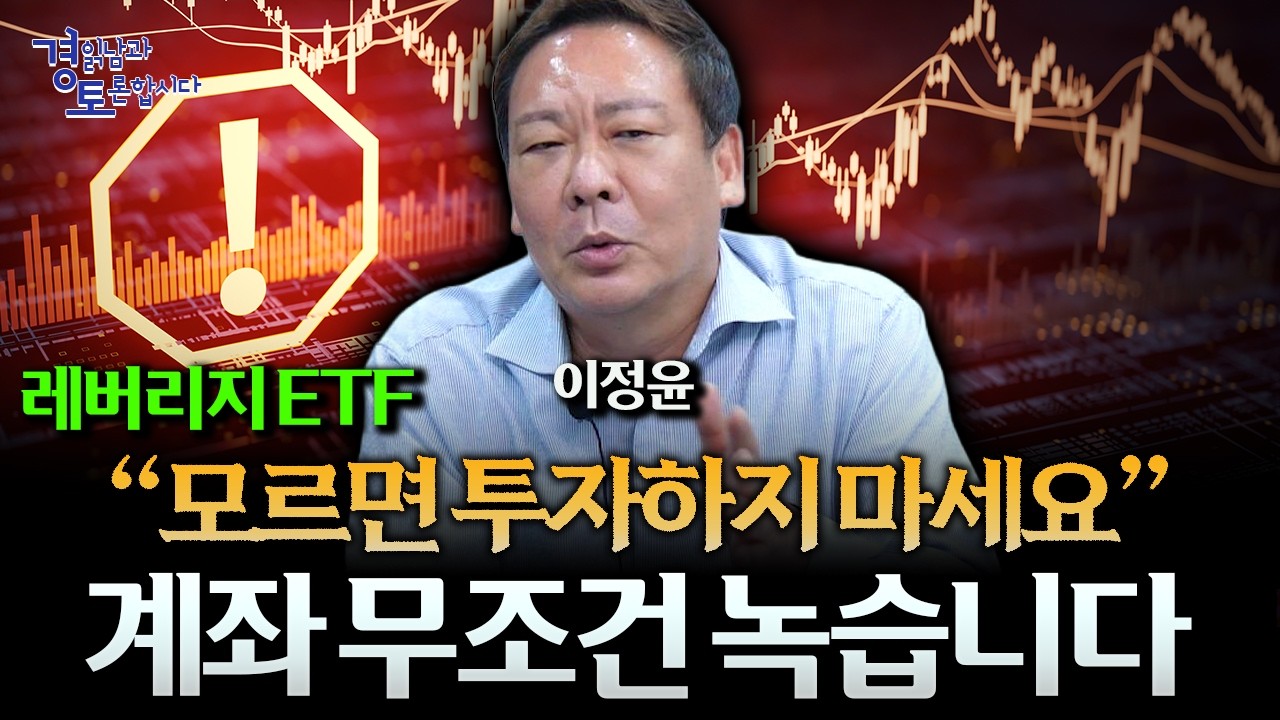
● Retirement-Revolution
Building a Lifetime Monthly Pension of KRW 1 Million with KRW 300,000 a Month: A Retirement Cash Flow Strategy More Important Than Private Pensions, National Pension, or Dividend Investing
The key point is not simply that “KRW 300,000 a month can generate KRW 1 million a month for life.”
The real issue is that a pension is not a return-maximization product, but a system designed to create uninterrupted retirement cash flow.
If KRW 300,000 is contributed monthly for 20 years, total principal amounts to KRW 72 million.
However, if the accumulation period continues until age 65 and a certain level of return or a guaranteed structure is applied, a lifetime monthly payout of KRW 1 million from age 65 may become structurally feasible.
That said, several conditions must be reviewed carefully: whether the product prohibits early surrender, whether it is tax-free or tax-deferred, whether the remaining balance can be inherited upon death, and how the real purchasing power of KRW 1 million changes after inflation.
1. What is the actual principal if KRW 300,000 is contributed monthly for 20 years?
A monthly contribution of KRW 300,000 equals KRW 3.6 million per year.
That is KRW 36 million over 10 years and KRW 72 million over 20 years.
At this stage, it is natural to ask how KRW 72 million can support a lifetime monthly payout of KRW 1 million.
- Monthly contribution: KRW 300,000
- Annual contribution: KRW 3.6 million
- Total principal over 20 years: KRW 72 million
- Key variable: post-contribution accumulation period and return rate until age 65
The important point is that pensions are not calculated on principal alone.
In particular, if the plan begins in one’s 30s and is held until age 65, an additional long accumulation period follows the contribution phase.
This extended time horizon creates the compounding effect.
2. A balance of KRW 100 million at age 65 can imply a monthly pension of about KRW 500,000
The most intuitive framework in the original text is as follows.
If the pension reserve reaches KRW 100 million at age 65, it can be structured into a lifetime annuity of roughly KRW 500,000 per month.
Using the same logic, KRW 200 million may support about KRW 1 million per month, and KRW 300 million may support about KRW 1.5 million per month.
- KRW 100 million at age 65: about KRW 500,000 per month
- KRW 200 million at age 65: about KRW 1 million per month
- KRW 300 million at age 65: about KRW 1.5 million per month
These figures are not fixed formulas that apply to every product.
They vary depending on product structure, assumed interest rate, annuity commencement age, gender, guarantee period, lifetime payout design, and insurer-specific terms.
However, they provide a useful benchmark for retirement asset planning.
They allow a practical reverse calculation of the pension reserve required at age 65.
3. Why KRW 300,000 a month can lead to KRW 1 million a month: time, compounding, and guarantee structure
Monthly contributions of KRW 300,000 for 20 years equal KRW 72 million in principal.
But if the plan starts in one’s 30s and continues to age 65, the assets may be invested for more than 30 years.
If a long-term return of around 4% to 5% is consistently applied, the balance at age 65 may grow to roughly two to three times the principal.
In other words, the key factor is not the contribution amount itself, but the length of the compounding period.
In retirement planning, time is often a more powerful asset than capital size.
That is why a contribution of KRW 300,000 has very different outcomes when started in the 30s versus the 50s.
4. Guaranteed annuities and tontine-style structures: a system that rewards persistence
The core product structure referenced in the original text is a guaranteed annuity, especially a tontine-style annuity.
In practical terms, a tontine structure tends to reward those who remain in the plan until the end.
It can be compared to a benefit for completing the marathon.
Some products are designed from the outset so that monthly contributions of KRW 300,000 for 20 years can later convert into a monthly payout of KRW 1 million from age 65.
In such cases, the key condition is not to surrender the policy early.
Early surrender may eliminate guarantee benefits or substantially reduce the surrender value.
- Advantage: retirement cash flow becomes easier to estimate in advance.
- Advantage: stable monthly income can be created independently of stock market volatility.
- Risk: early surrender may cause losses or reduce benefits.
- Risk: guarantee terms, payout conditions, and inheritance rules differ by product.
5. Reframing the roles of National Pension, retirement pension, private pension, and housing pension
Retirement income cannot usually be secured with a single pension product.
A layered approach using basic pension support, National Pension, retirement pension, private pension, and housing pension is more realistic.
- Basic pension: a foundational safety net for eligible older adults.
- National Pension: the core public pension system in Korea.
- Retirement pension: assets accumulated through employment.
- Private pension: a tool for supplementing retirement cash flow.
- Housing pension: a strategy to generate living expenses from real estate holdings.
In practice, the National Pension alone is often insufficient to cover monthly living expenses.
Retirement pension balances may also be lower than expected due to interim withdrawals, job changes, or investment losses.
As a result, private pension products function less as a choice and more as a core tool for stabilizing retirement cash flow.
6. What happens to the remaining balance if the pension holder dies?
The purpose of retirement planning is to protect against longevity risk.
However, one of the most common questions in practice is: “What happens if I die after receiving the pension?”
The answer depends on the type of pension.
6-1. National Pension upon death: survivor pension is the main mechanism
If a recipient of the National Pension dies, a survivor pension may be paid to eligible dependents.
Based on the original explanation, approximately 50% to 60% of the previous amount may be paid to survivors.
However, this is not available to everyone.
- Spouse remains eligible
- Children under 25 remain eligible
- Parents aged 60 or older remain eligible
The key point is that the National Pension cannot be transferred freely like private property.
Public pension survivor benefits are defined by law.
If the recipient is unmarried, divorced without a spouse, or has only adult children, survivor pension eligibility may be limited.
6-2. Pension savings and IRP upon death: transfer or withdrawal of remaining funds
Pension savings and IRP accounts are representative tax-deferred pension accounts.
If the account holder dies while receiving benefits, the remaining balance may be transferred to a spouse.
If there is no spouse, the balance may be settled through inheritance procedures.
Another important point is that death may qualify as a permissible early withdrawal event.
In such cases, the remaining balance may be withdrawn at a specified tax rate.
The original text cited a 5.5% tax rate for such withdrawals.
However, actual taxation depends on the contribution period, tax deduction status, account structure, and legislative changes, so verification is necessary.
6-3. Life insurer annuities upon death: dependent on product structure
Life insurer annuities often provide for remaining balances to be paid to heirs upon death.
Many standard annuities also include a guaranteed payout period.
For example, if the product guarantees 20 years of payouts but the annuitant dies after 15 years, the remaining 5 years may be paid to heirs.
By contrast, some tontine-style annuities are described as transferring the entire remaining balance to heirs.
However, this varies significantly by policy terms.
It should not be assumed that all annuities automatically pass the full balance to heirs.
Before subscribing, the death benefit structure, guarantee period, and beneficiary conditions must be reviewed carefully.
7. Should one contribute more to the National Pension or prepare more private pension assets?
This decision should not be made based on return alone.
Family structure must also be considered.
The National Pension is a powerful public pension because it provides lifetime payments, but its survivor coverage is limited.
Private pensions, by contrast, may allow the remaining balance to be inherited or distributed under more flexible terms depending on the product structure.
For unmarried individuals, divorced individuals, those with adult children, or those without a spouse, the survivor structure of the public pension may be less favorable than expected.
In such cases, private pension planning may offer greater flexibility from an inheritance perspective.
8. Tax-free pensions and tax-deferred pensions are fundamentally different
Many investors mistakenly classify pension savings and IRP as tax-free products.
In reality, pension savings and IRP are tax-deferred products, not tax-free products.
They provide a current tax deduction or tax deferral, while taxation is applied later when benefits are received.
By contrast, tax-free pensions are generally found in certain life insurance annuity products.
Examples include standard annuities, variable annuities, guaranteed annuities, foreign-currency annuities, and tontine-style annuities.
However, tax-free treatment requires compliance with contribution limits, holding periods, and payment conditions such as monthly or lump-sum funding.
9. The real meaning of tax-free: exemption applies to gains, not principal
One of the most common misunderstandings is the meaning of tax-free treatment.
Tax-free does not mean the entire principal is exempt from taxation.
The principal has already been funded with after-tax income.
Accordingly, the principal is not subject to additional taxation in the same way.
The true benefit of tax-free treatment is the exemption of gains from taxation.
For example, if KRW 100 million is invested and KRW 50 million of gains are generated, the tax-free benefit applies to the KRW 50 million of gains.
The KRW 100 million principal is not an additional taxable item.
- Principal: money already funded with after-tax income.
- Gains: interest, dividends, and capital gains.
- Tax-free benefit: generally exempts gains from taxation.
For that reason, investors should not rely on the term tax-free alone.
If returns are low or losses occur, the practical value of tax exemption is limited.
The first consideration should be the actual return structure and the ability to maintain the product over the long term.
10. Can dividend income or crypto gains be used for retirement?
Yes, in principle.
However, “possible” is not the same as “stable as retirement income.”
Dividend stocks, covered call ETFs, crypto gains, and monthly distribution products may appear attractive in favorable conditions.
But cash flow can be disrupted by earnings changes, interest rates, recession, price declines, dividend cuts, and exchange-rate volatility.
Dividend investing is often viewed as a source of steady income.
However, companies may reduce or suspend dividends during weak economic periods.
If dividends are cut, share prices may also decline.
The same applies to covered call ETFs.
Although monthly distributions appear attractive, a decline in the underlying asset can erode principal.
In some cases, distributions may effectively include a return of capital.
What appears to be stable monthly income may coincide with a declining total asset base.
11. The main difference between pensions and direct investing: management ability declines with age
In younger years, individuals may actively manage stocks, ETFs, crypto, bonds, and real estate.
However, in one’s 70s and 80s, investment decisions, account management, tax reporting, and rebalancing become much more difficult.
In retirement, management burden can become a greater risk than return volatility.
If KRW 1 million is needed reliably every month but investment income fluctuates between KRW 1.5 million one month and zero the next, financial stability is weakened.
Retirement cash flow should prioritize predictability over excitement.
This is the key difference between pensions and dividend or crypto-based strategies.
12. Splitting pension payment dates can improve retirement cash flow management
One practical strategy mentioned in the original text is to divide pension products or stagger their payout dates.
For example, setting payments to arrive on the 5th, 15th, and 25th of each month can make expense management easier.
- 5th: National Pension or basic living-expense account
- 15th: private pension or insurance annuity
- 25th: retirement pension or additional living-expense account
Salaries are typically paid once a month, but in retirement, more frequent inflows can improve psychological stability.
For retirees who want simpler money management, staggered pension payment dates are a practical approach.
13. The most important points rarely emphasized in other news or video content
First, “KRW 1 million per month” refers to future money.
KRW 1 million received 20 or 30 years later will not have the same purchasing power as KRW 1 million today.
Inflation-adjusted real income matters more than nominal pension amounts.
Second, for guaranteed annuities, retention is more important than return.
Early surrender may void guarantee benefits and reduce the surrender value.
Therefore, the contribution amount should be set at a level that can be maintained until maturity.
Third, returns matter more than the tax-free label.
Tax-free treatment has value only if gains are generated.
Focusing only on tax exemption may obscure low returns or high fees.
Fourth, family structure changes pension strategy.
The National Pension has defined survivor eligibility.
Depending on marital status and children’s independence, the inheritance flexibility of private pensions may become more important.
Fifth, in retirement, automated cash flow may matter more than investment skill.
After retirement, monthly income determines financial stability.
Direct investing can offer higher returns, but it also entails greater management burden and volatility risk.
14. How to apply the KRW 300,000 pension strategy in practice
The first step is to calculate the monthly income required after age 65.
Next, estimate expected National Pension benefits, retirement pension assets, and the gap that private pension assets must fill.
- Step 1: set a target for monthly retirement living expenses.
- Step 2: check the expected National Pension benefit.
- Step 3: review retirement pension and private pension balances.
- Step 4: calculate the monthly income shortfall.
- Step 5: decide whether KRW 300,000, KRW 500,000, or KRW 1 million per month is sustainable.
- Step 6: compare tax-free annuities, pension savings, IRP, and guaranteed annuity products.
- Step 7: diversify pension payment dates to structure retirement cash flow.
The key is not to place all assets into a single product.
Public pensions, retirement pensions, private pensions, and investment assets should each serve distinct roles.
A practical approach is to use pensions for stable living expenses and separate ETFs or dividend stocks for additional returns.
15. Conclusion: retirement planning is about cash flow design, not return competition
The claim that KRW 300,000 per month can generate KRW 1 million per month for life may sound aggressive.
However, the underlying logic is straightforward.
Start early, maintain contributions consistently, secure a long compounding period, and select a stable payout structure.
At the same time, no single product is optimal for everyone.
Age, income, family structure, health status, risk tolerance, and tax circumstances all affect the most suitable pension strategy.
Guaranteed annuities and tax-free annuities offer clear advantages, but early surrender risk and product-specific terms must be reviewed carefully.
In retirement, the priority is not how much one can earn, but how much income arrives every month without interruption.
From that perspective, private pensions are not merely financial products; they are tools for building a retirement salary system.
< Summary >
Contributing KRW 300,000 per month for 20 years results in total principal of KRW 72 million.
Starting in one’s 30s and investing over the long term may allow a pension reserve of about KRW 200 million by age 65 through compounding.
At age 65, KRW 100 million may correspond to about KRW 500,000 per month, and KRW 200 million may correspond to about KRW 1 million per month in a lifetime annuity structure.
Pension savings and IRP are tax-deferred products, not tax-free products.
Tax-free pensions are generally available through life insurance annuity products only when specific conditions are met.
Tax-free treatment applies to gains, not principal.
The National Pension’s survivor benefits are limited by eligibility rules, so family structure must be considered.
Dividend investing and crypto gains are too volatile to rely on as core retirement cash flow.
The essence of retirement planning is not high returns, but stable monthly cash flow.
[Related Articles…]
- How to Build a Lifetime Monthly Salary with Private Pension Planning
- Dividend Investing vs. Retirement Cash Flow: A Structural Comparison
*Source: [ Jun’s economy lab ]
– 월 30만 원으로 평생 월 100만 원 받는 연금의 비밀 (ft.연금박사 이영주 대표)