● Semiconductor Bloodbath, China Shock, Nvidia Drama
U.S. Semiconductor Stocks Plunge: China Memory Fears, DUV Localization, and Nvidia Circular Financing Concerns
This selloff in semiconductor stocks should not be viewed simply as a correction after a strong rally.
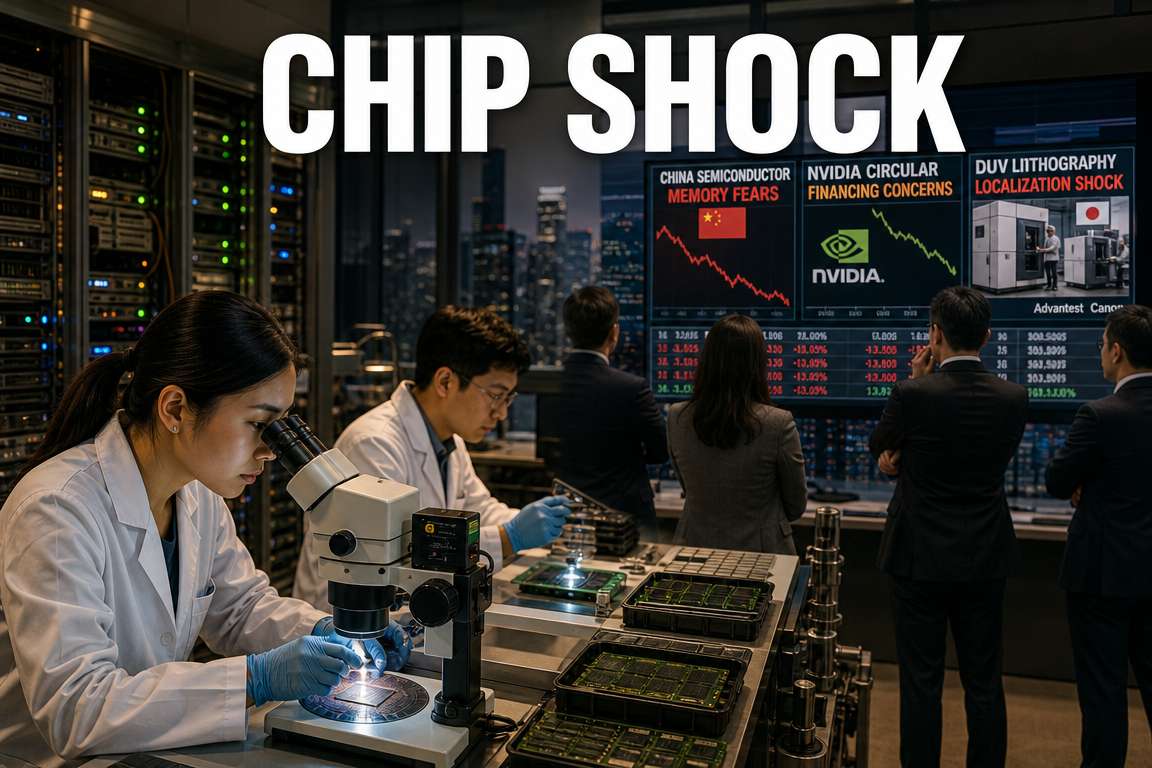
Markets were hit by a combination of concerns, including China’s semiconductor expansion, oversupply fears in memory chips, news on DUV equipment localization, questions over Nvidia’s AI investment structure, and potential spillover into the KOSPI.
The simultaneous decline in the ADRs of SK hynix, Micron, and Nvidia indicates that investors are reassessing the risk premium across the global semiconductor industry, not just at the individual company level.
More importantly, most of the adverse headlines were not new. They were largely familiar narratives that the market reused as a selling rationale.
The key issue is not the news itself, but why the market is reacting so strongly now.
1. Why U.S. Semiconductor Stocks Fell Together
The main development highlighted in the original text is the sharp decline in the ADRs of SK hynix, Micron, and Nvidia in the U.S. market.
These three companies differ in business profile, but they share one common feature.
- SK hynix ADR: A leading memory semiconductor company focused on HBM and DRAM.
- Micron: The leading U.S. memory semiconductor company.
- Nvidia: A core company in AI chips and data center GPUs.
Their simultaneous decline suggests that the market is no longer questioning a single company’s earnings, but rather the entire AI semiconductor value chain.
U.S. equities have recently rallied on expectations of expanding AI investment, data center demand, and HBM supply shortages.
However, the longer a rally lasts, the more sensitive the market becomes to even small negative catalysts.
This time, the triggers were China’s push into memory semiconductors and concerns over Nvidia’s large-scale investment structure.
2. First Negative Catalyst: Fears That China Will Enter the Memory Market
The main driver behind the selloff was concern that China could eventually gain control of the memory semiconductor industry as well.
China has already disrupted several manufacturing sectors, including displays, solar panels, batteries, steel, and shipbuilding, through large-scale investment and cost competitiveness.
As a result, investors fear that China may apply a similar strategy to memory semiconductors.
In particular, news related to CXMT heightened market concern.
CXMT is one of China’s key DRAM companies and is frequently cited in discussions about China’s memory self-sufficiency strategy.
The market’s reaction is straightforward.
Memory semiconductors are highly vulnerable to pricing pressure when supply expands.
Samsung Electronics, SK hynix, and Micron have long dominated the global DRAM market, but the entry of a Chinese producer with significant volume could undermine the pricing cycle.
3. Why the CXMT Issue Matters for SK hynix and Micron
SK hynix and Micron were particularly weak because both are highly sensitive to memory semiconductor cycle dynamics.
In memory semiconductors, product differentiation matters, but pricing cycles remain the dominant factor.
When demand is strong and supply is constrained, DRAM prices rise and earnings improve sharply.
When supply increases and inventories build, prices can weaken quickly.
If CXMT expands meaningfully, investors are likely to consider the following scenarios:
- Production capacity could expand rapidly with state support in China.
- Commodity DRAM prices could come under pressure.
- Micron’s profitability could be affected first.
- SK hynix could also face pressure in the general DRAM cycle.
- The pace of recovery in the global memory market could slow.
However, one distinction matters.
China’s progress in commodity memory does not mean it can immediately challenge SK hynix’s strength in HBM.
HBM requires advanced packaging, yield control, customer qualification, and close cooperation with Nvidia.
Therefore, while the China memory narrative may pressure stocks in the short term, it does not imply an immediate erosion of HBM competitiveness.
4. Second Negative Catalyst: China’s DUV Equipment Localization
Another key headline was China’s reported progress in localizing DUV, one of the core tools used in semiconductor manufacturing.
DUV refers to deep ultraviolet lithography equipment, which is used to pattern circuits onto wafers.
Lithography tools are central to semiconductor manufacturing.
They determine how precisely circuits can be drawn, which directly affects performance and yield.
That said, investors should note an important distinction.
The most technically demanding tool is not DUV but EUV.
EUV, or extreme ultraviolet lithography, is essential for the most advanced semiconductor processes.
ASML of the Netherlands effectively dominates EUV, and it is also one of the most tightly controlled items in U.S. export restrictions on China.
In other words, DUV localization does not mean China can immediately produce cutting-edge AI chips without constraints.
Still, the market did not respond in a highly nuanced way.
Investors reacted to the broader implication that China’s semiconductor self-sufficiency is advancing further.
5. DUV vs. EUV in Simple Terms
The difference between DUV and EUV does not need to be overly complicated.
DUV is a high-performance tool, but EUV is a more advanced technology required for leading-edge semiconductors.
- DUV: Used across mature nodes, some memory processes, and multiple patterning applications.
- EUV: Essential for advanced nodes such as 5nm and 3nm, and for high-performance chips.
- China’s DUV localization: A sign of progress toward semiconductor self-reliance.
- China’s EUV access: Still a much more difficult challenge.
Therefore, the DUV news should be interpreted less as evidence that China can immediately rival Nvidia-class GPUs and more as a sign that China may continue broadening its base in commodity semiconductors and memory production.
For markets, that is sufficient to matter.
Semiconductor valuations reflect future expectations as much as current earnings.
6. Third Negative Catalyst: Nvidia’s Circular Financing Concerns
Nvidia also faced an additional source of pressure beyond China-related semiconductor concerns.
The original text noted that Nvidia’s commitments or financing arrangements with SK, OpenAI, and others exceeded KRW 100 trillion.
The market’s concern is whether AI demand is truly organic or whether Nvidia is effectively helping to create demand through capital recycling.
Nvidia is the dominant company in AI chips.
OpenAI, cloud providers, and data center operators need Nvidia GPUs to run AI services.
However, if Nvidia invests in customers or partners, and those counterparties then use the capital to purchase Nvidia GPUs, investors may view this as circular demand.
In simplified form, the concern is as follows:
- Nvidia invests in AI ecosystem companies.
- Those companies use the funds to buy Nvidia GPUs.
- Nvidia’s revenue increases.
- The company’s growth profile appears stronger.
- However, the durability of end demand remains uncertain.
This is the core of the circular financing or circular transaction concern.
Even if it is not identical to the legal definition of cross-shareholding, investors are questioning whether the AI investment cycle has become overly self-reinforcing.
7. Why the Nvidia Issue Matters More
Nvidia is not just a semiconductor company.
It is the market’s leading symbol of the AI investment cycle.
When Nvidia weakens, the impact can extend to AI semiconductors, data centers, cloud infrastructure, power systems, cooling, HBM, and semiconductor equipment stocks.
For that reason, Nvidia-related news functions as a broader signal for risk appetite in U.S. equities.
The company had already embedded very high expectations in its valuation.
The market was assuming sustained AI demand, rising data center investment, and continued GPU purchases by customers.
Once circular transaction concerns emerge, the market begins to ask the following questions:
- Are AI data center investments translating into real cash flow?
- Have key customers such as OpenAI established sufficiently durable business models?
- Can large-scale GPU demand continue over the long term?
- Has Nvidia’s revenue growth already peaked?
- Have AI semiconductor valuations moved too far ahead of fundamentals?
Once those questions spread, corrections can extend beyond Nvidia to the broader AI sector.
8. This Is Not New Information: These Are Themes the Market Reuses When It Wants to Sell
One of the most important observations in the original text is that these are not entirely new narratives.
This is the key to interpreting the selloff.
China’s semiconductor self-sufficiency has been discussed for years.
Concerns about Chinese memory producers have also been known for a long time.
Nvidia’s ecosystem investments and customer linkage have likewise been debated repeatedly.
So why did stocks fall so sharply now?
The answer lies in positioning.
After a strong rally, investors look for reasons to take profits.
When familiar risks resurface, they become effective selling catalysts.
In other words, the decline reflects market fragility more than news novelty.
AI semiconductor expectations had become elevated, and capital had crowded into related stocks, so even small cracks triggered selling.
9. Impact on the KOSPI: Why the Korean Market Is More Sensitive
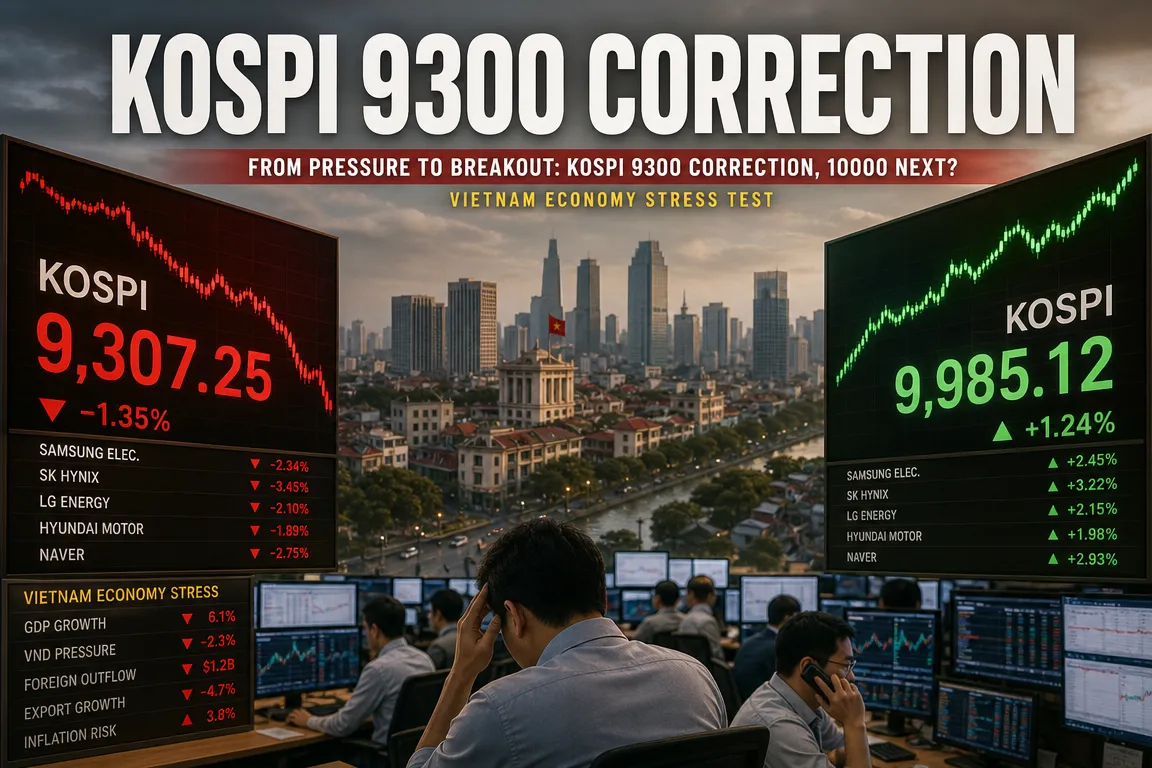
The original text also noted that KOSPI night futures were down 6%.
That magnitude suggests not a routine correction, but a significant deterioration in sentiment.
Korea’s equity market has a high concentration in semiconductors.
Because Samsung Electronics and SK hynix carry substantial index weight, weaker global semiconductor sentiment can weigh more heavily on Korean markets.
SK hynix, in particular, has been a key driver of the Korean market through HBM expectations.
If Nvidia, Micron, and SK hynix ADRs all fall together in the U.S., the pressure is likely to carry into the next trading session in Korea.
Investors in Korea should monitor the following:
- Whether Nvidia stabilizes intraday.
- The extent to which Micron prices in memory-related concerns.
- How much of the SK hynix ADR decline transfers to the local listing.
- Whether KRW/USD weakens sharply.
- Whether foreign investors continue to sell futures.
Whether the semiconductor selloff becomes a broader KOSPI correction will depend largely on foreign flows and exchange-rate behavior.
10. The Most Important Point Often Missed in Other Reports
The most important issue is not simply that China localized DUV or that CXMT is growing.
The real question is whether confidence in the AI semiconductor upcycle is starting to weaken.
The market is currently torn between two narratives:
- Positive view: AI demand is structurally growing, and earnings for Nvidia and HBM leaders will continue to improve.
- Negative view: AI investment has run too far ahead, and China supply growth plus circular financing concerns will pressure valuations.
The key issue is not whether China has already caught up technologically.
The market can lower future earnings expectations simply on the possibility that it may do so eventually.
Semiconductor stocks often move on expectations for future growth rather than current earnings.
Another critical point is Nvidia’s customer-investment structure.
For the AI industry to remain durable, end users and enterprises must adopt AI services and generate revenue from them.
If AI infrastructure investment remains concentrated in GPU purchases and data center expansion, markets will eventually question the return on that capital.
Once that question spreads, valuations across AI-related stocks can reset.
11. Investor Checklist
This selloff should not be dismissed as simple panic.
It should also not be ignored.
Investors monitoring macro and global equity trends should watch the following indicators:
- Micron share price trend: Indicates the market’s view on the commodity memory cycle.
- SK hynix share price and HBM premium: Helps determine whether China risk and HBM competitiveness are being separated.
- Nvidia trading volume: Useful for distinguishing a normal correction from institutional selling.
- Philadelphia Semiconductor Index: Tracks sentiment across U.S. semiconductor stocks.
- KRW/USD exchange rate: A key indicator of foreign capital outflows.
- China semiconductor policy news: Additional equipment localization or subsidy expansion matters.
- AI data center investment announcements: Show whether demand remains intact.
The key issue is not whether long-term semiconductor growth has ended, but how much near-term expectation compression the market will demand.
12. A Balanced View of the Selloff
It would be excessive to conclude from this news alone that U.S. semiconductors are finished.
Even if China has localized DUV, that does not mean it can immediately dominate EUV or the advanced AI semiconductor ecosystem.
Even if CXMT grows, SK hynix’s HBM competitiveness does not disappear overnight.
And while Nvidia’s investment structure is a short-term concern, the growth narrative can recover if actual AI infrastructure demand remains strong.
However, the market reaction is meaningful.
Investors are no longer accepting AI semiconductor narratives uncritically. They are beginning to assess numbers, cash flow, and supply risk more carefully.
The next phase of the market may be less about broad AI-theme appreciation and more about which companies can withstand China-related supply risk and scrutiny over AI investment sustainability.
For SK hynix and Micron, the focus should be on memory pricing cycles. For Nvidia, the focus should be on the quality of AI demand and the durability of the investment structure.
KOSPI investors will likely continue to face near-term volatility, but whether this becomes a long-term trend break or simply a correction from overheating will depend on upcoming earnings and capital flows.
13. Conclusion: The Core Issue Is Expectation Reset, Not China Alone
The surface-level reasons for the selloff in U.S. semiconductor stocks were China memory fears, CXMT-related concerns, DUV localization news, and Nvidia’s circular financing debate.
But the core issue is that market expectations had become too elevated, and a cluster of familiar risks re-emerged at the same time.
Semiconductors remain central infrastructure for the AI era.
AI chips, memory semiconductors, HBM, and data center investment remain important long-term themes.
However, financial markets do not always reward a strong industry and a strong stock price at the same time.
Even high-quality sectors can correct when expectations become excessive.
At this stage, the question is not whether semiconductors are finished, but which companies can withstand Chinese supply risk and the current AI demand validation phase.
SK hynix and Micron should be assessed through the lens of memory pricing cycles, while Nvidia should be assessed through the quality of AI demand and the sustainability of its investment model.
For KOSPI investors, near-term volatility is difficult to avoid, but whether this becomes a structural trend reversal or simply a cooling-off period will depend on future earnings and market flows.
< Summary >
The selloff in U.S. semiconductor stocks was driven by concerns over China’s entry into memory semiconductors, CXMT growth, DUV localization, and Nvidia’s circular transaction structure.
Most of these were not new risks, but familiar narratives reused as selling catalysts.
DUV localization signals progress in semiconductor self-reliance, but it should be distinguished from EUV and leading-edge AI chip capability.
Nvidia’s main risk is whether AI demand is truly end-user driven or artificially reinforced through investment and procurement loops.
The KOSPI is highly sensitive to weaker global semiconductor sentiment because of the heavy weighting of Samsung Electronics and SK hynix.
Going forward, actual earnings, cash flow, HBM competitiveness, and resilience to China supply risk are likely to matter more than the AI theme alone.
[Related Articles…]
- U.S. Semiconductor Stocks and the Outlook for AI Chips
- Nvidia Investment Structure and the Global AI Cycle
*Source: [ 내일은 투자왕 – 김단테 ]
– 미국 반도체 나락가는 이유 #마이크론 #하이닉스 #엔비디아