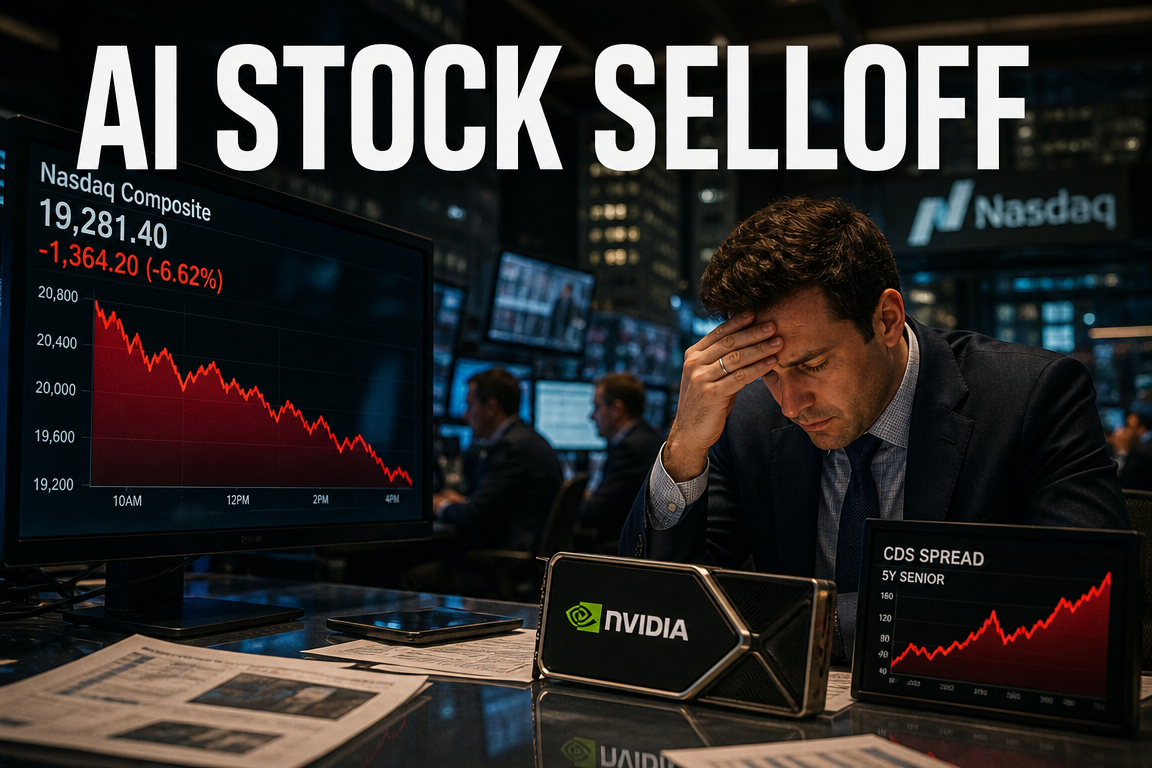
● AI Panic Spreads, Nasdaq Slides, Nvidia CDS Surges
AI Stock Concerns Extend From Korean Semiconductors to Nasdaq
The core issue is not simply that SK Hynix and Samsung Electronics shares declined.
What matters is that AI semiconductor concerns originating in the Korean market are now affecting Nasdaq, global equities, the bond market, crude oil, and FOMC rate expectations simultaneously.
Markets are also entering a highly sensitive phase ahead of Meta and Microsoft earnings, where higher AI spending may be treated as a negative, while lower spending may also be viewed negatively.
This report outlines why AI stock concerns are spreading beyond Korea to the U.S. market, and highlights key variables often overlooked in news coverage, including CDS, GPU rental rates, and the true implications of AI CAPEX.
1. Market backdrop: global equities weakened on AI semiconductor concerns
Based on intraday levels cited in the source, U.S. equities were broadly weaker.
The move is notable because it occurred ahead of both the FOMC meeting and major Big Tech earnings, underscoring rising market caution.
-
Nasdaq: down about 0.94%
-
Dow Jones: down about 1.5%
-
S&P 500: down about 0.77%
-
Russell 2000: down about 1.6%
Equity markets often remain relatively range-bound ahead of major events such as the FOMC or large-cap earnings.
In this case, however, selling pressure intensified before the events themselves.
This indicates that investors have become more sensitive to AI stocks, AI infrastructure, and the semiconductor supply chain.
Heatmaps showed notable weakness in AI-related hardware names, AI infrastructure companies, and semiconductor equipment stocks.
By contrast, mega-cap names such as Amazon, Apple, Google, and Microsoft were relatively resilient and helped cushion index declines.
Micron Technology fell more than 5%, while the SK Hynix ADR declined about 1.55%.
Micron’s larger decline suggests that concerns over the memory semiconductor cycle are also spreading in the U.S. market.
2. Three drivers behind the decline in U.S. equities
The selloff appears to reflect several overlapping factors rather than a single headline.
Broadly, there are three drivers.
① AI stock concerns from Korea have spread to the U.S.
The most important factor is the transmission of AI semiconductor concerns from the Korean market to the U.S.
Bloomberg also ran coverage asking how far AI fears originating in Korea could spread.
In other words, weakness in Korea and broader Asian markets is now being interpreted as a potential signal for the global AI semiconductor demand cycle.
Korea is home to key global memory semiconductor companies, including SK Hynix and Samsung Electronics.
Accordingly, sharp declines in Korean semiconductor stocks can be viewed by global investors not as a local issue, but as a warning sign for AI-related demand more broadly.
Recent market concern has focused on whether AI infrastructure spending has become excessive.
Investors are questioning whether the rapid increase in spending on data centers, GPUs, HBM, servers, and power infrastructure can be justified by future earnings.
② Middle East risk and the surge in crude oil prices
The second negative factor is geopolitical risk in the Middle East.
The source states that Iran attacked a U.S. military base in Jordan and that crude oil rose sharply after Trump referred to strong retaliatory action against Iran.
-
WTI: up about 6%
-
Brent: up about 7%
Higher oil prices are a headwind for equities.
Rising crude can reintroduce inflation pressure and weaken expectations for rate cuts.
As rate expectations deteriorate, growth stocks and technology names, especially AI-related stocks in Nasdaq, face additional pressure.
③ Caution ahead of the FOMC and major Big Tech earnings
The third factor is uncertainty ahead of the FOMC and earnings from Meta and Microsoft.
The source cites a Wall Street Journal report from Nick Timiraos indicating that futures markets were pricing in roughly a 33% probability of a rate hike.
If the market is genuinely pricing in a possible rate hike, that is a material concern.
AI stocks are highly sensitive to discount rates because their valuations depend heavily on future growth expectations.
As a result, a more hawkish FOMC tone could create further downside pressure on AI semiconductors, Big Tech, and growth equities more broadly.
3. Why this is not just a memory semiconductor issue: the entire AI infrastructure complex is under pressure
This move should not be interpreted solely as a memory semiconductor correction.
The key point is that not only memory names, but AI infrastructure stocks more broadly, are weakening.
-
Vertiv: data center power and cooling infrastructure
-
Caterpillar: infrastructure and industrial equipment
-
Eaton: power management infrastructure
-
Arista Networks: data center networking equipment
Weakness across these names suggests the market is not only concerned about memory pricing.
Investors are increasingly questioning whether the broader AI data center investment cycle has become overstretched.
In practical terms, the market is asking the following questions:
Can spending on AI data centers continue at this pace?
Can demand for GPUs and HBM remain as strong as it is now?
Can hyperscalers generate sufficient cash flow to support this level of investment?
4. JP Morgan’s key warning: widening CDS spreads on Nvidia
One of the most important but less widely discussed indicators is CDS.
CDS can be understood as the price of insurance against default risk for a company.
A widening CDS spread generally indicates that the credit market is assigning higher perceived risk to that issuer.
JP Morgan flagged the widening CDS spread on Nvidia as a concern.
Nvidia is not a company that spends AI CAPEX; rather, it benefits from AI CAPEX.
When hyperscalers such as Microsoft, Google, Amazon, and Meta increase spending, Nvidia benefits through GPU sales.
If even Nvidia’s CDS spread is widening, that suggests the market is becoming more cautious about the entire AI investment cycle.
JP Morgan also noted that the concentration of AI-related positioning has not yet fully unwound.
That implies a market where many positions remain crowded, and further downside could trigger additional forced selling or risk reduction.
5. A more serious risk: rising cross-stock correlations
A particularly important point in JP Morgan’s briefing was the possibility that correlations among index constituents could rise further if the market weakens again.
In simple terms, this means that the selloff could move beyond AI stocks and into the broader market.
In the early phase of a correction, weakness may remain limited to a specific theme.
For example, AI semiconductors, data centers, or power infrastructure stocks may decline while the rest of the market remains stable.
However, as market stress increases, investors tend to reduce exposure across risk assets regardless of sector.
At that stage, even companies with strong fundamentals may be sold off alongside weaker names.
This is the most important phase to monitor in global equities.
What begins as a thematic correction can later evolve into a broader market correction.
6. A more constructive view: hyperscaler cash flow may be underestimated
There is, however, also a more constructive interpretation.
The source cites a positive view from a U.S. financial executive.
The core argument is that the market may be overstating the balance-sheet risk facing hyperscalers.
The current concern is straightforward.
Microsoft, Google, Amazon, and Meta are spending heavily on AI data centers, and there is concern that this spending could become difficult to fund entirely through internal cash flow.
That has raised fears that companies may need to rely more heavily on corporate bond issuance or external financing.
However, the constructive view focuses on GPU rental pricing.
Current GPU compute rental rates are reportedly more than twice as high as legacy long-term contract prices.
For example, if an AI company signed a contract in 2024 at $1 per hour, a comparable contract today may require more than $2 per hour.
In other words, hyperscalers may have been renting GPUs at too low a price in the past, and as those legacy contracts expire, they may be able to renew at materially higher rates.
If that occurs, cloud revenue and operating cash flow at hyperscalers could improve.
Under that scenario, the market’s concern about heavy reliance on debt issuance to fund AI CAPEX may ease.
That view depends on an important condition.
GPU rental rates must remain elevated.
Demand from AI startups and enterprise customers must also remain strong.
If GPU rental rates weaken, the constructive thesis would lose support.
7. Is CDS a genuine default signal, or a market narrative?
Another point raised in the source is that the CDS market is relatively small, which means pricing can sometimes be distorted.
A wider CDS spread does not necessarily mean a company’s true default risk has increased materially.
In smaller markets, it is possible for concentrated positioning to push CDS spreads higher.
That can then support a narrative that credit risk has increased, even if the underlying fundamentals have not changed to the same extent.
This should not be taken as evidence that such a dynamic has actually occurred.
Rather, CDS should be interpreted as a market price signal that reflects sentiment and positioning, not as an absolute measure of truth.
8. A modest rebound in DRAM spot prices offers some support for memory investors
For memory semiconductor investors, the one mildly positive data point is a small rebound in DRAM spot prices.
The source notes that DRAM spot prices edged higher as of July 28.
In a period of sharp equity declines, a further collapse in DRAM spot prices would have created additional pressure on memory stocks.
A stable or slightly higher spot price suggests that, at least on the physical pricing side, conditions have not completely deteriorated.
That said, equity markets often respond to sentiment more quickly than to pricing data.
Even if DRAM prices remain stable, semiconductor stocks can fall if investors become concerned about slowing AI demand.
9. Korea’s leverage restrictions: a delayed attempt to cool market excesses
In Korea, the Financial Services Commission stated that single-name leveraged products could be restricted to professional investors.
The government also said it would immediately pursue a plan to limit leverage ETF exposure to around 20% of total investment capital.
This measure appears aimed at reducing excessive leveraged speculation by retail investors.
If leverage has concentrated heavily in AI semiconductor names, a decline in share prices could quickly magnify losses.
However, market participants may see the move as coming too late.
When regulation is introduced after volatility has already increased, it can further weaken sentiment in the short term.
10. The earnings trap: the market may view any outcome negatively
The most difficult upcoming event is earnings from Meta and Microsoft.
The issue is not simply earnings per share, but guidance for AI CAPEX.
If Meta and Microsoft say they will increase AI spending further, the market may interpret that as follows:
AI spending is becoming excessive.
Can this level of spending be supported by cash flow?
Will corporate bond issuance rise?
Will credit risk and CDS premiums increase further?
On the other hand, if they say they will moderate AI spending, the market may interpret that as:
AI semiconductor demand is slowing.
GPU and HBM orders may weaken.
Semiconductor stocks should be sold.
In other words, the market is in a difficult position.
Higher AI CAPEX can be read as negative, but lower AI CAPEX can also be read as negative.
In this environment, market interpretation matters more than the reported numbers themselves.
11. The key point missing from many headlines
The most important issue in this AI stock correction is not the price decline itself.
The key is that the market is changing how it evaluates the AI investment cycle.
-
First, the market is no longer asking only whether AI demand exists; it is asking whether AI investment will be monetized.
Until recently, higher AI infrastructure spending alone was enough to support gains in semiconductor and data center stocks.
Now, however, the scale of investment is so large that recovery and monetization have become the key variables.
-
Second, AI semiconductor stocks are no longer only a stock market issue; they are increasingly connected to credit markets.
Widening CDS spreads may indicate that bond investors are pricing in concern before equity investors fully react.
This is more important than standard semiconductor supply-and-demand headlines.
-
Third, GPU rental rates are an important hidden variable for hyperscaler earnings.
If legacy low-priced contracts expire and new contracts are repriced higher, cloud companies’ operating cash flow could improve more than expected.
That would reduce concerns about the sustainability of AI CAPEX.
-
Fourth, additional downside could turn an AI correction into a broader market correction.
When correlations rise, investors may sell both high-quality and lower-quality names indiscriminately.
At that point, liquidity management becomes more important than individual stock selection.
-
Fifth, Big Tech earnings will be driven more by interpretation than by the reported numbers.
If Meta and Microsoft present AI spending plans, a market already leaning negative may still interpret the results unfavorably.
12. Key indicators investors should monitor now
In the current phase, stock prices alone may not be sufficient for decision-making.
The following indicators should be monitored together:
-
Changes in CDS spreads for Nvidia and major hyperscalers
-
DRAM and HBM price trends
-
GPU cloud rental price trends
-
AI CAPEX guidance from Microsoft, Meta, Google, and Amazon
-
Post-FOMC changes in rate expectations
-
Crude oil trends and further Middle East escalation risk
-
Whether Nasdaq and the Philadelphia Semiconductor Index decline together
-
Capital flow trends into Samsung Electronics and SK Hynix within the KOSPI
Investors in AI semiconductors should focus not only on chip pricing, but also on Big Tech cash flow and credit risk.
The market is no longer simply pricing an earnings cycle; it is testing the sustainability of the AI investment cycle itself.
13. Conclusion: AI fears are not over; they are entering a validation phase
AI stock concerns have spread from Korea to the U.S. market for a clear reason.
Investors are no longer questioning the AI growth narrative itself, but rather the cost of that growth and the likelihood of monetization.
AI data center investment is likely to continue.
However, equities cannot rise simply because investment continues.
What matters now is how quickly that spending is converted into revenue and operating cash flow.
The next phase will depend on three factors.
First, whether Big Tech can demonstrate the cash flow needed to fund AI CAPEX.
Second, whether GPU rental rates and cloud revenue remain strong enough to meet expectations.
Third, whether interest rates and crude oil prices continue to pressure growth-stock valuations.
Rather than attempting to call a bottom, investors should focus on which indicators the market is actually responding to.
The AI rally is not over, but the easy stage of gains in AI stocks has clearly passed.
< Summary >
AI stock concerns are spreading from the Korean semiconductor market to Nasdaq and global equities.
U.S. equities weakened amid the FOMC, Big Tech earnings, Middle East risk, and surging crude oil prices.
The key issue is not only memory semiconductors, but the sustainability of AI data center investment as a whole.
JP Morgan warned about widening CDS spreads on Nvidia and crowded AI positioning.
By contrast, higher GPU rental rates and the expiration of low-cost legacy contracts may support hyperscaler cash flow.
Meta and Microsoft earnings are in a highly sensitive phase where both higher and lower AI CAPEX can be interpreted negatively.
Investors should now monitor not only semiconductor prices, but also CDS, GPU rental rates, interest rate expectations, crude oil, and Big Tech cash flow.
[Related Articles…]
*Source: [ 내일은 투자왕 – 김단테 ]
– AI 주식 공포. 한국을 넘어 전세계로 퍼지나?
● Fed Hold Sparks Market Jitters
July FOMC Rate Hold Explained: What Markets Should Focus on in the 9-3 Vote and Kevin Warsh Press Conference
The most important point from this July FOMC meeting is not simply that the policy rate was held unchanged.
The key issues are the 9-3 voting split, the tone of the Kevin Warsh press conference, the Federal Reserve’s interpretation of U.S. inflation and labor market data, and the combined implications for exchange rates and Wall Street direction.
Markets are likely to focus less on whether rate cuts are approaching and more on how sharply internal disagreement within the Fed has widened.
In that sense, this meeting is a meaningful inflection point for U.S. equity investors, KRW/USD traders, and investors in the KOSPI and growth stocks.
1. July FOMC outcome: policy rate held with a 9-3 vote
The July FOMC kept the policy rate unchanged.
The most notable detail was the 9-3 vote, indicating that the decision was not unanimous.
In Fed rate-setting, a growing number of dissenting votes usually signals disagreement over the outlook for growth, inflation, labor conditions, and financial markets.
Although the hold appears stable on the surface, it suggests that debate over the next policy move has intensified.
Market interpretation is likely to split into two broad views.
First, inflation has not yet fully returned to target, so rate cuts remain difficult to justify.
Second, signs of labor-market and growth slowdown are strengthening, which could accelerate discussion of rate cuts.
The 9-3 vote indicates that both views are increasingly present within the Fed.
2. Three phrases to watch in the Kevin Warsh press conference
Markets should focus closely on specific language in the press conference.
What the Fed emphasizes in its commentary can move U.S. equities, Treasury yields, the dollar index, and the KRW/USD exchange rate simultaneously.
First: “confidence in disinflation.”
If the Fed judges that U.S. inflation is continuing to move toward its 2% target, expectations for rate cuts may rise.
If, however, the Fed continues to highlight services inflation, wage growth, and housing-related pressures, rate-cut expectations could be pushed back.
Second: “labor market balance.”
If unemployment rises or payroll growth slows, the Fed may lean more toward defending growth.
However, if wage growth remains elevated, the Fed may remain reluctant to move quickly on cuts.
Third: “additional tightening risk.”
If the press conference does not clearly rule out further tightening, markets may treat that as a hawkish signal.
In that case, U.S. technology and growth stocks could face short-term pressure.
3. Why the 9-3 vote matters more than the rate decision itself
The most important number in this meeting is not the policy rate level but the 9-3 split.
A divided vote shows a widening gap in how Fed officials assess growth and inflation.
For investors, this matters more than the unchanged rate itself.
If the three dissenting votes supported cuts, markets may interpret that as growing support for a more dovish stance.
That could push Treasury yields lower and support U.S. equities.
It could also ease dollar strength and provide some relief to the KRW/USD exchange rate.
If the three dissenting votes supported hikes, markets may interpret that as lingering inflation concern.
In that case, expectations for cuts would weaken, and growth-oriented U.S. equities and Korean large-cap technology stocks could come under pressure.
For that reason, the decisive issue is not the word “hold” itself, but who dissented and in what direction.
4. Key language to review in the statement
The FOMC statement can move markets through a single word or phrase.
This time, the most important sections are the assessments of growth, inflation, labor, and financial conditions.
On growth: investors should assess whether the U.S. economy is still described as resilient or whether slowdown risks are becoming more prominent.
If the economy is described as resilient, rate-cut expectations may fall.
If softer consumption, weaker business investment, or tighter credit conditions are emphasized, rate-cut expectations may rise.
On inflation: the key issue is whether inflation continues to show disinflationary progress.
If the Fed acknowledges “further progress,” markets may read that positively.
If it emphasizes that inflation remains elevated, the statement will likely be seen as more hawkish.
On labor: the key question is whether the labor market is moving from overheating toward balance.
If it remains too strong, wage and service-price pressure may persist.
If it weakens too quickly, recession risks become harder to ignore.
5. U.S. equity impact: technology and growth stocks
The July FOMC can have a direct impact on Wall Street.
Large-cap growth names such as Tesla, Nvidia, Apple, and Microsoft are particularly sensitive to changes in rate expectations.
If rate-cut expectations rise, the present value of future earnings increases, supporting growth-stock valuations.
That would favor the Nasdaq and broader growth equities.
If the Fed emphasizes inflation risks, long-term Treasury yields could rise.
Higher long-term yields typically weigh on growth-stock valuations and increase overall equity volatility.
From a value-investing perspective, periods of overreaction may create opportunities in high-quality businesses.
However, in a higher-rate environment, companies with weak cash flow profiles are generally less attractive than those with strong earnings and balance sheets.
6. Exchange rates: KRW/USD depends on the Fed’s tone
The KRW/USD exchange rate may move sharply depending on the tone of the press conference.
A hawkish message would likely support dollar strength.
That would create upward pressure on the KRW/USD rate.
By contrast, if the Fed acknowledges disinflation and leaves room for cuts, dollar strength could ease.
That would be supportive for the Korean won and other risk-sensitive currencies.
For Korean investors, exchange rates are highly relevant.
Returns on U.S. equity holdings are affected not only by stock performance but also by currency movements.
Even when U.S. stocks rise, a weaker dollar can reduce returns in won terms.
Conversely, a rising exchange rate can partially offset equity losses.
7. KOSPI impact: foreign flows and semiconductors are central
The July FOMC is also important for the KOSPI.
Foreign flows into Korean equities are highly sensitive to U.S. rates and currency expectations.
If rate-cut expectations rise and dollar strength eases, foreign capital may rotate into Korean equities.
In that case, semiconductors, batteries, internet, and biotech stocks could benefit.
If the Fed remains hawkish, foreign investors may continue to prefer dollar assets over emerging markets.
That would likely be a near-term headwind for the KOSPI.
In Korea, the direction of Samsung Electronics and SK hynix remains especially important.
Even with a strong AI semiconductor cycle, high U.S. rates can still limit valuation expansion.
8. Why the next round of economic data matters more now
After this FOMC, markets are likely to refocus on macro data.
The most important releases include payrolls, CPI, PCE inflation, retail sales, and manufacturing indicators.
The Fed has repeatedly said it will evaluate a broad data trend rather than rely on one indicator.
That means a single inflation reading is not enough to confirm a cut.
Likewise, one weak labor report is not enough to establish a recession.
Investors should monitor whether upcoming data strengthens the case for cuts or supports a longer period of elevated rates.
In that sense, the FOMC is not the end of the story, but the starting point for interpreting the next data cycle.
9. The most important point often missed in other coverage
The key issue is not the hold itself, but whether the Fed’s reaction function is changing.
Many headlines focus on the rate hold, market reaction, and currency volatility.
Investors should instead ask under what conditions the Fed is prepared to act next.
For example, would a further moderation in inflation be enough to support cuts?
Would the Fed tolerate softer employment if inflation remains sticky?
These distinctions can materially affect asset prices.
Another important point is that the 9-3 vote sends a psychological signal to markets.
Internal division at the Fed may show up more often in future statements, press conferences, and speeches.
Markets may begin pricing not only the next rate decision but also the likelihood of further shifts in the vote split.
Finally, the AI investment cycle is still colliding with the rate cycle.
AI semiconductors, data centers, power infrastructure, and cloud investment remain structurally strong.
However, sustained high rates can continue to pressure valuations for companies whose growth is priced far into the future.
For that reason, AI-related stocks should be assessed not only on long-term growth potential, but also on rates and earnings delivery.
10. Action items for investors
First, review changes in the inflation language in the statement.
Terms such as “further progress,” “still elevated inflation,” and “lack of confidence” can move markets.
Second, look for clues on the timing of rate cuts in the press conference.
Even without a direct date, the Fed’s description of data dependence matters.
Third, track the U.S. 10-year Treasury yield.
Lower long-term yields are supportive for growth stocks, while higher yields tend to weigh on technology.
Fourth, monitor the dollar index and KRW/USD together.
Currency moves matter for both U.S. equity investors and Korean investors.
Fifth, watch foreign flows into the KOSPI.
Whether foreigners buy or sell semiconductors and large-cap stocks after the meeting will help signal the near-term direction of the Korean market.
11. Scenario-based market outlook
Scenario 1: The Fed is interpreted as dovish
Rate-cut expectations rise and U.S. Treasury yields may decline.
Nasdaq and growth stocks could strengthen.
Dollar strength may ease, putting downward pressure on KRW/USD.
The KOSPI could benefit from improved foreign inflows.
Scenario 2: The Fed is interpreted as hawkish
Rate-cut expectations weaken and long-term yields may rise.
Technology and growth stocks could face near-term pressure.
Dollar strength may continue, lifting KRW/USD.
The KOSPI could face foreign selling pressure.
Scenario 3: The message is neutral and ambiguous
Markets may wait for the next payroll and inflation releases for direction.
In that case, equities may shift toward stock-specific differentiation.
Companies with strong earnings may hold up better than those supported mainly by expectations.
< Summary >
The key takeaway from the July FOMC is the 9-3 vote to hold rates unchanged.
More important than the hold itself is the signal that views within the Fed are diverging.
In the Kevin Warsh press conference, investors should focus on language related to inflation, labor, and the conditions for cuts.
U.S. equities are likely to react through growth stocks if rate-cut expectations increase, while hawkish messaging could pressure technology shares.
The KRW/USD exchange rate will depend largely on the Fed’s tone and the direction of the dollar.
The KOSPI will be influenced by foreign flows and the response of major semiconductor names.
After the meeting, payrolls and inflation data are likely to become the main determinants of the next market move.
The most important issue is not the rate hold itself, but whether the Fed’s policy reaction function is changing.
[Related Articles…]
U.S. Rate Outlook After FOMC and Equity Strategy
KRW/USD Outlook and Global Portfolio Positioning
*Source: [ Maeil Business Newspaper ]
– [LIVE] 7월 FOMC 성명서 해설 l 케빈 워시 기자회견 동시통역 l 기준금�� 9대3 동결