● Samsung Soars, Hynix Slips, Foreigners Pick Winners
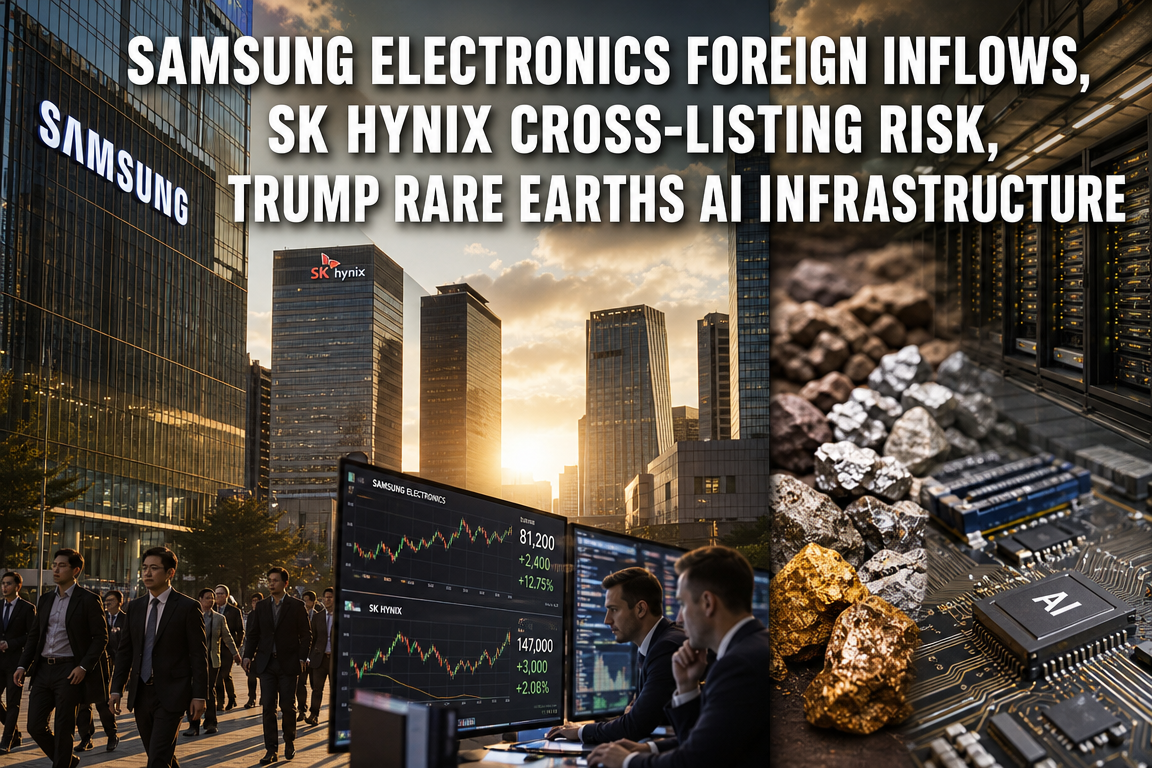
The real reasons Samsung Electronics is rising more strongly: foreign inflows, cross-listing risk, and the semiconductor cycle have diverged
The key point in today’s market is not simply that Samsung Electronics has risen.
The focus is why foreign investors are buying Samsung Electronics first, why SK Hynix is comparatively weaker, and whether this trend can extend into a broader KOSPI bull market.
This move reflects a combination of semiconductor sector recovery, improving Korean semiconductor exports, Micron’s long-term supply contract signals, expectations for shareholder returns, and concerns over cross-listing risk.
On the surface, it looks like a rally in Samsung Electronics, but the underlying message is how foreign flows are selecting the most liquid and relatively safer semiconductor representative in Korea.
1. Today’s main market development: Samsung Electronics is driving the KOSPI
One of the most notable trends in the KOSPI market is Samsung Electronics’ strong rebound.
As Samsung Electronics rises, the broader index is being lifted with it.
By contrast, SK Hynix has not shown the same degree of momentum despite the improving semiconductor outlook.
- Foreign buying is supporting Samsung Electronics and driving KOSPI gains.
- SK Hynix remains relatively weak despite sector optimism.
- The KOSDAQ is under pressure as the market rotates into large-cap leaders.
- Investors are watching whether capital continues to shift toward semiconductor blue chips.
In practical terms, the question is no longer whether to buy semiconductors, but which semiconductor name to own.
2. The first reason Samsung Electronics and SK Hynix have diverged: cross-listing risk
The most important difference in this move is the cross-listing issue.
SK Hynix is facing growing market concern over potential subsidiary IPO plans.
Cross-listing refers to a structure in which a parent company and its subsidiary are both listed.
The concern is that such a structure may dilute the value of existing parent company shareholders.
For investors, if the reason to own SK Hynix is the growth potential of a specific subsidiary, what happens if that subsidiary is separately listed?
Existing SK Hynix shareholders may feel they are not fully capturing that growth value.
For this reason, foreign investors are highly sensitive to cross-listing risk.
- Cross-listing can reduce the appeal of the parent company for shareholders.
- A subsidiary IPO may help capital raising in the short term.
- However, it can create dilution concerns for existing shareholders.
- Foreign investors closely monitor governance risk in the Korean market.
As a result, Samsung Electronics is relatively less exposed to this issue and is viewed as the standard large-cap semiconductor proxy.
SK Hynix still has clear strengths in HBM and AI semiconductor exposure, but governance-related concerns are limiting share price momentum.
3. Why foreign investors are buying Samsung Electronics: the simplest way to gain Korea semiconductor exposure
Foreign investors are the main driver behind Samsung Electronics’ recent gains.
From their perspective, the Korean semiconductor market is once again becoming investable.
The semiconductor cycle is seen as moving beyond the bottoming phase and into recovery.
Korean semiconductor export data is improving, and global memory companies have turned more constructive in their comments.
In particular, Micron’s positive message regarding long-term supply contracts was an important market signal.
When memory companies speak confidently about long-term contracts, the market interprets this as evidence that demand recovery may be structural rather than temporary.
- Expectations are rising that the semiconductor cycle has passed its low point.
- Improving Korean semiconductor exports are supporting earnings recovery expectations.
- Micron’s comments on long-term supply contracts were read as a positive demand signal.
- Lower market volatility in Korea is creating a more favorable environment for foreign inflows.
In this setting, if foreign investors want Korea semiconductor exposure, Samsung Electronics is the most obvious choice because of its liquidity, index influence, and risk management profile.
Samsung Electronics is the KOSPI’s benchmark name and the first stock global investors typically use to access the Korean market.
4. Why SK Hynix is relatively weaker: shareholder value concerns are outweighing earnings strength
SK Hynix’s weakness should not be interpreted simply as an earnings issue.
In fact, the company remains highly competitive in AI servers and the HBM market.
HBM is a key component in AI data centers and AI semiconductors.
It is one of the central memory segments benefiting from demand linked to Nvidia GPUs.
Even so, the share price has lagged Samsung Electronics because investors are also pricing in non-earnings risks.
The main issue is the possibility of a subsidiary IPO and the resulting cross-listing debate.
- SK Hynix remains a strong company in HBM competitiveness.
- It is a direct beneficiary of AI semiconductor demand growth.
- However, subsidiary IPO risk and cross-listing concerns are weighing on sentiment.
- Foreign investors place significant emphasis on governance and shareholder returns.
In effect, the issue for SK Hynix is not whether it is a good company, but whether foreign investors are comfortable buying it now.
Even with strong earnings expectations, investors tend to be cautious when shareholder value dilution risks are visible.
5. Is Samsung Electronics’ rally only a rebound, or the start of a broader uptrend?
Market views on Samsung Electronics’ rebound are divided into two interpretations.
The first is that it is a technical rebound after a prolonged decline.
Given how much the KOSPI had fallen from its peak, some recovery was expected.
The second is that the move reflects the early stage of a broader uptrend supported by a semiconductor cycle recovery and foreign inflows.
If semiconductor exports improve, memory prices recover, AI investment expands, and global rate pressure eases, Samsung Electronics could continue to lead the KOSPI higher.
- Technical rebounds are common after sharp drawdowns.
- If exports and earnings expectations improve, the move can become a trend.
- Continuation of foreign net buying is the key confirmation factor.
- Upward revisions to Samsung Electronics’ earnings consensus are also important.
- USD/KRW and U.S. interest rate trends remain relevant for KOSPI direction.
At this stage, it is more realistic to view the market as testing whether a large-cap semiconductor recovery phase is becoming more durable, rather than assuming a full-scale bull market.
6. Why the KOSDAQ weakens when Samsung Electronics strengthens
The pattern of a weaker KOSDAQ when Samsung Electronics rises strongly is common.
The reason is that capital is limited.
When foreign and institutional money flows into Samsung Electronics, semiconductor blue chips, and KOSPI leaders, there is relatively less capital available for small and mid-cap growth names.
In particular, when rate uncertainty remains, large-cap names with visible earnings are preferred over KOSDAQ growth stocks.
Samsung Electronics offers dividends, balance sheet strength, global competitiveness, and benchmark index status, making it more attractive from a risk management perspective.
- When capital rotates into large caps, the KOSDAQ can be left behind.
- Foreign investors tend to prefer highly liquid names.
- Samsung Electronics is the representative driver of the KOSPI.
- As volatility declines, buying interest in large-cap semiconductor names can increase.
Therefore, a strong Samsung Electronics session accompanied by a weaker KOSDAQ is not unusual.
It is better understood as a signal that the market is selectively buying large-cap semiconductors rather than buying risk assets broadly.
7. The key point often overlooked in other coverage: foreign investors are buying a reduction in Korea discount, not just semiconductor earnings
The most important point in this move is not simply the semiconductor recovery narrative.
Foreign investors do not look only at earnings when they buy Korean semiconductor stocks.
They also assess governance, shareholder returns, cross-listing risk, dividend policy, and share buyback or cancellation potential.
Samsung Electronics is relatively strong for this reason.
While Samsung still faces many challenges, global investors see it as the most standard way to invest in Korean semiconductors.
By contrast, SK Hynix has strong AI memory growth potential, but cross-listing concerns can temporarily reduce its valuation appeal if subsidiary IPO debates intensify.
- Foreign investors are highly sensitive to shareholder dilution risk in Korea.
- Cross-listing is one of the key structural reasons behind Korea’s valuation discount.
- Samsung Electronics has a premium as both the semiconductor leader and the KOSPI benchmark.
- SK Hynix is an AI beneficiary, but governance risk can cap share price momentum.
- The market is now assessing both earnings recovery and shareholder return credibility.
Many reports explain the move only as a semiconductor rally.
However, the more important issue is which Korean semiconductor company foreign investors view as the safer entry point.
8. Key investment factors to monitor going forward
When assessing Samsung Electronics and SK Hynix, several indicators should be monitored together.
- Foreign net buying: the key indicator for determining whether Samsung Electronics’ rise is a trend or a one-off rebound.
- Semiconductor export data: continued improvement would strengthen earnings recovery expectations.
- Memory price trends: DRAM and NAND pricing directly affect Samsung Electronics’ earnings.
- HBM supply competition: competition between SK Hynix and Samsung Electronics remains central in AI semiconductors.
- Subsidiary IPO and cross-listing regulation: these can materially affect SK Hynix sentiment.
- Shareholder return policy: dividends, buybacks, and share cancellations can influence foreign inflows.
- U.S. rates and USD/KRW: global liquidity and FX trends directly affect foreign capital flows.
For Samsung Electronics to extend its gains, earnings revisions must follow the improvement in sentiment.
For SK Hynix to regain momentum, the company needs not only HBM growth but also a clearer message that shareholder value will not be undermined.
9. Conclusion: this is not just a Samsung Electronics rally, but a market that reveals how foreign investors choose
Samsung Electronics is rising not only because the semiconductor cycle is improving.
The move also reflects foreign inflows, benchmark status, reduced cross-listing concern, and rising expectations for shareholder returns.
SK Hynix has strong growth exposure in HBM and AI semiconductors, but subsidiary IPO and cross-listing concerns can weigh on sentiment.
By contrast, Samsung Electronics is the most liquid and accessible way for foreign investors to gain Korea semiconductor exposure.
For this rebound to develop into a broader uptrend, foreign buying must continue and semiconductor exports and earnings expectations must keep improving.
At this stage, the more important task is to understand why the market chose Samsung Electronics first, rather than to chase the move indiscriminately.
< Summary >
The main reason Samsung Electronics is rising strongly is the inflow of foreign investors.
Foreign investors are re-evaluating Korean semiconductor exposure and are first choosing Samsung Electronics because it is highly liquid and carries relatively lower governance risk.
SK Hynix has strong HBM and AI semiconductor growth potential, but subsidiary IPO and cross-listing concerns are weighing on the stock.
This move reflects not only a semiconductor rebound, but also expectations for shareholder returns, reduced cross-listing concerns, and a narrower Korea discount.
Going forward, foreign net buying, semiconductor exports, memory prices, HBM competition, and shareholder return policy should be monitored together.
[Related Articles…]
- Samsung Electronics and the Semiconductor Cycle Outlook
- AI Semiconductors and Global Memory Industry Trends
*Source: [ 내일은 투자왕 – 김단테 ]
– 삼성전자만 오르는 진짜 이유 #코스피 #삼성전자 #하이닉스
● Trump Mining Reboot, Rare Earths AI Boom, China Shock
Trump Announces U.S. Mining Rebuild, Renewing Interest in Critical Minerals, Rare Earths, and AI Infrastructure Ahead of the September U.S.-China Summit
The key issue is not simply that rare earth stocks moved higher.
The significance lies in the U.S. government formally designating critical mineral supply chains as national security assets, with the defense establishment now directly engaging through loans, equity investments, and priority purchase agreements.
In particular, ahead of the September U.S.-China summit, the United States is deploying pressure points across robotics, drones, fiber optics, solar, and battery raw materials.
This report reviews Trump policy beneficiaries, rare earth stocks, commodity investing, AI infrastructure, and U.S.-China tensions as a single thematic framework.
It also considers whether this is a short-term trading theme or a structural industrial reallocation in U.S. equities.
1. Why the U.S. Is Rebuilding Mining: Reducing Dependence on China
The Trump administration has announced a rebuild of U.S. mining.
In practical terms, this means reducing reliance on China for rare earths and critical minerals.
The most notable aspect of the announcement is the lead agency.
Under a conventional industrial policy, the Commerce Department or the Energy Department would typically take the lead.
This time, however, the defense and national security apparatus is at the center.
This signals that mineral investment has been elevated from industrial policy to national security strategy.
- Approximately $3 billion in planned loans and investments for critical mineral companies
- Support for strategic raw materials used in batteries, drones, satellites, ammunition, fighter jets, and spacecraft
- Expanded use of government equity participation to share in upside
- Priority access for the defense supply chain to domestically produced minerals
The rationale is clear.
Fighter jets, missiles, drones, electric vehicles, smartphones, data centers, and AI servers all depend on these materials.
China controls a substantial share of this supply chain.
For the United States, the ability of China to restrict rare earth exports during periods of tension represents a material strategic risk.
2. Trump’s New Slogans: “Baby Mine Baby” and “Mineral Maxing”
The Trump administration is actively promoting this mining rebuild agenda.
Expressions such as “Baby Mine Baby,” “Mine Maxing,” and “Mineral Maxing” have been used in the coverage.
In simple terms, the message is that mining development will be accelerated as much as possible.
While this may appear to be political branding, the fact that the White House, the Energy Department, and defense-related channels are using the same message is important.
This creates a market signal that the U.S. government intends to support the sector structurally.
Trump’s public emphasis on rare earth magnets by physically holding one was also symbolic.
Rare earth magnets are used in fighter jets, spacecraft, drones, electric vehicle motors, smartphones, and advanced electronics.
They are foundational materials for next-generation industry.
3. Where the Capital Is Going: The Mineral Type Matters More Than the Company Name
According to the report, many of the beneficiaries are private companies.
As a result, the more important question is not which stock to buy immediately, but which mineral categories the U.S. government now treats as strategic assets.
The key areas are as follows.
- Rare earth magnets: essential for fighter jets, drones, spacecraft, and EV motors
- Graphite: a core input for battery anodes
- Lithium: a critical raw material for EV batteries and energy storage systems
- Scandium and other specialty metals: used in aerospace and advanced defense materials
- Bauxite and aluminum feedstocks: linked to rockets, aviation, and space applications
- Tungsten and other rare minerals: used in ammunition, defense, and high-strength industrial materials
The key feature of this policy is that it is not limited to subsidies.
The U.S. government is offering loans, taking equity positions, and securing priority access to output where necessary.
For companies, this reduces financing risk and improves sales visibility.
For investors, it increases the predictability of revenues.
4. What the Attendance List Suggests About the U.S. Mineral Supply Map
The event reportedly included CEOs from major global mining companies.
The attendance itself can be interpreted as a policy signal.
- BHP: one of the world’s largest diversified mining companies
- Rio Tinto: a major resource company with exposure to iron ore, copper, and aluminum
- Freeport-McMoRan: a leading copper producer
- MP Materials: frequently cited as the leading U.S. rare earth company
- Other rare earth, lithium, and specialty mineral companies: potential candidates for government support or equity participation
MP Materials is a recurring name in U.S. rare earth supply chain discussions.
Market attention is also driven by the fact that the U.S. Department of Defense previously invested in MP Materials and secured meaningful influence.
To replace China-centered rare earth supply chains, the U.S. must build the full chain from mining to separation, refining, and magnet manufacturing.
Accordingly, investors should monitor not only mining companies but also materials processing, magnet manufacturing, battery supply chains, defense, and AI infrastructure companies.
5. The Most Important Shift: From Subsidy Policy to a National Shareholder Model
This is the core point that is often underemphasized in other coverage.
U.S. industrial policy is moving from simple subsidies toward equity investment and priority procurement.
In the past, governments often provided grants or subsidies and stopped there.
The current approach is different.
The government is becoming a shareholder in strategic companies, extending loans, and securing early access to production.
For private firms, this effectively means the government becomes both a customer and an investor.
For market participants, this creates a combination of policy momentum and improved earnings visibility.
This model is likely to recur in semiconductors, rare earths, lithium, quantum computing, nuclear power, defense, space, and drones.
When evaluating U.S. policy beneficiaries, investors should look beyond whether subsidies exist.
They should also assess whether the government takes equity, acts as a buyer, and frames the sector in national security terms.
6. Strategic Industries the Trump Administration Has Already Supported
The report notes that the Trump administration has repeatedly supported selected strategic sectors.
Key areas include the following.
- Semiconductors: support for Intel and domestic chip supply chain rebuilding
- Rare earths: support for leading U.S. rare earth companies such as MP Materials
- Lithium: investment aimed at stabilizing the battery supply chain
- Mining development: domestic resource development in Alaska, Texas rare earths, and other locations
- Quantum computing: linked to next-generation security, defense, and AI technologies
- Nuclear power: tied to rising electricity demand and AI data center power needs
- Drones, space, and defense: central to countering China and competing for technological leadership
These sectors share one feature: they are connected to national security.
Although administrations change, the broader U.S.-China competition does not.
For both major parties, technological competition with China is a shared baseline assumption.
As a result, critical minerals, semiconductors, defense, AI infrastructure, and nuclear power may continue to attract structural support beyond short-term trading themes.
7. Why the September U.S.-China Summit Matters: Pressure Tactics Are Increasing
The report identifies the September 24 U.S.-China summit as an important turning point.
The interpretation is that the United States is deploying pressure measures ahead of the meeting.
Recent pressure points suggest a targeted approach toward sectors in which China remains strong.
- Chinese robotics: restrictions on Chinese robotics and related components
- Data center power components: scrutiny of Chinese dependence in items such as inverters
- Battery waste and tungsten: tighter control over critical materials flowing to China
- Fiber optic components: restrictions on Chinese components used in AI data centers
- Solar raw materials: tariff and floor-price discussions for polysilicon and related inputs dominated by China
- Drones: efforts to replace Chinese drones with U.S.-made systems
This is not simply trade regulation.
It indicates that the front line of U.S.-China competition is expanding from semiconductors to robotics, power infrastructure, fiber optics, batteries, rare earths, and drones.
AI data centers depend on power equipment, fiber optics, semiconductors, cooling systems, grid infrastructure, and copper.
As a result, AI infrastructure stocks may increasingly be viewed as strategic infrastructure rather than as pure technology names.
8. Why AI Infrastructure and Fiber Optics Are Moving Together
The report notes that U.S. fiber optic stocks rebounded after the possibility of restrictions on Chinese fiber optic components emerged.
Lumentum and Coherent are among the companies referenced.
AI data centers do not operate on GPUs alone.
They also require optical interconnects, power conversion equipment, cooling systems, grid infrastructure, copper, and nuclear-generated electricity.
If the U.S. restricts Chinese fiber optic components, domestic and non-Chinese supply chain companies may benefit.
For this reason, AI infrastructure beneficiaries should be analyzed beyond Nvidia and similar semiconductor names to include fiber optics, power equipment, nuclear power, copper, and rare earths.
9. The Commodity Environment Is Gradually Becoming More Supportive
The report also notes that a weaker dollar and stable interest rates are supportive for commodities.
In general, a weaker dollar can be positive for commodity prices.
Stable rates may improve sentiment not only toward growth stocks but also toward commodities, mining, and infrastructure-related investments.
If those conditions reverse, however, commodity-linked stocks may face pressure.
Investors should therefore monitor not only policy momentum, but also the dollar, interest rates, China’s growth outlook, and global manufacturing indicators.
10. Investment Approach: ETFs May Be More Practical Than Single Names
The report argues that ETF exposure may be more appropriate than chasing individual names after sharp gains.
These sectors can move by 50% or 80% in a single day on policy headlines.
Without U.S. daily price limits, volatility can be extreme.
For less experienced investors, sector ETFs may provide a more balanced approach than concentrated positions in single stocks.
- U.S. semiconductor ETFs: exposure to supply chain reorganization
- Rare earth ETFs: exposure to strategic materials and critical minerals
- Lithium ETFs: exposure to batteries and electric vehicle supply chains
- Nuclear and uranium ETFs: exposure to rising power demand from AI data centers
- Defense and drone ETFs: exposure to U.S.-China tensions and defense spending
- Space ETFs: exposure to satellites, launch systems, and defense-related space infrastructure
- Quantum computing ETFs: exposure to next-generation security, defense, and AI capabilities
ETF composition should still be checked carefully.
Some funds labeled as rare earth ETFs may have large lithium exposure or may include Chinese companies.
For policy-driven exposure, investors should confirm whether the portfolio is weighted toward the United States or allied supply chains.
11. Strategic Sectors to Watch in the Near Term
Before the September U.S.-China summit, Trump policy beneficiaries may regain attention.
The report notes movement in rare earths, fiber optics, space, drones, nuclear power, quantum, Palantir, and SpaceX-related themes.
Key sectors to monitor include the following.
- Rare earths and critical minerals: direct beneficiaries of reduced China dependence
- Copper and mining stocks: linked to power grids, AI data centers, and electrification
- Fiber optics: beneficiaries of AI server connectivity and restrictions on Chinese components
- Drones: beneficiaries of Chinese substitution and defense automation
- Space: linked to satellite communications, defense surveillance, and launch systems
- Nuclear power: connected to the power needs of AI data centers
- Quantum computing: potential policy support as a national security technology
- Semiconductors: central to reshoring and technology competition
However, after sharp advances, profit taking may follow.
Markets may rise ahead of the summit on expectations and then weaken afterward if the catalyst fades.
Accordingly, short-term trading and medium-term investing should be treated separately.
12. Key Risks Investors Should Monitor
Policy beneficiaries are attractive, but risks remain significant.
Volatility is particularly high in critical minerals and rare earths.
- Risk of chasing extended names: late entries after headline-driven rallies can lead to poor timing
- China retaliation risk: China may respond with export controls or tariffs on rare earths
- Permitting delays: mining development often faces environmental review and local opposition
- Refining and processing bottlenecks: separation and magnet manufacturing may be more constrained than mining itself
- Policy uncertainty: funding pace may shift with budgets, elections, and legislative negotiations
- Commodity price volatility: a stronger dollar, higher rates, or weaker Chinese growth may weigh on the theme
Importantly, owning a mine does not automatically translate into immediate earnings.
Mining projects can take years, and refining and processing capacity must also be built.
Investors should therefore distinguish between companies with near-term earnings potential and those that are longer-dated options on policy support.
13. One-Sentence Summary
The Trump administration’s mining rebuild announcement is not simply a rare earth theme; it reflects a broader U.S. effort to reorganize strategic supply chains into a national security framework amid U.S.-China competition.
Critical minerals, AI infrastructure, semiconductors, nuclear power, drones, space, and defense may continue to trade within the same strategic framework.
Near term, the period leading into the September U.S.-China summit may strengthen policy-related momentum.
Over the medium term, investors should continue tracking industries in which the U.S. government becomes both an investor and a buyer.
Key Points That Other Coverage Often Misses
- First, the U.S. government is moving beyond subsidies and becoming a shareholder in strategic companies.
- Second, defense involvement indicates that critical minerals are being treated as security assets, not just industrial inputs.
- Third, the larger bottleneck may be refining, separation, and magnet manufacturing rather than mining itself.
- Fourth, AI infrastructure beneficiaries extend beyond semiconductors to fiber optics, power equipment, copper, nuclear power, and rare earths.
- Fifth, the September U.S.-China summit may serve as a near-term inflection point for policy-sensitive stocks.
[Related Articles…]
- Rare Earth Supply Chain Reallocation and U.S. Critical Mineral Strategy
- AI Infrastructure Investment and Winners in Power and Fiber Optics
*Source: [ 소수몽키 ]
– 트럼프 칼 갈았다? 9월 미중회담 대격돌의수혜주들