● Nvidia, AI-Bubble, Wall-Street, Shock
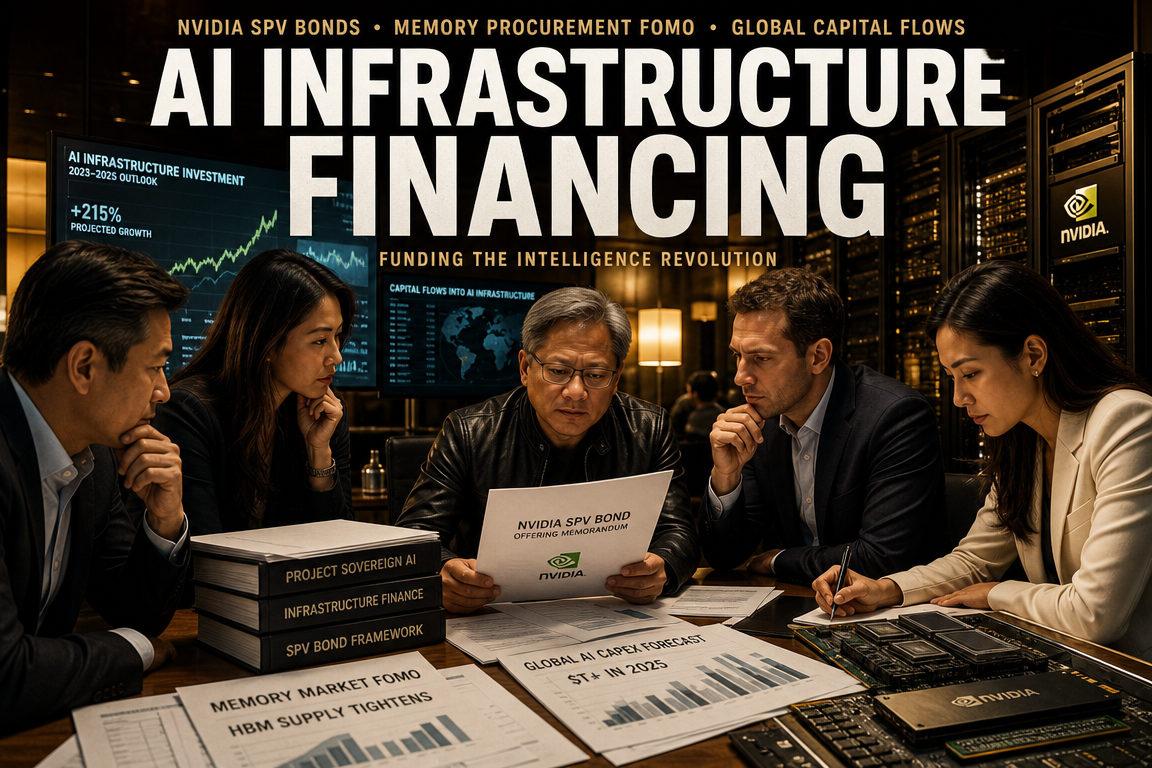
Nvidia’s proposed $500 billion AI infrastructure financing plan: AI investment has become a financial-system event, not a semiconductor cycle
The key point of this news is not simply that Nvidia will sell more GPUs.
The more important issue is that the funding base for AI infrastructure is expanding from Big Tech cash to Wall Street capital, pension funds, insurers, and retail investor money.
In practical terms, Big Tech companies such as Microsoft, Amazon, Google, and Meta have so far funded GPU purchases with internal cash flow or corporate debt.
Now, the proposed model is to have special purpose vehicles, or SPVs, own the data centers, issue bonds, and have major Wall Street asset managers buy those bonds.
If successful, this could trigger another expansion in AI infrastructure investment.
If it fails, the impact could extend beyond a semiconductor correction to the bond market, global financial markets, and broader asset prices.
For this reason, this issue should be viewed not as an Nvidia stock story, but as a sign that the AI bubble is beginning to move into the financial system.
1. News summary: why Nvidia is seeking to raise $500 billion for AI infrastructure with Wall Street
Recent reports indicate that Nvidia is working with major financial firms to raise approximately $500 billion, or about KRW 750 trillion, for AI infrastructure.
Firms reportedly involved include Apollo, Blackstone, BlackRock, Brookfield, KKR, and Goldman Sachs.
These are not simply investment firms, but large asset managers and financial institutions that oversee capital from pension funds, insurers, institutions, high-net-worth clients, and retail investors.
In other words, this structure is not based solely on Nvidia’s own capital.
It is a mechanism to connect Wall Street-managed capital to AI data centers and GPU purchases.
Where earlier AI investment relied on Big Tech cash flow, this approach seeks to expand AI infrastructure through the bond market and private credit market.
This matters because competition in the AI industry is increasingly shifting from technology execution to financing capability.
2. How the capital flow works: GPU buyers shift from Big Tech to SPVs
To understand this structure, it is necessary to understand SPVs.
An SPV is a separate legal entity created for a specific purpose.
In this case, it would own and operate data centers and GPU assets.
Traditionally, Big Tech either issued corporate debt directly or used internal cash to acquire GPUs and data center capacity.
Under the proposed model, the SPV issues bonds.
Asset managers such as Apollo, BlackRock, and Blackstone then purchase those bonds using capital from the funds they manage.
The underlying capital in those funds comes from pension funds, insurers, institutional investors, and retail investors.
The SPV uses the proceeds to build data centers equipped with Nvidia GPUs.
AI companies such as OpenAI, Anthropic, cloud providers, and AI service firms then lease computing capacity from those data centers.
Those companies pay usage fees to the SPV.
The SPV uses that cash flow to service bond interest.
Interest payments are then passed through the asset managers to pension funds, insurers, and other investors.
In summary, the flow is as follows.
- Capital from pension funds, insurers, and retail investors flows into Wall Street funds.
- Those funds buy bonds issued by AI data center SPVs.
- The SPVs use the proceeds to acquire Nvidia GPUs and data center capacity.
- AI companies lease the resulting computing power.
- Usage fees from AI companies become the SPV’s cash flow.
- The SPV uses that cash flow to pay bond interest.
On the surface, this appears to be a clean structure.
The key issue, however, is that it assumes sustained demand for AI computing.
3. What it means if Nvidia can provide up to 25% of the financing
One of the most notable points in the report is that Nvidia may participate in the financing structure by up to 25%.
The exact form is not yet clear, but the market is interpreting this as possible equity participation, subordinated support, credit enhancement, or co-investment.
This matters because Nvidia has recently faced scrutiny over circular transaction risk.
In simple terms, if Nvidia invests in an AI company and that company then uses the funds to buy Nvidia GPUs, critics may argue that Nvidia is effectively financing its own revenue.
This proposed structure is different at the surface level.
Nvidia would not fund the entire project, but would help expand AI infrastructure through Wall Street and institutional capital.
However, if Nvidia participates up to 25%, the structure would not be entirely free of circularity concerns.
For asset managers, Nvidia’s participation could make the investment more attractive because it implies shared risk.
Nvidia may view this as a way to attract external capital and expand GPU demand.
The structure is attractive to both sides, but it also creates the possibility that a decline in AI demand could transmit risk into the financial sector.
4. The collateral is not real estate, but computing power
In traditional infrastructure finance, collateral is typically physical assets such as real estate, roads, ports, or power plants, along with the cash flow they generate.
For example, when an office building is financed, rental income serves as the repayment source.
In this AI infrastructure model, the collateral is the data center, the GPUs, and the usage fees generated by computing power.
AI companies pay to use GPUs, and those payments become the source for debt service.
On paper, the model is rational.
AI model training and inference demand remains elevated, and high-performance GPU capacity is a monetizable asset.
However, there is a major variable.
The price of computing power is not fixed.
When AI demand is strong and GPUs are scarce, computing prices remain high.
But if GPU supply expands rapidly, AI monetization slows, or new chips quickly replace existing hardware, computing prices may fall.
In that case, the SPV’s cash flow weakens and bond repayment capacity comes under pressure.
The core risk is whether future rental demand for computing power can remain high enough to support the structure.
5. Bull case: if successful, the AI hardware investment cycle could expand again
If this structure works, it could be a strong positive for Nvidia and the broader AI semiconductor ecosystem.
The main reason is that it opens a new source of capital.
So far, AI data center investment has depended largely on Big Tech operating cash flow and cash reserves.
But as the scale of capital expenditure has grown, investors have started to question the burden.
Rising corporate bond issuance, higher interest costs, and widening CDS spreads for some large technology companies have already appeared.
In this context, Wall Street capital could reduce the financing burden on Big Tech.
Continued AI data center investment would help sustain demand for Nvidia GPUs.
The benefits could also extend to HBM memory, power infrastructure, cooling systems, servers, network equipment, and semiconductor tools.
In particular, memory semiconductor and power infrastructure companies could see another growth cycle tied to AI infrastructure spending.
In a successful scenario, AI infrastructure investment could evolve from a short-term trend into a new global capital expenditure cycle.
6. Bear case: if it fails, the AI bubble could shake the bond market before the stock market
The risk is the failure scenario.
This is not only a problem for Nvidia shareholders.
Once pension funds, insurers, and retail capital begin flowing into AI infrastructure bonds, the risk can spread across the financial system.
If AI demand falls short of expectations, data center utilization could decline.
Lower computing prices would weaken SPV cash flow.
The credit quality of the bonds issued by the SPV could deteriorate.
That would reduce the value of the funds holding those bonds.
Losses would then be transmitted to pension funds, insurers, and retail investors.
At that point, bond market liquidity could tighten and spreads on AI-related credit products could widen.
This would not be a simple technology stock correction.
It could become a broader credit event in global financial markets.
In the current environment, where high interest rates have not fully normalized, the stability of long-duration infrastructure cash flows is especially important.
When rates are high, bond financing becomes more expensive and the present value of future cash flows declines.
For that reason, AI infrastructure finance must be assessed not only through technology growth, but also through the interest-rate and credit cycle.
7. Similarities to the 1870s railroad bubble: good infrastructure can still fail under a poor financing structure
This issue is particularly interesting because it resembles the 1870s railroad boom.
In the 1870s, the United States saw a major expansion in transcontinental railroad construction.
Railroads were a transformative infrastructure asset for the economy.
The problem was not the railroads themselves, but the aggressive financing structures built around them.
At the time, the Northern Pacific Railway required substantial capital.
Financier Jay Cooke marketed railroad bonds and earned significant fees and equity incentives.
He initially tried to sell the bonds to institutional investors, but demand was weak because the risk was viewed as high.
He then began selling them to retail investors.
Using newspaper advertising, patriotic marketing, and a broad sales network, railroad bonds were distributed to the public.
However, when the 1873 global credit contraction began, demand for risky assets weakened sharply.
The sale of railroad bonds stalled, Jay Cooke’s firm failed, and the episode helped trigger the Panic of 1873.
The key point is that railroad infrastructure ultimately created enormous long-term value for the U.S. economy.
But short-term cash flows were insufficient, and excessive leverage in the financing structure created instability.
AI today has a similar profile.
AI infrastructure may generate major long-term productivity gains.
However, if excessive debt, optimistic demand assumptions, and liquidity dependence are combined, near-term financial risk is possible.
8. Anthropic IPO potential: why AI companies are preparing to go public now
The source report also mentioned that Anthropic may be preparing for an IPO in September or October.
Anthropic is a leading generative AI company behind Claude.
Its annualized revenue appears to have grown rapidly, which has increased the likelihood of a public listing.
The report appears to imply ARR of around $7.4 billion for Anthropic and about $4.1 billion for OpenAI.
However, AI revenue figures vary widely depending on the date of reporting and methodology, so investors should verify the latest filings and reliable reporting before making decisions.
An Anthropic IPO matters because it links directly to AI infrastructure finance.
Once AI model companies are public, the market will scrutinize revenue growth, operating losses, GPU costs, cloud spending, and customer retention much more closely.
Until now, sentiment could be supported simply by the narrative that AI demand is surging.
After an IPO, the company must be validated by income statements and cash flow statements.
If companies such as Anthropic demonstrate strong growth and credible monetization, confidence in AI infrastructure credit may improve.
Conversely, if revenue rises quickly but losses widen even faster, the market may begin to question the quality of AI computing demand.
9. The most important point that is often missed in other coverage
The key issue here is not that Nvidia will sell more GPUs.
The central point is that AI industry risk is shifting from technology-company shareholders to long-duration capital providers.
Pension funds and insurers typically seek stable long-term returns.
As Larry Fink of BlackRock has suggested, AI infrastructure bonds that offer investment-grade credit and reasonable yields may appear attractive.
However, investors need to focus on several questions.
- Under what assumptions is the credit rating of AI data center bonds determined?
- Can the structure still service debt if computing prices fall by 30% or 50%?
- How quickly is GPU depreciation being modeled?
- Do OpenAI, Anthropic, and similar tenants provide genuine long-term contractual demand?
- Can power supply and cooling infrastructure keep pace with the buildout?
- If Nvidia participates by 25%, where does it sit in the capital structure in a loss scenario?
- If the SPV fails, who can acquire the assets and at what price?
These questions matter because AI infrastructure bonds may appear to be stable infrastructure products.
In reality, they are credit products backed by assets whose technology cycle is moving very quickly.
It is difficult to treat them as 30-year stable cash-flow assets in the way that traditional infrastructure is valued.
No one can guarantee that today’s top GPU will retain the same rental value several years from now.
For that reason, this structure looks like infrastructure finance on the surface, but in practice it is a new product combining AI semiconductor cycles and bond market risk.
10. Key checkpoints for investors
First, investors should examine the quality of Nvidia’s revenue.
Who is paying for the GPUs is now more important than revenue growth alone.
It is necessary to distinguish between direct Big Tech demand, demand supported by Nvidia, and demand funded through SPVs and bond financing.
Second, data center utilization should be monitored.
Building data centers is not the same as making them profitable.
Low utilization increases repayment risk.
Third, interest-rate direction matters.
AI infrastructure projects require large amounts of long-term capital and are sensitive to financing costs.
If rate cuts become more substantial, funding pressure may ease.
By contrast, prolonged high rates would pressure both investor appetite and repayment stability.
Fourth, the pace of AI monetization must be tracked.
Revenue growth at services such as ChatGPT and Claude is important, but what matters more is whether they can absorb GPU costs and still generate profit.
Fifth, the semiconductor supply chain should be monitored.
Investors should track not only Nvidia GPUs, but also HBM, packaging, servers, networking, power equipment, and cooling systems.
If AI infrastructure spending continues, the entire value chain will move with it.
11. One-line conclusion on this Nvidia development
AI investment is moving beyond Big Tech technology competition and into Wall Street credit creation.
If successful, Nvidia and the AI infrastructure ecosystem could expand again.
If unsuccessful, the impact could extend from the equity market to the bond market and the broader asset market.
At this stage, the key question is not whether AI is good or bad.
The critical issue is who is providing the capital, who is bearing the risk, and where the actual cash flow will come from.
Nvidia’s proposed $500 billion AI infrastructure financing plan signals both continued growth potential for the AI industry and a new source of risk for the global financial system.
< Summary >
Nvidia is reportedly working with major Wall Street asset managers on a financing structure for roughly $500 billion of AI infrastructure.
The core model shifts funding away from Big Tech cash and toward Wall Street funds backed by pension, insurance, and retail capital buying AI data center SPV bonds.
The SPVs would use the proceeds to acquire Nvidia GPUs and data centers, while AI companies would lease the computing capacity and pay usage fees.
If successful, AI semiconductor and data center investment could expand again.
If it fails, the risk could spread beyond Nvidia’s stock price to the bond market, asset markets, and the global financial system.
Key risks include falling computing prices, GPU depreciation, delayed AI monetization, and a prolonged high-interest-rate environment.
This development suggests that AI is moving from a technology cycle into a financial system cycle.
[Related Articles…]
- Nvidia and the AI Semiconductor Investment Cycle
- AI Infrastructure Investment and the Data Center Outlook
*Source: [ 내일은 투자왕 – 김단테 ]
– 엔비디아 이젠 올인?! 판돈이 너무 커졌습니다 ㄷㄷㄷ
● AI, Oil, CPI, Shock
Morgan Stanley’s “Memory Procurement FOMO,” the AI infrastructure capital cycle, and Brent crude at $90: Key takeaways for U.S. equities
Today’s market story is not simply that oil rose or semiconductors rebounded.
The more important development is that AI infrastructure investment is spreading beyond Nvidia GPUs into servers, storage, memory semiconductors, optical communications, and power infrastructure.
At the same time, Brent crude briefly moved above $90 per barrel, reviving inflation and rate concerns, while tomorrow’s U.S. CPI release is likely to set the tone for U.S. equities this week.
In addition, Anthropic’s and Unitree’s IPO plans indicate that the AI public-markets cycle is moving back into an overheated phase, while the Tesla-SpaceX merger discussion is not merely a rumor but a sensitive issue tied to Elon Musk’s compensation structure and control rights.
Below is a structured summary of today’s New York market briefing across macroeconomics, semiconductors, AI, crude oil, IPOs, and Tesla governance.
1. Early U.S. market tone: a wait-and-see session ahead of CPI
U.S. equity futures were modestly higher before the open.
- S&P 500 futures rose about 0.18%.
- Dow Jones Industrial Average futures also gained about 0.18%.
- Nasdaq 100 futures advanced about 0.37%, reflecting expectations for a rebound in technology stocks.
- Russell 2000 futures increased about 0.22%.
After the open, however, the tone softened.
The Nasdaq turned negative intraday, the S&P 500 held near flat, and the Dow remained relatively resilient.
The market has been reluctant to take aggressive positions for a clear reason.
Tomorrow’s July CPI and Thursday’s PPI are both pending.
If the inflation data cools after last week’s weak labor report, expectations for Fed rate cuts could strengthen.
Conversely, if higher oil prices feed through to CPI, the market could face the worst combination: slowing growth and sticky inflation.
In this environment, institutional investors are more likely to wait for the data before increasing risk exposure.
2. Crude oil: Brent briefly crosses $90 and becomes the main market variable
The most closely watched market driver today was crude oil.
Brent crude briefly moved above $90 per barrel intraday.
Although it later eased back to around $87, the market has already begun recalibrating inflation risk.
- WTI traded around $81-$82 per barrel early in the session.
- Brent peaked at $90 before retreating to the $86-$87 range.
- Expectations for talks involving Iran and Oman around the Strait of Hormuz helped ease some supply-disruption concerns.
- However, the prospect of direct U.S.-Iran negotiations remains limited.
The importance of oil goes beyond energy stocks.
Higher oil prices affect freight costs, production costs, electricity bills, and consumer prices.
In other words, rising crude prices translate into inflation pressure, which in turn affects U.S. Treasury yields and Fed policy.
At one point, the 10-year U.S. Treasury yield rose above 4.7%, approaching this year’s highs.
For equities, Brent’s ability to stay above $90 and the 10-year yield’s ability to hold in the 4.7% range are the key near-term indicators.
3. U.S. small-business sentiment: unexpectedly stronger despite labor slowdown concerns
Today’s U.S. small-business sentiment data also drew attention.
The July U.S. small-business optimism index came in at 99.8.
That was 2.4 points higher than the previous month and the highest level since August last year.
It also moved above the long-term average of 98.
- The share of small businesses planning to increase hiring rose to 20%.
- That was the highest level since October 2022.
- However, 36% of companies also said they were having difficulty filling open positions.
This data contrasts somewhat with last week’s payroll report, which pointed to labor-market cooling concerns.
Large employers may be slowing hiring, but smaller firms still appear willing to expand headcount.
That said, persistent labor shortages could continue to support wage pressure, which is not necessarily constructive for the Fed.
4. Nvidia’s $500 billion AI infrastructure funding plan: turning GPUs into financial assets
Nvidia announced a major initiative yesterday.
The company plans to attract more than $500 billion in third-party capital for AI infrastructure.
At an exchange rate of KRW 1,400 per dollar, that is roughly KRW 700 trillion.
That is comparable to South Korea’s annual government budget.
The key point is that Nvidia does not intend to invest the entire amount directly.
Instead, it is working with large asset managers including BlackRock, Blackstone, Apollo, Brookfield, Goldman Sachs, and KKR to connect financing for customers buying AI data centers and GPUs.
In simple terms, if a customer wants Nvidia GPUs but lacks the capital, Nvidia is positioning itself to connect them with global financing providers.
Jensen Huang’s message is that GPUs should be viewed not just as products, but as infrastructure assets that can be financed.
The logic is that GPUs can be treated more like real estate, power plants, or data centers, where financing structures are standard.
That is the real significance of the announcement.
AI semiconductors are increasingly being treated as financialized infrastructure assets rather than simple hardware products.
Market reaction, however, was not fully positive.
Nvidia shares fell about 2.8% on the day of the announcement.
Some investors questioned whether this structure effectively recycles financing back into Nvidia revenue and artificially supports valuation.
5. Morgan Stanley’s “memory procurement FOMO”: the most important sentence in semiconductors today
The most important semiconductor-related headline today was Morgan Stanley’s comment on “memory procurement FOMO.”
FOMO usually refers to investors’ fear of missing out.
In this case, it refers to companies fearing that they may not be able to secure enough memory semiconductors.
Morgan Stanley analyst Erik Woodring said companies are beginning to view rising memory prices not as a temporary phenomenon but as a structural shift that could last for years.
Ordinarily, when prices rise, buyers delay purchases.
Right now, the opposite is happening.
Rather than postponing PC, server, or storage purchases, companies are bringing them forward.
The reason is that securing supply has become more important than price.
- AI data-center spending is spreading from GPUs to CPUs, servers, storage, and memory.
- Companies are concerned that memory prices may rise further or that supply may tighten.
- As a result, they are trying to lock in volumes now, even at current prices.
This trend could affect memory makers such as SK Hynix, Micron, and Samsung Electronics, as well as server, storage, and networking equipment companies.
Morgan Stanley also stressed that a strong hardware cycle should not be confused with attractive valuations.
Related hardware stocks are up roughly 100% from early 2025, and valuations have expanded to around 25x earnings, which the firm described as expensive.
In other words, the industry backdrop is strong, but much of the valuation rerating may already be reflected in share prices.
This is the key point.
This is no longer a phase for indiscriminately buying semiconductor names on the back of a strong cycle.
Investors need to focus on companies that can still benefit from long-term AI infrastructure spending while retaining room for earnings and margin expansion.
6. Intel’s $20 billion equity offering: the opposite of Nvidia’s financing model
Intel expanded its equity offering from $15 billion to $20 billion.
This is reported to be the first large-scale public share sale by Intel since its 1971 IPO.
- The offer price is $95 per share.
- That represents a discount of about 2.6% to the previous close of $97.52.
- More than 200 million new shares are expected to be issued.
- That could result in dilution of roughly 3%-4% of the existing share count.
- Including the underwriters’ overallotment option, dilution could rise to about 4.7%.
Intel shares weakened after the announcement.
Existing shareholders face dilution pressure.
At the same time, strong institutional demand suggests some investors remain constructive on Intel’s long-term AI investment and foundry turnaround potential.
The contrast with Nvidia is clear.
Intel is raising capital directly for its own operations.
Nvidia, by contrast, is connecting external financing to support customer demand for GPUs.
That distinction reflects the current positions of the two companies.
Nvidia is helping design the capital flow of the ecosystem, while Intel is still in a phase that requires capital expansion for survival and reinvestment.
7. Post-close earnings tonight: testing the real strength of AI infrastructure demand
The earnings season for megacap tech is largely behind us, but several AI infrastructure-related mid-cap companies report after the close today.
- CoreWeave will provide insight into AI cloud and data-center demand.
- Super Micro Computer will reflect the intensity of AI server demand.
- Quintrum will help gauge sentiment around quantum-computing investment.
- Lumentum will show trends in AI optical communications and data-center networking investment.
- Kava will provide visibility into growth in consumer spending and store expansion.
- Firefly Aerospace will be a read on space and rocket-related demand.
In particular, CoreWeave, Super Micro Computer, and Lumentum will be important for assessing whether AI data-center investment is translating into actual orders and revenue.
For Nvidia’s $500 billion financing concept to support the broader ecosystem, growth must extend beyond GPUs to servers, power, optical communications, cooling, and storage.
8. Tesla-SpaceX merger speculation: Musk’s $1 trillion compensation and control issue
The Tesla-SpaceX merger discussion has not been formally announced.
However, reports from the Wall Street Journal and other outlets are examining what would happen if such a transaction were pursued.
The key issue is Elon Musk’s performance-based compensation and control rights.
Tesla shareholders previously approved a compensation package that could be worth as much as $1 trillion.
To receive it, Musk would need to meet extremely ambitious milestones, including Tesla’s valuation targets, 20 million vehicle deliveries, 1 million robots sold, and 1 million robotaxis in operation.
However, reports indicate a crucial exception in the contract.
If Tesla were acquired by another company, some of the performance conditions could be treated as satisfied.
If SpaceX were to acquire Tesla, Musk might be able to secure compensation without fully achieving the robot and robotaxi targets.
| Category | Key point | Market implication |
|---|---|---|
| Performance compensation | Tesla acquisition could relax compensation conditions | Potentially favorable to Musk |
| Acquisition price | The valuation at which SpaceX acquires Tesla is critical | Directly linked to Musk’s payout |
| Control rights | SpaceX’s dual-class voting structure could carry over into the combined entity | Musk’s voting power could increase materially |
| Shareholder risk | Whether the terms are favorable to Tesla’s public shareholders remains uncertain | Shareholder approval and regulatory review remain key variables |
According to reports, SpaceX has a dual-class voting structure that gives Musk substantial control.
Tesla is generally a one-share, one-vote company, but if SpaceX’s voting structure were applied after a merger, Musk’s voting power could increase significantly.
Some analyses suggest that while Musk’s economic stake in a combined company could be around 32%, his voting power could rise above 70%.
That said, this remains a scenario analysis based on media reports.
A real transaction would still need Tesla shareholder approval, U.S. regulatory review, and resolution of China-related business issues.
9. Anthropic IPO plans: three key risks for a potential record-scale AI listing
Anthropic is reportedly meeting with investors ahead of a potential IPO as early as September, or by October at the latest.
The company is currently being discussed at a valuation of roughly $1 trillion.
The final offering size and pricing are not yet set, but the market is already discussing the possibility of one of the largest IPOs on record.
Investors are focusing on three main questions.
9-1. Can it compete with lower-cost Chinese AI models?
Anthropic’s Claude is regarded as a high-performance model, but also as expensive.
Chinese AI models are improving rapidly while maintaining clear price competitiveness.
Anthropic acknowledges its pricing is high, but says it will continue focusing on performance improvements and frontier model development.
9-2. How will it manage tensions with the Trump administration?
According to reports, the U.S. Department of Defense wanted broader use of Claude for military purposes, but Anthropic insisted on limits around mass surveillance and autonomous weapons use.
This reportedly increased tensions with the Trump administration and led to disputes over government technology usage and legal action.
Government contracts are a major market for AI companies.
As a result, strained relations with the U.S. government could become an important valuation risk for an Anthropic IPO.
9-3. How will it address data-center and power constraints?
AI growth requires large-scale data centers and power supply.
However, local communities in the U.S. are increasingly resistant to data-center construction, higher electricity bills, and pressure on the power grid.
For AI companies such as Anthropic, strong model performance alone is not enough.
They must also address power, cooling, permitting, and social acceptance in order to justify valuation.
10. Unitree IPO: a symbol of China’s humanoid-robot investment surge
Chinese humanoid-robot company Unitree is also preparing for an IPO.
According to the Financial Times, retail investor demand for Unitree shares was more than 5,500 times the allocation available.
That is far stronger than the more than 200 times oversubscription recorded in the recent CXMT listing.
- Unitree plans to issue about 44.4 million shares in the IPO.
- The offer price is reported at CNY 150.8 per share.
- The company aims to raise about $900 million.
- That is roughly KRW 1.2 trillion.
- Last year’s valuation was estimated at around 219x earnings and 36x sales.
By valuation metrics, the stock is expensive.
Even so, demand has been intense because Chinese retail investors are betting heavily on the growth of AI robotics and humanoid systems.
Unitree shipped about 5,500 humanoid robots last year.
Of the capital raised, about CNY 2 billion, or roughly $300 million, is expected to be invested in AI model development for robotics.
In other words, the company is not just building robot hardware; it is also investing directly in the software intelligence that powers those robots.
The same trend is visible in China’s broader equity market.
The STAR 50 index has gained more than 27% this year, while the CSI 300 has risen by less than 1%.
In China as well, capital is concentrating not in the broad market, but in advanced technology names such as AI, semiconductors, and robotics.
11. AI IPO market comparison: SpaceX, SK Hynix ADR, and Anthropic
The original report compared recent large listings with Anthropic’s prospective valuation.
| Company | Key point | Implication |
|---|---|---|
| SK Hynix ADR | Cited as a U.S. market listing example | Reflects global investor demand for memory semiconductors |
| SpaceX | Valuation cited at about $1.75 trillion | Serves as a benchmark for mega-scale IPOs |
| Anthropic | Private-market valuation cited around $960 billion to $1 trillion | Signals potential for a very large AI-model listing |
The key issue is how much stock Anthropic would actually float.
A large valuation alone does not necessarily create ample liquidity if only a small portion of shares is sold to the public.
Conversely, a large offering could have a significant impact on AI-sector sentiment and capital allocation.
12. WSJ on TIPS: inflation protection and a 3% real yield
The Wall Street Journal noted that long-dated Treasury Inflation-Protected Securities, or TIPS, are worth watching ahead of the CPI release.
TIPS differ from conventional Treasuries because the principal adjusts with inflation.
In other words, if inflation rises, the principal is preserved accordingly.
The real yield on 30-year TIPS has recently reached about 3%.
That means investors can still expect close to a 3% real return even after adjusting for inflation.
Given elevated U.S. equity valuations, TIPS may be becoming relatively more attractive for long-term or risk-conscious investors.
This does not mean tomorrow’s CPI will necessarily be hot.
Rather, it suggests that investors who are concerned about the persistence of inflation may view TIPS as a defensive tool.
13. The deeper issue that is often missed in other coverage
The most important takeaway today is not the movement of individual stocks.
The real story is that the AI industry is shifting from a technology race to a capital-raising race.
13-1. AI infrastructure is becoming financialized
Nvidia’s $500 billion financing initiative is less a GPU sales strategy than an infrastructure-finance strategy.
Building AI data centers, buying GPUs, securing power, and laying optical networks require enormous capital.
Going forward, the winners may be not only those that build the best chips, but those that can also provide financing to customers.
13-2. Memory FOMO signals strength, but it may also indicate a late-cycle pattern
Companies bringing forward memory purchases is constructive for the industry.
However, pulling demand forward can also shift future demand into the present.
In other words, near-term earnings may look strong, but inventory adjustments could follow later.
That is why Morgan Stanley emphasized that the cycle is strong, but valuations are already demanding.
13-3. Brent at $90 is an early warning signal before CPI
The market is waiting for tomorrow’s CPI print, but oil is already signaling the direction of inflation pressure.
If Brent remains above $90, expectations for Fed rate cuts could be challenged again.
In particular, if oil rises while labor is cooling, the market will need to worry about both slower growth and reaccelerating inflation.
13-4. Anthropic and Unitree IPOs are a test of the quality of the AI bubble
The rise of AI IPOs is a positive signal, but it can also be a sign of overheating.
Anthropic still needs to navigate government friction, data-center resistance, and competition from Chinese AI.
Unitree, meanwhile, must justify a valuation implied by a 219x P/E ratio with real earnings.
If these IPOs succeed, AI enthusiasm could intensify further.
If post-listing performance weakens, valuation concerns across AI growth stocks could re-emerge.
13-5. The Tesla-SpaceX merger discussion is more about governance than technology synergy
Many view a Tesla-SpaceX combination as a convergence of EVs, robots, space, and AI.
However, the more important issue is Musk’s compensation and voting control.
Depending on the structure, a merger could substantially strengthen Musk’s control over Tesla.
As a result, the central question is not the growth narrative, but whether the terms are favorable to ordinary shareholders.
< Summary >
U.S. equities were range-bound ahead of the CPI and PPI releases.
Brent crude briefly crossed $90, raising renewed inflation and rate concerns.
Nvidia’s $500 billion AI infrastructure financing plan is turning GPUs into a financially structured infrastructure asset.
Morgan Stanley said companies are beginning to exhibit “memory procurement FOMO,” bringing forward memory purchases for fear of future shortages.
However, semiconductor hardware stocks have already rallied sharply, making stock selection critical.
Intel raised capital through a $20 billion equity offering, creating dilution pressure for existing shareholders.
Anthropic’s and Unitree’s IPO plans show that AI investment enthusiasm is broadening in both the U.S. and China.
The Tesla-SpaceX merger discussion remains primarily a governance issue tied to Musk’s compensation and control rights.
The key market checkpoints this week are whether Brent retests $90, how the 10-year Treasury yield trades around 4.7%, and the outcome of July CPI.
[Related Articles…]
*Source: [ Maeil Business Newspaper ]
– 모건스탠리 “메모리 조달 FOMO”ㅣ앤트로픽·유니트리 상장 러시ㅣ브렌트유 장중 90달러 돌파ㅣ테슬라·스페이스X 합병, 머스크 1조달러 잭팟? | 홍혜진의 뉴욕브리핑