● Musk Plans 10GW AI Data Centers
Why SpaceX Is Trying to Become an “AI Hyperscaler” Instead of a Rocket Company
The core point of this piece is not simply, “Elon Musk is drawing another big picture.”
What matters is that SpaceX’s rockets and Starlink cash flow are ultimately connected to AI data centers, cloud computing, Grok, Tesla autonomous driving, and Optimus.
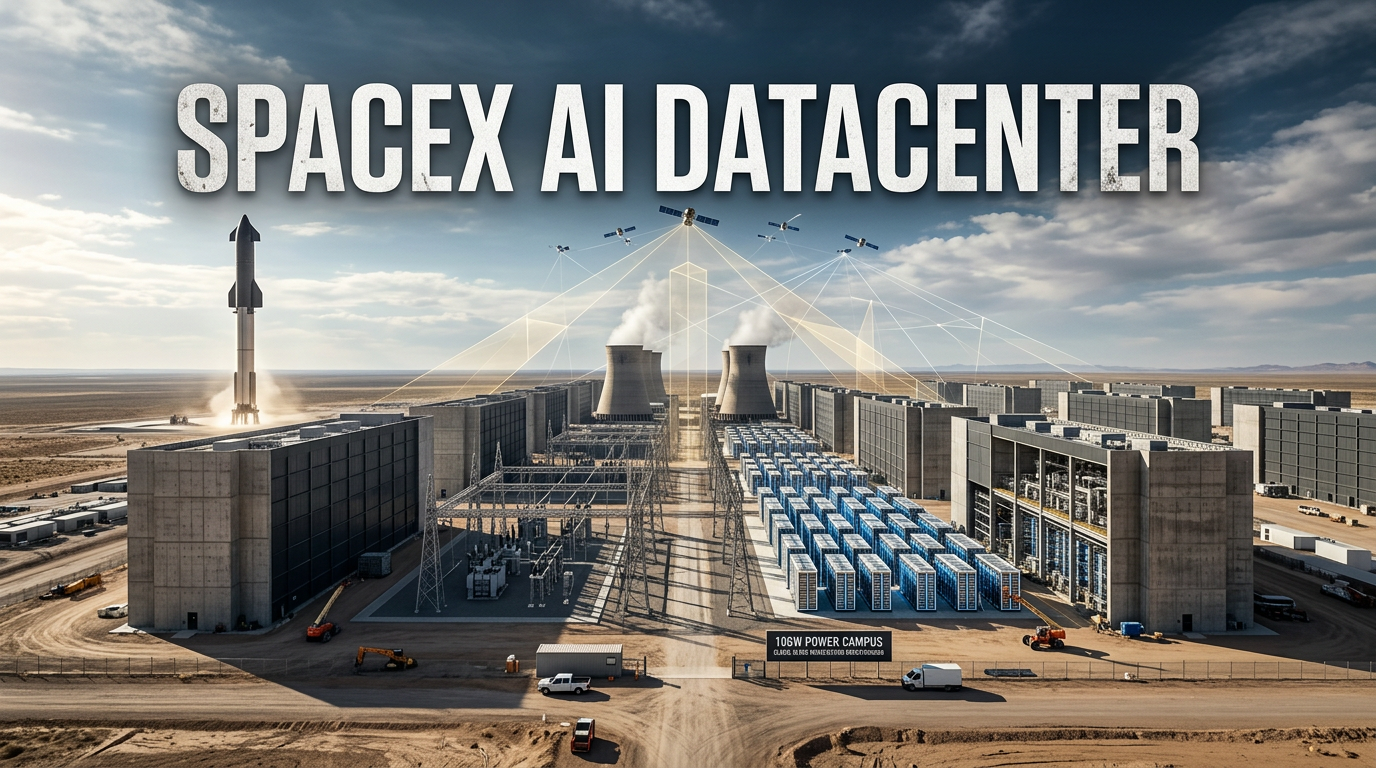
In particular, the most notable point in the original is the scenario in which SpaceX secures data center infrastructure of up to 10GW by 2027.
If that becomes reality, SpaceX would no longer be just a space launch company, but a new hyperscaler candidate built on Nvidia GPUs and power infrastructure.
However, the earnings, revenue forecasts, and 2027 plan discussed here are not officially verified materials like those of a publicly listed company, but an interpretation based on the claims and estimates in the original content.
So in this article, I will treat it not as an “official confirmed fact,” but as a “Musk-style AI infrastructure strategy scenario.”
1. SpaceX’s Real Transformation: From Rocket Company to AI Infrastructure Company
When we normally think of SpaceX, we think of rocket launches, reusable launch vehicles, Starship, and Starlink satellite internet.
But the perspective presented in the original is completely different.
The core business of SpaceX is increasingly shifting from space launches to AI computing leasing.
In other words, it is reinvesting the cash flow generated from rockets and satellites into AI data centers, then leasing that computing capacity to outside companies.
Put simply, this is closer to “cyber real estate.”
Just as a real estate developer builds a building, takes tenants, and collects rent, SpaceX is aiming to build data centers and GPU clusters and lease computing power to AI companies.
The key here is not simply GPU rental.
It is a full-stack AI strategy that bundles computing infrastructure, cloud services, proprietary AI models, and API sales.
2. Growth Rates by Business Segment in the Original: The AI Segment Dominates
The original divides SpaceX’s business into three main parts.
- Space launch and satellite business
- Starlink-based communications business
- AI computing and cloud business
Based on the original, the space segment is described as growing by about 29% year over year.
The Starlink communications segment is presented as growing by about 66%.
But the AI segment is mentioned as growing by an astonishing 247%.
Of course, early-stage businesses can show very large growth rates because the base is small.
But what the original emphasizes more importantly is revenue scale.
Starlink revenue is presented at about $3 billion, and AI revenue is mentioned at about $2.3 billion.
At that level, it is reasonable to interpret the AI business as no longer a side experiment, but already something of considerable scale.
One billion dollars means $1 billion.
To simplify the exchange rate, it is easier to think of it as roughly 1.3 trillion to 1.5 trillion won.
So $2.3 billion can be interpreted as revenue on the scale of about 3 trillion won.
3. Why Musk Absolutely Needs AI Data Centers
The reason Elon Musk wants AI data centers is not just because they are profitable.
All of Musk’s businesses require enormous computing power.
- Tesla FSD autonomous driving training
- Optimus humanoid robot training
- xAI’s Grok model training
- Starlink network optimization
- SpaceX launch vehicle and satellite operations data analysis
The problem is that all of these businesses compete for the same computing pool.
It is like having only one kitchen in a restaurant while needing to handle dine-in customers, delivery orders, and employee meals at the same time.
In the end, the bottlenecks are GPUs and power.
The core asset of the AI era is no longer just software, but “GPU data centers secured with power.”
That is why, from Musk’s perspective, gigawatt-scale AI data centers are essential.
4. The 2026 $100 Billion and 2027 $305 Billion Scenario
The most aggressive figure presented in the original is the revenue outlook.
The claim is that by December 2026, annualized revenue could exceed $100 billion.
Annualized revenue is a concept that converts a specific month’s revenue into an annual figure by multiplying it by 12.
For example, if December monthly revenue is $8.33 billion, it is annualized to look like $100 billion in revenue.
That method is often used to describe growth companies, but it may differ from actual annual revenue.
It is similar to saying, “My annual salary is around this much,” based on a month in which bonuses were unusually high.
Still, high-growth companies do get evaluated by these metrics in the market.
The original also presents a scenario in which annualized revenue reaches about $305 billion by the end of 2027.
The key point is that about $235 billion of that would come from AI computing lease revenue.
In other words, roughly 77% of total revenue would come from the AI infrastructure leasing business.
If this structure materializes, SpaceX would look less like a rocket company and more like a hyperscaler competing with Amazon AWS, Microsoft Azure, and Google Cloud.
5. When the Business Mix Changes, SpaceX’s Identity Changes Too
Based on the original scenario, SpaceX’s revenue structure in 2027 changes dramatically.
- AI computing leasing: about 77%
- Starlink and connectivity: about 12%
- Grok-based AI applications: a separate growth pillar
- Space launch business: about 2%
At that point, the question arises: “Is SpaceX even a space company?”
Of course, the long-term vision is space.
But in the short term, the business that makes the most money and grows the fastest is AI data centers and cloud computing.
What Musk is really aiming for is likely a structure that converts rocket business cash flow into AI infrastructure.
6. Can SpaceX Build a 10GW Data Center?
The original explains that SpaceX is targeting 2GW by the end of 2026 and up to 10GW of data center infrastructure by 2027.
Given the premise that it has already reached around 1.7GW, reaching 2GW does seem realistic.
The problem is 10GW.
To go from 2GW to 10GW, an additional 8GW is needed.
To secure that within one year, it would need to add roughly 667MW of power and data center infrastructure every month.
That pace is difficult even for major big tech companies.
At present, the biggest bottleneck in the AI data center market is closer to power infrastructure than to GPUs.
Even if you buy Nvidia GPUs, you cannot run them without electricity.
Even if you have land, you cannot operate if grid connections are delayed.
7. The Secret of Musk’s Speed: He Does Not Wait for the Grid
Normally, data centers receive electricity from the grid.
But in the United States, connecting large-scale data centers to the grid can take 3 to 7 years.
Opposition from local residents, transmission expansion, power approval procedures, and environmental regulations all become obstacles.
The Musk-style approach is to avoid this bottleneck.
It is an on-site generation method where power facilities are installed directly on the site.
In other words, instead of bringing electricity from outside, the data center generates and uses power directly on the property.
The reason this strategy matters is speed.
In AI model competition, even a few months’ delay in completing a data center can leave you a generation behind in model performance competition.
The AI industry is now moving almost like an arms race.
Whoever secures GPUs faster, connects power faster, and trains models faster wins.
8. The Core of On-Site Power Generation: Gas Turbines, Reciprocating Engines, Fuel Cells
The original mentions three major on-site power generation methods.
- Gas turbines
- Reciprocating engines
- Fuel cells
Solar power and small modular nuclear reactors can also be long-term candidates.
But from the perspective of quickly running data centers right now, gas turbines, reciprocating engines, and fuel cells are presented as more realistic options.
In particular, mobile gas turbines have the advantage of being loaded onto trailers and quickly installed on-site.
The original explains that this is also why companies that supply modular power equipment, such as Solaris Energy Infrastructure, are getting attention.
Instead of waiting for the existing grid, you bring the generation equipment directly next to the data center.
This can be seen as a strategy that resolves the power bottleneck faster than conventional hyperscalers.
9. Why Power Infrastructure Stocks Were So Strong
As AI data center investment grows, the market has reacted strongly to power infrastructure stocks.
Gas turbine companies, power equipment companies, transmission and distribution equipment companies, cooling system companies, and power management companies are all being revalued as part of the AI value chain.
In the gas turbine field, companies such as GE Vernova, Mitsubishi-related firms, and Siemens Energy are often mentioned.
In fuel cells, companies like Bloom Energy are getting attention as an on-site power generation theme.
When looking at AI investment now, it is no longer enough to focus only on Nvidia, big tech earnings, or cloud revenue.
You need to look at power, cooling, land, gas pipelines, generators, transformers, and transmission networks as well.
An AI data center is a semiconductor industry, but at the same time an energy industry and an infrastructure industry.
10. Why AI Computing Lease Prices Keep Rising
An interesting point in the original is that even for the same 1GW data center, contract pricing can vary widely.
GPU cloud capacity contracted in the past is locked in at relatively low prices.
By contrast, computing based on the latest Blackwell GPUs can command much higher prices.
The reason is simple.
GPUs that can be used right now are scarce.
It is like needing a place to live now and having to pay expensive short-term rent even if a new apartment will be ready a year later.
AI companies are in the same position.
It matters that power will come later and the data center will be completed later, but they need to train models right now.
This “time premium” is why immediately usable AI computing carries high prices.
That is also why companies such as Google and Anthropic are actively seeking external computing resources.
11. The Real Money Comes Not from GPU Leasing, but from APIs
Leasing GPUs does make money.
But what the original emphasizes more importantly is Grok API sales.
Simply leasing GPUs is similar to selling raw materials.
But if you build your own AI model and sell that model through an API, the value added becomes much greater.
It is like making more money by turning apples into fruit cups, taking orders on a platform, and also collecting delivery fees than by simply wholesaling the apples.
That is the essence of a full-stack AI strategy.
- Secure GPUs and data centers directly
- Sell them externally in cloud form
- Train your own models
- Create higher margins through APIs and applications
According to Morgan Stanley estimates, the ROIC mentioned in the original is up to about 46%.
That means a company with its own infrastructure, its own models, and its own APIs can generate very high returns on investment.
That is why even a $5 billion investment in a 1GW data center could be recovered within two years.
12. Why Big Tech Is Building AI Data Centers Like Crazy
There is still talk in the market that “AI doesn’t make money” and “AI is a bubble.”
But big tech’s actions are the opposite.
Microsoft, Google, Amazon, Meta, and Oracle are all continuing to invest in AI data centers without slowing down.
In fact, they are increasing investment more aggressively.
The reason is that the payback math is already there.
Once cloud computing, AI APIs, enterprise AI services, developer tools, and automation solutions start making money, data centers are no longer just a cost but highly profitable assets.
For someone using AI only as a free chatbot, this profitability is not very visible.
But companies are using AI for coding automation, customer service automation, data analysis, legal document review, drug development, robot control, and ad optimization, creating real cost savings and revenue growth.
So when looking at the AI economic outlook, the key question is not “How much are people using chatbots?”
It is how much computing companies are buying, and how much productivity that computing creates.
13. Grok Must Succeed for Musk’s AI Strategy to Be Complete
The final key takeaway emphasized in the original is Grok.
If the SpaceX or Musk ecosystem ends only as a simple computing leasing company, there is a limit to the margins.
But if Grok rises to a level comparable to OpenAI, Anthropic, and Google Gemini, the story changes.
That is because Grok can be sold together with GPU infrastructure.
For example, it becomes possible to offer a package to enterprise customers that says, “We’ll lease you GPUs, provide the model, provide the API, and even attach X platform data and distribution channels.”
If that happens, SpaceX could build a hyperscaler business model similar to AWS, Azure, and Google Cloud.
The original suggests that Grok is currently slightly behind top-tier models, but that it may be able to catch up when cost effectiveness and update speed are considered.
In the end, the biggest challenge in Musk’s AI strategy is not only securing GPUs or power, but model quality at the end.
Grok must succeed for the profitability of AI data centers to maximize.
14. Why a SpaceX and Tesla Merger Scenario Comes Up
The original title even mentions a SpaceX and Tesla merger.
However, no actual merger has been officially announced.
This is closer to a scenario interpreting the strategic direction of the Musk ecosystem.
Why does this kind of story come up?
The reason is that computing assets are also extremely important to Tesla.
- Tesla FSD requires large-scale driving data training
- Optimus requires robot behavior models and simulation training
- xAI’s Grok requires large GPU clusters
- SpaceX has cash flow and infrastructure from Starlink and rocket business
In other words, Tesla, SpaceX, xAI, and X all need the same AI infrastructure.
From this perspective, what matters more than whether they merge is “integration of the computing pool.”
Even if they are not legally one company, a structure may emerge where data centers, AI models, and GPU clusters are used jointly.
If, over the long term, a stronger tie is needed, methods such as equity swaps, strategic investments, service contracts, and infrastructure-sharing agreements could emerge.
So from an investor’s perspective, rather than the merger itself, what matters is how AI computing resources are allocated within the Musk ecosystem.
15. Nvidia Is Becoming the Central Bank of the AI Era
Another important point in the original is Nvidia.
The reason Musk emphasizes continuing to use Nvidia GPUs may not simply be technical preference.
Nvidia has enormous cash flow and is a core supplier in the AI data center ecosystem.
Now Nvidia is becoming not just a GPU seller, but something close to the center of AI infrastructure finance.
Put simply, when Nvidia invests or provides support, that money may come back as purchases of Nvidia GPUs.
The market has raised concerns about circular financing in this structure.
If AI investment keeps succeeding, it can generate enormous leverage effects, but if demand weakens, the entire supply chain could shake at once.
This is both the biggest opportunity and the biggest risk in the AI industry.
16. The Real Key Takeaway That Other News Doesn’t Really Explain
Most news stops at “Musk is building a 10GW data center,” “the scale of AI investment is huge,” or “power shortages are the problem.”
But the real key takeaway is the empty space between those points.
There is a time gap between the power already secured and the power contracted for the future.
This time difference creates the most expensive premium in the AI industry.
In other words, what investors should look at is not simply “Who bought the most GPUs?”
Who can generate power right now.
Who can shorten data center delivery times.
Who can turn that computing into high margins through their own models and APIs.
These three things are the core point.
In the AI era, the bottleneck is moving from semiconductors to power, from power to delivery speed, and from delivery speed to model monetization.
Those who understand this flow first can secure a much more advantageous position in AI infrastructure investing.
17. Checkpoints to Watch from an Investment Perspective
Viewed from the perspective of U.S. stocks and the global economic outlook, the points to monitor are fairly clear.
- Check whether AI data center investment 규모 continues to rise.
- Look at the order backlog and delivery lead times of power infrastructure companies.
- Verify the earnings of gas turbine, fuel cell, cooling system, and transformer companies.
- See whether Nvidia GPU demand actually translates into cloud revenue.
- Watch changes in enterprise API usage for Grok, Claude, GPT, and Gemini.
- See how much Tesla FSD and Optimus absorb AI computing demand.
- Also check whether circular financing structures are becoming excessive.
The AI industry is no longer just a software game.
It is a huge economic system connected to interest rate outlooks, capital raising costs, energy prices, data center sites, grid approvals, and cloud demand.
So when looking at big tech earnings going forward, you should not look only at revenue and EPS.
You need to look at CAPEX, data center utilization, power secured, AI API revenue, and depreciation burdens as well.
18. Conclusion: What Musk Is Aiming For Is a Larger AI Platform Than a “Space Company”
Putting the original together, Musk’s big picture is simple.
Rockets are the long-term vision.
Starlink is the cash flow.
AI data centers are the core infrastructure.
Grok is the monetization engine.
Tesla FSD and Optimus are internal demand sources.
Nvidia GPUs are the weapon.
Power infrastructure is the bottleneck.
When all of this is combined, the Musk ecosystem operates as one giant AI platform.
If SpaceX really secures 10GW-scale AI infrastructure in 2027 or 2028, the market may revalue the company not as a rocket firm, but as a next-generation hyperscaler.
Still, the execution risks are large.
It has to overcome 10GW data center construction, power procurement, GPU acquisition, cooling systems, capital raising, regulatory approvals, and model competition.
Even so, one direction is clear.
The winner of the AI era is likely to be not the company that only builds models well, but the company that connects power, GPUs, cloud, models, and APIs all together.
< Summary >
There is a scenario in which SpaceX is not just a rocket company, but expands into AI data centers and cloud computing businesses.
The core point is a structure in which Starlink and space business cash flow is invested into AI infrastructure, GPU computing is leased out, and high-margin profits are created through Grok APIs.
The 2027 10GW data center target is extremely aggressive, but some realism exists if on-site generation and modular power infrastructure are used.
The real bottlenecks in the AI industry are not only GPUs, but power, delivery time, cooling, land, and capital raising.
The core of the Musk ecosystem is connecting SpaceX, Tesla, xAI, and Starlink into one AI computing pool.
Investors should now look not only at big tech earnings, but also at power infrastructure, AI data center CAPEX, cloud revenue, and API monetization.
[Related Articles…]
- AI Data Center Power Bottlenecks and Infrastructure Investment Opportunities
- The AI Cloud War Built by Nvidia and Big Tech
*Source: [ 월텍남 – 월스트리트 테크남 ]
– 스페이스X + 테슬라 합병까지 노리는 ‘진짜 머스크의 계획’