● CPI, AI Power Struggle, Semiconductor Shock
U.S. CPI Immediate Analysis: More Important Than an Inflation Shock Is the AI Geopolitical Competition and the Semiconductor Value Chain
The key point of this article is not simply that U.S. CPI came in line with expectations.
The more important issue is that U.S. inflation appears to be showing signs of peaking, which has reduced concerns about further rate hikes, while the U.S.-China AI competition is increasingly influencing semiconductor investment cycles and the direction of the KOSPI.
What the market may overlook is not that Chinese AI has fully surpassed the United States, but that it is beginning to pressure the U.S. in cost efficiency, power infrastructure, and the data ecosystem.
This trend connects Samsung Electronics, SK Hynix, NVIDIA, hyperscalers, data center investment, and future FOMC policy.
1. U.S. July CPI Release: The Market Reacted More With Relief Than With Inflation Shock
According to the original text, U.S. July CPI matched market expectations.
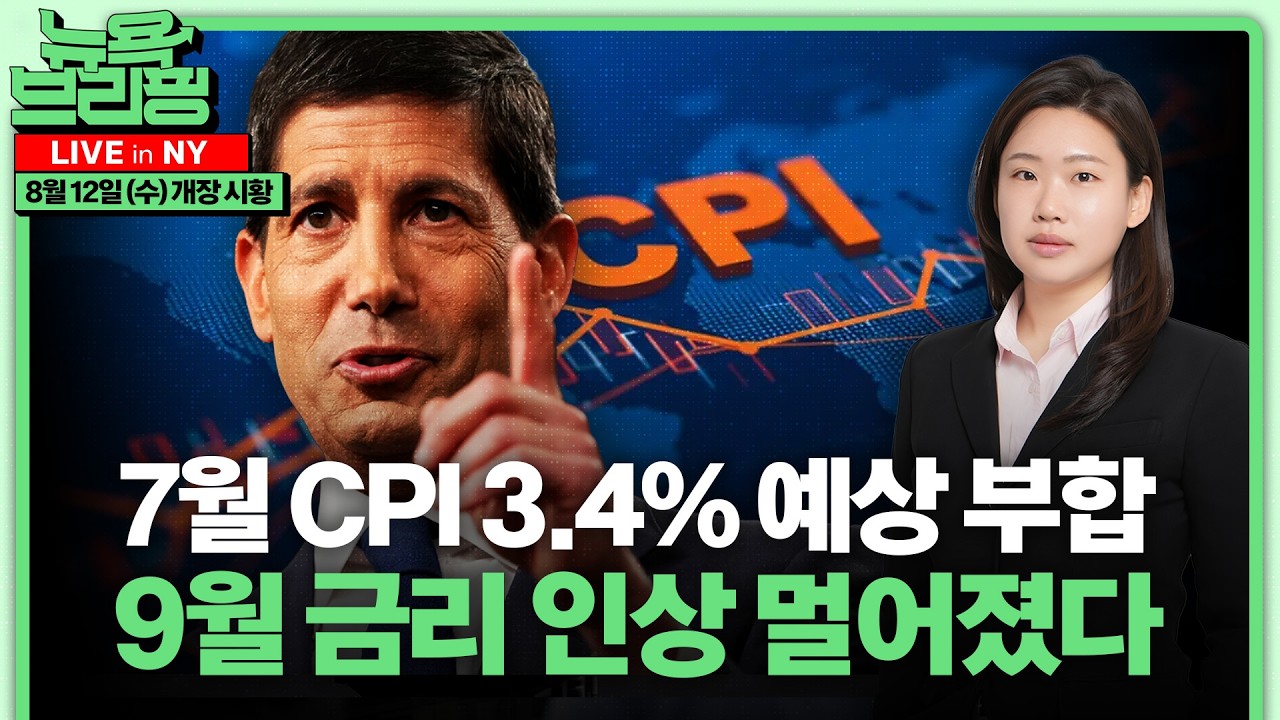
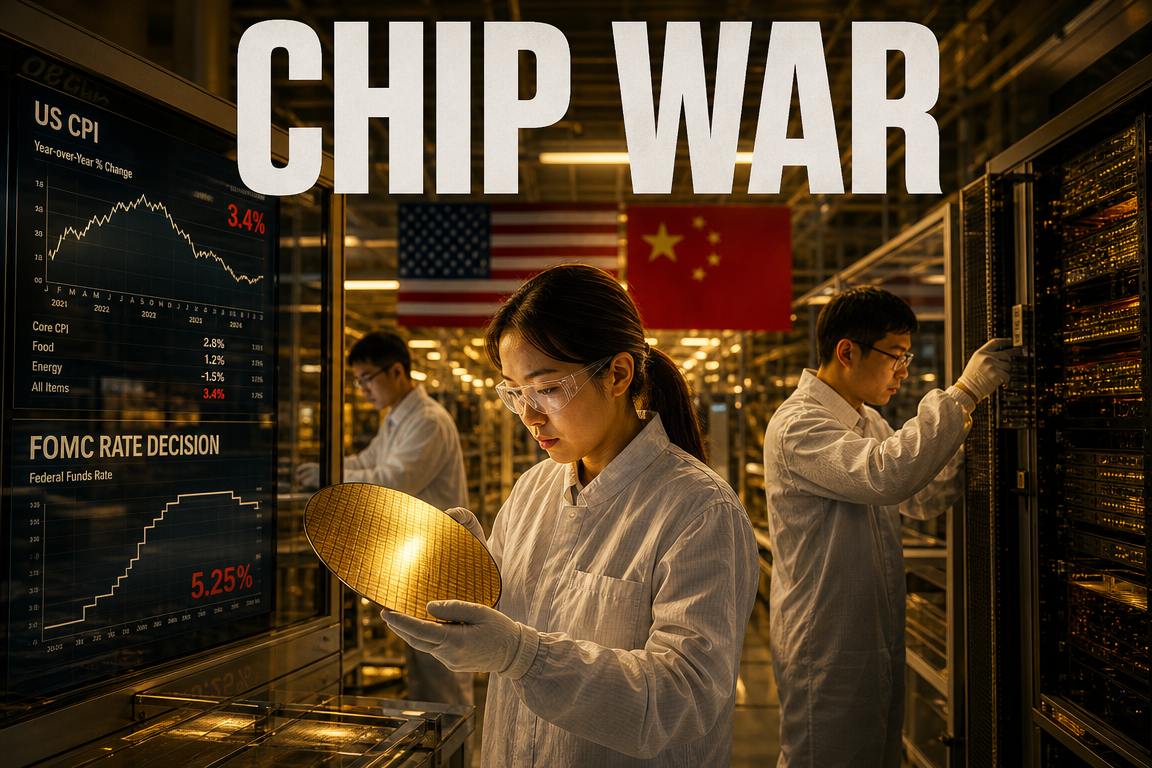
Headline CPI rose 3.4%, and core CPI rose 2.5%, both in line with consensus.
The key point is that monthly inflation pressure did not accelerate further.
The market had been concerned that Middle East tensions and rising crude oil prices could push inflation higher again.
However, the release suggested that inflation was more likely to have peaked in May than to be entering a new upside cycle.
- Headline CPI: In line with expectations
- Core CPI: In line with expectations
- Interpretation: Greater confidence in inflation peaking
- Market reaction: Lower concern over further rate hikes
- Key variables: Next PPI release and August CPI
Rather than concluding that inflation has clearly been subdued, the more accurate interpretation is that fears of a renewed inflation surge have eased.
In particular, core inflation meeting expectations weakens the Federal Reserve’s justification for an urgent additional rate hike.
2. CPI Detail: Energy Prices Remained Volatile, But the Pressure Did Not Spread Broadly
The most important component in this CPI release was energy prices.
Crude oil prices rose again in July amid the Middle East conflict and uncertainty around the Strait of Hormuz.
The market was concerned that higher energy prices could spill over into broader consumer inflation.
However, the analysis in the original text indicates that the energy-price increase did not materially transmit into core goods or core services inflation.
- Food prices: Limited rebound
- Energy prices: Temporary upward pressure from Middle East risks
- Core goods: Stable
- Core services: No strong reacceleration
- Housing costs: Continued moderation
Housing inflation is particularly important.
In U.S. CPI, services inflation is heavily driven by housing costs, which tend to keep core CPI elevated.
The original text noted that housing inflation eased from around 3.4% and 3.3% to 3.2%.
This suggests that inflation is not structurally reaccelerating, even as external oil shocks remain present.
3. Lower Inflation Expectations: The Signal the Federal Reserve Watches Closely
Inflation expectations are also important.
They measure how much consumers and businesses expect prices to rise in the future.
The original text stated that expected inflation fell to 2.4%.
A lower reading indicates that consumers and firms do not strongly believe inflation will continue rising.
For the Federal Reserve, stable inflation expectations are critical.
The more dangerous issue is not current inflation itself, but the possibility that inflation expectations become entrenched.
If households expect persistent inflation, wage demands rise, firms lift prices further, and a wage-price spiral can emerge.
This release points to a lower risk of that dynamic.
4. FOMC Outlook: Rate-Hike Risk Eased, While Rate-Cut Expectations Remain Intact
The CPI release has the most direct implications for FOMC policy expectations.
According to the original text, the market’s rate outlook shifted modestly after the release.
Before the data, the probability of holding rates steady was around 56.1%; after the release, it rose to 58.1%.
Conversely, the probability of a rate hike fell from 43.9% to 41.9%.
The direction matters more than the exact levels.
With CPI broadly in line with expectations, the Fed has less justification for pushing ahead with further tightening.
At the same time, the labor market and broader economy have not weakened enough to force immediate rate cuts.
The most reasonable interpretation is that a hold has become more likely, while expectations for eventual rate cuts may gradually recover.
- Near-term outlook: Lower rate-hike risk
- Medium-term outlook: Renewed rate-cut expectations
- Key event: Jackson Hole meeting
- Next inflection points: August CPI and September FOMC
- Market impact: Lower U.S. Treasury yields, weaker dollar index potential
5. Market Impact: Equities, Treasury Yields, the Dollar, and Bitcoin All React to CPI
When U.S. CPI is stable, the first major reaction is usually in U.S. Treasury yields.
If the probability of further hikes declines, Treasury yields tend to move lower.
Lower yields create a more favorable environment for growth stocks and technology shares.
In particular, AI semiconductors, large-cap technology, and the Nasdaq can benefit.
The dollar index is also affected.
When markets believe U.S. rates are unlikely to rise further, upward pressure on the dollar weakens.
A softer dollar can be supportive for emerging-market assets and Korean won assets in the short term.
Bitcoin and other risk assets are also sensitive to liquidity expectations.
As rate-cut expectations increase, the market may rotate toward higher-risk assets.
That said, CPI alone does not justify a broad rally across all risk assets.
Middle East risks, PPI, labor data, and Federal Reserve commentary remain important variables.
6. U.S. Labor Market: Unemployment Remains Low, But Hiring Is Slowing
Another important point in the original text is the U.S. labor market.
The U.S. economy is still not weak enough to be described as in recession.
Third-quarter GDP estimates from the New York Fed and Atlanta Fed remain constructive.
However, labor-market details are less robust.
The unemployment rate is stable, but new hiring is slowing.
The original text described this as a low-hire, low-unemployment environment.
Companies are not engaging in mass layoffs, but they are also not hiring aggressively.
This trend may also be linked in part to broader AI adoption.
In other words, the U.S. economy is not in recession, but job creation is becoming less dynamic.
If inflation continues to stabilize under these conditions, the Fed will increasingly need to weigh labor-market conditions.
Ultimately, the policy path will depend on the balance between inflation and employment.
7. U.S.-China AI Competition: Sanctions Accelerated China’s Drive Toward Self-Reliance
Another major theme in the original text, alongside CPI, is the U.S.-China AI competition.
The United States has tightened export controls to restrict China’s access to advanced semiconductors.
Restrictions on NVIDIA’s high-end AI chip sales are part of that effort.
However, the original text frames this as a “sanctions paradox.”
Rather than stopping China, the restrictions appear to have accelerated efforts to build a domestic semiconductor value chain and AI ecosystem.
DeepSeek R1 drew attention by delivering strong performance at low training cost.
Kimi K3 was also cited as evidence of China’s progress, particularly in open-weight models with large parameter scales and strong capability.
The key issue is not that China has fully overtaken the United States.
The more relevant point is that China is narrowing the gap by improving cost efficiency and building a domestic ecosystem under constrained conditions.
8. Five Core Drivers of AI Competition: Data, Models, Compute, Power Infrastructure, and Research Capability
The original text does not treat AI competition as a matter of model performance alone.
It divides the AI industry into five core elements.
- Computing power
- Power infrastructure
- AI models and algorithms
- Data ecosystem
- Research capability
Viewed through this framework, the United States remains strong in some areas, while China is rapidly catching up or showing strength in others.
Investors should assess the structure of the competition rather than relying on a simple binary view.
9. Computing Power: The United States Still Dominates Data Center Capacity
In terms of computing power, the United States remains far ahead.
The original text cited 12,255 data centers globally.
Of those, 4,767 are in the United States and 376 are in China.
The gap remains substantial.
Data centers are the core infrastructure for training and inference in AI models.
This is why hyperscalers continue to invest heavily in capital expenditure.
Microsoft, Amazon, Google, and Meta have been deploying massive CAPEX into data centers and AI servers, creating strong demand for semiconductors.
However, expansion is not determined by data center count alone.
Even if data centers can be built, growth is constrained if power supply is insufficient.
As a result, AI competition is increasingly becoming a competition in power infrastructure as much as in semiconductors.
10. Power Infrastructure: Why China Has an Unexpected Advantage
The most notable point in the original text is power infrastructure.
While the United States dominates in data center count, its electricity generation capacity is not expanding at a comparably dramatic pace.
By contrast, China has rapidly increased power generation and is described as exceeding the U.S. by roughly a factor of two.
AI data centers consume very large amounts of electricity.
As AI models expand and physical AI, robotics, autonomous driving, and smart manufacturing develop, electricity demand will rise further.
If power becomes a bottleneck, even advanced GPUs cannot support unlimited infrastructure growth.
China benefits from a broader industrial base that includes renewable energy, batteries, transmission networks, power equipment, and mineral resources.
This is an area that is often underemphasized in market commentary.
The AI competition is increasingly about who can supply electricity more cheaply and reliably, not only who has the most powerful GPUs.
11. AI Model Competition: The United States Leads, But China Is Pressuring Through Cost Efficiency
The United States still appears ahead in AI model performance.
The original text described the technology gap as equivalent to roughly three months of progress.
This does not mean China is three months away from catching up; rather, it suggests the gap has narrowed to that scale when measured by current capability.
China’s main approach is distillation.
Distillation transfers the reasoning and response capabilities of large models into smaller models to improve efficiency.
The original text noted that China has used this technique to cut training costs significantly and reduce inference costs.
For enterprises, top-end performance is not the only consideration.
The objective is profit maximization, not just performance maximization.
As a result, even slightly lower-performing but much cheaper models can gain traction.
This is why Chinese AI models have become a competitive force globally.
12. Data Ecosystem: China’s Super App Structure Provides a Structural Advantage
Data is essential in AI competition.
The United States has strong platform-level data through services such as Facebook, Instagram, and Amazon.
China, however, collects broader and more connected data through super apps such as WeChat and Alipay.
A standard e-commerce app may know only what a user bought.
By contrast, a super app can connect payments, mobility, messaging, lifestyle services, finance, and spending behavior.
For AI models, the connectivity of data matters as much as its volume.
China’s super-app ecosystem may therefore offer advantages in AI training and service development.
There are, of course, significant concerns around privacy, surveillance, and regulation.
However, from an industrial competitiveness standpoint, China’s data structure has strengths that support AI development.
13. Research Capability: China Has Rapidly Advanced in Papers, Patents, and AI Talent
To assess AI’s future competitiveness, current products alone are insufficient.
Basic research capability must also be considered.
The original text highlighted citation rates, patents, publications, and technical talent as key indicators.
Historically, U.S. AI research was cited far more often.
However, the original text states that Chinese research citation rates have exceeded U.S. levels in the 2020s.
China was also described as having patent and publication volumes roughly twice those of the United States.
This suggests that China is moving beyond imitation and strengthening its basic research base and talent pool.
Over the long term, AI leadership may become more fragmented and more competitive.
14. Falling AI Prices and Token Economics: Pressure on U.S. AI Profitability
As Chinese open-source AI models spread, token pricing is one of the first areas affected.
One of the main revenue sources for AI companies is usage-based token billing.
However, if China’s low-cost, high-performance models gain adoption, token prices across the market may decline.
The original text said the token price index has fallen about 40% from its peak after the spread of Chinese open-source models.
Enterprises may adopt a model-mixing strategy, combining high-end and low-cost models.
This lowers AI usage costs but can pressure profitability for U.S. AI companies.
In other words, AI usage can expand even if AI company margins are compressed.
This is one reason valuations for hyperscalers and AI-related stocks may come under pressure.
15. Jevons Paradox: Lower Prices Can Drive Explosive AI Demand
A key concept the market may overlook is Jevons paradox.
When technological progress improves efficiency and lowers prices, consumption does not necessarily fall.
Instead, lower unit costs can cause overall usage to rise sharply.
The same may apply to AI.
If token prices decline, companies may use AI more extensively.
Adoption can expand beyond chatbots into robotics, autonomous driving, smart factories, biotech, advanced manufacturing, and physical AI.
In that case, semiconductor demand may not weaken; it may instead create new sources of demand.
In the near term, lower prices may raise concerns about AI company earnings, but over the long term they may expand total demand for AI infrastructure and semiconductors.
16. Semiconductor Market Outlook: Separate Short-Term Price Action From Long-Term Demand Expansion
Recent volatility in semiconductor stocks has multiple causes.
There are concerns that hyperscaler CAPEX may not continue rising at the same pace, and AI model price declines have increased worries about profitability.
China’s cost-efficient AI strategy is also putting pressure on the U.S.-centric AI investment cycle.
However, this does not necessarily mean the end of the semiconductor supercycle.
As AI usage costs decline, the range of applications may continue to expand.
Physical AI, robotics, advanced manufacturing, and biotech automation could all generate new computing demand.
For Korea, Samsung Electronics and SK Hynix should be assessed through HBM, memory semiconductors, and AI server demand.
As the U.S. and China AI ecosystems diverge, a strategy focused on only one side will be insufficient.
Technology, customers, and geopolitical risk must all be managed across the semiconductor value chain.
17. U.S.-China AI Ecosystem Fragmentation: Two AI Worlds May Emerge
The original text emphasizes the possibility of geoeconomic fragmentation.
In the future, countries may increasingly align with either the U.S. AI ecosystem or the Chinese AI ecosystem.
The United States has expanded its AI infrastructure around the NVIDIA CUDA ecosystem.
China is building its own hardware and software ecosystem through firms such as Huawei and Alibaba.
The increasing participation of countries in China-led AI cooperation frameworks is also important.
If this trend continues, AI may become divided into U.S.-aligned and China-aligned systems rather than a single global standard.
Korea should avoid reducing this issue to a simple pro-U.S. versus anti-China framework.
From an industrial and market perspective, supply-chain diversification and pragmatic positioning are required.
18. The Most Important Point Not Often Highlighted Elsewhere
The central message of the original text is not the CPI number itself.
The key mechanism is: inflation stabilization leads to lower rate-hike risk, which supports liquidity expectations and prompts a reassessment of the AI semiconductor value chain.
Another important point is that AI competition is not determined by GPU performance alone.
Power infrastructure, data connectivity, open-source models, token pricing, research talent, and geopolitical standards are all moving together.
Markets focus on NVIDIA earnings or U.S. CPI, but beneath that, China’s cost-efficient AI ecosystem is pressuring the margins and investment plans of U.S. AI companies.
At the same time, lower AI costs may increase total semiconductor demand through Jevons paradox.
Therefore, the market should not be framed simply as an AI bubble collapse or a supercycle continuation.
The more accurate view is that AI profitability may be pressured while AI usage continues to expand sharply.
That distinction is critical for assessing semiconductors, the KOSPI, U.S. technology stocks, Bitcoin, the dollar, and Treasury yields.
19. Key Items for Korean Investors to Monitor
- First, whether both U.S. CPI and PPI remain stable.
- Second, how strongly the Fed signals rate cuts at the September FOMC.
- Third, whether hyperscaler CAPEX is actually declining or merely slowing.
- Fourth, how much China’s low-cost AI strategy is pressuring U.S. AI profitability.
- Fifth, whether demand for Samsung Electronics and SK Hynix HBM continues to expand through physical AI and data center growth.
In the short term, stable CPI is positive for equities.
In the medium term, the sustainability and profitability of the AI investment cycle may continue to drive semiconductor volatility.
In the long term, the key sectors may include AI infrastructure, power grids, data centers, high-performance memory, power semiconductors, and cooling systems.
< Summary >
U.S. July CPI was in line with expectations and increased the likelihood that inflation has peaked.
Concerns about further rate hikes have eased, while expectations for future rate cuts may gradually recover.
U.S. Treasury yields and the dollar index may face downward pressure, while equities and Bitcoin may benefit from a more supportive liquidity backdrop.
However, PPI, labor data, the Jackson Hole meeting, and the September FOMC remain the next key variables.
In AI, China is accelerating its catch-up efforts through cost-efficient models, power infrastructure, and data ecosystem advantages despite U.S. restrictions.
Lower AI pricing may pressure U.S. AI profitability, but it may also expand long-term semiconductor demand through Jevons paradox.
Korean investors should assess semiconductor value chains, power infrastructure, and AI demand expansion within the context of U.S.-China ecosystem fragmentation.
[Related Articles…]
*Source: [ 경제 읽어주는 남자(김광석TV) ]
– [LIVE] 미국 CPI 물가 심층분석 : ‘인플레 쇼크’ 오는가? [즉시분석]
● CPI Relief,AI Surge,Geo Risk
After U.S. CPI, the real focal point is not the September FOMC, but the data released before then
The key takeaway from this week’s New York equity action is not simply that U.S. CPI came in line with expectations.
More importantly, the report reduced pressure for another rate hike at the September FOMC, while still leaving inflation too elevated for the Federal Reserve to declare victory.
At the same time, Nebius demonstrated AI data center demand with operating results that challenged short-seller concerns, and Foxconn is beginning to be re-rated as an AI server manufacturer rather than only an iPhone assembler.
On the downside, the stalemate in U.S.-Iran negotiations and the risk around the Strait of Hormuz remain variables that could again pressure oil prices and inflation.
This report connects U.S. CPI, the September FOMC, U.S. interest rates, AI servers, and New York market trends in one view.
1. July U.S. CPI: Why the market took it as a relief
July U.S. CPI came broadly in line with market expectations.
Headline CPI rose 3.4% year over year.
On a month-over-month basis, it increased at a moderate pace of around 0.1% to 0.2%.
Core CPI, excluding food and energy, also came within expected ranges.
The significance of the data is straightforward.
If inflation had reaccelerated, the Federal Reserve would have faced greater pressure to consider another hike at the September FOMC.
Instead, the report did not signal an inflation shock severe enough to force an immediate policy response.
The market therefore treated the release as supportive.
- Headline CPI: up 3.4% year over year.
- Core CPI: within expectations.
- Housing: still the main contributor to inflation.
- Energy: lower gasoline and oil prices helped ease upward pressure.
- Market interpretation: the odds of a September hike fell, but it is still too early to discuss rate cuts.
In other words, this was not a strong inflation print, but rather a non-disruptive one.
Inflation is still well above the Federal Reserve’s 2% target, but the data did not surprise markets to the upside.
2. Market reaction in New York: Nasdaq and semiconductors led the move
U.S. equity futures rose after the CPI release.
The Nasdaq 100 futures led the advance.
The Dow Jones and S&P 500 also moved higher, but capital clearly rotated toward semiconductors and AI infrastructure.
- Dow Jones futures: up around 0.3%.
- S&P 500 futures: up around 0.4% to 0.5%.
- Nasdaq 100 futures: up around 1%.
- Russell 2000: small-cap stocks also rebounded.
- VIX: declined, reflecting improved risk sentiment.
By sector, semiconductors, semiconductor equipment, and computer hardware were strongest.
Nvidia, Broadcom, Micron, Intel, and AMD all advanced.
Data center infrastructure names such as Arista Networks, Seagate, SanDisk, and Western Digital also outperformed.
By contrast, some large-cap technology and software names were weaker.
Microsoft and Apple underperformed, while Meta and Tesla also declined.
The current market is not simply buying “AI” broadly. It is shifting toward AI infrastructure companies with confirmed demand and earnings visibility.
3. U.S. interest rate outlook: September FOMC hike odds have fallen, but the story is not over
Before the CPI release, markets assigned roughly similar probabilities to a September FOMC hike or hold.
After the CPI data, the probability of a hold rose to around 55%.
Markets initially interpreted the report as reducing the likelihood of another September hike.
However, it would be premature to translate that into expectations for an imminent rate cut.
Inflation remains elevated from the Federal Reserve’s perspective.
Housing inflation remains sticky, and core inflation is still far from the 2% target.
As a result, the Fed will not react to CPI alone.
The central bank is likely to review PPI, PCE, labor market, and consumption data before making its September FOMC decision.
4. Key data points to monitor before the September FOMC
This CPI release cleared only one important hurdle.
A number of critical economic indicators remain before the September FOMC.
4-1. 10-year Treasury auction
The 10-year Treasury auction scheduled for the afternoon of the CPI release is important because it offers a direct read on long-term rate direction.
Strong demand for Treasury securities pushes yields lower.
Weak demand pushes yields higher.
Higher long-term yields pressure growth stocks and technology shares.
Nasdaq and AI-related names are especially sensitive to rate moves.
4-2. July PPI and initial jobless claims
The next key release is July PPI.
PPI measures inflation at the producer level.
It is important because it helps estimate the upcoming PCE reading.
The Federal Reserve places greater emphasis on PCE than CPI.
So even if CPI is benign, a hot PPI print could quickly change market sentiment.
At the same time, initial jobless claims are also important.
Labor market strength that is too firm can revive inflation concerns.
On the other hand, a sharp weakening in labor conditions could increase recession concerns.
4-3. Federal Reserve commentary
Remarks from Cleveland Fed President Beth Hammack are worth watching.
Hammack is generally viewed as a hawkish policymaker.
She was among those who supported a rate hike at the July FOMC.
Markets will watch whether she continues to argue for another hike after the CPI data.
Remarks from Richmond Fed President Thomas Barkin also matter.
Barkin has taken a more cautious stance, emphasizing the need to assess inflation, labor, and consumption data further.
4-4. July retail sales and the University of Michigan sentiment index
Consumer data arrive later in the week.
Weak July retail sales would increase concern about slowing U.S. consumption.
Strong data would signal that the U.S. economy remains resilient.
In the University of Michigan survey, expectations for inflation will be closely watched.
If consumers believe inflation will remain elevated, actual inflation may prove difficult to bring down.
4-5. July PCE and the August jobs report
July PCE inflation will be released on August 26.
PCE, not CPI, is the Federal Reserve’s official inflation target measure.
Core PCE is particularly important.
PCE captures changes in consumption patterns more broadly than CPI.
It also includes some items such as medical costs that are paid by employers.
Then in September, the August jobs report and August CPI will be released before the September 15-16 FOMC meeting.
5. The Fed’s real shift: reducing communication may matter more than rates themselves
One of the most important points in this market is the Fed’s changing communication approach.
The Federal Reserve has historically provided a significant amount of forward guidance.
Investors used those signals to price bonds, equity valuations, and borrowing costs.
If the Fed reduces that guidance, the market becomes more uncertain.
Greater uncertainty can lead investors to demand higher compensation.
That, in turn, can push long-term Treasury yields higher.
Higher long-term yields raise corporate borrowing costs, mortgage rates, and broader financing expenses.
This is not just a communication issue; it can affect real economic costs.
In other words, if the Fed reduces its signaling and becomes more data-dependent, long-term rate pressure could rise rather than fall.
This is a key issue to monitor not only at the September FOMC but also at the Jackson Hole symposium later this month.
6. Nebius up 17%: AI compute demand outweighed short-selling concerns
Nebius is a neocloud company providing AI data center and GPU cloud services.
Following its earnings release, the stock rose about 17% in premarket trading.
Second-quarter revenue reached $582.3 million.
That represents a 454% increase from a year earlier.
Adjusted EBITDA also turned positive.
Last year the company posted a loss, but this time it reported a $236 million gain.
The key issue is not only top-line growth.
The main point is that AI server rental demand is expanding rapidly while the business is beginning to generate profits.
The stock had been under pressure from short-selling concerns linked to Michael Burry.
Burry had argued that Nebius looked expensive and that debt was rising too quickly to support data center investment.
AI data center businesses are indeed capital intensive.
GPU procurement, power, cooling systems, buildings, and networking infrastructure all require substantial capital.
Even when revenue rises sharply, investment spending and debt can rise alongside it.
Still, the market chose to focus more heavily on growth and execution in this report.
Strong results from CoreWeave, another peer, also reinforced the view that AI compute demand remains robust.
7. Foxconn earnings: AI servers are now more important than iPhones
Foxconn has long been known as Apple’s iPhone assembler.
Its latest results suggest that identity is changing.
Second-quarter net profit reached TWD 59.97 billion.
That was up 35% year over year and above market expectations.
The main driver was AI servers.
Cloud and networking businesses accounted for 51% of total revenue, crossing the halfway mark for the first time.
By contrast, consumer electronics, including iPhones, fell to about 29% of revenue.
Foxconn should now be viewed less as an iPhone assembler and more as a key manufacturing partner for Nvidia AI servers.
The company is one of Nvidia’s major AI server manufacturers.
It also produces Nvidia’s next-generation Vera Rubin server racks.
Mass production preparation is under way for the third quarter, with shipments expected to begin in the fourth quarter and scale into next year.
8. The real bottleneck in AI servers: CoWoS supply, not GPU demand
The most important message from Foxconn’s results is not that demand is strong.
That has already been established.
The real issue is that supply remains constrained even when companies want to produce more.
TSMC’s CoWoS advanced packaging process is a major bottleneck.
CoWoS is a technology that stacks multiple high-performance chips into a single AI package.
Nvidia accelerators do not operate as standalone GPUs.
They require ultra-fast communication between GPUs and HBM high-bandwidth memory.
CoWoS is a critical process that makes this possible.
Foxconn’s CEO said CoWoS capacity is expected to increase by more than 50% next year.
However, actual AI server shipments will depend on how much chip and packaging capacity TSMC can secure.
That point is highly significant.
The bottleneck in AI is now less about demand and more about supply-chain execution.
HBM, CoWoS, power, cooling, data center land, and networking equipment all need to scale together before AI servers can ship at higher volumes.
9. Sector rotation today: AI infrastructure outperformed the M7
The market has been rotating rapidly.
When semiconductors outperform, software tends to lag, and vice versa.
Today clearly favored semiconductors and hardware.
- Strong sectors: semiconductors, semiconductor equipment, computer hardware, and AI data center infrastructure.
- Weak sectors: selected software, communication services, healthcare, and energy.
- Financials: maintained a relatively firm trend.
- Japanese banks: also strong on expectations of higher rates in Japan.
This pattern suggests that investors are increasingly distinguishing between different layers of the AI theme.
The market is no longer buying AI indiscriminately.
Capital is rotating toward companies with confirmed orders, revenue, and margin support.
10. Oil and U.S.-Iran talks: a renewed inflation risk
U.S.-Iran negotiations have again stalled.
There had been some expectation that the Strait of Hormuz might reopen partially, but sentiment has weakened again.
Iran has indicated that unless the U.S. accepts its conditions, it will not allow the Strait of Hormuz to reopen.
Its demands include the release of frozen assets, easing of financial sanctions, and an end to regional conflict involving Gaza and Lebanon.
The Trump administration has signaled that it could respond more forcefully if Iran continues to harden its position.
In addition, another attack on a vessel was reported at the Bab-el-Mandeb Strait, at the entrance to the Red Sea.
A cargo ship reportedly came under attack, with fatalities reported, in an incident believed to be linked to Houthi forces.
The U.S. military also reportedly used Hellfire missiles against a vessel to disable it after an alleged violation related to Iran’s port blockade.
This is not only a diplomatic issue.
It is a potential shock to maritime logistics and oil supply chains.
If oil prices rise again, they could add pressure to CPI and PCE later on.
In that sense, U.S.-Iran negotiations remain a hidden variable for the September FOMC.
11. Commodities and currencies: gold and silver stronger, dollar softer, yen unstable
The dollar weakened modestly after the CPI release.
The move reflected the view that pressure for another U.S. rate hike had eased.
Treasury prices rose slightly, and yields stabilized somewhat.
Gold rose about 1%.
Silver gained more than 2%, showing stronger momentum.
Oil gave back part of the prior day’s gains.
- WTI: eased slightly in the low $82 range.
- Brent: eased slightly in the high $88 range.
- Dollar index: slightly weaker.
- Gold: up about 1%.
- Silver: up more than 2%.
- Yen: slightly firmer, but still not stable.
The yen has not yet found a durable stabilization point despite coordination efforts between the U.S. and Japan.
As a result, expectations for further Bank of Japan tightening continue to surface.
Bitcoin rose modestly, but remains range-bound without a clear trend.
12. Earnings to watch today: Cisco, Coherent, and Cerebras
Several earnings reports may help confirm the AI infrastructure trend.
12-1. Cisco
Cisco is a network equipment company.
Its results help gauge whether AI data center investment is translating into network equipment orders.
Consensus expectations are for EPS of $1.17 and revenue of $16.82 billion.
12-2. Coherent
Coherent supplies optical communication equipment for AI data centers.
It is a useful indicator of the pace of AI data center expansion.
12-3. Cerebras Systems
Cerebras is an AI chip company.
It is developing very large AI chips using a different architecture from Nvidia’s GPUs.
Although a loss is still expected, revenue growth and order visibility will be the main focus.
13. The most important point often missed in other coverage
Three issues matter most in this event set.
13-1. The CPI relief was already partially priced in
Oil had already moderated somewhat in July, and markets had partly priced in the view that CPI would not surprise materially to the upside.
That is why New York equities did not surge even after a benign CPI print.
The market is already moving to the next releases.
In other words, the combination of PPI, PCE, labor, and consumption data matters more than CPI alone.
13-2. If the Fed speaks less, long-term yields could rise
It is easy to assume that less Fed communication means less intervention.
In practice, the opposite can happen.
If the future policy path becomes less transparent, investors may demand higher yields on long-duration bonds.
That can push long-term rates higher and weigh on technology valuations.
This is a structural risk, not just a question of whether the Fed hikes again.
13-3. In AI investing, the scarcest asset is not demand, but manufacturing capacity
Nebius and CoreWeave showed that AI compute demand remains strong.
Foxconn’s results showed that AI server orders are strong.
At the same time, TSMC CoWoS, HBM, power, cooling, and server rack manufacturing remain the bottlenecks.
Going forward, AI investing is likely to depend less on who is involved in AI and more on who can solve the supply constraints.
14. Investor takeaways
- U.S. CPI provided relief, but it does not settle the September FOMC decision.
- The Fed is likely to await PPI, PCE, labor, consumption, and inflation expectation data.
- Nasdaq and semiconductors are reacting sensitively to near-term rate stability.
- AI server and data center names should be selected based on earnings support, not theme exposure alone.
- High-growth AI infrastructure companies such as Nebius require attention to both growth and leverage.
- Foxconn’s results show that AI supply chains are becoming more important than iPhone assembly as an investment theme.
- Stalled U.S.-Iran talks remain a potential oil and inflation risk.
- Reduced Fed forward guidance could lift long-term yields through higher uncertainty.
< Summary >
July U.S. CPI came in line with expectations and supported New York equities.
However, inflation is still above the Federal Reserve’s target, so PPI, PCE, labor, and consumption data remain critical before the September FOMC.
Semiconductors and AI infrastructure outperformed, while some large-cap technology and software names lagged.
Nebius posted 454% revenue growth and a positive EBITDA result, easing short-seller concerns.
Foxconn is increasingly being re-rated as an AI server manufacturer rather than an iPhone assembler.
The key bottleneck in AI is not demand, but supply-chain capacity in areas such as TSMC CoWoS, HBM, power, and cooling.
Stalled U.S.-Iran negotiations and Strait of Hormuz risk remain potential sources of renewed oil and inflation pressure.
Fed communication strategy is also important, as reduced guidance could raise long-term yields through higher uncertainty.
[Related Articles…]
- September FOMC: Key Outlook for U.S. Interest Rates
- AI Server Supply Chain and Semiconductor Investment Trends
*Source: [ Maeil Business Newspaper ]
– CPI 다음은? 9월 FOMC까지 체크포인트ㅣ공매도 뚫고 네비우스 17% 급등ㅣ폭스콘 순익 35%↑…아이폰보다 AI 서버ㅣ미·이란 협상 교착ㅣ홍혜진의 뉴욕브리핑