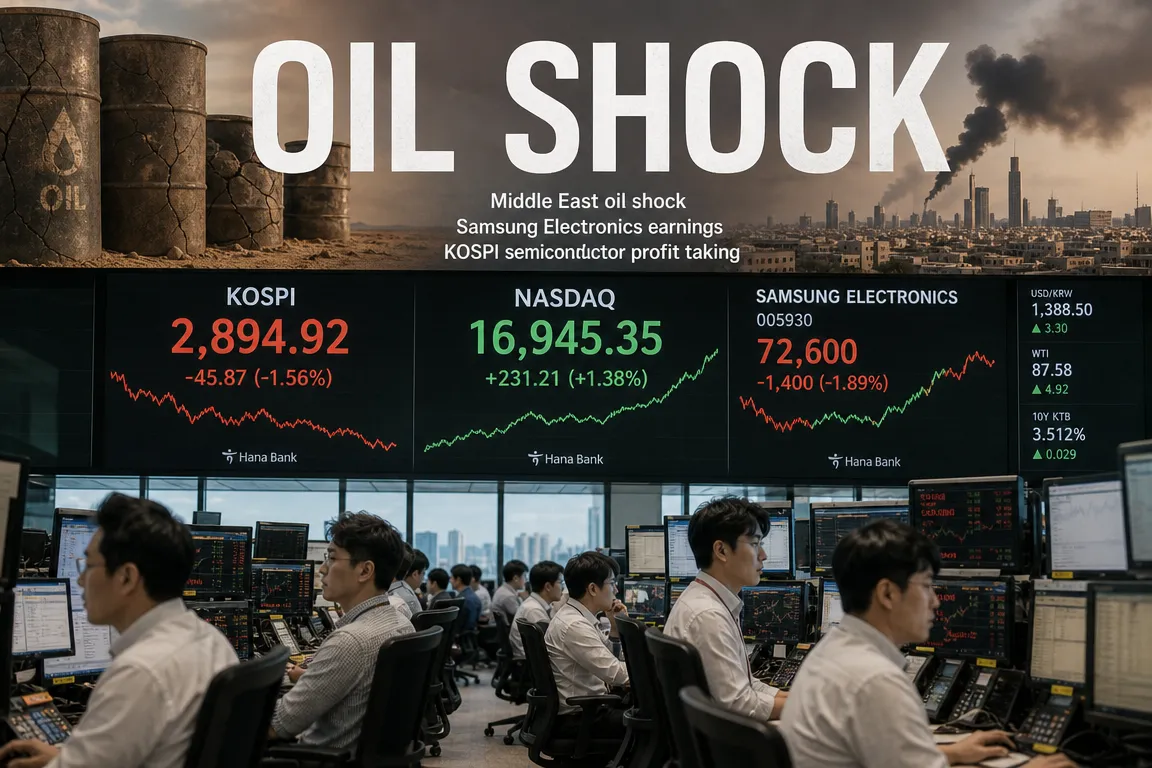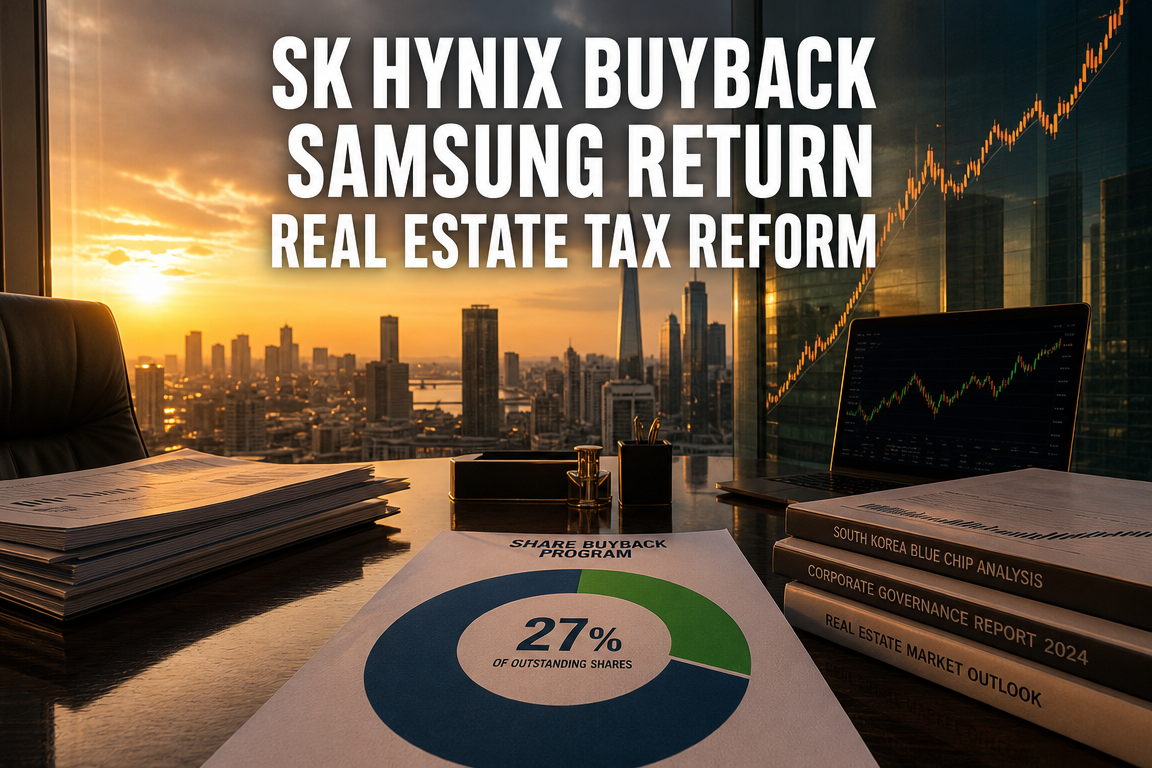
● SK hynix Shock, 40T Buyback, Samsung Next
Key Takeaways from SK hynix’s 40 Trillion Won Shareholder Return Announcement: The More Important Change Is the Shift to “More Than 50% of Cash”
The key point in SK hynix’s latest announcement is not simply the headline figure of “40 trillion won in shareholder returns.”
The intraday stock decline of nearly 10%, the subsequent narrowing of losses to around -1% in NXT trading, the disclosure of a share buyback, and the change in wording to returning more than 50% of future cash flow to shareholders are the critical items.
In other words, the market initially reacted negatively, but after reviewing the details, it reassessed the announcement as a possible sign of a structural shift in SK hynix’s shareholder return policy rather than a short-term event.
Attention is now shifting naturally to Samsung Electronics.
If SK hynix has introduced such an aggressive policy, Samsung Electronics is now under greater pressure to present a shareholder return plan, including buybacks, higher dividends, or a broader capital return framework that equity investors would consider credible.
1. Why SK hynix shares fell sharply intraday and then recovered
According to the original report, SK hynix fell by nearly 10% at one point during the session.
Later, losses narrowed to around -1% in NXT trading.
This suggests that the market initially interpreted the announcement negatively, then softened its view after reassessing the details.
The initial disappointment was straightforward.
Some market participants and securities firms had expected a much larger capital return package, with speculation extending to as much as 100 trillion won.
Against that backdrop, 40 trillion won could easily be seen as below expectations.
However, the details suggest that the announcement contains more significance than the headline number alone indicates.
In particular, the scale of the share buyback, the allocation of future cash flow, and the possibility of additional returns appear to have changed the market’s interpretation.
2. The core of the announcement is the 40 trillion won shareholder return
SK hynix is reported to have announced a shareholder return package of 40 trillion won.
The return mechanism consists of two main components.
The first is share repurchases.
The second is dividends.
A share buyback involves a company purchasing its own stock from the market.
Because the number of shares outstanding may decline, expectations for earnings per share improvement typically follow.
Dividends are cash distributions made directly to shareholders.
For investors, this is a direct and stable form of capital return.
Particularly notable is the company’s disclosure that it will buy back shares over the next three months.
Based on the original report, this is viewed as one of the largest buybacks ever announced by a listed Korean company.
At this scale, the announcement should be viewed not as symbolic but as a factor that could affect market liquidity and supply-demand conditions.
3. Share buybacks and share cancellations are not the same
Investors should distinguish clearly between repurchases and cancellations.
A buyback is the act of purchasing shares from the market.
A cancellation is the permanent retirement of those shares.
From a shareholder perspective, cancellation is generally the stronger action.
That is because only cancellation reduces the total number of outstanding shares and can structurally increase the value of existing equity stakes.
If repurchased shares are held rather than canceled, they may later be used for employee compensation, mergers and acquisitions, or other corporate purposes.
For that reason, investors should verify whether the announcement refers only to buybacks or also includes actual cancellations.
4. The most important change is the wording shift from “within 50% of cash” to “more than 50%”
The most important element of this announcement is the change in policy language.
Previously, SK hynix was understood to have used wording indicating shareholder returns of up to 50% of cash generation.
This time, the company appears to have shifted to a framework of returning more than 50% of cash to shareholders.
This is a meaningful change.
“Within 50%” allows flexibility, meaning the company could return only 10%, 20%, or 30% depending on conditions.
“More than 50%” establishes a floor.
In practical terms, this means that as SK hynix generates more cash from AI memory, HBM, and an improving memory cycle, shareholder returns could also increase.
For investors, this policy change may matter more than the buyback itself.
That is because it represents a structural shift that could affect valuation over several years rather than a one-time event.
5. Why the market was initially disappointed: expectations were too high
The announcement is not weak in absolute terms.
A 40 trillion won return package is substantial.
Buybacks, dividends, and the possibility of additional returns are all positive developments for shareholders.
However, markets tend to focus on the gap between expectations and reality rather than absolute size.
As noted in the original report, some brokerage estimates were close to this level, which limited the upside surprise.
In addition, speculation about a 100 trillion won package may have created an elevated benchmark.
In such cases, stock prices can fall even after good news is announced.
The reason is often not that the news is bad, but that expectations were too high.
This is especially true for large-cap Korean stocks and semiconductor names, where foreign flows, institutional positioning, and pricing-in effects can drive significant volatility after announcements.
6. Why the announcement still matters
The announcement matters because SK hynix is signaling that it no longer wants to be evaluated solely as a cyclical memory company.
Historically, memory semiconductor companies were viewed as highly cyclical businesses that earned heavily in good periods and suffered in downturns.
However, AI infrastructure investment, rising HBM demand, and data center expansion are changing the market’s perception of SK hynix’s cash generation capacity.
The addition of large-scale shareholder returns reinforces a valuation re-rating narrative.
The key issue is no longer just whether the semiconductor cycle is improving, but how much cash the company can return to shareholders.
This is similar to the premium that U.S. megacap technology companies have long received through buybacks and dividends.
If SK hynix continues moving in that direction, it could also support a broader re-rating of Korean equities.
7. Market attention is now shifting to Samsung Electronics
With SK hynix introducing a 40 trillion won return plan, investor attention has shifted to Samsung Electronics.
Samsung Electronics is the largest company in the Korean market by market capitalization.
As a result, its shareholder return policy has implications not only for the company itself but also for overall sentiment toward the KOSPI.
If SK hynix is pursuing aggressive buybacks and expanded capital returns, Samsung Electronics may face stronger expectations to respond with a more competitive policy.
Samsung Electronics is also balancing large cash reserves, memory-cycle recovery expectations, AI semiconductor competition, and foundry investment requirements.
Investors are watching to see whether the company will maintain a limited dividend framework or expand buybacks and share cancellation policies.
If Samsung Electronics delivers a return policy that exceeds market expectations, it could support a broader revaluation of the Korean semiconductor sector.
If the policy is weaker than expected, the valuation gap versus SK hynix may widen further.
8. The key point that is often overlooked
Many headlines will focus on the surface elements: “40 trillion won,” “buyback,” and “share price volatility.”
However, the real issues are the following four points.
First, SK hynix is shifting toward a cash-flow-based shareholder return model.
Historically, earnings were highly volatile, but the company is now signaling a framework that returns a meaningful share of cash generation to shareholders.
This can change how the company is valued.
Second, buybacks matter less than cancellation.
Buybacks can support near-term supply-demand conditions, but cancellation has a much stronger long-term effect on shareholder value.
Investors should closely monitor how repurchased shares are treated.
Third, the announcement puts pressure on Samsung Electronics.
Because SK hynix has moved first, any comparatively conservative response from Samsung Electronics could disappoint the market.
Samsung is now being judged not only on memory-cycle recovery but also on shareholder-friendly policy.
Fourth, the balance between AI investment and shareholder return remains critical.
SK hynix still needs to invest in HBM, server DRAM, and AI data center demand.
Returning capital is important, but so is funding future growth.
Long-term valuation will depend on how well the company balances investment with shareholder distribution.
9. Key points investors should monitor going forward
1) Buyback size and execution pace
Execution matters more than announcement.
Investors should track how quickly the company repurchases shares over the next three months.
Faster execution could provide stronger near-term support for the stock.
2) Whether repurchased shares are canceled
This is especially important for long-term investors.
If repurchased shares are canceled, per-share value can improve.
If they are simply held, the impact may be more limited.
3) The specifics of dividend expansion
Dividends provide direct cash returns to investors.
Future payout ratios, dividend yields, and free-cash-flow-based frameworks will be important to watch.
4) Sustainability of HBM and AI semiconductor demand
SK hynix’s capacity to return capital ultimately depends on earnings.
AI demand must remain strong for cash generation to hold up.
HBM supply agreements, pricing trends, and competitor entry timing should also be monitored.
5) Samsung Electronics’ follow-up policy
Samsung’s response could influence sentiment across the entire Korean semiconductor sector.
If Samsung announces stronger buybacks or cancellation measures, it could support the broader KOSPI.
10. What this means for the KOSPI and the Korean market
SK hynix’s large-scale shareholder return is not just a company-specific event.
It could contribute to a broader re-rating of Korean equities.
Korean companies have long traded at discounts due to low payout ratios, weak cancellation practices, and governance concerns.
If a major semiconductor company such as SK hynix commits to returning more than 50% of cash generation to shareholders, that perception may begin to change.
For foreign investors, this may be seen as evidence that Korean corporates are placing greater emphasis on shareholder value.
That could support the KOSPI alongside the semiconductor recovery cycle and AI investment trends.
However, sustainability remains the key issue.
A one-time announcement may have limited impact.
But if buybacks, higher dividends, share cancellations, and additional capital returns continue, investor interest in SK hynix and Samsung Electronics could improve materially.
11. Interpretation for individual investors
Individual investors should avoid viewing this announcement as purely positive or purely negative.
If the stock has already risen significantly, profit-taking may follow even after good news.
Conversely, if the stock corrects in the short term, a structurally stronger shareholder return policy may improve the medium- to long-term investment case.
The key is to distinguish between expectations and actual delivery.
If the market expected 100 trillion won and the company announced 40 trillion won, disappointment can create short-term selling pressure.
But if the policy of returning more than 50% of cash is maintained, the longer-term outlook may still improve.
Accordingly, this announcement should be read primarily as a signal that SK hynix’s capital allocation strategy is changing.
12. Conclusion: the 40 trillion won figure matters less than SK hynix’s new return threshold
The main takeaway from SK hynix’s announcement is not the 40 trillion won number itself.
The more important point is the company’s guidance that it will return more than 50% of future cash generation to shareholders.
This is an important shift for the investment case of Korean semiconductor companies.
Buybacks can support near-term trading conditions, and dividends provide direct cash returns.
Over time, however, share cancellation, sustained AI-related earnings, and Samsung Electronics’ response will matter more.
If SK hynix follows through and Samsung Electronics also adopts a stronger shareholder return policy, one of the key valuation discounts in Korean equities could narrow.
Ultimately, the issue is not whether SK hynix is spending 40 trillion won.
The real question is how seriously Korea’s semiconductor leaders intend to prioritize shareholder value.
[Related Articles…]
AI Semiconductor Cycle and Outlook for Korean Semiconductor Stocks
Samsung Electronics Shareholder Return Policy and KOSPI Re-Rating Strategy
*Source: [ 내일은 투자왕 – 김단테 ]
– 하이닉스 40조원 자사주 소각!? #하이닉스 #삼성전자 #코스피
● Housing Clash, Liquidity Shock, Tax Bomb, Supply Crunch
What happens to the real estate market when a policy to “cool housing prices” conflicts with fiscal expansion to “release money”?
The core issue in this discussion is not simply whether housing prices rise or fall.
The key point is that the government is signaling housing price stability on one side while creating conditions through expansionary fiscal policy and liquidity supply that may push asset prices higher on the other.
Against this backdrop, Korea’s real estate market is entering not a simple correction phase, but a contest of strength between policy and market forces, as long-term holding tax reform in 2028, real estate PF risk, LH supply constraints, tax pressure on high-value homes, and instability in the jeonse and monthly rental market all converge.
Most news coverage frames the issue as “taxes are rising” or “supply measures are being introduced.” In practice, however, long-term owners are already calculating whether to sell before 2028, hold through the period, or factor in the possibility of a change in administration. That is the most important dynamic now underway.
This article summarizes the discussion in a news-style format within the broader context of the real estate outlook, the Korean economy, higher interest rates, expansionary fiscal policy, and housing supply.
1. The main conflict: housing price stability vs. fiscal expansion
The most strongly raised issue in the discussion was the inconsistency in policy direction.
The government says it wants to stabilize housing prices.
At the same time, next year’s budget is reportedly being designed in a highly expansionary fiscal direction.
In simple terms, this means pressing the brake with one foot while stepping on the accelerator with the other.
Housing prices are determined not only by loan restrictions or taxes.
They also respond to interest rates, liquidity, household income expectations, government spending, supply shortages, and investor sentiment.
When the government injects more money into the economy, liquidity rises.
When liquidity rises, the value of cash falls relative to scarce assets, and the value of those assets may increase.
This is especially relevant for Seoul’s core apartment complexes, premium homes in areas such as Banpo and Hannam-dong, and redevelopment districts with structurally limited supply.
These are not just housing units; they are scarce assets.
As a result, trying to contain high-end housing prices while simultaneously expanding liquidity is highly difficult from a policy consistency standpoint.
The discussion described this as similar to “turning on the left signal while driving to the right.”
2. Rate hikes appear aimed as much at FX and real estate stability as at inflation
The discussion also offered a key interpretation of the Bank of Korea’s rate hikes.
Rate increases are generally explained as measures to control inflation.
However, the discussion argued that recent hikes are not driven solely by consumer prices, but also by the need to stabilize the foreign exchange market and the real estate market.
Higher interest rates increase debt service burdens.
Higher debt service burdens reduce housing demand.
For that reason, rate hikes have a short-term restraining effect on housing prices.
The issue arises when the government simultaneously uses fiscal expansion to inject money into the market.
Monetary tightening suppresses demand, while fiscal expansion stimulates it, creating policy divergence.
In that environment, market participants tend to focus more on actual capital flows than on policy messaging.
Ultimately, budget execution and liquidity conditions may become stronger signals for the real estate market than official statements.
3. Real estate PF: expanding supply may revive financial risk
Professor Kim Gwang-seok highlighted real estate PF as a major weak link.
In 2022 and 2023, PF distress was a major risk to the Korean economy.
Because the structure links developers and financial institutions, PF deterioration can spread into the broader financial system.
At that time, regulators forced financial institutions to tighten lending to construction companies.
That shifted lending behavior toward caution, which in turn reduced housing supply.
If the government now tries to expand housing supply by loosening PF lending again, the near-term effect may be positive for supply.
However, the same move could reignite PF distress.
In other words, solving supply shortages could create a new financial risk.
This matters because the housing market is not just a property issue; it is also tied to financial system stability.
Supply expansion is necessary, but reopening PF excessively could create a negative cycle over the longer term.
4. The era of liquidity expansion: money does not reach everyone equally
Dr. Kim Dae-ho said the global economy is now in a phase of liquidity expansion.
The United States is seeing a large-scale flow of money through fiscal expansion under the Trump administration, increased Treasury issuance, and war-related spending burdens.
Japan is also facing political pressure to expand fiscal spending in order to support growth.
Korea is also moving toward greater liquidity through support payments, fiscal expansion, and policy finance.
The key concept here is the Cantillon effect.
When money is created, it does not reach everyone equally.
New liquidity typically reaches financial institutions, large corporations, asset holders, and highly creditworthy borrowers first.
By the time it reaches the general public, asset prices may already have risen.
In that case, homeowners benefit from higher asset values, while non-owners face weaker real purchasing power.
This is the mechanism behind the so-called “sudden impoverishment” effect.
For that reason, price stabilization policy becomes more important in a liquidity-driven environment.
However, if liquidity continues to be expanded while taxes and regulations are used alone to suppress prices, market distortions can deepen.
5. Long-term holding tax reform: the central issue in this discussion
The most important issue in the discussion was the long-term holding special deduction.
This deduction reduces capital gains tax for people who have held property for a long time.
The policy rationale is straightforward.
Over long holding periods, nominal asset values can rise significantly because of inflation.
For that reason, some tax relief for long-term owners is considered necessary.
However, a move to cap the deduction at 1 billion won from 2028 could create a major shock to the market.
For example, consider a home purchased years ago for 1 billion won that is now worth 8 billion won or 10 billion won.
Under the existing system, the long-term holding deduction could significantly reduce capital gains tax.
But if the deduction is capped at 1 billion won, the tax burden could rise sharply.
In some cases, the discussion suggested the increase could reach 4 billion to 6 billion won in tax costs under extreme scenarios.
As a result, long-term owners now face a difficult choice: sell before 2028 or hold.
This is the point at which a much larger struggle in the real estate market begins.
6. Sell before 2028 or hold: the market is now pricing in politics as well as policy
The importance of the long-term holding deduction reform is not limited to tax burdens.
It also forces the market to factor in future legal changes, administration changes, and policy sustainability.
If the current policy direction is expected to continue beyond 2028, long-term owners may prefer to sell before that date.
By contrast, if the market believes the deduction could later be relaxed again after a change in government, there may be less pressure to sell now.
In other words, homeowners are now required to consider not only housing price trends but also political timing.
This is risky because policy can begin to function less as a stabilizer and more as a weapon in a contest with the market.
If tax rules are not predictable, market participants struggle to make normal decisions.
The result may be trading freezes, distressed sales, hold strategies, increased gifting, and more transactions structured through corporations or family members.
The stated objective may be price stability, but the market effect may be greater uncertainty.
7. The problem with tax policy: too much pressure, too little incentive
The discussion also criticized current tax policy as being overly focused on penalties.
Taxes are a powerful market adjustment tool.
However, they can also distort the market.
For example, tax incentives could be provided to multi-home owners who supply rental housing, renovate aging properties for the rental market, or provide homes for vulnerable groups.
This would give market participants a clear incentive structure.
By contrast, raising the tax burden broadly across all owners can intensify resistance.
The discussion argued that current policy is closer to a blunt punitive approach than a balanced mix of incentives and penalties.
If comprehensive real estate taxes, capital gains taxes, and reduced long-term holding deductions all work at the same time, the burden can rise not only for high-value homeowners but also for middle-class asset holders.
Real estate tax policy needs to be precise.
Otherwise, the outcome may be not price stabilization, but inventory lock-up, rent pass-through, lower transaction volumes, and weaker market confidence.
8. Housing supply policy: the intent exists, but execution capacity remains weak
The government’s intention to expand housing supply was viewed positively.
However, the key issue is whether supply can actually be delivered quickly and in sufficient volume.
The discussion suggested that many existing supply measures are essentially rehashed versions of previously announced sites and plans.
Repackaging leftover land or relaunching old plans is unlikely to change market expectations.
In real estate, supply is not driven by the mere promise that housing will be built someday.
Market participants must believe that large-scale supply is truly coming.
If a strong supply signal appears, some buyers may delay purchases.
If the signal is weak, buyers may conclude that supply in Seoul’s core districts will remain tight and move to buy.
In the end, credibility matters more than headline numbers.
9. Why LH is not moving: funding and accountability are the core issues
Professor Hong Chun-wook said LH and similar public institutions should play a central role in expanding supply, but in practice they are difficult to mobilize.
There are two main reasons.
First, LH lacks sufficient financial capacity.
Land compensation, infrastructure development, and direct construction require substantial capital.
Second, public institutions must later answer for audit findings and management evaluations.
Even if the government demands rapid supply now, losses later can lead to audit criticism, disciplinary action, or poor management evaluations.
Under such conditions, public institutions cannot move aggressively.
For that reason, the discussion called for a special law or special regulatory framework for LH.
For example, LH could be given 10 trillion won in capital expansion and its debt ratio reduced to improve financing capacity.
The framework would also need to shield the institution from accountability penalties for certain losses incurred during supply expansion.
Management evaluation should also be based on the number of units supplied, not just short-term profitability.
Without such institutional protection, public institutions will struggle to deliver real results.
10. The Singapore model: a stronger public housing signal may be needed
Dr. Kim Dae-ho said Korea could learn from the Singapore model.
Singapore is a leading example of a government using a strong public housing system to manage housing stability.
His argument was that if Korea has excess tax revenue, it should consider allocating it to large-scale housing supply rather than short-term subsidies or stimulus measures.
The key is to send the market a clear signal that the government is serious about building more homes.
Supply expectations are more powerful than regulation or taxes alone.
Public housing for young households, newly married couples, first-time buyers, and lower-income groups can directly improve housing stability.
If real estate policy focuses only on suppressing prices, it becomes a confrontation with the market.
By contrast, focusing on housing for vulnerable groups and rental market stability gives policy a clearer rationale and more measurable impact.
11. The policy objective should change: from housing price stability to housing stability
The final major point in the discussion was that the policy objective itself needs to be reset.
Can policy really control housing prices fully?
The discussion expressed skepticism.
Housing prices are not determined by policy alone.
Interest rates, liquidity, economic growth, income expectations, demographics, supply shortages, investor sentiment, and global capital flows all operate together.
For that reason, setting the goal as a specific housing price target increases the risk of failure.
The policy objective should instead be housing stability.
Vulnerable groups must be clearly identified.
For them, the priority is not lower prices for premium Seoul apartments, but stable rental housing, rental market stability, long-term residency security, and reduced housing cost burdens.
Focusing on rental and housing stability may be more effective for actual welfare than focusing on the sales market.
If policy frames itself as a battle over high-end home prices, uncertainty across the broader asset market can increase.
12. The most important point that other coverage often misses
First, long-term holding deduction reform is not simply a tax hike; it is a policy that directly changes the timing of sales for long-term owners.
Once 2028 becomes the reference point, the market naturally begins to calculate whether to sell before then or hold.
This can temporarily increase supply, but it can also create a substantial amount of waiting behavior by owners who expect policy reversals.
Second, the real estate market now reflects not only the economic outlook but also the political outlook.
Once the market starts pricing in whether the deduction will remain, be revised, or be relaxed again, the effectiveness of policy may weaken sharply.
Third, expansionary fiscal policy can directly conflict with housing price stabilization policy.
In a liquidity-rich environment, scarce assets tend to rise in value.
Seoul’s core real estate in particular is highly sensitive to liquidity because supply is limited.
Fourth, loosening PF lending again may expand supply, but it can also increase financial risk.
This is highly relevant to the real estate outlook, but it is often underreported.
Fifth, relying only on taxes to suppress the market can lead to rent pass-through and a transaction freeze.
When ownership taxes, capital gains taxes, and reduced long-term holding deductions all move together, the impact can spill over from the sales market into the rental market.
13. Key checkpoints to watch in the real estate market ahead
1) Whether the 2028 long-term holding deduction reform is actually implemented.
This will directly affect selling decisions for owners of high-value homes.
2) The scale and execution pace of expansionary fiscal policy.
The larger the fiscal stimulus, the more supportive the liquidity environment may be for asset prices.
3) The direction of the Bank of Korea’s rate policy.
Further hikes would restrain loan demand, while growing expectations of rate cuts could revive buying sentiment.
4) The extent to which PF support is expanded.
The balance between supply expansion and financial stability is critical.
5) Whether a special law for LH or a liability shield for public institutions is introduced.
Public supply will not scale without addressing funding and accountability constraints.
6) The trajectory of the jeonse and monthly rental market.
The rental market often signals stress to end users before the sales market does.
7) The need to distinguish between Seoul core areas and regional property markets.
The Seoul core, suburban areas, major regional cities, and smaller regional markets can all move differently.
14. Implications for investors and end users
Non-homeowners should look beyond short-term price direction and examine the rental market, borrowing costs, income stability, and supply plans.
Single-home owners should assess how changes in the long-term holding deduction affect them specifically.
For those with long holding periods and large capital gains, tax modeling is essential.
Multi-home owners should assess not only ownership taxes but also capital gains tax, rental income tax, gift tax, and future policy risk.
Owners of high-value homes should review their sale, gift, and holding strategies in advance, because tax burdens may change significantly around 2028.
At the same time, making rushed decisions in a period of policy uncertainty can also be risky.
The market does not take policy at face value; it prices in the durability of policy as well.
For that reason, the current market cannot be reduced to a simple “sell” or “hold” conclusion.
The key variables are each investor’s asset structure, tax burden, cash flow, housing purpose, and exposure to political and policy risk.
15. Conclusion: this is no longer a price battle, but a credibility battle
The discussion can be summarized in one sentence: Korea’s real estate market is now a contest of credibility between the government and the market.
The government is trying to contain prices through taxes and regulation.
But the market is watching liquidity, fiscal expansion, supply shortages, and policy sustainability.
Even if the government repeatedly emphasizes price stability, the market will trust the flow of money if actual budget execution points toward higher asset prices.
In addition, when tax rules such as the long-term holding deduction change abruptly, market participants begin to prioritize survival strategies over normal transactions.
Real estate policy should not be designed as a war.
It needs to provide consistency and predictability so that market participants can act rationally.
Ultimately, a more realistic solution is not to forcibly suppress housing prices, but to protect vulnerable households, stabilize the rental market, and increase actual supply.
< Summary >
The key issue in this discussion is the conflict between housing price stabilization policy and fiscal expansion.
When money is released, liquidity rises, and housing in Seoul’s core districts, as a scarce asset, may move higher.
The 2028 reform of the long-term holding special deduction could create a large tax burden for long-term owners and trigger a major struggle between selling and holding.
Expanding real estate PF lending may increase supply, but it can also revive financial risk.
Expanding LH supply will require capital injections, special legislation, and liability protection.
The policy objective should shift from suppressing housing prices to stabilizing housing access, rental markets, and protection for vulnerable groups.
The real estate market is now a complex environment shaped simultaneously by policy credibility, liquidity, tax rules, supply conditions, and political timing.
[Related Articles…]
- 2026 Korean Economy Outlook and Asset Market Shifts
- Real Estate Outlook Amid Interest Rates and Liquidity Cycles
*Source: [ 경제 읽어주는 남자(김광석TV) ]
– “집 안 팔고 버티면 다 망합니다” 부동산 시장에 거대한 싸움 시작됐다 | 경읽남과 토론합시다 | 3자토론 김대호x홍춘욱x김광석 [2편]