● Tesla Explodes, Not Permits, Austin Robotaxi Charging Bet Ignites, Vegas Snub Fades
Tesla Surges 4.23%; The Real Driver Was Austin’s Robotaxi Charging Hub, Not the “10-Vehicle Permit”
The most important point in Tesla’s latest stock move is not simply that it received a robotaxi permit.
In Las Vegas, Tesla had applied for 5,000 vehicles, but only 10 were approved, which was a negative headline.
Even so, Tesla closed at $351.12, up 4.23%.
The broader market was not especially strong.
The S&P 500, Nasdaq, and Dow all rose only around 0.2%.
In other words, this rally appears to have been driven more by Tesla-specific developments than by general market sentiment.
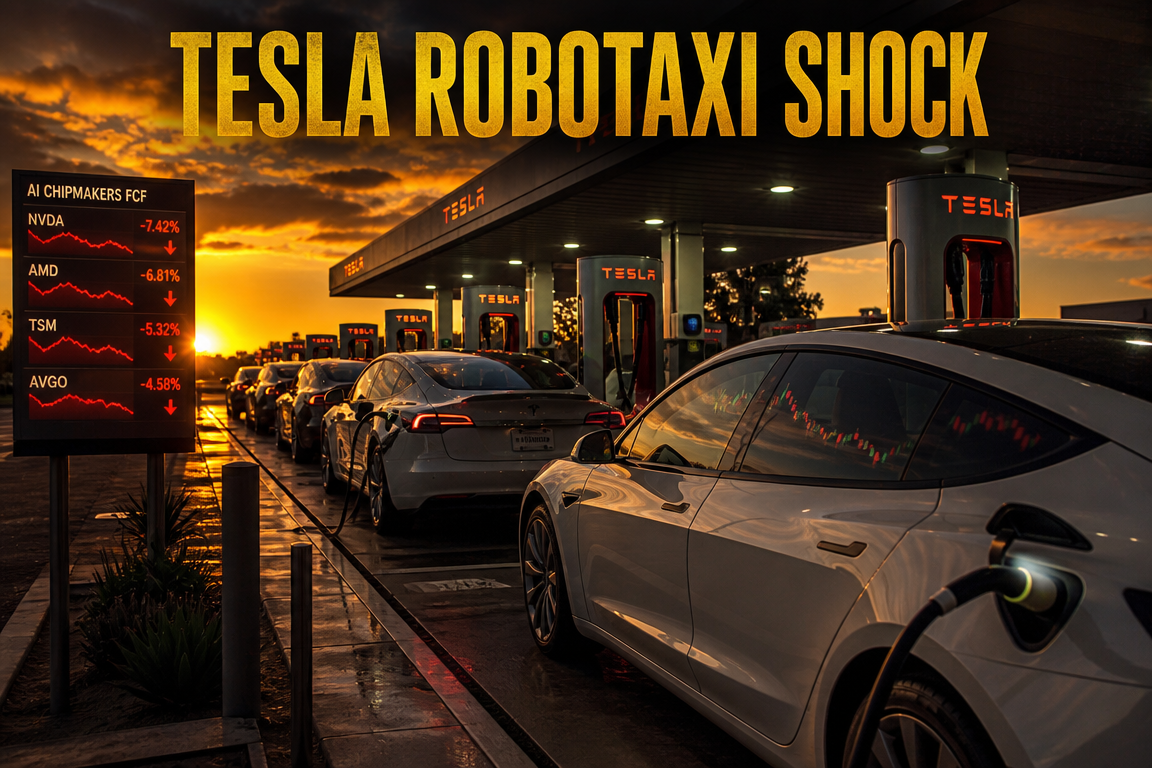
The key catalyst was the new robotaxi-focused charging facility planned in Austin.
In particular, market attention shifted toward the 48-stall Supercharger site and the wireless charging infrastructure reportedly sized for up to 80 vehicles.
Investors appear to be focusing less on how many vehicles regulators approve and more on how much operating infrastructure Tesla is actually building.
1. Tesla’s trading action today: the market was quiet, but Tesla moved sharply higher
Tesla closed at $351.12.
The stock gained 4.23% on the day.
By contrast, major indices were nearly unchanged.
- S&P 500: up about 0.2%
- Nasdaq: up about 0.16%
- Dow Jones: up about 0.2%
That makes it difficult to argue that Tesla rose simply because the broader market was strong.
A more plausible explanation is that investors reacted to a Tesla-specific development.
That said, US rate dynamics also provided some support.
Growth stocks are sensitive to long-term yields.
When rates decline, the present value of future earnings rises, which tends to favor growth names such as Tesla.
2. The US rate backdrop: the Fed was hawkish, but long-term yields declined
A notable feature of this session was the divergence between the FOMC minutes and bond market reaction.
The Federal Reserve’s July minutes were interpreted as relatively hawkish.
Some participants indicated that further rate hikes could be considered if inflation does not decline sufficiently.
Normally, that kind of message would weigh on growth stocks.
However, the US Treasury announced plans to increase long-dated bond purchases to at least double the previous scale, which helped push long-term yields lower.
- US 10-year Treasury yield: around 4.65%
- US 30-year Treasury yield: around 5.2%
This backdrop supported Tesla shares.
Still, lower yields alone do not fully explain Tesla’s outsized move.
The more important factor is that Tesla’s robotaxi strategy is increasingly being reflected not just in permits, but in infrastructure buildout.
3. Las Vegas robotaxi permit: 5,000 requested, only 10 approved
At first glance, there was also negative news for Tesla.
The company applied for a permit to operate a driverless ride-hailing service, or robotaxi, in Las Vegas, requesting authorization for up to 5,000 vehicles in the first year.
However, the approval was reportedly limited to about 10 vehicles.
That is only 0.2% of the requested scale.
The operating conditions are also restrictive.
- Operations limited to designated areas around the Las Vegas Strip
- No passenger service on roads exceeding 45 mph
- No airport pickups
- Human supervision required in some form
These restrictions are meaningful for Tesla’s robotaxi business.
In particular, the ban on airport pickups is a drawback from a revenue perspective.
Airport demand is typically among the most stable and high-value segments in ride-hailing.
That limitation is especially relevant in Las Vegas, where tourist and business travel generate substantial airport traffic.
As a result, initial profitability may remain constrained.
4. Why the stock still rose: the Las Vegas decision was not new
The key point is that the Las Vegas permit decision was already made on July 27.
In other words, the market was not reacting to a newly discovered negative headline.
Instead, investors appeared to focus on new construction filings in Austin, Texas.
The market reaction was driven less by permit count and more by evidence that Tesla is spending capital to support actual operations.
In equities, plans and execution are valued very differently.
Announcements can be delayed.
But once a company leases land, files construction permits, and begins preparing transformers and charging equipment, the story changes.
At that point, the project begins to look like a schedule rather than a concept.
5. The Austin robotaxi charging hub: the main driver behind the move
Tesla reportedly leased a parking-lot site on East St. Elmo Road in Austin.
The location sits directly across from an existing Tesla service center.
Construction filings indicate plans for a dedicated robotaxi charging facility there.
The first phase centers on 48 Supercharger stalls.
Given that a typical urban Tesla Supercharger site often has 8 to 12 stalls, this would be a relatively large installation.
Forty-eight stalls would be roughly four to six times the size of a standard urban charging site.
More importantly, the filings reportedly mention up to 80 wireless chargers.
On a site-wide basis, this points to a charging capacity of roughly 128 vehicles.
- Wired Superchargers: 48
- Wireless chargers: up to 80 mentioned
- Total charging capacity: roughly 128 vehicles
The significance is not simply the number of chargers.
Wireless charging may be a critical component of fully driverless robotaxi operations.
Without a driver, there is no one to connect a charging cable.
If a vehicle is to park autonomously, charge from a floor-mounted pad, and return to service, wireless charging infrastructure becomes essential.
6. Should the 80 wireless chargers be treated as confirmed?
That point should be treated cautiously.
Tesla-focused outlet Teslarati noted that the reference to 80 wireless chargers in the filings may be an error.
There were also comments that the equipment shown in the drawings does not fully match the description.
At present, the following points appear more reliable.
- Tesla is moving forward with a large robotaxi charging facility in Austin
- The plan for 48 wired Superchargers appears relatively clear
- The broader site appears designed for operations at a scale of about 128 vehicles
- The 80 wireless chargers were mentioned in filings, but require further verification
However, investors reacted to the possibility itself.
If wireless charging infrastructure is ultimately confirmed, Tesla’s autonomous vehicle business could move from a pilot phase toward commercial operation.
7. Tesla is preparing not just a charging site, but a driverless vehicle operations base
The Austin filings reportedly include more than chargers.
They also reference transformers, lighting, security cameras, Wi-Fi, and other operational infrastructure.
That combination looks more like a driverless fleet operations base than a conventional EV charging station.
The hardest part of a robotaxi business is not only driving.
Once vehicles run all day, they require charging, cleaning, inspection, software updates, and security management.
Traditional taxis rely on drivers to monitor vehicle condition.
Robotaxis do not have that human layer.
For that reason, city-level operating hubs are likely essential.
The Austin site appears to fit that role.
8. Tesla is also preparing a large service facility in Las Vegas
Tesla is reportedly also preparing a sizable facility in Las Vegas.
A roughly 1,040-square-meter building in the city’s southwest is being converted at an estimated cost of about $3.1 million, or roughly 430 million yen equivalent in the source report.
Local media reported that the facility could include six vehicle lifts and space for eight Superchargers.
That scale may appear excessive if the company only intends to operate about 10 vehicles immediately.
But the picture changes if Tesla originally sought authorization for 5,000 vehicles.
Even with only 10 vehicles approved for now, the company may be building the operational base needed for much broader expansion.
That is important for Tesla’s stock because markets often discount future scalability more than current operating numbers.
9. Tesla’s robotaxi footprint is already extending across multiple cities
The robotaxi-related charging and operations sites currently being discussed span five cities.
- Austin
- Phoenix
- San Antonio
- Dallas
- Las Vegas
This suggests Tesla is not conducting a single-city experiment.
Preparing multiple hubs across several states indicates a strategy designed to scale quickly as regulatory approvals allow.
Autonomous ride-hailing does not expand through software alone.
In practice, it requires charging sites, service facilities, cleaning systems, customer support, insurance, and regulatory coordination.
Tesla’s current effort is therefore not just an app for robotaxi rides, but a city-level operating network for EV charging and autonomous fleet management.
10. Why the Cybercab event and the Austin charging hub are connected
Tesla is also reported to have created an official webpage for a Cybercab-related event.
The page reportedly states that the time, date, and location may change.
Based on the invitation scale, offered benefits, and transportation conditions, the event appears more like a limited on-site presentation than a large-scale launch event.
The venue is Gigafactory Texas in Austin.
That is notable because the new robotaxi charging facility is also being developed in Austin.
The event mechanics are also worth noting.
Each robotaxi ride appears to count as one entry, with no clear limit on the number of rides taken.
In effect, more rides could mean a higher chance of winning.
That structure may not be purely promotional.
Tesla may also be trying to gather more ride data around the Austin robotaxi program before and after the event.
AI driving systems improve with more real-world operating data.
In that sense, the Cybercab event may be designed to serve both marketing and data collection purposes.
11. The market’s reference point has shifted from permits to charger counts
The core of Tesla’s latest move is that investors are now focusing on different metrics.
Previously, the market asked how many vehicles regulators would approve.
On that basis, Las Vegas’s 10-vehicle approval is disappointing.
But this time, the focus shifted to how much infrastructure Tesla is preparing to operate.
With a 128-vehicle charging configuration being discussed in Austin and a larger service facility being prepared in Las Vegas, Tesla is signaling actual execution.
That is what distinguishes Tesla from many other EV companies.
The company is being re-rated not only as a vehicle manufacturer, but also as an AI autonomous driving platform and an EV infrastructure operator.
If robotaxi services become commercially viable, Tesla’s valuation framework could extend beyond automotive manufacturing to include mobility platforms, AI software, and charging infrastructure.
12. The most important point other coverage often misses
The most important point in this story is not the 80-wireless-charger figure itself, but the move to solve the final bottleneck in operational automation.
A driverless robotaxi is not complete simply because it can drive.
It must be able to charge on its own, return to designated sites, enter maintenance and cleaning routines, and then redeploy to areas of demand.
Only when that full process is automated does the business become a true robotaxi operation.
In that sense, the Austin site may function more like a logistics center for robotaxis than a conventional charging station.
Just as Amazon built logistics hubs to enable fast delivery, Tesla appears to be building city-level operating bases for autonomous mobility.
That framework is much more important than short-term permit counts.
The 10-vehicle approval in Las Vegas shows the limits of current regulation.
By contrast, the infrastructure spending in Austin and Las Vegas suggests Tesla is preparing for future expansion.
The market appears to have responded to that future potential.
13. Key checkpoints for Tesla shareholders at the $351 level
With Tesla now trading around $351, the key issue is not the single-day rally itself.
What matters more is whether the following developments are confirmed over time.
- Whether construction on the Austin robotaxi charging hub actually begins
- Whether the 80 wireless chargers are a filing error or a real plan
- Whether the Cybercab event date is formally confirmed
- How quickly ride data accumulates in Austin
- Whether Las Vegas operating restrictions are eased
- Whether other cities such as Phoenix, Dallas, and San Antonio move toward concrete hubs
- Whether lower US rates continue to support growth-stock valuations
If the wireless charging infrastructure is confirmed, expectations for Tesla’s robotaxi and Cybercab business could strengthen further.
Conversely, if the 80-wireless-charger reference turns out to be an error or if construction is delayed, near-term sentiment could weaken.
Accordingly, investors should track not only the stock price, but also construction permits, site leases, charger orders, and regulatory approvals.
14. Investment interpretation
Tesla can no longer be explained solely by EV sales volume.
Investors increasingly view the company as an EV manufacturer, an AI autonomous driving company, a robotaxi platform, and an energy infrastructure operator.
The Austin charging hub news reinforced that re-rating narrative.
At the same time, this remains an early-stage business.
As shown by the 10-vehicle approval in Las Vegas, regulation moves more slowly than expectations.
Full nationwide deployment will require not only technology, but also insurance, safety rules, city-level approvals, and liability frameworks.
Even so, an important shift is evident.
Tesla has begun spending on infrastructure rather than simply talking about it.
The market appears to interpret that as a sign that robotaxi commercialization may be drawing closer.
< Summary >
Tesla closed at $351.12, up 4.23%.
Because the broader market was nearly flat, the move appears to have been driven by Tesla-specific developments.
Las Vegas approved only 10 vehicles out of Tesla’s request for 5,000, which was negative news.
However, that decision was already known and was not the main catalyst for the stock move.
The key development was the robotaxi charging hub planned in Austin.
The reported plan includes 48 Superchargers and the possibility of up to 80 wireless chargers, implying a broader operating infrastructure of roughly 128 vehicles.
Wireless charging is a critical component for fully driverless robotaxi and Cybercab commercialization.
Tesla is also building robotaxi operating hubs in Austin, Las Vegas, Phoenix, San Antonio, and Dallas.
Going forward, the main stock drivers are likely to be construction progress, wireless charging confirmation, Cybercab event timing, and regulatory easing, rather than permit counts alone.
[Related Articles…]
- Robotaxi Infrastructure and EV Charging Buildout Outlook
- Autonomy, AI, and the Next Phase of Mobility Platforms
*Source: [ 오늘의 테슬라 뉴스 ]
– 10대만 허가된 날 테슬라 4.23% 급등 ? — 오스틴에 무선 충전소를 짓습니다, $351 주주는?
● Korea Stocks Crash, Policy Shock, AI Bubble Burst
The Real Reason Korean Equities Cracked Suddenly: Liquidity, AI Semiconductors, the National Pension Service, and Leveraged ETFs Combined to Create a “Policy Risk” Shock
The key issue in this episode was not simply that stock prices had risen and then corrected.
Korean equities rallied sharply in a short period, driven by AI semiconductor expectations, global liquidity expansion, and a surge in single-stock leveraged ETF activity.
However, concerns over National Pension Service rebalancing, a slowdown in the semiconductor cycle, tighter regulation of leveraged products, and tax-oriented capital market policies all hit at once, sharply undermining market confidence.
This correction is important not only because of corporate earnings, but because it represents a clear case of how policy can weaken market sentiment.
Below is a consolidated view of the outlook for Korean equities, the KOSPI, the semiconductor supercycle, the AI investment cycle, and the National Pension Service asset allocation issue.
1. The Starting Point for the Rally in Korean Equities: Three Conditions Behind a “Mini Bubble”
The first point raised in the discussion was that Korean equities formed a kind of mini bubble.
This does not mean the rally was artificial or unsupported by fundamentals.
Rather, it means that genuine positive factors were present, but the market priced them in too quickly and too aggressively.
The first condition was liquidity.
As major economies moved to support growth by easing financial conditions, more capital became available for risk assets.
Expectations of rate cuts, fiscal expansion, and policy support naturally pushed investors toward equities.
Korean equities benefited from this environment.
The second condition was narrative momentum.
Markets require a compelling story about a new growth regime.
In this case, AI semiconductors played that role.
Following ChatGPT, demand for data centers, HBM, GPUs, and AI servers surged, lifting expectations for SK hynix and Samsung Electronics.
Given the large weight of semiconductors in Korean equities, the AI semiconductor story became a broader equity-market thesis for the KOSPI.
The third condition was a new speculative vehicle.
Single-stock leveraged ETFs were identified as a major contributor to volatility.
These products amplify gains in rising markets, but they can also accelerate declines by triggering forced selling and stop-loss behavior.
In other words, they reinforce upside momentum when fundamentals are favorable, but intensify downside moves when sentiment weakens.
2. Why the Market Suddenly Broke Down: The Negative Catalysts Did Not Arrive Sequentially, but Simultaneously
The weakness in Korean equities cannot be explained by a single factor.
It is not enough to cite semiconductor concerns alone, nor is it sufficient to focus only on leveraged ETFs.
The key point is that multiple negative catalysts arrived at roughly the same time.
First, AI semiconductor expectations were priced in too quickly.
Second, single-stock leveraged ETFs concentrated individual investor capital excessively in a small group of leading names.
Third, the National Pension Service rebalancing issue created fears of large-scale selling.
Fourth, government capital market policy was interpreted as more tax-oriented than shareholder-friendly, weakening sentiment.
Fifth, while U.S. equities remained relatively resilient, Korean equities were hit harder, increasing relative underperformance concerns.
In this environment, stock prices can fall even when earnings remain solid.
That is because the market responds more strongly to the rate of change in expectations than to current earnings alone.
Even if AI semiconductor demand remains strong, a slowdown in the pace of growth can lead the market to compress valuations.
3. National Pension Service Controversy: The Market’s Most Sensitive Concern Was Credibility
The discussion strongly criticized the National Pension Service’s equity allocation and rebalancing issue.
The National Pension Service is one of the largest institutional investors in Korea’s capital markets.
As a result, its trading activity is not viewed as a normal portfolio decision, but as a market-wide signal.
The problem was that the market became less able to predict the National Pension Service’s behavior.
If there is a defined equity allocation limit, that rule should be followed.
If the limit changes, the process should be explained clearly and implemented transparently.
However, the discussion argued that the National Pension Service did not adhere properly to its earlier limit and failed to communicate rebalancing decisions adequately.
The original role of the National Pension Service is to help stabilize the market by taking profits during strong rallies and providing support during sharp declines.
But if portfolio adjustment is delayed during the rally and then rebalancing signals appear during a correction, the market may interpret this as the start of large-scale selling.
Whether actual selling occurred is secondary to the fact that the market began to believe it might.
In equity markets, credibility often matters more than numbers.
When institutional rules appear unstable, foreign and domestic investors revisit the discount associated with Korean equities.
This directly conflicts with policy efforts aimed at reducing the Korea discount.
4. Single-Stock Leveraged ETFs: A Rocket in a Rising Market, a Bomb in a Falling Market
Single-stock leveraged ETFs were identified as a key driver of volatility in Korean equities.
When funds flow into leveraged products tied to large-cap stocks, upside moves become amplified.
For investors, this is attractive because it can generate large short-term gains.
The problem appears in the opposite direction.
When prices weaken, leveraged ETFs generate larger losses, prompting investors to sell quickly.
That selling pressure is then transmitted to the underlying stock, which further increases ETF losses and creates a negative feedback loop.
The discussion also referenced the case of the ELW market, which shifted from a mass-market product to a more professional investor base following regulatory tightening.
In this episode as well, higher margin requirements and investor-protection measures reduced the share of single-stock leveraged ETF trading, helping to moderate volatility somewhat.
The decline in their share of total trading value since mid-August was noted as an important observation.
5. Has the Semiconductor Supercycle Ended?: The Issue Is Not Growth, but a Slowing Growth Rate
Many investors are asking the same question:
Has the AI semiconductor cycle ended?
The main conclusion from the discussion was not that the cycle has ended, but that expectations ran ahead of fundamentals and that a slowdown in growth rates may pressure valuations.
Hyperscale companies are still investing heavily in data centers.
Meta, Amazon, Microsoft, Google, and Oracle continue to allocate substantial capital to AI infrastructure.
The discussion noted a trend in which their combined investment scale may rise from about $0.2 trillion in 2024 to about $0.4 trillion in 2025 and about $0.8 trillion in 2026.
That represents an enormous level of spending.
However, markets focus on growth rates, not just absolute spending levels.
If investment doubles every year and then slows to 20-30% growth, and later to the low double digits, the market will interpret that as momentum decay.
Demand can remain strong while stock prices still correct if valuations had already priced in exponential growth.
This is critical for the outlook for Korean equities.
Even if Samsung Electronics and SK hynix continue to deliver strong earnings, share prices can consolidate if the market had expected a faster pace of improvement.
Because the KOSPI is highly sensitive to semiconductor leadership, any slowdown in hyperscaler capex growth must be monitored closely.
6. The More Important Point the Market May Be Missing: AI Investment Is Ultimately a Free Cash Flow Question
A key issue that is less frequently covered in other media is the free cash flow position of hyperscalers.
AI data center investment is still increasing.
However, the market now has to assess whether that spending can be funded through internal cash generation or will require greater debt dependence.
The discussion noted that free cash flow among major U.S. technology companies is under pressure and could move into negative territory for some names.
If AI infrastructure investment is financed increasingly through debt, the market will no longer view it as a one-way growth story.
Rising investment-grade credit spreads would increase funding costs and weigh on technology valuations.
In simple terms, strong AI semiconductor demand does not mean AI investment can expand indefinitely.
When companies can fund investment through earnings, markets reward them.
When they must borrow to continue investing, investors begin to focus on profitability and balance-sheet quality.
This transition could alter the strength of the semiconductor supercycle.
7. A Structural Weakness in Korean Equities: Earnings Are Rising, but How Much Reaches Shareholders?
For Korean equities to be re-rated, higher corporate earnings alone are not enough.
Investors ultimately ask how much of those earnings are returned to shareholders.
When semiconductor companies continue large-scale investment, profits may rise while cash is reinvested into capex.
After accounting for bonuses, R&D, capacity expansion, and new plant investment, the room for dividends and buybacks may remain limited.
At that point, the market asks:
“Earnings are strong, but what changes for shareholders?”
The discussion viewed policy efforts such as revisions to the Commercial Act, dividend tax reform, and measures to prevent share-price suppression as constructive in principle.
However, if spin-off listings, low dividends, and opaque governance practices persist, investors will not see meaningful progress.
Concerns around SK hynix-related subsidiary listing issues and quarterly dividend debates were raised in this context.
Ultimately, reducing the Korea discount requires execution, not just policy language.
Just as important as earnings is how those earnings are shared with shareholders.
8. Policy Assessment: Ninety-Nine Positive Signals Can Be Undone by One Negative Message
The discussion described the policy failure as severe.
The background was that capital market policy initially moved in a positive direction, but investor confidence was damaged at a critical moment.
The direction of policy aimed at reducing the Korea discount, strengthening capital markets, and improving corporate financing efficiency is broadly appropriate.
Commercial law reform, shareholder rights protection, and criticism of spin-off listings are long-standing market concerns.
However, the market also reacted very sensitively to tax-related signals.
Restrictions around ISA accounts, concerns over higher health insurance contributions linked to dividend income, and fears of heavier tax burdens on dividend investors all contributed to the perception that the government was sending mixed messages.
Consistency is the most important principle in capital market policy.
If shareholder-friendly measures are announced while dividend investing appears to become less attractive, the policy impact is weakened.
Investors respond to institutions, and then to actual implementation.
9. KOSPI Outlook: A Rebound Is Possible After the Selloff, but a Return to the Prior High Will Take Time
The outlook for Korean equities in the second half of the year is not straightforward.
A rebound is possible if liquidity improves again.
Volatility may also ease if the share of single-stock leveraged ETF trading continues to decline.
However, several conditions are needed before the previous strong uptrend can resume.
First, concerns about slowing hyperscaler AI investment growth must ease.
Second, expectations for Samsung Electronics and SK hynix earnings must be re-priced positively.
Third, the National Pension Service’s rebalancing principles must become more transparent.
Fourth, the government must send a clearer policy signal in favor of shareholder returns rather than tax expansion.
Fifth, foreign investors need greater institutional confidence in the Korean market.
In practical terms, the most reasonable view is to expect a short-term rebound and a medium-term trading range.
The AI semiconductor cycle has not ended, but the market is unlikely to continue pricing in the same level of growth as before.
Accordingly, the KOSPI is better viewed as entering a phase of policy normalization and earnings confirmation rather than immediate trend acceleration.
10. Key Indicators Investors Should Monitor
First, hyperscaler capex guidance.
The scale of AI data center investment by Meta, Amazon, Microsoft, Google, and Oracle remains the central driver of AI semiconductor demand.
Second, free cash flow among U.S. technology companies.
Whether AI investment is funded internally or requires more debt will be a critical variable.
Third, investment-grade credit spreads.
If funding costs rise in credit markets, AI infrastructure spending may slow.
Fourth, the National Pension Service’s domestic equity allocation and rebalancing framework.
Its role as a stabilizer or a perceived source of selling pressure will materially affect sentiment.
Fifth, policy direction on dividends, ISA accounts, and health insurance contributions.
Policies that reduce the attractiveness of dividend investing could weaken long-term capital inflows.
Sixth, shareholder return policies at Samsung Electronics and SK hynix.
Whether earnings growth translates into dividends, buybacks, and governance reform will be central to reducing the Korea discount.
Final Conclusion
The recent correction in Korean equities was not simply a semiconductor pullback.
It was a multi-factor shock driven by slowing AI investment growth, credibility concerns around the National Pension Service, structural volatility from leveraged ETFs, and negative policy signals centered on taxation.
Much of the media coverage has focused only on semiconductors or leveraged ETFs.
However, the more important issue is how policy and institutions altered market expectations.
Equity markets appear to move on earnings, but in practice they move on trust.
If the government, pension system, and corporations fail to restore investor confidence, Korean equities are likely to remain discounted even when earnings are strong.
At the same time, the opportunity remains.
If the National Pension Service clarifies its investment principles, if policy concerns around dividend investing are eased, and if companies strengthen shareholder returns, Korean equities could be re-rated.
The AI semiconductor theme remains intact.
[Related Articles…]
KOSPI Outlook and Key Volatility Drivers
AI Semiconductor Cycle and Global Data Center Investment Trends
*Source: [ 경제 읽어주는 남자(김광석TV) ]
– “최악의 정책 실패다” 잘나가던 한국 증시, 한순간에 무너진 이유 | 경읽남과 토론합시다 | 3자토론 김대호x홍춘욱x김광석 [3편]