● SK Hynix Shock, Samsung Pressured, SK Securities Soars
Why SK Securities Was the Real Beneficiary of SK Hynix’s KRW 40 Trillion Share Buyback Issue
Today’s market reaction was not simply about “SK Hynix rising.”
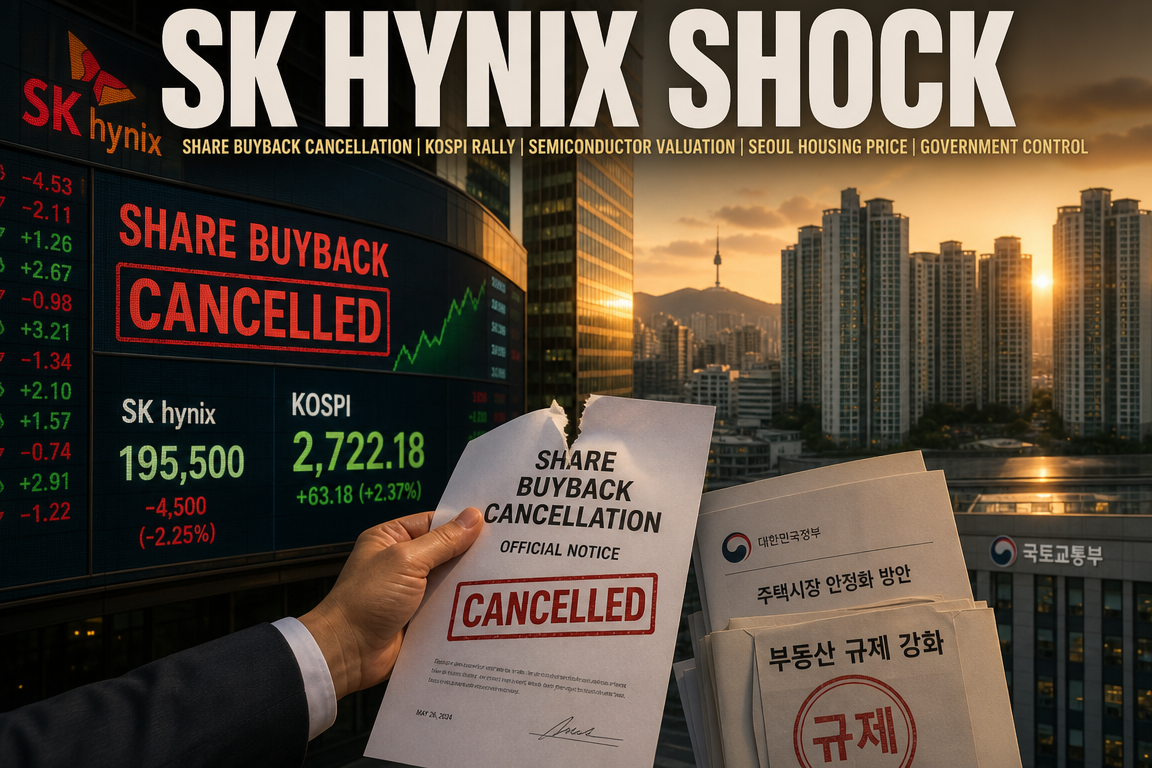
The key point was that SK Hynix’s large-scale share buyback and cancellation announcement lifted overall KOSPI sentiment, while the strongest price reaction came not from SK Hynix, but from SK Securities.
This report examines why SK Hynix’s shareholder return policy affected the market, the significance of JPMorgan’s target price increase, the implications for Samsung Electronics, and the key point that is often overlooked in other coverage.
1. SK Hynix’s buyback issue was the starting point for today’s KOSPI rally
Today’s KOSPI rebound was driven by SK Hynix’s large-scale share buyback and cancellation issue.
The market interpreted the headline as SK Hynix announcing a share repurchase and cancellation plan worth approximately KRW 40 trillion.
A share buyback means a company purchases its own shares in the market.
If those shares are then canceled, the number of shares outstanding declines.
In simple terms, the total number of pizza slices decreases.
If company value is unchanged, the value per remaining share increases.
For this reason, investors generally view share cancellation as a stronger shareholder return measure than a buyback alone.
2. Why the market reacted strongly to the KRW 40 trillion figure
The main reason for the market’s strong reaction was the scale.
The headline referred not to a few hundred billion won, but to a KRW 40 trillion program.
Against the backdrop of a semiconductor upcycle, rising HBM demand, and expanding AI data center investment, the company signaled that it intends to return more cash to shareholders.
In particular, the message that more than 50% of earnings will be used for shareholder returns was a strong signal to the market.
This does not simply imply one-time support for the share price this year.
It suggests that as earnings grow, the company is more likely to continue using dividends, buybacks, and cancellations as shareholder return tools.
For global investors, this is a meaningful development.
One reason Korean equities have long traded at a discount has been relatively low shareholder return ratios.
Accordingly, this announcement can be seen as a catalyst not only for SK Hynix, but also for expectations of reduced Korea discount concerns.
3. How buybacks followed by cancellations affect valuation
A share buyback is the repurchase of a company’s own stock.
A share cancellation permanently removes those shares from circulation.
This reduces the number of shares outstanding.
As the share count declines, earnings per share, or EPS, improves.
If the same price-to-earnings ratio, or PER, is applied, fair value can rise.
For this reason, institutional and foreign investors often interpret share cancellations as a corporate value enhancement event.
When a company with strong cash flow cancels shares, the market tends to read it as evidence that management has confidence in future earnings power.
In SK Hynix’s case, the move was combined with expectations of improving profitability from AI semiconductors and HBM.
4. Why JPMorgan’s target price revision mattered
The upward momentum was also supported by a target price increase from a global investment bank.
The video referenced JPMorgan’s target price of KRW 2.75 million for SK Hynix.
However, target price levels and units may differ depending on the original report, so investors should verify the primary source or filing.
The key point is not the exact number, but that JPMorgan assigned a higher value to SK Hynix’s cash generation and expanded shareholder returns.
For large-cap KOSPI stocks, foreign brokerage research often acts as a short-term catalyst.
In periods of improving semiconductor outlook, a target price increase functions as a buy signal rather than a simple opinion.
This time, improving sentiment was supported by expectations for AI semiconductors, HBM, and memory price recovery.
5. The real standout was not SK Hynix, but SK Securities
The most notable market reaction today was that SK Securities moved much more sharply than SK Hynix.
According to the video, SK Securities was identified as the party handling SK Hynix’s share buyback execution, and the stock hit the upper limit.
This illustrates the complexity of the Korean market.
At first glance, SK Hynix would appear to be the primary beneficiary of a large buyback announcement.
In practice, however, short-term trading flows can shift toward brokers expected to execute the transaction or benefit from related fees.
For a company like SK Securities, which has a relatively small market capitalization and is highly sensitive to news flow, price elasticity can be much stronger than that of a large-cap name.
This shows that the “fundamental beneficiary” and the “short-term flow beneficiary” can differ.
6. The key driver behind SK Securities’ limit-up move was symbolic significance
Some investors may assume that SK Securities’ limit-up move was driven by a very large fee from the buyback mandate.
In reality, the more important factor was symbolic significance rather than fee size.
The market interpreted the fact that SK Securities was linked to a large-scale buyback program of a blue-chip semiconductor company as a strong positive catalyst.
Brokers are typically sensitive to rising trading volume, corporate finance activity, buyback execution, and capital market expansion themes.
Added to that was the connection to the same SK corporate group, which concentrated investor attention.
Thus, SK Securities’ rally was driven less by an immediate change in earnings estimates and more by event-driven expectations and short-term flows.
7. What this means for Samsung Electronics
SK Hynix’s aggressive shareholder return policy may place pressure on Samsung Electronics.
Among Korea’s semiconductor leaders, Samsung Electronics remains the largest by market capitalization.
However, in AI semiconductors and the HBM market, SK Hynix has been re-rated more quickly.
If SK Hynix combines this with large-scale buybacks and cancellations, investors are likely to demand a more active shareholder return policy from Samsung Electronics as well.
Samsung Electronics has substantial cash holdings and stable dividend capacity.
However, from a global investor perspective, measures such as share cancellations, ROE improvement, and shareholder value enhancement can carry a stronger valuation premium than dividends alone.
In that sense, SK Hynix’s move may have an indirect effect on Samsung Electronics’ share price outlook.
8. The significance is broader when viewed through the semiconductor cycle
This event should not be viewed solely as a shareholder return issue.
It is also grounded in the market’s belief that the semiconductor cycle is entering a recovery phase.
AI server investment, HBM supply tightness, memory price recovery, and data center demand are all improving at the same time.
In such an environment, semiconductor companies are likely to see faster cash flow improvement.
When companies start generating stronger cash flow, investors focus on two questions.
First, whether the company can continue to invest for growth.
Second, how much of the cash will be returned to shareholders.
SK Hynix has provided a strong answer to the second question through this announcement.
As a result, this issue may lead not only to a short-term stock reaction, but also to a broader re-rating of Korean semiconductor valuations.
9. The most important point that is often overlooked
The real issue here is not simply that SK Hynix will spend money.
The more important point is that Korea’s large-cap companies are changing their capital allocation behavior.
Historically, Korean companies often retained cash or focused heavily on large-scale capital expenditures even when profits were strong.
In semiconductors, capital investment is of course essential.
However, global investors increasingly expect both growth investment and shareholder returns.
The reason U.S. mega-cap technology companies command high valuations is not only growth, but also their ability to consistently execute buybacks and cancellations using strong cash flow.
If SK Hynix is committing more than 50% of cash flow to shareholder returns, the message is that Korean semiconductor companies may be moving closer to global standards.
This is more important than the short-term limit-up headlines.
10. Key variables investors should monitor
The first factor to confirm is the actual buyback size and timeline.
Even if the announced figure is large, the share price impact will depend on the execution schedule, whether purchases are staggered, and the cancellation timetable.
The second factor is SK Hynix’s free cash flow.
Shareholder returns must ultimately be supported by cash generation to remain sustainable.
HBM revenue, memory pricing, and operating margin improvement will be important.
The third factor is Samsung Electronics’ response.
SK Hynix’s stronger shareholder return policy could pressure Samsung Electronics to adopt a similar approach.
The fourth factor is foreign investor flow.
KOSPI large-cap semiconductor stocks can move sharply depending on foreign trading activity.
The fifth factor is whether SK Securities’ surge leads to any sustained earnings contribution.
Although SK Securities rose strongly on the event, investors should later verify actual profit contribution and trading volume trends.
11. Why SK Hynix and SK Securities should be analyzed separately
For SK Hynix, the core drivers are the semiconductor cycle, HBM competitiveness, AI investment trends, and shareholder return policy.
From a medium- to long-term perspective, both earnings and valuation must be considered.
By contrast, SK Securities displayed a more event-driven, short-term trading profile in this episode.
Although both names were linked to the same catalyst, the investment cases are fundamentally different.
SK Hynix is a matter of corporate value re-rating.
SK Securities is a matter of event-driven flow and short-term speculation.
Failing to distinguish between the two can lead to inappropriate risk-taking.
12. What this means for the broader KOSPI market
This SK Hynix issue also sends a positive signal to the broader KOSPI market.
For Korean equities to escape persistent undervaluation, strong earnings alone are not enough.
How companies distribute those earnings also matters.
Buybacks, share cancellations, dividend increases, and ROE improvement are likely to become central themes in the KOSPI value-up narrative.
Government value-up initiatives will also require changes in corporate capital allocation to be effective.
In that context, SK Hynix’s move may also influence large-cap names in financials, holding companies, autos, and batteries.
13. Short-term overheating should be monitored
That said, investors should be cautious about chasing the move simply because the stock price rose sharply today.
In particular, names such as SK Securities that hit the upper limit may face high volatility in the next session.
Stronger catalysts can also lead to faster profit-taking.
SK Hynix is constructive from a long-term perspective, but further upside must be justified by actual earnings and cash flow performance.
Investors should review regulatory filings, original research reports, and buyback execution details rather than relying only on headlines.
< Summary >
SK Hynix’s KRW 40 trillion share buyback and cancellation issue drove the KOSPI rally.
Share cancellation reduces the number of shares outstanding and supports the value of remaining shares.
JPMorgan’s target price revision and expectations that more than 50% of cash flow will be returned to shareholders supported sentiment.
However, the strongest price reaction came not from SK Hynix, but from SK Securities, which was highlighted as a buyback execution beneficiary.
The key takeaway is that Korea’s semiconductor companies are moving toward a more global shareholder return framework.
This may increase pressure on Samsung Electronics to expand its own shareholder returns and support broader KOSPI value-up expectations.
At the same time, SK Securities may face short-term overheating risk, while SK Hynix still needs actual cash flow and buyback execution to sustain the move.
[Related Articles…]
SK Hynix Shareholder Return and Semiconductor Outlook
HBM Cycle and AI Data Center Investment Trends
*Source: [ 내일은 투자왕 – 김단테 ]
– 40조 축포의 진정한 주인공 #하이닉스 #삼성전자 #SK증권
● Government vs Market, Seoul Housing Battle, 99 Percent Impossible or 99 Percent Controlled
Can Housing Prices Be Controlled by the Government? Key Takeaways from a Three-Way Debate on Real Estate Policy: “99% Possible vs. 99% Impossible”
The core issue in this debate was not simply whether housing prices would rise or fall.
The real point of contention was whether the government can control the property market, or whether interest rates, liquidity, and market sentiment are more powerful forces.
In particular, the discussion brought together the key variables that matter most when assessing the current housing outlook: Seoul apartment prices, housing supply, lending restrictions, price caps on new homes, and rental-market stress.
In summary, the three speakers held sharply different views.
Kim In-man argued that, in practical terms, it is 99% difficult for the government to control housing prices.
Han Mun-do argued that the government could control prices if it truly wanted to, but has chosen not to.
Kim Gwang-seok took a middle position, noting that policy matters, but broader macroeconomic trends can outweigh policy measures alone.
The following is a news-style summary of the main points.
1. The Starting Point: Is Government Intervention Excessive or Limited?
The first question was whether current government intervention in the property market is excessive.
Kim In-man said intervention is extensive.
However, he described it not merely as extensive intervention, but as intervention that has lost policy identity.
In other words, many measures are being introduced, but the policy objective is unclear.
It is not obvious whether the goal is to restrain prices, support transactions, expand supply, or protect end users.
The most dangerous policy in real estate is not a strong policy, but a policy whose intent the market does not believe.
Once market participants begin to doubt whether the government genuinely wants to curb prices, the effectiveness of lending restrictions and tax policy weakens.
2. Kim In-man’s View: It Is Realistically Very Hard for the Government to Control Housing Prices
Kim In-man argued that the claim that the government can control housing prices is highly idealistic.
Policy can influence the market, but maintaining long-term price stability is close to impossible in practice, he said.
He first pointed to the supply expansion under the Roh Tae-woo administration, especially the first-generation new towns and the 2 million-unit housing plan.
The Roh administration significantly expanded supply while also suppressing demand.
At that time, the first-generation new towns were developed very quickly.
The plan was announced around 1988, and actual move-ins began in 1992 to 1993.
By current standards, such execution speed is almost impossible.
Today, even the third-generation new town program faces a structure of land compensation, local resistance, litigation, approvals, and construction-cost issues, making the process take more than 10 years.
Kim In-man emphasized that this difference is critical.
3. The Roh Tae-woo Case: Supply Shock and Demand Restraint Worked Together
The stabilization of housing prices under the Roh administration cannot be explained by supply expansion alone.
Supply growth and demand restraint operated simultaneously.
For example, the capital gains tax exemption for a single-home owner was far stricter than it is today.
Today, the general rule is two years of ownership, and two years of residence in regulated areas, but at that time the requirement was three years of residence and five years of ownership.
Strong measures such as land public ownership principles were also introduced.
If the current government were to fully revive a land-public-ownership framework, political resistance would be substantial, but that policy environment existed at the time.
As a result, supply increased while investment demand was suppressed.
This combination led to housing-price stabilization, and some argued that no major policy response was needed even into the Kim Young-sam administration.
Kim In-man acknowledged this case, but stressed that the same approach is difficult today.
He argued that new-town supply now moves slowly, aggressive tax policy triggers public backlash, and political leadership cannot sustain such measures consistently over a long period.
4. Kim In-man’s Core Argument: Seoul Is a Structurally Supply-Deficient Market
Kim In-man identified the main feature of the Seoul housing market as structural demand excess.
Jobs, education, transportation, healthcare, and cultural infrastructure are concentrated in Seoul.
He suggested that even annual supply of 50,000 units in Seoul could still be insufficient.
This does not mean supply is irrelevant.
It means that because demand in Seoul is so strong, ordinary supply policy alone cannot lower prices over the long term.
In his view, Seoul apartment prices are not merely a housing issue, but a result of job concentration, income disparity, metropolitan centralization, educational infrastructure, and asset preference.
Accordingly, a policy-only approach to controlling prices may underestimate the structural nature of the market.
5. Han Mun-do’s View: The Government Can Control Housing Prices, but Chooses Not To
Han Mun-do took the opposite view.
He argued that if the government applies strong intent and the right policy mix, it can control housing prices.
His criticism was that the issue is not an inability to control prices, but a refusal to do so.
He first cited Japan.
Japan did not merely curb a property bubble; it also experienced a severe market collapse under strong total loan regulation and financial tightening.
Japan’s case also involved broader macroeconomic factors, including U.S.-Japan interest rates, exchange rates, and adjustments in the value of the yen.
Nevertheless, Han argued that government policy clearly delivered a decisive shock to the market.
In other words, strong financial policy and lending restrictions can materially move the property market.
6. Han Mun-do’s Key Case 1: The Roh Tae-woo Administration Did Control Prices
Han Mun-do also viewed the Roh Tae-woo administration as a major example.
At that time, Seoul’s population was growing rapidly.
The rental market was under severe pressure.
The extension of tenant protection from one year to two years was also driven by surging deposit prices and housing instability.
In that environment, the government aggressively pursued a supply plan of 1 million to 2 million units, and market sentiment began to shift once actual construction became visible.
In real estate, numbers matter, but so does belief that supply will actually materialize.
Han argued that this change in sentiment helped keep prices stable for roughly nine years, from 1990 until the Asian financial crisis.
7. Han Mun-do’s Key Case 2: The MB Administration’s Public Housing and Price Shock
Han Mun-do also cited the Lee Myung-bak administration.
Although the global financial crisis was an external factor, he argued that policy helped prevent a rapid rebound in Seoul housing prices.
The MB administration used stimulus measures in regional areas, such as tax incentives for purchasing unsold homes, while in Seoul and core metropolitan areas it introduced public housing programs with lower price points.
At a time when Gangnam-area apartments were trading around 900 million to 1 billion won, the prospect of public housing priced at around 10 million won per pyeong changed buyer behavior.
Potential buyers often postponed purchases of existing homes when lower-priced public supply appeared likely.
Han argued that price caps and public housing can alter market expectations.
8. Han Mun-do’s Strongest Critique: Who Benefits from More Lending?
Han Mun-do’s sharpest point concerned the structure of credit expansion.
He argued that while more lending appears to help end users, in practice banks, builders, and existing property owners often benefit more.
The government provides guarantees, banks earn interest, and builders profit from sales.
Meanwhile, buyers assume larger debt burdens.
As a result, households without assets face higher prices and greater leverage, widening inequality.
He also criticized the housing supply system for relying too heavily on government guarantees and project financing leverage.
Korea’s construction model does not rely solely on equity; it is designed around government-backed financing and leverage to make projects viable.
For that reason, how the government structures guarantees and credit conditions can significantly affect both supply and prices.
9. Han Mun-do’s Conclusion: If the Government Builds Trust, the Market Will Wait
Han Mun-do argued that controlling housing prices requires more than simply tightening credit.
He said lending restrictions must be paired with a credible supply plan.
If the government can specify where, at what price, and by when homes will be supplied, buyers may choose to wait.
By contrast, if lending is tightened and then loosened again under political pressure, the market loses faith in the government.
He also criticized political actors for prioritizing current interest groups over future generations in housing policy.
His conclusion was clear:
If price caps on new homes, strict lending controls, public-interest supply, and consistent policy credibility are combined, housing prices can be controlled.
However, politics has not been willing to apply those measures fully.
10. Kim Gwang-seok’s View: Policy Matters, but Macroeconomic Trends Are Harder to Override
Kim Gwang-seok offered a macroeconomic perspective between the two positions.
He agreed that policy affects housing prices.
However, housing prices are not determined by policy alone.
Households, companies, investors, financial institutions, global interest rates, U.S. monetary policy, liquidity, and the business cycle all interact.
For that reason, real estate policy is only one factor among many, not an absolute variable that can fully control prices.
He compared policy to tides and waves.
Using a bucket to remove water does not turn a strong incoming tide into an outgoing one.
Policy can alter the slope or speed of the wave, but not reverse a large macroeconomic current.
11. The 2020-2021 Housing Boom Was Not Unique to Korea
Kim Gwang-seok argued that the price surge during 2020 and 2021 under the Moon Jae-in administration cannot be explained simply as a policy failure.
At that time, the world was in a zero-interest-rate and large-liquidity environment.
After COVID-19, governments and central banks around the world injected large amounts of money to prevent a recession.
As a result, asset prices rose across equities, housing, and digital assets.
Housing prices increased not only in Korea, but also in the United States, Canada, Australia, New Zealand, and major European markets.
Kim argued that Moon administration policy was not designed to push prices higher, and in fact worked in the opposite direction, but global liquidity was stronger than domestic policy.
In his view, the environment made it difficult for any policy to fully block upward pressure.
12. The 2022-2023 Price Decline Was Also Not Purely a Policy Result
Likewise, the decline in housing prices in 2022 and 2023 was driven more by global interest-rate hikes than by policy success under the Yoon Suk-yeol administration.
At that time, the world was facing the highest inflation in 40 years.
The U.S. Federal Reserve and other major central banks raised rates rapidly, and Korea could not avoid a high-rate environment.
Higher interest rates increase mortgage burdens.
Borrowing capacity also falls.
Investment demand weakens, and end users delay purchases.
In that environment, the property market naturally corrected.
Kim described this as a period in which market forces outweighed policy.
13. The Three Views in One Sentence
Kim In-man: Policy can affect prices, but in the current era it is difficult to control them over the long term.
Han Mun-do: If the government applies strong and consistent policy, prices can be controlled, but politics is failing to do so.
Kim Gwang-seok: Policy matters, but when macroeconomic forces such as interest rates and liquidity are stronger, policy has limits.
Taken together, these views provide the main framework for reading the current housing market.
Housing prices do not move on policy alone.
But policy is not irrelevant either.
The key question is whether policy, supply, finance, sentiment, and macroeconomic conditions are moving in the same direction.
14. Five Variables Most Important for the Current Property Outlook
First, interest rates.
Lower rates reduce mortgage burdens and can improve buyer sentiment.
By contrast, if rates stay elevated for a prolonged period, purchasing power remains constrained.
The direction of policy rates is the most important variable in the current outlook.
Second, liquidity.
When more money is circulating in the system, capital tends to move into asset markets.
As in 2020-2021, an expansion in liquidity can make it difficult for policy alone to suppress prices.
Third, housing supply.
Supply is meaningful only when it translates into actual starts and move-ins, not just announcements.
Markets respond to visible incoming inventory, not to distant planning claims.
Fourth, lending restrictions.
Lending rules directly constrain buying power.
However, if they are loosened after being tightened, policy credibility weakens and the market may expect a retreat.
Fifth, Seoul concentration.
Seoul apartment prices are not merely a housing issue.
Because jobs, education, transportation, income, and asset demand are concentrated in the capital, supply expansion alone is unlikely to solve the problem.
15. The Most Important Point Often Missed in Other Coverage
The most important takeaway from this debate is not whether prices can be controlled, but that policy credibility moves market prices.
Many reports focus only on lending restrictions, taxes, and supply numbers.
In practice, however, the market is more sensitive to the government’s sincerity and consistency than to raw figures.
When the government tightens lending, the market initially reacts cautiously.
But if buyers believe that restrictions will be reversed within months under public pressure, they do not wait and simply re-enter the market.
The same is true for supply.
If the government announces 1 million units but the market believes they will not be delivered for 10 years, the stabilizing effect is limited.
By contrast, when actual construction, pricing, and move-in schedules become visible, sentiment can shift quickly.
In other words, the essence of property policy is not announcement, but credible execution.
This is the key point often missed in most real estate news and online commentary.
16. The Realistic Conditions for Price Stability: Three Factors Must Align
Stabilizing housing prices requires more than a single policy tool.
Three conditions are needed at the same time.
First, lending restrictions must remain consistent.
During overheated periods, borrowing-based speculative demand needs to be reduced.
However, if credit is restricted without end-user protection, transaction freezes and rental stress can worsen.
Second, supply must be managed by actual move-ins, not announcements.
Announcements without delivery have little stabilizing effect.
For Seoul and the wider metro area, location credibility matters.
Third, expectations for new-home prices must be moderated.
If new-home prices keep rising, existing-home prices are supported.
Public housing, price caps, and land-rent models can help reset price expectations.
At the same time, overly low prices can create side effects such as lottery-like subscription demand, lower supply incentives, and fiscal pressure.
17. What to Watch in the Seoul Housing Market
When assessing Seoul housing, the issue is not simply whether the government can control prices.
The following factors should be monitored together.
1. The timing and pace of U.S. rate cuts
If U.S. rates fall, downward pressure may build for Korean rates as well.
This would affect mortgage rates and buyer sentiment.
2. Move-in volume in core Seoul districts
Supply signals in core demand areas such as Gangnam, Mapo, Yongsan, Yeouido, Mok-dong, and Seongsu matter more than supply in outer Seoul or regional markets.
3. Rental-price trends
Rising rents can lift sale prices by pushing renters toward purchase.
Rental shortages may accelerate conversion to ownership demand.
4. Whether lending restrictions are maintained
Any easing in DSR, LTV, or policy-loan conditions may be interpreted as an immediate signal of renewed liquidity.
5. Construction costs and new-home pricing
If construction costs continue to rise, it will remain difficult for new-home prices to fall.
High new-home prices can support existing-home valuations.
18. Investment Interpretation of the Debate
For non-homeowners, waiting on the assumption that the government will solve the housing market may be risky.
Interest-rate and liquidity cycles can overpower policy.
At the same time, owners and investors should not assume that Seoul prices will always rise.
If lending restrictions remain tight, supply credibility improves, and rates stay high, the market can still correct.
The key issue is not direction alone, but the combination of conditions.
If rates fall, credit eases, supply is delayed, and rents rise, upward pressure increases.
If rates stay high, credit remains tight, actual move-in volumes increase, and new-home prices soften, stabilization pressure strengthens.
The property market moves on combinations of conditions, not on political slogans.
19. Final Conclusion: The Government Can Regulate Prices, but Cannot Fully Dominate Them Alone
The most balanced conclusion from this debate is as follows.
The government can influence housing prices.
Lending restrictions, taxes, price caps on new homes, public housing, and supply policy all affect the market.
However, the government cannot fully dominate housing prices.
When global interest rates, liquidity, and the business cycle move strongly, policy effectiveness can be limited.
By contrast, when the macroeconomic environment is neutral, government policy can have a much larger effect.
Ultimately, the key to housing-price stability is not a single strong policy, but a combination of consistent policy credibility, actual supply, financial management, and the macroeconomic cycle.
And in the current market, what matters most is not the government’s announcement, but whether the market believes it.
< Summary >
This debate centered on three competing views of whether the government can control housing prices.
Kim In-man argued that in the current era, it is difficult for the government to control prices over the long term.
Han Mun-do argued that housing prices can be controlled if lending restrictions, price caps on new homes, and public supply are applied properly, but criticized politics for failing to do so.
Kim Gwang-seok explained that while policy matters, it has limits when macroeconomic forces such as interest rates and liquidity are stronger.
The key point is that housing prices are not determined by policy alone.
Going forward, interest rates, lending restrictions, housing supply, rental-market stress, and Seoul’s concentration structure must all be assessed together.
The most important factor is not the intensity of policy, but whether the market trusts it.
[Related Articles…]
2026 Economic Outlook: Rate Shift and Asset Market Scenarios
Seoul Housing Outlook and How Lending Rules Are Reshaping the Market
*Source: [ 경제 읽어주는 남자(김광석TV) ]
– 집값 잡기 99% 가능 vs 99% 불가능…전문가 3인 제대로 붙었다 | 경읽남과 토론합시다 | 3자토론 김인만x한문도x김광석 [1편]