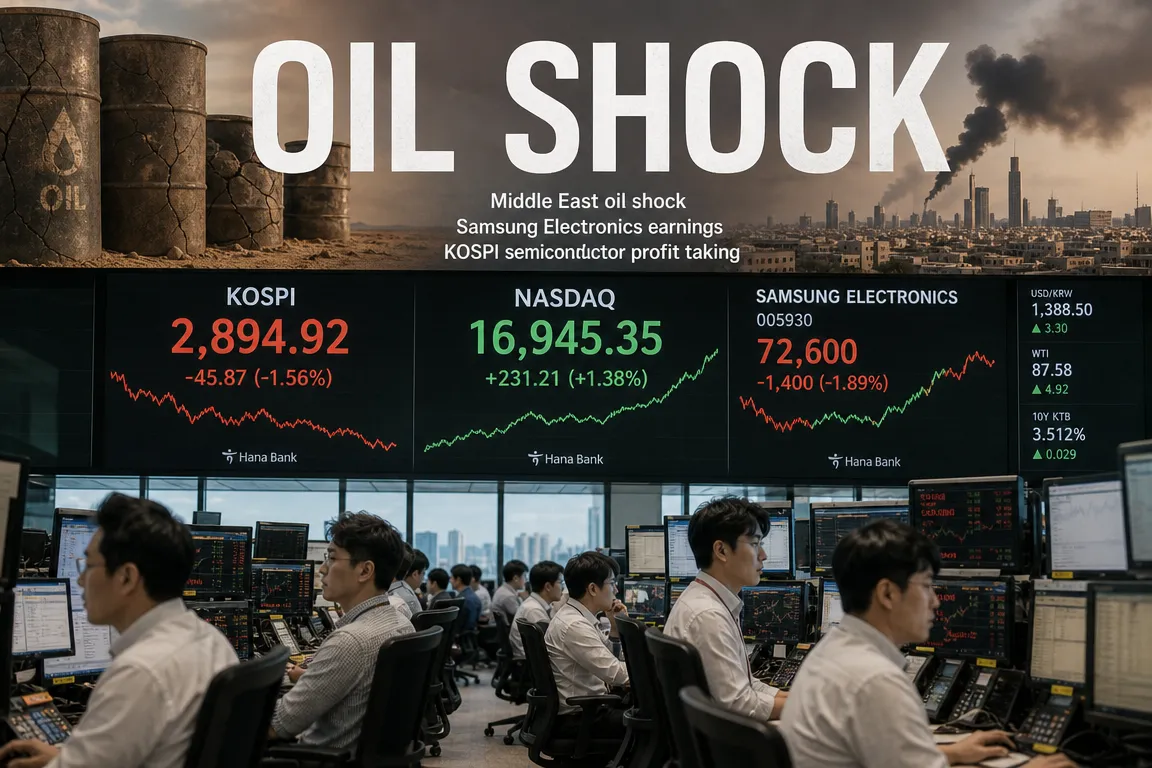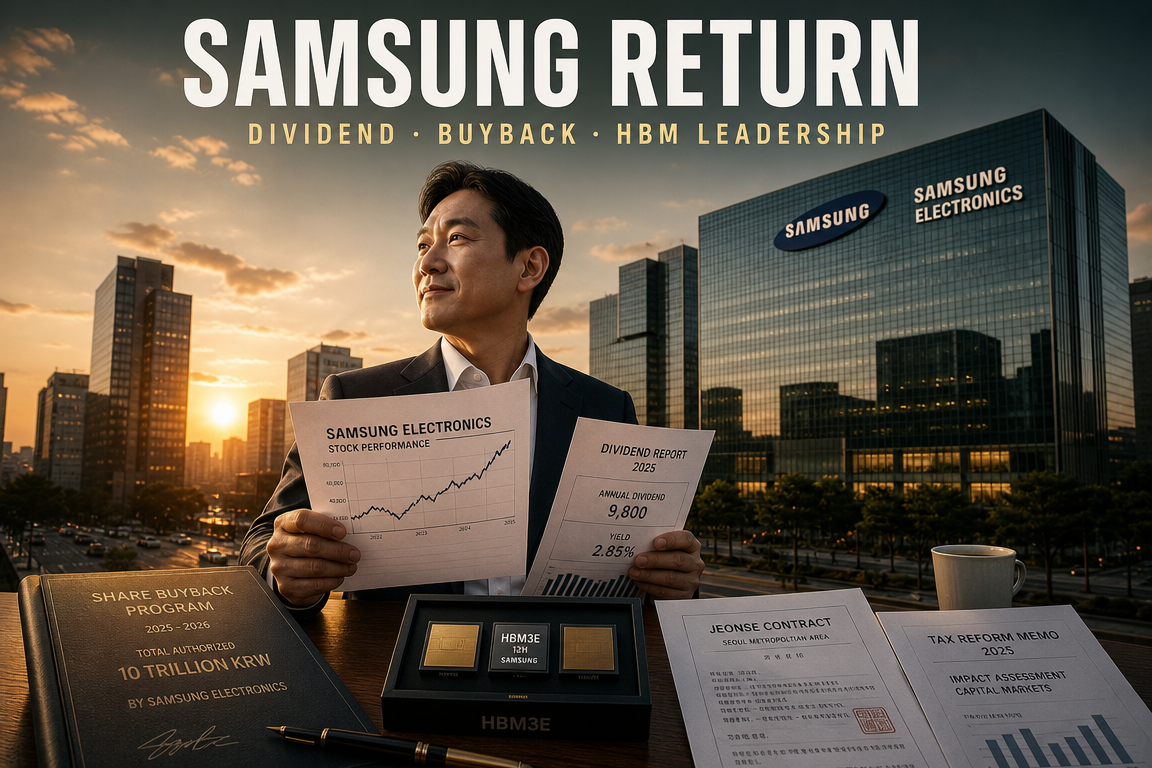
● Samsung Slumps, Buyback Shock, FCF Letdown
Samsung Electronics Shareholder Return Disappointment and the Real Reason the Stock Gave Back Its Gains
This Samsung Electronics issue is not simply a matter of “shareholder returns being too small.”
The key point is that the company’s announced shareholder return policy simultaneously raised concerns about its free cash flow calculation method, absence of share buybacks, relative weakness versus SK Hynix, and burden from financial holding company regulations.
In particular, as the AI semiconductor cycle reopens, investors were expecting Samsung Electronics to present a more aggressive shareholder-friendly policy, but the announcement was interpreted as more conservative than the market had anticipated.
That is why Samsung Electronics, after rising sharply intraday, ended up giving back most of its gains.
1. Today’s Market Reaction: Why Did Samsung Electronics Reverse So Suddenly?
Samsung Electronics recently announced its shareholder return plan.
The market had expected a more aggressive capital return stance, supported by the semiconductor upcycle, rising AI memory demand, and intensifying HBM competition.
However, investor reaction after the announcement was weaker than expected.
The stock initially moved higher, but after investors reviewed the policy details, it gave back most of its gains.
On the surface, the total amount of shareholder return did not deviate significantly from market expectations.
Based on the original disclosure, the annual shareholder return is interpreted at approximately KRW 9 trillion to 11 trillion, with about KRW 3 trillion already executed.
In other words, the disappointment was not primarily about the total size, but about the quality of the return policy.
2. The Core Issue: Why Did Samsung Electronics Fall Short of Market Expectations?
The most important line in the announcement was the principle of using “50% of future free cash flow for shareholder returns.”
At first glance, this appears reasonable.
It implies that half of the company’s cash generation will be returned to shareholders.
However, the issue lies in the comparison.
SK Hynix stated a policy of returning “50% or more” of free cash flow.
Samsung Electronics, by contrast, specified “50%.”
For investors, that distinction matters.
“50%” can be read as a ceiling.
By contrast, “50% or more” leaves room for higher returns when business conditions improve.
In an AI semiconductor investment cycle where cash generation may strengthen, the market tends to prefer a more flexible and more aggressive shareholder return framework.
3. A More Important Constraint: The Free Cash Flow Calculation Is Conservative
The most important point in this issue is not the payout ratio itself, but how free cash flow is calculated.
Samsung Electronics indicated that certain items will be excluded or deducted in the future free cash flow calculation.
The two key points in the original text are as follows.
First, advance payments received under LTA arrangements will be excluded from free cash flow.
Second, employee performance-related expenses will be deducted.
LTA refers to advance payments related to long-term supply agreements.
As AI semiconductors, memory, and HBM supply contracts expand, advance cash received from customers may increase.
If such cash is excluded from free cash flow, the cash base used for shareholder returns becomes smaller.
Put simply, even if the company generates substantial cash, the amount deemed distributable under the return formula may be lower.
As a result, even a “50% of free cash flow” policy may translate into a smaller realized return than investors expected.
This is the real reason the market was disappointed.
Investors do not focus only on dividends; they also focus on how much cash will be returned when future cash generation improves.
If the calculation method is conservative, expectations for shareholder returns are naturally reduced.
4. The Absence of a Clear Share Buyback Message Was Also a Negative
Another disappointing aspect of the announcement was the lack of a concrete message on share repurchases.
In the market today, buybacks and cancellations are often viewed as a stronger signal than dividends alone.
For a company believed to be undervalued, buybacks can support both the stock price and per-share value.
One reason SK Hynix’s shareholder return policy was received positively is that it offered more than just higher dividends.
It also included a mechanism that could directly support market demand for the stock.
Samsung Electronics, by contrast, did not provide the level of clarity investors had expected on buybacks.
For a company of Samsung Electronics’ scale, the direct market impact of buybacks may be limited.
Even so, they carry significant weight in investor sentiment.
They are a strong signal that management views the stock as undervalued.
5. Why Samsung Electronics Cannot Easily Announce Buybacks
There is an important structural issue here.
That issue is the Samsung Electronics shareholdings held by Samsung Life Insurance and Samsung Fire & Marine Insurance.
Due to financial holding company regulations, there are limits on how much Samsung Electronics stock financial affiliates can hold.
The original text noted that Samsung Life Insurance and Samsung Fire & Marine Insurance may not be able to exceed a 10% holding ratio in Samsung Electronics.
If Samsung Electronics repurchases and cancels shares, the total share count declines.
As a result, existing shareholders’ ownership percentages automatically rise.
That could mechanically increase the ownership ratios of Samsung Life Insurance and Samsung Fire & Marine Insurance as well.
This creates the potential for a regulatory issue.
Because of this structure, Samsung Electronics cannot easily announce an aggressive buyback and cancellation program in the same way SK Hynix can.
That is frustrating for shareholders, but given the combination of group governance and financial regulation, it is not a simple matter.
6. Differences in Shareholder Return Policies Between Samsung Electronics and SK Hynix
This issue highlighted the difference in shareholder return policies between Samsung Electronics and SK Hynix.
Both companies are positioned to benefit from the recovery in AI semiconductors and memory demand.
However, investor perception of shareholder-friendliness has differed.
SK Hynix has established a strong presence in the HBM market.
Combined with the “50% or more” language and expectations for buybacks, it presented a more aggressive stance to investors.
Samsung Electronics remains a much larger and more financially stable company.
However, because its shareholder return policy was read as comparatively conservative, the market reacted with disappointment.
What investors want now is not stability alone.
They want clarity on how much cash generated during the AI investment cycle will be shared with shareholders.
7. Samsung Electronics’ Dilemma in the AI Semiconductor Cycle
Samsung Electronics cannot simply return all available cash to shareholders.
That is because the company is simultaneously investing in AI servers, HBM, foundry operations, and advanced process technologies.
As the semiconductor cycle improves, investment needs also rise.
In AI semiconductors, the timing of capacity expansion and technology investment is critical.
From Samsung Electronics’ perspective, it must manage cash conservatively to account for major capex and R&D spending.
If it becomes too aggressive with shareholder returns, future competitiveness could be affected.
Conversely, if it is too conservative, the stock’s appeal in the Korea equity market may weaken.
This is Samsung Electronics’ dilemma.
The company must invest in AI semiconductor growth while also meeting the market’s demand for shareholder value creation.
8. The Most Important Points Often Missed in Other Coverage
First, the disappointment came from the formula, not the number.
The total shareholder return may not have differed significantly from expectations.
However, if free cash flow is calculated conservatively, the future capacity for shareholder return may appear smaller than it really is.
That is what investors focused on.
Second, “50%” and “50% or more” are not equivalent messages.
Although it may look like a small wording difference, the market interprets it as a signal of management’s stance.
“50%” reads as defensive, while “50% or more” reads as more shareholder-friendly.
Third, the absence of buybacks is not just a policy choice.
Samsung Electronics faces structural limits due to governance and financial holding regulations.
This structural constraint may act as a valuation discount factor.
Fourth, an AI semiconductor boom does not automatically translate into higher shareholder returns.
AI demand may improve revenue and cash flow.
However, if HBM, foundry, and advanced packaging investments also rise, actual distributable cash may remain constrained.
Fifth, Samsung Electronics’ stock is becoming more sensitive to shareholder return credibility, not just earnings.
In the past, a better semiconductor cycle was enough to lift the stock.
Today, global investors also evaluate dividends, buybacks, and capital allocation policy.
9. Key Monitoring Points for Investors
The first is free cash flow.
What matters is not only how much cash Samsung Electronics generates, but also how much of that cash is recognized in the shareholder return framework.
The second is HBM competitiveness.
If Samsung Electronics narrows the gap with SK Hynix in the AI semiconductor market, re-rating potential could increase.
However, if the shareholder return policy remains conservative, upside momentum may be limited.
The third is the possibility of buybacks.
If Samsung Electronics can address regulatory constraints or open the door to buybacks and cancellations through another mechanism, market reaction could improve.
The fourth is the predictability of the dividend policy.
Global long-term investors prefer consistent and predictable capital returns over one-time distributions.
The more clearly Samsung Electronics defines its dividend policy, the stronger its investment case may become.
The fifth is overall Korea market liquidity and sentiment.
Samsung Electronics is the benchmark stock in the Korea market.
Disappointment in its shareholder return policy affects not only the company itself, but also broader expectations for Korea’s valuation-up initiatives.
10. Conclusion: Samsung Electronics Needs a Stronger Message, Not Just a Larger Number
The reason this shareholder return announcement was disappointing is not that the amount was objectively too small.
The market wanted a stronger shareholder-friendly message aligned with the AI semiconductor era.
Instead, the announcement was interpreted as signaling continued conservatism in cash management.
Samsung Electronics’ position is understandable.
The semiconductor cycle is improving, but competition is intensifying.
It cannot ignore investment in HBM, foundry operations, advanced packaging, and AI server memory.
However, from the investor’s perspective, the situation is different.
For Samsung Electronics to re-establish a strong position in the global AI supply chain, it must show not only earnings recovery, but also credibility in shareholder value creation.
Going forward, Samsung Electronics’ stock is likely to respond more strongly to how much future free cash flow is returned to shareholders than to semiconductor cycle improvement alone.
< Summary >
Samsung Electronics gave back its gains because investors were disappointed by the shareholder return policy.
The total return amount was not meaningfully different from market expectations, but the free cash flow calculation was interpreted as conservative.
SK Hynix used the phrase “50% or more,” while Samsung Electronics used “50%,” which was viewed as a more limited signal.
The lack of a clear share buyback message also disappointed investors.
The holdings of Samsung Life Insurance and Samsung Fire & Marine Insurance, together with financial holding company regulations, make buybacks more difficult for Samsung Electronics.
Even if the AI semiconductor cycle improves, major investment needs may limit the extent of shareholder returns.
The main investment factors for Samsung Electronics now are semiconductor demand, HBM competitiveness, free cash flow, buyback potential, and shareholder return credibility.
[Related Articles…]
- Samsung Electronics Shareholder Return Policy and Stock Outlook
- SK Hynix Buybacks and AI Semiconductor Investment Strategy
*Source: [ 내일은 투자왕 – 김단테 ]
– 삼전 주주환원 실망스러운 이유 #삼성전자 #하이닉스 #주주환원
● Lease Shock, Tax Storm, Rent Crisis
Why a Tax Reform Could Trigger the Jeonse Market Before Affecting Home Prices
The central issue in this dispute is not simply that taxes on homeowners will rise.
The key point is that the reform could affect the jeonse market, rental housing supply, long-term holding tax benefits, and non-occupying single-homeowners before it produces any stabilizing effect on home prices.
In the debate, there was strong concern that a policy framed as “fair taxation” could, in practice, lead to a jeonse squeeze, higher monthly rents, tighter listings, and reduced rental housing supply.
When assessing housing policy, home price expectations alone provide only a partial view.
At this stage, the more relevant question is not who pays the tax initially, but who ultimately bears the burden.
1. Key issues in the tax reform debate
The debate focused on four main issues.
- Whether it is appropriate to distinguish between occupying and non-occupying single-homeowners
- Whether the concept of “fair taxation” is consistent with core tax principles
- Whether taxes should be raised before stabilizing the jeonse market
- Whether a tax reform without supply measures can stabilize home prices
The common concern among experts was clear.
While the goal of stabilizing home prices is understandable, poorly designed policy could leave tenants with the first and most direct impact.
In practical terms, pressure on homeowners could translate into displacement for existing jeonse tenants.
2. Why separating non-occupying single-homeowners is risky
The most controversial element of the reform is the proposed distinction between occupying and non-occupying single-homeowners.
The policy goal appears to be a more owner-occupier-oriented housing market.
However, actual housing arrangements are far more complex.
Some homeowners live elsewhere because of work, children’s education, parental care, health, or business requirements.
In some cases, families also exchange residences to manage commuting and childcare needs.
If all of these cases are grouped together as non-occupying single-homeowners and penalized through taxation, the policy may fail to distinguish investment from genuine housing needs.
One comment from the debate captured this concern:
“If all non-occupiers are treated as speculators, innocent households will be harmed.”
This is a central issue.
The main risk in housing policy is not only failing to curb speculation, but also misclassifying legitimate residential mobility and family-based housing adjustments as speculative behavior.
3. Why jeonse market disruption is a credible risk
The strongest warning in the debate was that the reform could trigger a jeonse market disruption.
Why would a tax policy affect jeonse so directly?
The answer is that it changes homeowner behavior.
Higher tax burdens on non-occupying single-homeowners create two main options.
The first is to move into the property.
The second is to sell it.
If the owner moves in, the existing tenant must leave.
If the owner sells and the buyer intends to occupy the property, the tenant may also be required to move out.
In effect, the tax is imposed on the owner, but the first person to be forced to adjust is often the tenant.
Jeonse prices can rise quickly when supply falls abruptly.
This is especially true in Seoul and other highly preferred areas, where a reduction in available jeonse listings can immediately intensify competition.
In such cases, jeonse inflation is often felt faster than home price changes.
4. How rental business sales could affect jeonse supply
Another major issue discussed was the impact on rental operators.
Registered rental businesses and buy-to-rent housing have contributed to jeonse market stability by keeping homes in rental use.
They also help constrain rent increases by maintaining rental obligations over a fixed period.
However, if tax benefits are reduced or expire, and if owners face pressure to sell by a certain date, they may choose to exit the rental market.
The problem is that such sales can undermine tenant stability.
Even if a lease term remains in place, a new owner intending to occupy the unit can force the tenant to relocate.
The debate described this as a situation in which tenants could enter the market all at once.
At the same time, jeonse supply would shrink while demand for jeonse remains elevated.
This combination tends to push prices higher.
5. Is “fair taxation” actually fair?
The reform is being presented under the banner of fair taxation.
However, the debate questioned whether it satisfies the basic requirements of fairness.
For fair taxation to hold, several conditions should be met.
- There should be broad social consensus.
- The tax burden should be reasonably linked to the benefit received.
- Taxation should reflect the ability to pay.
- The policy objective and policy instrument should be proportionate.
- The burden should be predictable for taxpayers.
Participants argued that the current reform does not fully meet these conditions.
In particular, a sudden increase in tax burden for retirees holding a single home over a long period may conflict with the principle of ability-to-pay taxation.
If income declines while property taxes rise sharply, the result may be forced sales or tax pass-through to tenants.
6. The absence of a balanced shift from transaction taxes to holding taxes
A basic principle of tax normalization in housing is to gradually raise holding taxes while lowering transaction and capital gains taxes to improve market mobility.
This allows those who want to sell to sell and those who need to move to do so.
However, the debate argued that the proposed reform is more focused on targeting specific groups than on restoring balance.
If transaction taxes remain heavy and capital gains tax rules remain complex while holding costs rise quickly, the market becomes more rigid.
It becomes harder to sell, harder to hold, and harder to rent out properties efficiently.
Under such conditions, normal market turnover weakens.
Rather than stabilizing the housing market, the policy can distort it further.
7. How changes to long-term holding deductions could freeze listings
Long-term holding deductions were another key issue.
The debate warned that placing a 10 billion won cap on long-term holding deductions, or tightening occupancy requirements, could further reduce listings.
The core question is whether all long-term owners should be treated as speculative actors.
A home held for more than 20 years is structurally different from a short-term speculative asset.
It is often tied to long-term housing plans, retirement assets, and family wealth management.
One view expressed in the debate was that a higher deduction for 10-year occupants is understandable, but non-occupying long-term owners also need a practical alternative.
For example, a model that grants stronger deductions to 10-year occupants while setting a separate framework for owners holding properties for 20 years or more was presented as more realistic.
8. Why retroactive application should be avoided
Retroactive application was one of the most frequently mentioned concerns.
Applying stricter rules only to new participants is relatively predictable.
However, if existing rental operators or homeowners who relied on the prior system are suddenly subject to new standards, market disruption becomes larger.
The danger of retroactive application is that the impact does not stop with homeowners.
If existing rental operators liquidate their properties, tenants living in those homes are also affected.
If an elderly landlord sells due to tax pressure, the new buyer may raise rents significantly.
In other words, retroactive application is not only a tax issue; it can become a housing stability issue.
If this is underestimated, the jeonse and monthly rental markets may be the first to weaken.
9. The overlooked issue of officetel acquisition tax
The debate also touched on youth housing and officetel acquisition tax.
At present, officetels used for residential purposes still face relatively high acquisition tax burdens.
The panel noted that a 4.6% acquisition tax on officetels does not align well with youth housing stability.
While apartments under 600 million won face comparatively lower acquisition tax burdens, a young buyer of a 300 million won officetel may face a higher effective rate.
This raises a policy consistency issue: if youth housing is a priority, why is a common substitute housing type still taxed so heavily?
This issue receives less attention in mainstream coverage, but it matters.
For young households and single-person households, officetels, urban-type housing, and villas are often more realistic alternatives than apartments.
Any housing ladder policy should take these options into account.
10. Prioritizing home price stability over jeonse stability
The most persuasive point in the debate was that jeonse market stability should come before home price stabilization.
Home prices are an asset-price issue.
They are important.
But jeonse and monthly rent concern immediate housing needs.
If the rental market becomes unstable, vulnerable households are affected first.
One analogy used in the debate was that fighting a bug by starting a forest fire is not acceptable.
In other words, a policy meant to address home price pressure should not destroy the broader rental market.
Housing policy should avoid increasing residential insecurity in the pursuit of price control.
11. Summary of expert positions
Kim In-man, Director
He argued that distinguishing non-occupying single-homeowners may be understandable in principle, but the side effects are significant.
In particular, he warned that tenants could be displaced.
He also questioned whether the reform meets the requirements of fairness, predictability, and ability-to-pay taxation.
Professor Han Moon-do
He argued that tax reform without supply measures is unlikely to stabilize home prices.
He supported a more balanced framework that lowers transaction taxes while gradually adjusting holding taxes.
He also stressed that failure to clearly exempt genuine non-speculative cases would weaken policy credibility.
Professor Kim Gwang-seok
He acknowledged that the reform has some merit from a tax equity perspective.
However, he said it would not be a good policy if it increased instability in the jeonse market.
He emphasized that even if home prices temporarily stabilize, creating a jeonse shock would represent a policy failure.
12. The most important point rarely emphasized elsewhere
Most coverage frames this issue simply as higher taxes, home price control, or pressure on multi-homeowners.
However, the real issue is that the final burden of the tax may not remain with the homeowner.
In the housing market, owners respond to tax pressure by changing behavior.
They may move in, sell, shift from jeonse to monthly rent, or raise rents.
The result of those decisions is usually felt first by tenants.
Accordingly, the main risk of the reform is not the tax rate itself, but the rapid reallocation of rental housing supply.
If jeonse listings fall, owner-occupier demand rises, and rental operators exit the market, the jeonse market can weaken quickly.
Another important point is that an overly simplistic classification of speculators can punish ordinary family housing adjustments.
Many non-occupying single-homeowners may not be speculative investors.
If policy fails to distinguish them accurately, it may be viewed as administrative convenience rather than fair taxation.
Finally, tax adjustments alone will not stabilize the market without supply-side measures.
Taxes do not create housing supply.
In some cases, poorly designed taxes can reduce existing rental supply.
The key conclusion of the debate is therefore clear.
To stabilize home prices, the jeonse market must be protected first.
13. Policy adjustments that may be needed
If the reform is to reduce market disruption, several adjustments appear necessary.
- Expand and refine exemption categories for non-occupying single-homeowners.
- Reflect work, business, children’s education, parental care, health, and family housing adjustments more realistically.
- Instead of forcing rental operators to sell, preserve tax benefits when rental price stability conditions are maintained.
- Implement tax reform only after establishing measures to stabilize the jeonse market.
- Design long-term holding deductions to distinguish between short-term speculation and long-term ownership.
- Adjust acquisition tax burdens on officetels, urban-type housing, and other alternative housing options for young buyers.
- Rebalance the housing tax structure as a whole, rather than changing holding, transaction, and capital gains taxes separately.
Policy is defined more by design than by direction.
The goal of an owner-occupier-oriented market can be reasonable.
But if the policy fails to reflect complex real-life housing situations, it will create unintended losers.
14. Key indicators to monitor going forward
Going forward, housing market analysis should not focus on home prices alone.
The following indicators should be monitored together.
- Rate of decline in jeonse listings in Seoul and the metropolitan area
- Jeonse price growth
- Monthly rent conversion ratio
- Sale volumes from rental operators
- Scope of exemptions for non-occupying single-homeowners
- Final design of long-term holding deductions
- Changes in acquisition tax and capital gains tax
- Timing of government housing supply measures
In particular, the pace of decline in jeonse listings should be watched closely.
A reduction in jeonse supply may be the earliest warning sign of broader market stress.
If jeonse prices rise sharply, the burden on renters seeking home ownership will also increase, which may in turn affect the sales market.
Ultimately, this tax reform is not simply a taxation issue.
It is a broader economic issue tied to the jeonse market, home price expectations, housing policy, supply, and household debt.
< Summary >
The core issue in this tax reform debate is the distinction between non-occupying single-homeowners and the resulting pressure on the jeonse market.
Experts agreed that while the goal of stabilizing home prices is understandable, the policy requires revision if it risks triggering a jeonse disruption.
The concept of fair taxation is also disputed on grounds of social consensus, predictability, and ability-to-pay principles.
Rental operator exits, changes to long-term holding deductions, and retroactive application could directly affect tenants.
The most important point is that the tax burden may not stop with homeowners and can be passed on to jeonse tenants.
Protecting the jeonse market should be the first priority before attempting to stabilize home prices.
[Related Articles…]
- 2026 Property Market Outlook and Key Price Drivers
- How Interest Rates and Rental Prices Affect the Korean Economy
*Source: [ 경제 읽어주는 남자(김광석TV) ]
– “이대로 통과되면 전세대란 옵니다” 집값 잡으려다 세입자가 직격탄 맞는다 | 경읽남과 토론합시다 | 3자토론 김인만x한문도x김광석 [3편]