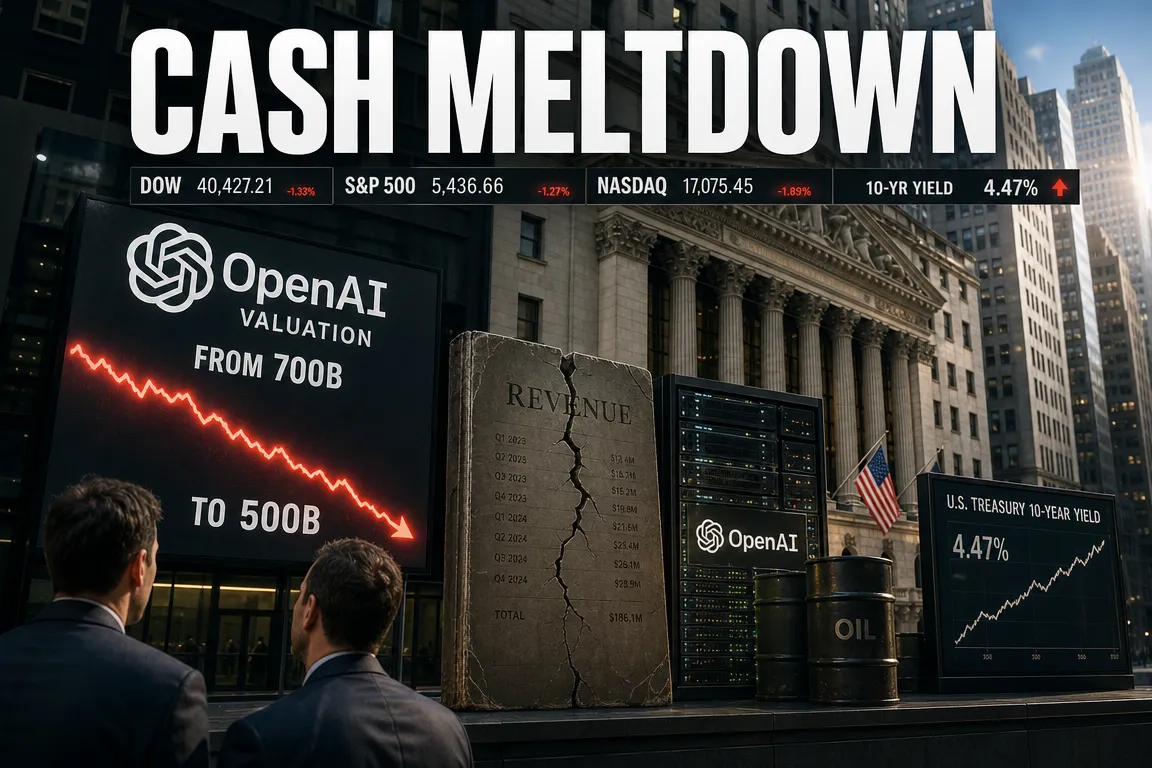

● Treasury-Funds Intervention Shock
Why Treasury Secretary Bessent’s Remarks on “Direct Intervention in the Treasury Market” Shook the Market
Possibility of direct intervention in the Treasury market
A shift in the government’s message toward the interest-rate market
Why Bitcoin and gold are gaining attention
AI investment and the reshaping of global capital flows
Trust in the dollar and fiat currency debasement
The deeper meaning behind U.S. Treasury policy that must be watched now
1. Key Takeaway News: One Remark from Bessent Changed the Market Landscape
U.S. Treasury Secretary Bessent stirred financial markets significantly after suggesting in a CNBC interview that the government could directly intervene in the Treasury market depending on conditions.
This was not just a simple remark, because it was interpreted as a sign that the U.S. government may intervene in the direction of interest rates and the bond market.
Markets are originally structured to determine interest rates and prices on their own, so it is highly unusual for the government to respond strongly in a way that suggests “the market is wrong.”
This remark caused an even bigger shock because it overlapped with debates over yen intervention, Treasury buybacks, and the AI funding war.
2. Why This Remark Was So Shocking
The reason Secretary Bessent’s remark was shocking was not simply because of the strong wording.
It was because the government openly said that it could take direct action if necessary, rather than merely “persuading” the bond market.
Market participants read this as a signal that “interest rates can also be managed in the direction the government wants.”
In other words, it means policy goals may take priority over free market price formation.
This kind of signal affects Treasury yields, the value of the dollar, stock valuations, and overall global capital flows.
3. How Bessent Views the Market: The Meaning of the “Asymmetric Information” Remark
The message Secretary Bessent delivered particularly strongly was an asymmetric information remark that sounded like, “I know something you do not.”
This expression was not just confidence, but carried the nuance that the government may have far greater visibility into hedge funds and market positioning.
For example, it can be interpreted to mean that the government can better see how much short positioning certain institutions have built up, where stop-losses may be triggered, and where liquidity is drying up.
This sounded like a warning that “speculative forces resisting the market may ultimately be overwhelmed by the government’s information advantage.”
From Wall Street’s perspective, this one remark could only be received as something close to a declaration of war.
4. Why Treasury Market Intervention Is Dangerous: Interest Rates Could Be Set by the Government, Not the Market
Treasury market intervention, simply put, means the government is trying to influence the price-discovery structure of interest rates.
Normally, interest rates are determined by the supply of bonds being sold and the demand from buyers.
However, if the government tries to control the direction of interest rates through buybacks, supply-demand adjustments, policy guidance, and market pressure, it can effectively be interpreted as something close to yield curve control, or YCC.
YCC is often discussed in the context of Japan, but the United States also used similar policies during the wartime period of the 1940s.
In other words, this remark evokes not an ordinary market stabilization measure, but the shadow of a wartime-level financial control policy.
5. Why the U.S. Government Is Going This Far Now
There are three major pressures underlying this trend.
First, if Treasury yields rise, the U.S. government’s interest costs increase sharply.
Second, AI competition is a battle of capital, so the side with lower funding costs has an advantage.
Third, compared with competitors such as China, where low-cost financing is available, pressure is growing for the United States to ease financial conditions as well.
In other words, the U.S. government is not simply trying to defeat the market; it is in a position where it must simultaneously contain the AI supremacy war and its fiscal burden.
6. AI and the Global Economy: The Real Background Behind This Message
The most important axis in this issue is actually AI.
The AI industry is not a game won by technology alone; it is a long-term battle that requires data centers, semiconductors, electricity, infrastructure, and enormous capital.
That is why the current environment can essentially be viewed as an AI funding war.
If China is using a low-interest-rate environment to provide capital to AI companies, the United States has no choice but to respond.
Secretary Bessent’s remark can ultimately be read as meaning, “We will manage even the financial market in order not to fall behind in the AI race.”
That is why AI-related stocks and global capital flows become the core point areas of beneficiaries and losers from this news.
7. Core Points Investors Should Watch
First, U.S. Treasury yields may continue to be strongly influenced by policy variables.
Second, the outlook for the dollar and interest rates may become more dependent on the intentions of the U.S. government than on simple economic indicators.
Third, AI-related stocks remain the strongest structural growth theme.
Fourth, stronger government intervention can shake market confidence, which may be favorable for alternative assets such as Bitcoin and gold.
Fifth, hedge fund and leveraged positions may be sharply shaken by a single policy remark, increasing the likelihood of greater volatility.
8. Why Bitcoin and Gold Can Rise Together
Many people view Bitcoin and gold only as safe-haven assets, but more accurately, they should be seen as assets whose preference rises when trust in fiat currencies weakens.
When signals grow stronger that the government is forcefully suppressing the market, artificially managing interest rates, or trying to cover debt problems through monetary policy, trust in currency can be shaken.
In such moments, people do not look only to the dollar; they seek alternatives such as gold and Bitcoin.
In other words, this remark gives gold and Bitcoin a meaning beyond simple expectations of falling interest rates.
The core point is that distrust may grow over whether financial markets are moving too much according to the government’s intentions.
9. The Most Important Point in This News That Others Are Not Discussing Enough
The most important point is not simply Treasury yields or stock prices, but the signal that the U.S. government may be trying to intervene in the market’s price-discovery function itself.
This is not simple economic stimulus.
It means the principle that market participants relied on, “prices are determined by the market,” may be shaken.
And this shift connects AI, Treasuries, the dollar, Bitcoin, gold, and hedge fund positions all at once.
In other words, this remark should not be viewed as bond market news, but as a signal that the rules of global capitalism may be changing slightly.
10. Market Signals to Watch Going Forward
Changes in the size and frequency of Treasury buybacks
The intensity of additional remarks from the U.S. Treasury
Whether Treasury yields remain abnormally stable
Changes in funding conditions for major AI stocks
Whether Bitcoin and gold strengthen together
Moves by hedge funds to reduce leverage
Whether dollar strength begins to weaken
If these signals move at the same time, the market is likely entering a policy-driven phase rather than dealing with a simple interest-rate issue.
Summary
Treasury Secretary Bessent’s remark on Treasury market intervention was an event that showed the possibility of direct U.S. government control over the interest-rate market.
The core points are the AI funding war, Treasury yield management, changes in trust in the dollar, and the potential benefits for Bitcoin and gold.
This issue should be viewed not as simple bond market news, but as a signal of change in the global financial order.
[Related Articles…]
Bitcoin Asset Allocation Strategy and Recent Market Trends
AI Investment and the Global Artificial Intelligence Industry Outlook
*Source: 이효석아카데미