● SK Hynix Bubble, Korea Stocks, U S Market Shift
After the SK Hynix overheating signal, where are the Korean and U.S. equity markets headed?
The core issue in this article is not simply that SK Hynix has risen significantly.
The more important point is what signal the market sends when market capitalization moves ahead of earnings capacity.
Another key question is not whether the KOSPI can revisit 10,000, but whether the slope of future gains in the U.S. and Korean equity markets may diverge.
In this discussion, semiconductor stocks, the U.S. equity market, the KOSPI outlook, interest-rate policy, and a weaker dollar are all part of the same framework.
The conclusion is that Korean equities remain highly dependent on semiconductors, while U.S. equities are moving from AI investment into a phase of monetization.
In addition, the second half of 2026 is likely to be shaped by the U.S. midterm elections, a U.S.-China summit, the Federal Reserve’s rate decisions, and a weaker-dollar strategy.
1. Why did the SK Hynix overheating signal prove accurate?
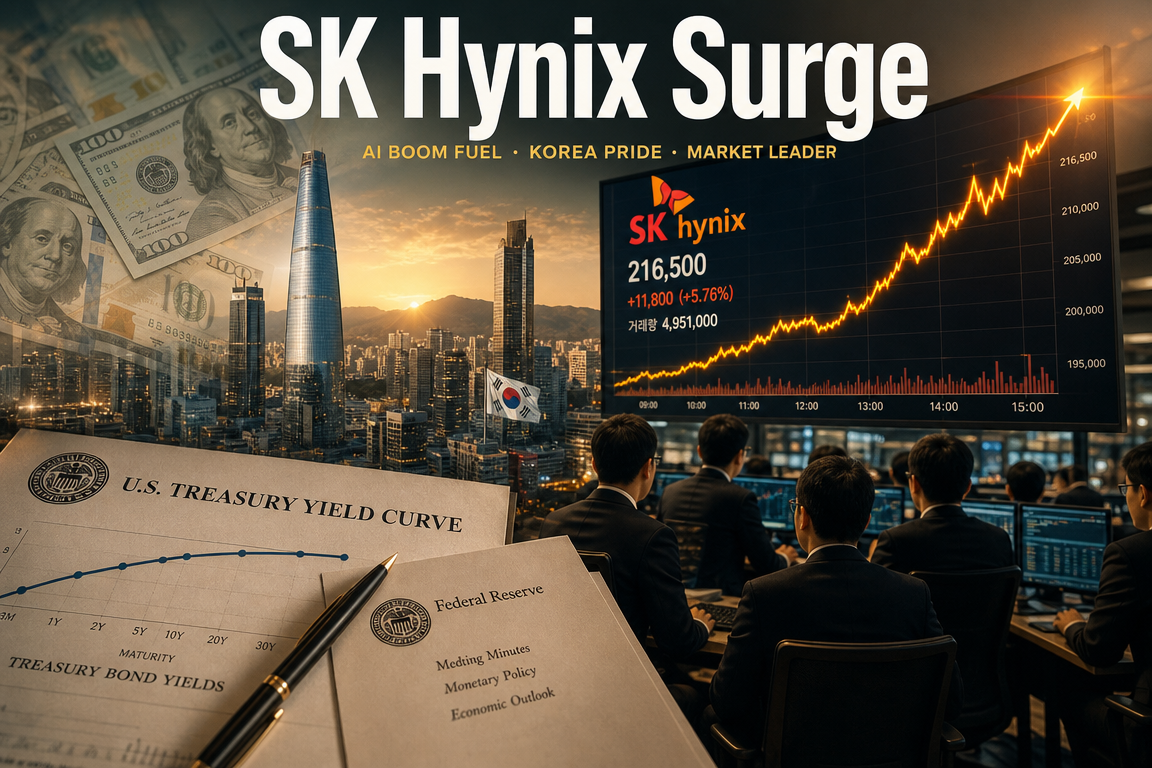
The starting point of the discussion was the possibility of a market-capitalization reversal between SK Hynix and Samsung Electronics.
The core logic is straightforward.
A company with the largest market capitalization should generally also be among the largest in earnings.
In the U.S. market, NVIDIA ranks first by market capitalization because it combines large earnings with strong growth expectations.
In Taiwan, TSMC dominates for the same reason: earnings scale and industry leadership move together.
SK Hynix is an excellent semiconductor company with strong HBM and AI memory growth, but its absolute earnings scale is still difficult to view as larger than Samsung Electronics.
If SK Hynix were to exceed Samsung Electronics in market capitalization under such conditions, it would indicate that expectations have moved ahead of fundamentals.
This is why the June correction in Korean equities was interpreted as an important signal.
2. Which is more real: earnings or stock prices?
An important point in the discussion was whether earnings or stock prices are more real.
One view holds that earnings are the real measure.
Actual profit, operating income, net income, and cash flow are the most objective data points.
From the perspective of a market strategist, however, stock prices are also real because they reflect expectations and risks in advance.
That does not mean prices are always correct.
Prices are expectations about earnings.
When expectations become excessive, bubbles form; when expectations become too low, valuations become depressed.
In the long run, prices converge toward fundamentals, but in the short run they can deviate substantially because of expectations.
The SK Hynix case fits this structure.
AI semiconductor expectations lifted the stock first, and then the share price corrected as earnings estimates were revised down in part.
3. The structural issue in Korea: concentration in semiconductors
The main feature of the Korean equity market is its excessive reliance on semiconductors.
The discussion noted that Samsung Electronics and SK Hynix account for a very large share of the KOSPI.
That means the direction of the Korean market is largely determined by Samsung Electronics, SK Hynix, and the semiconductor cycle.
Korean equities strengthened this year for clear reasons.
AI investment expansion, rising HBM demand, and expectations of a semiconductor upcycle all worked together.
In addition, expectations for increased domestic equity allocation by the National Pension Service, leverage ETF flows, and foreign buying contributed to the strong rally in May and June.
The issue now is what comes next.
If the National Pension Service’s incremental buying capacity declines and the leverage ETF effect weakens, the market will again depend on corporate earnings and foreign flows.
Without support from other sectors, the KOSPI’s upside will remain limited.
4. KOSPI 10,000: possible, but the pace may differ
The discussion also addressed the possibility of a KOSPI 10,000 level.
The key point is not whether the KOSPI can rise, but whether it can recover previous highs.
If earnings continue to improve, a return to prior highs remains possible.
However, it was argued that repeating the sharp advance seen from April through June would be difficult.
The reason is that volatility has declined.
Strong rallies typically require strong liquidity, strong flows, and strong expectations at the same time.
After a period of overheating and correction, investor sentiment has become more cautious.
In other words, the Korean market may rise again, but it is unlikely to do so at the same steep pace as before.
5. Why does the U.S. market look more attractive now?
The main reason the U.S. market appears more favorable than the Korean market is sector diversification.
Within the S&P 500, semiconductors have a meaningful weight.
But the U.S. market is not driven by semiconductors alone.
Software, cloud services, major platforms, biopharmaceuticals, financials, and industrials all provide multiple sources of support.
For example, if semiconductors pause, Microsoft, Google, and Amazon can help stabilize the market through software and cloud strength.
AI investment is now moving beyond the cost phase and into a monetization phase through cloud revenue and productivity gains.
This is the key point for U.S. equities.
The first stage of the AI cycle linked spending to NVIDIA and other semiconductor companies.
Now the big technology companies that use that AI infrastructure are beginning to generate real profits.
As a result, the U.S. market has multiple layers of support: if semiconductors pause, software can lead, and if software slows, other growth sectors such as biopharma can help absorb the impact.
6. Will U.S. exceptionalism return?
One of the key terms in the discussion was U.S. exceptionalism.
U.S. exceptionalism refers to the tendency of the U.S. economy and equity market to remain relatively strong even when global conditions weaken.
This is not simply because the U.S. government is strong.
The more important point is that U.S. companies have global pricing power.
Microsoft can raise software prices without losing users easily.
The same applies to Amazon Web Services and Google Cloud.
Apple, NVIDIA, and Meta also have their own ecosystems and market power.
These companies are likely to continue generating earnings over the long term despite higher rates and political uncertainty.
Ultimately, the strength of the U.S. market comes not from policy alone, but from corporate pricing power and global market leadership.
7. Three key inflection points in the second half of 2026: midterms, U.S.-China summit, and the Fed
Three major factors are likely to shape the market in the second half of 2026.
The first is the U.S. midterm elections.
Historically, equity markets tend to become volatile ahead of midterms.
In particular, uncertainty around October can cause swings in the S&P 500, the Nasdaq, and the KOSPI.
After the elections, however, political uncertainty often declines and markets tend to stabilize.
This time, however, the policy agenda and congressional balance under the Trump administration may affect the feasibility of policy execution.
The second factor is the U.S.-China summit and the APEC meetings.
The messages from the U.S. and China could affect Chinese equities, Korean export stocks, and companies tied to the semiconductor supply chain.
What matters more than the summit itself is the content of the discussions and any follow-up policy measures.
The third factor is the Federal Reserve’s interest-rate policy.
Interest rates act as gravity for equities.
Higher rates pressure growth valuations, while lower rates restore pricing support for future earnings.
8. From a liquidity perspective, a weaker dollar may matter more than fiscal spending
Governments approaching elections usually have an incentive to provide liquidity.
They may expand fiscal spending and use stimulus measures to support consumption and investment.
However, the discussion noted that the U.S. is already carrying a significant fiscal burden from war and defense spending.
As a result, it is difficult to assume that large-scale fiscal spending alone will create a major liquidity surge.
Instead, the more important variable may be a weaker dollar.
If the Trump administration encourages dollar weakness, it would support U.S. exporters.
A weaker dollar improves price competitiveness and may help reduce the trade deficit.
It also matters for global liquidity.
A weaker dollar can increase foreign investor interest in won-denominated assets, emerging markets, and Korean equities.
For Korean semiconductor companies in particular, global demand and pricing cycles matter more than exchange-rate levels alone, so dollar weakness is not necessarily negative.
9. Dollar weakness and reserve-currency status are different issues
One important clarification in the discussion was that a weaker dollar does not mean a weaker reserve-currency status for the dollar.
Exchange rates refer to the price of the dollar.
Reserve-currency status refers to the dollar’s use in payments and the global financial system.
Even if the dollar weakens, reserve-currency status can remain intact as long as the dollar continues to dominate global trade and finance.
Likewise, a strong dollar does not automatically imply stronger reserve-currency status.
The key variables are the dollar’s share in international payments, foreign-exchange reserves, commodity pricing, and global debt issuance.
Therefore, interpreting dollar weakness as an abandonment of dollar dominance would be an overstatement.
10. The Fed and Kevin Warsh: a less accommodative communication style
The discussion also covered Kevin Warsh, who has been mentioned as a potential future Federal Reserve Chair.
The key point is that his communication style is unlikely to resemble Powell’s more market-friendly approach.
Powell has generally tried to communicate clearly with the market and has provided relatively detailed explanations in press conferences.
Warsh would likely place more emphasis on balance-sheet normalization, monetary-policy discipline, and a tighter stance.
In that case, markets may find it harder to rely on traditional forward guidance.
When forward guidance weakens, investors must place greater weight on data, inflation prints, labor-market data, and financial-market reactions.
11. Rate-hike risk versus a hold scenario
The discussion included slightly different views on the rate outlook.
One view was that the U.S. economy remains strong and investment activity remains firm, so the Fed should keep open the possibility of one or two additional hikes.
However, these would not resemble the aggressive hiking cycle of 2022 and would likely be limited.
Another view was that current policy rates are already high enough, making a prolonged hold more likely than further hikes.
If inflation returns to a disinflationary path after temporary distortions from geopolitical tensions and higher oil prices, rate-hike concerns may diminish.
The key issue is not only the actual policy move.
Markets often react more strongly to the expectation of a rate hike or the expectation that rate cuts may begin.
In other words, equities can move even if the Fed does nothing, as long as investor expectations shift.
12. The key Jackson Hole focus: trimmed mean PCE
One of the more notable points in the discussion was the trimmed mean PCE.
The Fed typically focuses on core PCE inflation.
Trimmed mean PCE removes extreme outliers and shows the underlying trend more clearly.
If the Fed places greater emphasis on trimmed mean PCE, it may create a case that U.S. inflation is more stable than commonly assumed.
In that case, the rationale for keeping rates high weakens, and markets may price in a greater probability of cuts.
If the Fed Chair explicitly mentions trimmed mean PCE at Jackson Hole, it would be more than a passing comment; it could signal a shift in the policy framework.
That point may not receive wide coverage in general news, but it could have a meaningful impact on markets.
13. The most important points not often emphasized in other media
First, the issue in Korean equities is not direction, but slope.
This does not mean the Korean market must decline.
If U.S. equities rise, Korean equities may also move higher.
However, the U.S. market is supported by multiple sectors in rotation, while Korea remains heavily dependent on semiconductors.
Therefore, even in a rising market, the U.S. is more likely to sustain a steadier and longer uptrend.
Second, the leadership of the AI cycle is shifting from hardware to software.
In the early phase of the AI cycle, hardware names such as NVIDIA, SK Hynix, and Samsung Electronics attracted the most attention.
Now the focus is shifting toward companies that monetize AI infrastructure, especially cloud and software firms.
Missing this transition means viewing the AI cycle only in part.
Third, a weaker dollar may unexpectedly benefit Korean equities.
Many investors view a stronger won only as a negative for exporters.
But if a weaker dollar encourages capital flows into emerging markets, it could be positive for Korean equities from a liquidity standpoint.
For semiconductors in particular, global demand and the supply cycle matter more than exchange-rate logic alone.
Fourth, changes in rate expectations often move stocks before the actual policy change.
Even if the Fed does not cut rates, markets can rise once they believe that hikes are over.
Conversely, even without a new hike, equities can weaken if the risk of additional tightening grows.
For that reason, investors should watch not only the policy rate itself, but also Fed communication, inflation data, and long-term yields.
14. Investment strategy: sectors and assets to monitor
In the U.S. market, AI software and cloud companies remain important.
The market is likely to favor companies that convert AI investment into actual revenue.
Semiconductor stocks remain important, but the gap between expectations and earnings must be monitored closely.
Even with strong HBM, AI server, and data-center demand, valuations can correct if prices move too far ahead of earnings estimates.
In Korean equities, foreign flows and dollar weakness are critical.
If the dollar weakens and demand for won-denominated assets increases, capital could return to the KOSPI.
Once rates begin to fall, KOSDAQ growth stocks may regain attention.
In a high-rate environment, companies with current earnings are favored, but in a declining-rate environment, firms with higher future growth potential may be re-rated.
Defense stocks may remain attractive as a medium- to long-term sector with stable revenue and earnings growth.
In an environment of persistent geopolitical risk, order visibility and earnings stability in defense remain important.
15. Key indicators to monitor going forward
First, changes in the earnings estimates for SK Hynix and Samsung Electronics.
Ultimately, earnings matter more than market capitalization.
If SK Hynix’s earnings actually move above Samsung Electronics’, market interpretation may change.
Second, sector leadership within the S&P 500.
Investors should track whether leadership shifts from semiconductors toward software, cloud, and biopharma.
Third, the direction of U.S. long-term yields.
Lower long-term yields would create a more favorable environment for growth stocks and KOSDAQ names.
Fourth, the U.S. Dollar Index and the KRW/USD exchange rate.
A sustained weaker dollar could bring foreign flows back into Korean equities.
Fifth, whether Jackson Hole and the FOMC change the interpretation of inflation data.
If trimmed mean PCE is highlighted, markets may quickly increase expectations for rate cuts.
< Summary >
SK Hynix moving above Samsung Electronics in market capitalization can be interpreted as a sign that expectations have moved ahead of earnings capacity.
Korean equities have upside potential, but their slope is likely to remain weaker than that of U.S. equities because of high semiconductor concentration.
U.S. equities are supported not only by semiconductors, but also by software, cloud services, and biopharmaceuticals.
The AI cycle is shifting from hardware leadership toward cloud and software monetization.
The main variables for the second half of 2026 are the U.S. midterm elections, the U.S.-China summit, Federal Reserve policy, and dollar weakness.
Dollar weakness is different from a decline in reserve-currency status and may instead support foreign inflows into Korean equities.
If the Fed emphasizes trimmed mean PCE, expectations for rate cuts may rise and support equities.
Going forward, the key issue is less the absolute policy rate and more whether rate-hike concerns fade and rate-cut expectations build.
[Related Articles…]
AI Investment Cycle and Cloud Monetization Outlook
Semiconductor Outlook and Key Drivers for Korean Equities
*Source: [ 경제 읽어주는 남자(김광석TV) ]
– [풀버전] SK하이닉스 과열 시그널 적중… 지금 한국 증시는 어디로 갈까? | 경읽남과 토론합시다 | 이재만 실장
● Dollar Slumps, Bitcoin Soars, Fed Buybacks Shake Markets
The Case for Dollar Weakness, Bitcoin and Gold Strength, and Why the Fed’s Expansion of Short-Term Treasury Holdings Matters
The key issue in this market is not simply that U.S. equities rose.
U.S. Treasury yields moved higher again, the dollar weakened, oil prices rose, and yet New York stocks held up.
On the surface, this appears to be a “rally despite adverse conditions,” but beneath the surface it reflects a complex mix of U.S. fiscal deficits, changes in the Federal Reserve’s Treasury holdings, rising Bitcoin and gold prices, the memory semiconductor cycle, and Tesla’s robotaxi narrative.
Most headlines reduce the move to “dollar weakness supports Bitcoin and gold,” but the more important point is that the Fed has been materially increasing its holdings of short-term Treasuries.
This could have implications for U.S. fiscal funding, long-end yield control, the stablecoin market, and the path of future rate cuts.
1. New York Close: Major Indices Rose Despite Multiple Headwinds
U.S. equities closed higher even without a clear catalyst.
The Dow Jones Industrial Average rose 0.98%.
The S&P 500 gained 0.43%.
The Nasdaq advanced 0.43%.
Although the session appeared orderly on the surface, the broader backdrop was not particularly supportive.
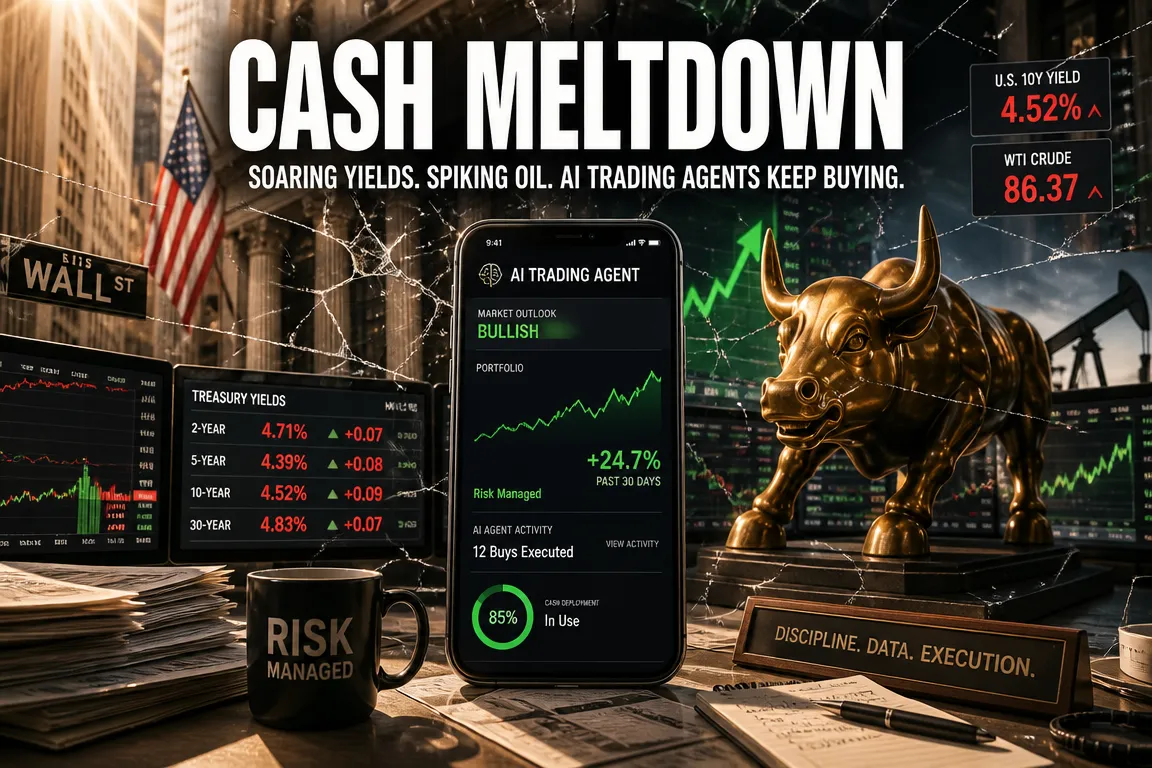
The 10-year U.S. Treasury yield moved back up to 4.74%.
This is close to levels seen before the recent Treasury buyback expansion announcement.
The dollar index weakened.
WTI crude rose above $87 per barrel.
In general, rising Treasury yields, higher oil prices, and a weaker dollar can weigh on equities.
That stocks still advanced suggests investors placed more weight on liquidity expectations and selective growth themes than on short-term macro headwinds.
2. Sector Performance: Materials and Consumer Discretionary Outperformed Big Tech
Large-cap technology did not lead the market higher.
Nvidia, Apple, and Amazon underperformed.
Google and Microsoft posted modest gains, but not enough to drive the broader market decisively.
Instead, the most notable strength came from Materials and Consumer Discretionary.
Materials rose more than 2%, making it the strongest sector of the day.
Materials typically outperform in expansionary phases.
Whether this move reflects a genuine growth outlook or a short-term positioning rebound still needs confirmation.
Consumer Discretionary was supported by Tesla’s strength.
Tesla’s more than 5% gain lifted sentiment across the sector.
Healthcare was volatile.
Moderna surged and retraced on news related to successful Phase 3 skin cancer trial results, but for the week it remained up more than 100%.
3. Tesla’s Rally: Robotaxi and Cybercab Expectations
Tesla rose 5.14%.
The main driver of recent strength has been expectations around robotaxis and Cybercab rather than electric vehicle sales.
Elon Musk indicated that the future revenue growth potential of Tesla and SpaceX may be far above current market expectations.
The comments reignited investor interest in the company’s growth narrative.
Tesla has scheduled a Cybercab-related event for August 23.
The market is focused not merely on a new vehicle launch, but on whether autonomous driving can develop into a viable revenue model.
Bullish estimates suggest a Cybercab could cost roughly $30,000 to produce.
After depreciation and annual operating costs, some projections imply about $10,000 of profit in the first year and roughly $40,000 per unit from the second year onward.
At a scale of 1 million vehicles, this could translate into annual operating profit in the tens of billions of dollars.
These assumptions are highly aggressive.
Regulation, insurance, liability, city-level operating approvals, maintenance, and autonomous driving validation remain major hurdles.
However, equity markets typically price in expectations before numbers are confirmed.
Tesla’s rally reflects a valuation based more on future platform potential than on current earnings.
4. Semiconductors: Memory Remained Relatively Resilient Versus System Chips
U.S.-listed semiconductor stocks were generally weaker.
However, memory-related names held up relatively well.
The current market pattern is not one in which all AI-related semiconductors rise uniformly, but rather one in which the memory cycle is being reassessed.
Bloomberg reported that some smart-money investors are rotating out of memory semiconductors.
On the surface, this appears negative.
But the underlying message is more about profit-taking and portfolio rebalancing than about deteriorating fundamentals.
Micron and SanDisk continue to be discussed at relatively low valuation levels.
Some capital may leave after recent gains, but there is limited evidence that underlying memory demand has weakened materially.
5. JPMorgan’s Memory Outlook: “This Is Not a Peak-Out”
JPMorgan released a report rejecting the view that the memory cycle has peaked.
There had been concern that the cycle could turn in 2027 or 2028.
JPMorgan, however, suggested that the combined DRAM and NAND market could continue growing in 2028.
According to the report, the combined DRAM and NAND market size was revised upward from about $169.1 billion to about $182.6 billion.
This implies that the memory market is not simply set to reverse after a short-term surge.
Growth rates may slow from current levels, but that is different from the market size actually declining.
South Korea’s export data also remains important.
Export unit prices for DRAM and NAND continue to trend higher.
Rising unit prices indicate improving pricing conditions rather than growth driven solely by volume.
The memory cycle remains a key variable for both the Korean economy and domestic equity markets.
6. Citadel’s SA Fund Position Cleanup: A Clue to Wall Street Capital Flows
Citadel’s Ken Griffin reportedly acquired the positions of the SA fund and later unwound a substantial portion of them.
The SA fund is said to have transferred a large share of its assets to Citadel after facing margin calls on leveraged positions.
Citadel reportedly acquired those positions at a discount and appears to have generated significant profits during the rebound in semiconductors and AI-related stocks.
Citadel has now disclosed that it has closed roughly 80% of those acquired positions.
This sends two signals to the market.
First, major Wall Street capital deploys liquidity to acquire quality assets during stress periods.
Second, even in strong AI and semiconductor themes, large investors may take profits quickly when conditions allow.
7. The Dollar’s Weakness: Treasury Buybacks and Confidence Concerns
The most important market development is dollar weakness.
Following the U.S. government’s announcement of expanded buybacks of long-dated Treasuries, the dollar has weakened.
Treasury buybacks can help suppress long-end yields.
When long-term yields are held down, the relative appeal of long-duration U.S. government bonds may decline.
The larger issue is the combination of fiscal deficits and rising federal debt.
U.S. national debt is now above $40 trillion, according to widely cited estimates.
Debt is increasing by tens of billions of dollars per day.
For investors, this naturally raises questions about the sustainability of U.S. debt management.
The dollar is not just a currency.
It is the global reserve currency and is closely tied to confidence in U.S. Treasuries.
When Treasury confidence weakens, the dollar can also come under pressure.
This is contributing to the strength in gold and Bitcoin.
8. Why Bitcoin and Gold Are Rising: Alternative Assets to the Dollar and Treasuries
Bitcoin has posted a weekly gain of more than 20%, marking a strong rally.
This is being supported in part by expectations for greater clarity in crypto regulation.
Optimism around the Clarity Act has also improved sentiment.
However, the broader driver is dollar weakness.
When the dollar declines, demand for alternative stores of value tends to rise.
Gold and Bitcoin are the main beneficiaries.
Gold is the traditional safe haven.
Bitcoin is increasingly treated as a digital scarce asset in periods of dollar skepticism.
Recent moves show Bitcoin and the dollar index moving in opposite directions.
As the dollar weakens, Bitcoin strengthens.
This is not just speculative momentum; it reflects a macro response to concerns over U.S. fiscal credibility.
9. The Economic Burden of U.S. National Debt Above $40 Trillion
Rising U.S. national debt first becomes an issue through interest costs.
When federal spending is roughly in the $7 trillion range, Treasury interest expense alone is estimated at around $1.2 trillion.
That reduces room for productive public investment.
Government spending is a major component of GDP growth.
Spending on infrastructure, research and development, defense, welfare, and industrial support contributes to growth.
But if interest costs become too large, those productive areas are crowded out.
The private sector also faces pressure.
If the government issues more debt to cover deficits, capital can be absorbed into Treasuries.
This is the crowding-out effect.
Because Treasuries are the safest asset, corporate and high-yield bonds must offer higher yields to attract capital.
That raises funding costs for private companies and can dampen investment.
Over time, this can weigh on consumption, investment, and U.S. growth.
That is why the Treasury market matters far beyond bond investors.
It is a core variable connecting equities, foreign exchange, commodities, and digital assets.
10. Treasury Ownership Structure: Domestic Holders and the Fed Matter More Than Foreigners
Foreign governments do hold significant amounts of U.S. Treasuries.
Japan is one of the largest holders.
Japan has reportedly reduced some Treasury holdings in the process of defending the yen.
However, domestic holders are now even more important.
U.S. private investors, money market funds, mutual funds, local governments, and pension funds hold a large share of Treasuries.
Another key holder is the Federal Reserve.
The Fed holds more than $4 trillion in U.S. Treasuries.
Recent data have placed that figure closer to $4.5 trillion.
The more important issue, however, is the composition of that portfolio.
In particular, holdings of short-term Treasuries have risen sharply.
11. The Most Important Point: Fed Holdings of Short-Term Treasuries Rose by About $340 Billion in One Year
This is the detail most headlines miss.
The Fed’s holdings of short-term Treasuries, or T-bills, have increased by about $340 billion over the past year.
By contrast, intermediate- and long-term holdings have not increased meaningfully, while inflation-linked holdings have declined.
This is unusual.
The Fed has been talking about quantitative tightening and balance sheet reduction.
Yet short-term Treasury holdings have increased substantially.
On the surface, that looks inconsistent with tightening, but structurally it resembles stronger short-term liquidity management.
That raises an important question.
Is the U.S. government increasingly relying on short-term Treasury issuance to reduce pressure on long-term funding costs?
The interaction between the Treasury’s account management, especially TGA operations, and the issuance structure may be linked to long-end yield control.
Stablecoins should also be considered, since they are becoming a growing source of demand for short-term Treasuries.
Stablecoin issuers hold large amounts of U.S. T-bills as reserve assets.
As the crypto market expands, demand for short-term Treasuries may also rise.
This could help the U.S. distribute some of its funding burden away from long-duration debt and toward the short-term Treasury market and the digital finance ecosystem.
This may become a significant issue for Treasury markets, crypto regulation, and the preservation of dollar dominance.
12. The Core Takeaway Missing From Most Coverage
First, dollar weakness is not driven only by rate-cut expectations.
It is also being shaped by fiscal deficits, Treasury confidence concerns, and expanded long-dated Treasury buybacks.
Second, the rise in Bitcoin and gold is better understood as a hedge against weakening confidence in the dollar rather than a simple risk-on move.
Bitcoin is increasingly behaving like digital gold.
Third, the increase in the Fed’s short-term Treasury holdings is the most important signal.
An increase in T-bill holdings while the Fed still talks about quantitative tightening suggests that a simple monetary-policy explanation is incomplete.
It may reflect a combination of Treasury issuance strategy, TGA management, stablecoin demand, and implicit long-end yield control.
Fourth, memory semiconductors should be viewed through structural demand rather than peak-out fears.
AI investment continues to support HBM, DRAM, and NAND demand.
Even if short-term profit-taking emerges, that does not automatically mean the cycle has ended.
Fifth, Tesla cannot be adequately valued as a conventional automaker.
The market is increasingly pricing Tesla as a robotaxi platform, an autonomous driving network, and an AI robotics company.
However, expectations are high, so post-event volatility could be substantial.
13. Next Week’s Key Events: PCE Inflation, Nvidia Earnings, and Jackson Hole
The most important macro release next week is the PCE inflation report.
It will be released at 8:30 a.m. Eastern Time on August 26, which is 9:30 p.m. in Korea.
Headline PCE is expected at about 3.7% year over year and 0.1% month over month.
Core PCE is expected at about 3.3% year over year and 0.2% month over month.
If PCE comes in above expectations, rate-cut expectations could weaken again.
The market is likely to react sharply if the monthly figure rises to 0.3% or higher.
That would suggest inflation is not yet fully under control.
The second key event is Nvidia’s earnings release.
This is not just a single-company report.
It is a reference point for whether the global AI investment cycle remains intact.
Data center revenue, GPU demand, margins, and forward guidance will all matter.
The third key event is the Jackson Hole meeting.
It will take place from August 27 to 30.
The main event is scheduled for August 28 at 10:00 a.m., which is 11:00 p.m. in Korea, with the speech by Kevin Warsh.
However, the speech may offer limited direct guidance on the policy rate path.
Even so, markets will scrutinize every phrase for clues about the Fed’s next move.
14. Investment Takeaways
Rising U.S. Treasury yields remain a headwind for equities.
However, continued dollar weakness could support commodities, gold, Bitcoin, and other liquidity-sensitive assets.
U.S. equities are likely to react strongly to PCE inflation and Nvidia earnings next week.
If PCE is softer and Nvidia reports strong results, AI-related stocks and the Nasdaq could regain momentum.
Conversely, a hot inflation print and weak guidance could trigger rapid profit-taking.
Bitcoin and gold should remain in focus as long as dollar weakness persists.
That said, Bitcoin has already rallied sharply and may remain volatile, so chasing strength should be approached cautiously.
Memory semiconductors should be monitored through export unit prices and AI server demand rather than short-term positioning.
If DRAM, NAND, and HBM pricing remains firm, corrections may create opportunities from a medium- to long-term perspective.
Tesla’s next test will be whether the Cybercab event converts expectations into a clearer commercial path.
The robotaxi business could scale substantially if successful, but regulatory and technical uncertainty remains high.
< Summary >
U.S. equities rose even as Treasury yields increased, the dollar weakened, and oil prices climbed.
Tesla advanced on robotaxi and Cybercab expectations.
Memory semiconductors remained relatively resilient, while JPMorgan reduced peak-out concerns and pointed to continued structural growth potential.
The main driver of dollar weakness is expanding Treasury buybacks and the burden of U.S. national debt above $40 trillion.
Bitcoin and gold are rallying as alternative assets opposite the dollar and U.S. Treasury confidence.
The most important point is that the Fed’s holdings of short-term Treasuries increased by about $340 billion over the past year.
This is not just a bond market issue; it may be connected to U.S. fiscal policy, stablecoins, long-end yield control, and rate-cut expectations.
Next week’s PCE report, Nvidia earnings, and the Jackson Hole meeting are likely to determine near-term market direction.
[Related Articles…]
- U.S. Treasury Trends and Their Impact on Global Asset Markets
- Memory Semiconductor Cycle and the Outlook for AI Investment
*Source: [ Maeil Business Newspaper ]
– [문지웅의 빅머니 LIVE] 미국 국채, 달러 가치와 반대로 움직이는 비트코인과 Gold. 연준의 단기국채 보유 증가는 어떻게 봐야할까.