● Tesla-Waymo AI War, Fake Peak, RoboTaxi Battle
Waymo’s “Fake Summit” Remark and the Tesla Robotaxi Competition: The Real Issue Is AI Operating Cost, Not Sensors
The key point in this dispute is not the old “Waymo uses lidar, Tesla uses cameras” debate.
What matters is that Waymo indirectly targeted Tesla in its official blog without naming it, while Waymo itself is gradually moving toward the direction Tesla has long pursued.
This also connects with Nvidia’s earnings beat, gains in the Nasdaq, expanded AI infrastructure spending, robotaxi unit economics, and the recent controversy surrounding a real-world Waymo incident.
With Tesla shares rising 2.6% to $354.81 on the original reference, competition in autonomous driving is shifting from technical philosophy to who can deploy faster, cheaper, and at larger scale.
1. Market backdrop: Before Tesla, look at Nvidia and AI infrastructure
In the original reference, Tesla shares rose 2.6% to $354.81.
The S&P 500 gained 0.72%, the Nasdaq rose 1.57%, and the Dow Jones Industrial Average advanced 0.20%.
The main driver of the broad market strength was Nvidia’s earnings.
Nvidia reported quarterly revenue more than doubling year over year, while data center revenue was said to have grown 117%.
Its guidance for next-quarter revenue growth was also cited at around 70%, signaling that the AI infrastructure investment cycle remains intact.
This is directly relevant to autonomous driving.
Autonomous driving is not only about how reliably vehicle AI can interpret the road, but also about how cheaply that AI can be trained and operated.
In that sense, Nvidia’s results are not just a semiconductor headline; they are a signal to read across Tesla, Waymo, robotaxis, and AI data center investment trends.
-
Tesla shares: $354.81 in the original reference, up 2.6%
-
Nasdaq: up 1.57% on strength in AI-related equities
-
Nvidia: 117% growth in data center revenue, confirming continued AI infrastructure demand
-
Autonomous driving industry: AI training cost, inference cost, and per-vehicle cost are becoming the key competitive variables
2. Waymo’s official blog message: “Tesla’s approach is a fake summit”
Waymo published an official blog post titled “10 AI lessons learned from more than 200 million miles of fully autonomous driving.”
The author was identified as Sreekanth Thirumalai, who leads AI-based technology at Waymo.
Notably, the post did not mention Tesla even once.
Even so, at least three of the ten points can be read as a direct critique of Tesla FSD and its camera-based autonomous driving strategy.
The timing also matters, as the post appeared shortly before Tesla’s Cybercab event, reinforcing the view that Waymo was responding to Tesla.
3. Waymo’s first critique: “Camera-only full autonomy is difficult”
Waymo’s first major point was the need for multimodal sensors.
Waymo argued that while cameras are useful, large-scale, safe full autonomy requires more than cameras alone.
Waymo described the sensor roles as follows:
-
Lidar: provides a precise 3D structural understanding of the environment
-
Cameras: interpret visual information such as traffic light colors, sign text, and lane markings
-
Radar: tracks object speed and supports detection in rain, fog, and dust
This argument is aimed squarely at Tesla’s camera-centric FSD strategy.
Waymo’s logic is straightforward.
Cameras are useful, like human eyes, but a single visual sensor cannot guarantee complete safety.
Tesla’s counterview is that because humans drive with vision and cognition, a camera-based system can scale if supported by sufficient data and neural networks.
This debate is ultimately about whether more sensors improve safety, or whether stronger AI judgment improves scalability.
4. Waymo’s second critique: “Improving driver assistance does not mean you have built a robotaxi”
Waymo’s strongest phrase was “fake summit.”
The analogy is that a climber may believe a visible peak is the summit, only to discover the true summit lies much farther ahead.
Waymo is effectively arguing that Tesla’s FSD is close to such a fake summit.
In other words, improving a driver-assistance system does not automatically lead to fully autonomous unmanned driving.
Waymo’s view is that a true robotaxi system must be designed from the outset for driverless operation.
Tesla, by contrast, believes that collecting real-world driving data from millions of vehicles and progressively improving FSD can lead to full autonomy.
This is the core philosophical difference between Waymo and Tesla.
-
Waymo: a robotaxi system must be designed from day one for unmanned operation
-
Tesla: large-scale real-world data can be used to evolve FSD toward full autonomy
5. Waymo’s third critique: “Black-box AI cannot build trust”
Waymo also criticized black-box AI.
Here, black box refers not to a recording device, but to an AI model whose internal decision process cannot be explained.
For example, if camera input enters a neural network and the AI outputs “turn left,” Waymo argues that the system is risky if no one can clearly explain why that decision was made.
Waymo says it applies an additional verification layer.
After the AI makes a driving decision, the command is checked against physical laws and traffic rules to assess collision risk.
In other words, Waymo emphasizes that it is not enough for AI to decide; the decision must also be validated by a separate safety system.
This is an important message for regulators, insurers, and investors.
For robotaxis to scale, low accident rates alone are not sufficient; companies must also explain why a decision was made when an incident occurs.
6. However, Waymo is also moving closer to Tesla’s direction through larger AI models
The notable contradiction in Waymo’s post is that while it criticizes Tesla, its own technical direction is becoming more similar to Tesla’s.
Waymo said that it previously operated separate functional modules.
There were separate modules for detecting pedestrians, tracking vehicles, reading traffic lights, and determining routes.
But as systems grow, this approach becomes harder to manage.
Waymo said it is now moving toward a larger, more integrated foundation model.
It also said it is using vision-language models to improve situational understanding and leveraging Gemini to train the system to interpret complex context, such as hand signals from police officers.
The key point is that Waymo is increasing the share of neural-network-based AI in its system.
Waymo was previously more committed to a modular structure that could be independently verified as safer.
Yet this post shows that it is also moving toward more integrated AI, stronger neural networks, and more self-evaluation systems.
This is not fundamentally different from the direction Tesla has long advocated.
7. Waymo’s AI scoring system resembles Tesla’s Optimus training approach
Waymo said that good drivers need good critics.
Instead of having the driving AI evaluate itself, a separate AI model scores the driving result.
In simple terms, one AI drives while another grades the performance, allowing the system to learn what was good and what was poor.
This is similar to common approaches in reinforcement learning and robot training.
Good actions receive rewards, risky or inefficient actions receive penalties, and the AI gradually learns better policies.
This also connects to Tesla’s Optimus humanoid robot and its broader robot training systems.
Whether for autonomous vehicles or humanoid robots, the core issue is how AI learns and generalizes from complex real-world situations.
On that basis, Waymo and Tesla may appear to follow different paths, but their AI training structures are increasingly converging.
8. The real difference between Waymo and Tesla: dependence on HD maps
The biggest difference between Waymo and Tesla is not sensors; it is mapping.
Waymo still relies on high-definition maps.
The vehicle moves within a highly detailed prebuilt map and focuses on changes or objects newly appearing on the road.
This approach is well suited to controlled performance in specific regions.
But the limitation is clear.
It is difficult to expand immediately into areas where HD maps do not exist.
Tesla, by contrast, aims to interpret the road in real time using cameras and AI without HD maps.
If successful, this would create much greater scalability.
Software that works in one city could potentially work in others, enabling faster global deployment.
-
Waymo’s strength: high control and stability in limited areas
-
Waymo’s weakness: map building and geographic expansion require time and cost
-
Tesla’s strength: large-scale expansion if the software matures
-
Tesla’s weakness: proving fully unsupervised safety remains the main challenge
9. Waymo’s new robotaxi: fewer sensors, better performance?
Waymo recently discussed its new robotaxi vehicle, “Ohai.”
The vehicle is based on a Zeekr platform from Geely and is equipped with Waymo’s sixth-generation autonomous driving hardware.
The sensor package includes 13 cameras, 4 lidar units, and 6 radar units.
That is still a large sensor array, but Waymo said the total number of sensors is down 42% from the previous generation.
Waymo also said that despite reducing sensors, performance improved and the autonomous driving hardware cost fell below $20,000.
This point is important.
Waymo is publicly arguing that multimodal sensors are necessary, while in practice it is reducing the sensor burden significantly.
If performance improves as sensors are reduced, then the gap is being filled by AI and software.
In other words, Waymo is also lowering hardware dependence and increasing AI dependence.
That aligns with the direction Tesla has been pursuing for some time.
10. Unit economics are the real battleground: robotaxis are about economics before technology
The most important variable in the robotaxi market is vehicle-level cost.
According to Morgan Stanley estimates cited in the original reference, Waymo’s earlier Jaguar-based robotaxi reportedly cost around $200,000 per vehicle.
The new Zeekr-based vehicle is estimated at roughly $40,000 to $125,000.
Waymo’s reasons for reducing sensors, lowering hardware costs, and using a Chinese vehicle platform are clear.
It must improve robotaxi unit economics to compete with Tesla.
No matter how advanced the technology is, a robotaxi service cannot scale if the cost per vehicle remains too high.
Tesla, by contrast, already has mass-production capability and an established vehicle platform.
If FSD reaches unsupervised capability, Tesla could gain a strong advantage in robotaxi economics.
For overseas equity investors, the key question is not who becomes perfect first, but who first expands at a profitable scale.
11. Tesla robotaxi expansion: dispatch AI matters as much as driving AI
At the same time Waymo published its long blog post, Tesla’s official robotaxi account reportedly announced service expansion, according to the original reference.
Operating hours were extended from 6:00 a.m. to 10:00 p.m., seven days a week, and the number of unsupervised vehicles reportedly increased.
Reduced wait times were attributed not only to FSD updates, but also to improved dispatch and routing intelligence.
This is an important point.
A robotaxi is not just a car that can drive itself.
It is a platform business that combines demand forecasting, dispatch optimization, route planning, charging management, vehicle utilization, and regional traffic pattern analysis.
Just as Uber and Lyft are not simply transportation companies but algorithmic platforms, Tesla’s robotaxi business should also be viewed as an AI operations platform.
The long-term investment question is whether Tesla can evolve from an automaker into an AI mobility platform company.
12. Tesla’s city expansion strategy: multiple-city rollout rather than one-city concentration
According to the original reference, Tesla is expanding robotaxi operations across several cities, including Austin, Dallas, Houston, Miami, Orlando, and Tampa.
Miami, Orlando, and Tampa were described as starting without supervisors from the outset.
This strategy differs materially from Waymo’s.
Waymo tends to build detailed maps and operational infrastructure in a single city before expanding outward.
Tesla, by contrast, is pursuing a strategy built on software generalization across multiple cities at once.
If Tesla’s approach succeeds, it could scale much faster than a city-by-city deployment model.
However, the downside is also significant.
Road culture, weather, pedestrian behavior, and traffic signals differ by city, and AI may not generalize well enough if those differences are not handled properly.
13. Waymo accident controversy: the question raised by a video showing the vehicle moving after impact
The original reference cites an ABC News report involving a Waymo robotaxi accident video.
The video reportedly shows a Waymo robotaxi colliding with a vehicle exiting a parking area in California and then continuing to move instead of stopping immediately.
Some observers interpreted this as a hit-and-run type issue involving an unmanned vehicle.
Waymo reportedly said the vehicle moved to a wider area in order to exchange insurance information.
However, the video raises the question of whether the vehicle clearly recognized the collision and responded safely, or whether it continued moving without fully detecting the impact.
The incident matters because it conflicts with Waymo’s earlier blog claims.
Waymo argued that lidar, cameras, and radar complement one another and provide higher safety than cameras alone.
But in the real incident, the company did not fully explain how the sensors interpreted the collision or why the vehicle did not stop immediately.
This is where Waymo’s own critique of black-box AI comes back to challenge Waymo itself.
14. The key issue most reports miss: the sensor debate is secondary; accountability and explainability are primary
Many reports and videos reduce this issue to “Waymo lidar vs. Tesla cameras.”
But the more important question is not how many sensors are installed.
The hardest problem in the robotaxi business is whether the company can explain who made the decision, how, and why when an accident occurs.
Human drivers can provide statements after an incident.
Unmanned vehicles cannot.
Companies therefore need to explain log data, AI decision paths, sensor fusion results, and the decision tree to regulators and insurers.
That is why Waymo criticized black-box AI in the first place.
But if Waymo itself cannot clearly explain a real-world incident, it is not immune to the same problem.
Tesla, likewise, will need more than a low accident-rate claim if it wants to move FSD to a fully unsupervised level.
Over the long term, explainable decision-making may become central to regulatory approval.
Ultimately, the winner in robotaxis may not be the company with the smartest AI, but the one that builds the safest, most affordable, and most explainable AI operating system.
15. Investment perspective: the Tesla-Waymo rivalry should be viewed as an industry-structure shift, not just share-price volatility
Tesla’s move above $354 is important, but what matters more is that the market continues to value Tesla as an AI platform company rather than only an automaker.
Waymo is currently ahead in commercial robotaxi operations.
In the original reference, Waymo was described as operating roughly 3,000 robotaxis across more than 10 U.S. cities and completing more than 500,000 paid rides per week.
By those numbers, Waymo is effectively the current leader in robotaxis.
However, Tesla has manufacturing scale, FSD data, charging infrastructure, AI training systems, and robotics technology integrated into a single ecosystem.
That means Waymo may lead in current deployment, while Tesla may earn the larger expansion premium.
Investors should focus on three variables rather than short-term share moves.
-
First, the pace at which Tesla FSD expands into unsupervised robotaxis
-
Second, how much further Waymo can lower vehicle-level costs
-
Third, how regulators define explainable AI and accident accountability
These three factors are likely to have a direct impact on Tesla’s share price, Waymo’s valuation, and investor sentiment toward autonomous driving equities.
16. Conclusion: Waymo’s critique reflects confidence, but it may also signal concern
Waymo’s long-form official post clearly reflects confidence.
Its 200 million-plus miles of fully autonomous driving experience, commercial robotaxi operations, and multimodal sensor stack are major assets.
At the same time, the post can also be read as a warning sign about Tesla’s Cybercab and robotaxi strategy.
Waymo criticizes Tesla as a “fake summit,” but in terms of reducing sensors, integrating AI models, and lowering costs, Waymo is moving closer to the path Tesla has long followed.
Tesla, by contrast, has a strong scalability profile but still needs to prove the safety and explainability of fully unsupervised autonomy more clearly.
Consumers do not buy philosophy.
They choose the robotaxi that arrives faster, costs less, is safer, and handles accountability more clearly when incidents occur.
For that reason, this conflict between Waymo and Tesla is not merely a technology debate; it is a contest to control the future mobility economy.
< Summary >
Waymo did not name Tesla in its official blog, but it effectively criticized Tesla’s camera-based FSD and driver-assistance approach to autonomy.
Its central phrase, “fake summit,” argues that improving driver assistance does not automatically lead to a fully unmanned robotaxi.
At the same time, Waymo is reducing sensor count by 42%, strengthening integrated AI models, and moving in a direction that resembles Tesla’s approach.
Recent controversy around a Waymo incident shows that multimodal sensing is not a complete solution and that explainable AI and accountability remain critical in autonomous driving.
Going forward, the robotaxi winner is likely to be determined by unit cost, scalability, safety, and regulatory readiness rather than by sensor count alone.
[Related Articles…]
*Source: [ 오늘의 테슬라 뉴스 ]
– 웨이모가 테슬라를 “가짜 정상” 이라 불렀습니다 — 근데 무인 웨이모는 사고를 내고 그냥 갔습니다, $354 주주는?
● US Debt Bomb, Treasury Selloff, Global Shock
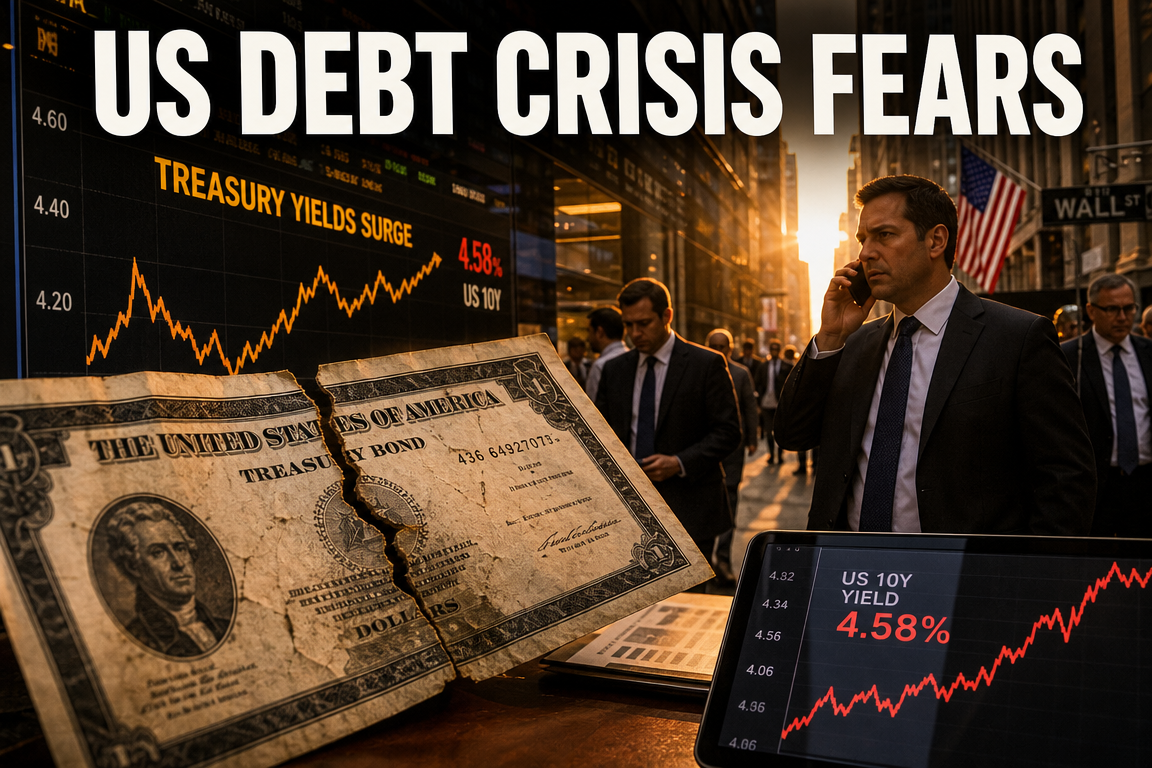
Wall Street Has Started Backing Away from U.S. Treasuries: Why the $40 Trillion Debt Burden and Rising Treasury Yields Matter
The core issue is not simply that U.S. debt is large.
The more important point is that as the U.S. government continues to expand borrowing, China and major central banks, which previously provided steady demand for U.S. Treasuries, are stepping back.
If Wall Street hedge funds and private financial institutions also become more reluctant to hold U.S. Treasuries, higher Treasury yields could become not just a U.S. issue but a global increase in financing costs across financial markets.
In that sense, the problem connects U.S. public debt, trade deficits, fiscal deficits, the dollar, gold demand, and the potential for a future financial crisis.
1. U.S. debt at $40 trillion: the growth rate matters more than the headline number
U.S. federal debt is currently estimated at around $40 trillion.
That level is already historically heavy, but the larger concern is that debt is increasing by roughly $2.25 trillion to $2.5 trillion per year.
At a simple conversion, that is roughly KRW 300 trillion in additional debt each year.
Given that South Korea’s annual government budget is around KRW 800 trillion, the U.S. is adding almost four times that amount in new debt every year.
- U.S. federal debt: about $40 trillion
- Annual debt increase: about $2.25 trillion to $2.5 trillion
- Daily increase: roughly $8 billion
- Key issue: the pace of debt accumulation, not only the size
The United States can sustain higher debt than most countries because it issues the world’s reserve currency.
However, reserve currency status does not allow unlimited debt issuance.
Eventually, someone must buy the Treasuries, and if demand weakens, Treasury prices fall and yields rise.
2. Why Wall Street and hedge funds are becoming more cautious on Treasuries
Historically, U.S. Treasuries were regarded as the safest asset globally.
When markets became unstable, investors sold equities and bought U.S. Treasuries.
Central banks also held a significant share of their foreign reserves in Treasuries.
That pattern is changing.
China has reduced its Treasury holdings, and several major central banks have increased gold reserves instead of Treasury exposure.
At the same time, hedge funds and private financial institutions are becoming less willing to treat U.S. Treasuries as a risk-free allocation.
This matters because central banks and private investors behave differently.
Central banks manage reserves, financial stability, and monetary policy.
Hedge funds and financial firms are primarily driven by returns.
If yields become unattractive or risks rise, they can sell aggressively.
- China: reducing Treasury holdings
- Major central banks: increasing gold allocations relative to Treasuries
- Wall Street hedge funds: evaluating Treasuries on risk-adjusted return
- Core risk: demand shifting from stable long-term buyers to more volatile private capital
3. Why higher U.S. Treasury yields affect the entire global market
U.S. Treasury yields serve as a benchmark for global capital markets.
When Treasury yields rise, the impact is not limited to U.S. corporations.
Government bond yields and corporate bond spreads in Korea, Europe, and emerging markets also come under pressure.
For example, if U.S. Treasury yields rise, Treasuries become more attractive relative to other sovereign bonds.
That reduces the incentive to buy lower-yielding bonds from countries such as Korea or from emerging markets.
As a result, other issuers may need to offer higher yields to attract capital.
This pushes up financing costs globally.
Corporate bond issuance becomes more expensive, and equity markets can also face pressure.
When bond yields rise, the relative appeal of equities declines and valuation discount rates increase.
- Higher U.S. Treasury yields → upward pressure on global sovereign yields
- Higher global sovereign yields → higher corporate bond yields
- Higher corporate yields → higher funding costs for companies
- Higher funding costs → weaker investment and slower growth
- Growth slowdown risk → higher equity market volatility
This can create a debt-driven negative feedback loop.
The government must issue more debt, investors demand higher yields, higher yields raise interest costs, and rising interest costs require still more borrowing.
4. The starting point of the U.S. debt problem is the trade deficit
To understand the U.S. debt issue, fiscal deficits alone are not enough.
The key structural factor is the persistent trade deficit and current account deficit.
The United States has long imported more than it exports.
As manufacturing shifted to China and other countries under free trade, the U.S. became more consumption-oriented.
American consumers purchased goods produced overseas, and the U.S. financed the shortfall through Treasury issuance and foreign capital inflows.
This was possible because of reserve currency status, but there is no guarantee it can continue indefinitely.
Someone must keep financing the U.S., and Treasuries remain the main channel for that funding.
- Offshoring of manufacturing → decline in domestic manufacturing employment
- Rising imports → widening trade deficit
- Widening current account deficit → greater reliance on foreign capital
- More Treasury issuance → accumulation of public debt
- Rising interest costs → larger fiscal deficits
In that context, the trade deficit is not simply a matter of importing too much.
It is a system-level issue linked to industrial structure, employment, welfare spending, fiscal deficits, and public debt.
5. Why Trump’s tariff war has returned
Trump’s tariff policy should not be viewed only as protectionism.
It can also be interpreted as an attempt to address the U.S. trade and fiscal imbalance.
Trump has repeatedly emphasized the severity of trade imbalances.
The goal is to bring manufacturing back to the United States, raise import prices through tariffs, and encourage domestic production.
The intended outcome is a larger manufacturing base, a smaller trade deficit, and lower long-term fiscal strain.
The challenge is that trading partners do not accept this approach passively.
China is likely to respond, and Europe and other partners may also take countermeasures to protect domestic industries.
As a result, tariff escalation can reduce trade imbalances while also disrupting global supply chains and adding inflation pressure.
- Tariff increases → higher import prices
- Higher import prices → incentives for domestic production
- Manufacturing reshoring → potential job growth in the U.S.
- Lower trade deficit → potential improvement in the current account
- But retaliation may follow → weaker global trade and higher inflation pressure
6. Why weakening the dollar is part of the discussion
If the U.S. wants to rebuild manufacturing and expand exports, price competitiveness matters.
If the dollar is too strong, U.S. goods become more expensive abroad.
That weakens export competitiveness and can reduce the effectiveness of reshoring efforts.
For that reason, a weaker dollar can be seen as one tool for reducing the trade deficit.
A lower dollar improves the export price competitiveness of U.S. goods and raises the cost of imports.
That may support domestic production.
However, dollar weakness is a double-edged sword.
Higher import prices can reaccelerate U.S. inflation.
In addition, if global investors lose confidence in dollar assets, demand for U.S. Treasuries can also weaken.
7. Increased gold demand is not just a passing trend
The recent accumulation of gold by major central banks is a significant signal.
Gold does not generate yield.
Nevertheless, when central banks buy more gold, it suggests a preference for system-risk hedging over return optimization.
In particular, the shift away from U.S. Treasuries toward gold raises the question of whether Treasuries remain the unquestioned safe haven.
U.S. Treasuries remain the largest and most liquid bond market in the world.
However, confidence is no longer as unconditional as it once was, and concerns about debt sustainability are increasing.
- Concerns over U.S. Treasury credibility
- Greater dollar volatility
- Rising geopolitical risk
- Diversification of foreign reserves by central banks
- Higher demand for gold
8. Ray Dalio’s warning on a potential debt crisis within three years
Ray Dalio has warned that U.S. debt dynamics could eventually develop into a crisis.
The central question is whether a system in which the U.S. borrows to repay existing debt remains sustainable.
The government must issue more Treasuries to cover principal and interest payments on outstanding debt.
When Treasury yields rise, interest expense increases.
Higher interest expense widens the fiscal deficit, which then requires more borrowing.
If investors demand even higher yields, the negative loop intensifies.
This is the debt spiral described in the original thesis.
Even if the system does not break immediately, any loss of market confidence could trigger a disorderly adjustment.
9. Financial crises usually begin with debt
Historically, many financial crises have started with excessive debt.
Whether the borrower is a company, household, or government, crisis occurs when obligations can no longer be serviced.
The United States is different from most countries because it issues the reserve currency, but it is not immune to debt pressure.
When assessing the risk of a U.S.-origin financial crisis, the key issue is not simply sovereign default.
The more realistic risks are a sharp rise in Treasury yields, weakening confidence in the dollar, equity market corrections, credit stress, and a decline in global liquidity.
- Step 1: Increase in Treasury issuance
- Step 2: Weaker demand from major central banks and Wall Street
- Step 3: Higher U.S. Treasury yields
- Step 4: Higher interest costs and larger fiscal deficits
- Step 5: Higher corporate funding costs
- Step 6: Greater volatility in equity and property markets
- Step 7: Rising risk of a global financial crisis
10. The most important point often missed in other coverage
First, the buyer base for U.S. Treasuries is changing.
In the past, central banks and long-term investors formed the stable demand base for Treasuries.
As private financial institutions and hedge funds take a larger share, the market becomes more sensitive.
These investors respond to returns rather than to political alliances or financial stability concerns.
Second, higher Treasury yields are not just a U.S. issue; they are a higher global discount rate.
U.S. Treasury yields anchor the valuation of global assets.
When yields rise, valuations for equities, real estate, corporate bonds, and emerging-market assets all face pressure.
Third, tariff wars affect inflation and debt dynamics at the same time.
Tariffs can support manufacturing reshoring, but they also raise import prices.
If inflation rises again, rate cuts become harder, and higher rates then increase the burden on U.S. public finances.
Fourth, rising gold prices may reflect a shift in confidence rather than a simple investment theme.
Higher gold demand can indicate growing diversification away from a system centered on the dollar and U.S. Treasuries.
Fifth, crises usually appear sudden, but they are built over time.
If U.S. debt, fiscal deficits, trade deficits, Treasury yields, and the dollar all weaken at the same time, markets can reprice rapidly.
11. Three possible scenarios ahead
Scenario 1: Ordered adjustment
The U.S. moderates fiscal spending, slows debt issuance, and manages yields and the dollar in a stable manner.
In that case, global markets can adapt gradually without major disruption.
However, the political cost may be high because it would likely require tax increases or spending restraint.
Scenario 2: Prolonged high rates
Treasury demand weakens and yields remain elevated for an extended period.
In that case, corporate funding costs stay high and equity valuations remain under pressure.
Korea and the broader global economy would also continue to face higher borrowing costs.
Scenario 3: Disorderly market adjustment
Confidence in U.S. Treasuries weakens sharply and yields spike in a short period.
In that case, the dollar, equities, bonds, and commodities could all experience significant volatility.
This is the closest scenario to the debt-crisis risk highlighted by Ray Dalio.
12. What investors and professionals should monitor
This topic may appear macroeconomic, but it has direct implications for portfolios and financial planning.
If U.S. Treasury yields rise, the impact can extend to loan rates, corporate bonds, equities, foreign exchange, and gold.
- Monitor the direction of U.S. Treasury yields.
- Track whether the dollar is strengthening or weakening.
- Assess why demand for gold and other safe-haven assets is rising.
- Evaluate the impact of prolonged high rates on corporate earnings.
- Consider the effect of tariff escalation on inflation and supply chains.
Equity investors should avoid assuming that a crisis will simply create a buying opportunity.
During stress periods, even high-quality companies can reprice sharply, and markets can remain under pressure longer than expected if liquidity tightens.
Investors should review cash allocation, diversification, dollar assets, gold, high-quality bonds, and defensive sectors.
< Summary >
U.S. debt has reached roughly $40 trillion and continues to grow at a rapid pace each year.
The key concern is that issuance is rising while China, major central banks, and parts of Wall Street are no longer absorbing Treasuries as aggressively as before.
If Treasury yields rise, sovereign yields and corporate borrowing costs around the world are likely to rise as well.
The root of the U.S. debt problem lies in persistent trade and fiscal deficits.
Trump’s tariff strategy and efforts to weaken the dollar can be viewed as attempts to correct these imbalances, but they also carry inflation and market volatility risks.
Going forward, the key variables are Treasury demand, Treasury yields, dollar direction, gold demand, and the risk of a broader financial crisis.
[Related Articles…]
*Source: [ 경제 읽어주는 남자(김광석TV) ]
– “월가마저 미국 국채를 버리고 있습니다” 40조 달러 부채폭탄, 진짜 위험은 지금부터 | 김광석의 북리뷰 | 트럼프 이후의 질서 [2편]