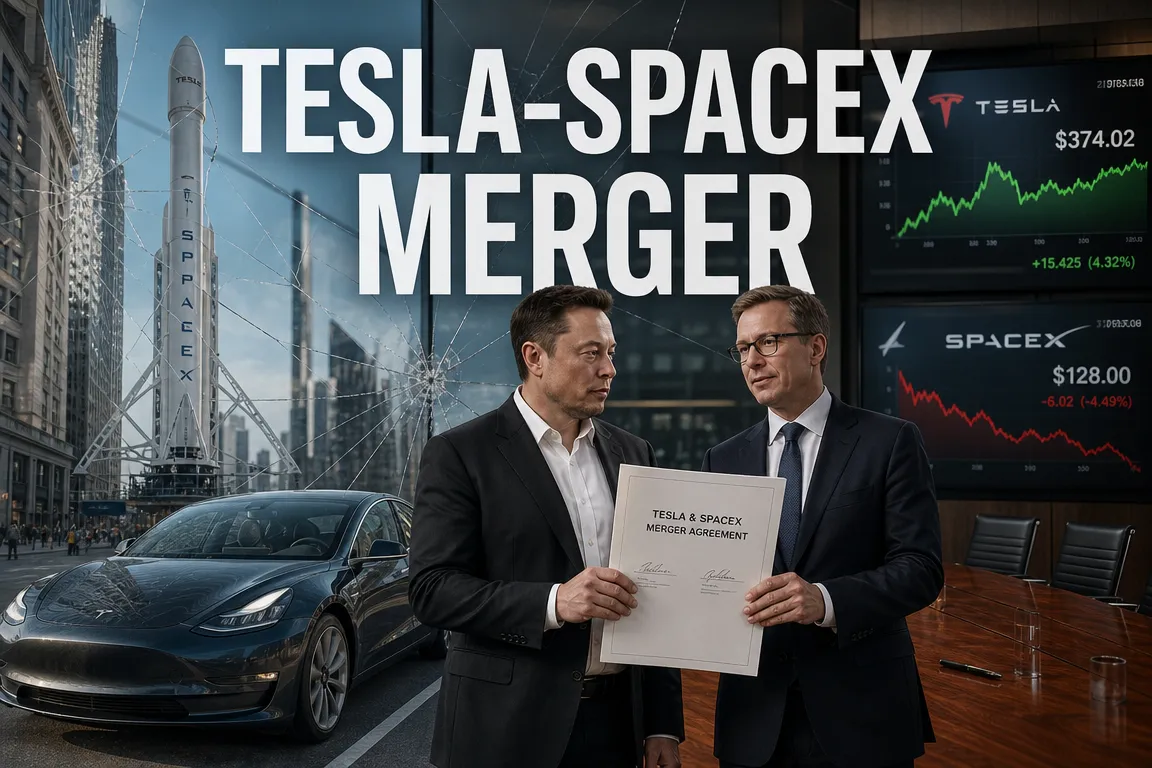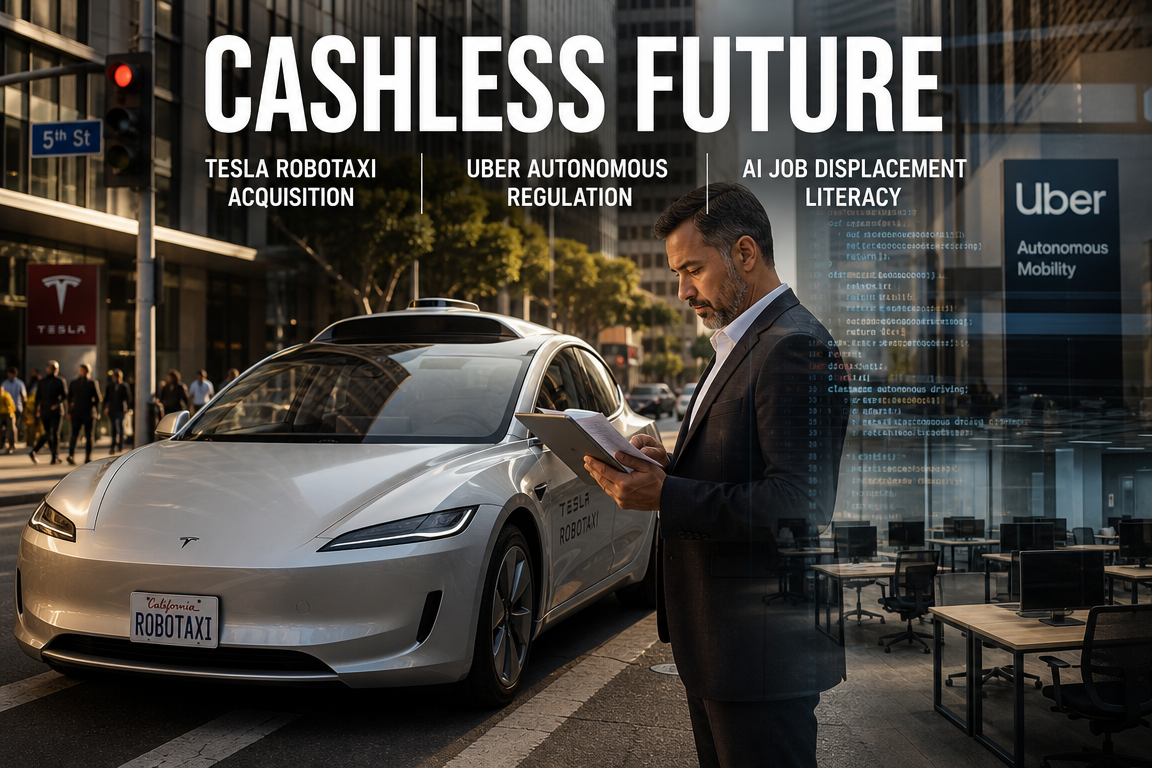
● Tesla Uber Buyout Rumor, RoboTaxi Shock, 300B Gamble
Did Tesla acquire Uber for $300 billion? The real issue is not the acquisition rumor, but the robotaxi timeline
The key point in this debate is not simply whether Tesla could buy Uber.
The main question is how much value Uber’s user base of more than 200 million people has for Tesla’s robotaxi strategy, and why the market is discounting Uber’s future earnings.
This note also reviews Goldman Sachs’ view on Tesla’s Cybercab cost competitiveness, why Uber supports autonomous-driving regulation, and the implications for investors watching Tesla around the $354 level.
1. A comment from an early Uber investor intensified the debate
The discussion began with remarks from Jason Calacanis, known as an early Uber investor.
He said that major M&A transactions could emerge across the autonomous-driving market.
He specifically said he would not be surprised if a big tech company such as Tesla, Amazon, or Google acquired Uber for $300 billion.
- Uber’s current market capitalization is around $155 billion.
- A $300 billion acquisition price would be nearly twice Uber’s current valuation.
- Tesla’s market capitalization is around $1.4 trillion.
- If Tesla financed the deal through stock issuance, dilution for existing shareholders could exceed 20%.
As a result, many Tesla investors and U.S. market commentators said the probability of Tesla acquiring Uber for $300 billion is very low.
On a simple arithmetic basis, that reaction is reasonable.
For Tesla shareholders, it is difficult to justify paying such a high premium for Uber.
2. Why this debate should not be dismissed as a passing rumor
Although it appears to be an implausible takeover rumor, the discussion raises a more important question.
Can Tesla build its own robotaxi app and still get users to download and adopt it quickly?
This is where Elon Musk’s acquisition of Twitter is often cited as a comparison.
Elon Musk acquired Twitter for $44 billion in October 2022.
He did not buy Twitter because he lacked the ability to build a social media app.
He bought an existing platform already installed on users’ phones and checked routinely.
Uber has a similar profile.
Uber is not just a ride-hailing app; it is a mobility platform that has already shaped user behavior.
- Uber has about 208 million monthly active users.
- That figure is up roughly 16% year over year.
- Quarterly trip volume is around 3.9 billion.
- New user adoption has remained strong in recent years.
In other words, Uber is still a growing mobility platform, not a declining one.
Even if Tesla builds a strong robotaxi app, attracting more than 200 million users overnight would be difficult.
That is why the core issue is less about whether Tesla can buy Uber and more about how the market values Uber’s app and user network.
3. Uber’s financial performance is improving, but its valuation multiple is falling
The most notable gap in the current Uber debate is the divergence between operating results and valuation.
Uber is not a company that is failing to make money.
Recent figures indicate meaningful improvement.
- Trailing 12-month revenue is about $55.2 billion.
- Trailing 12-month net income is about $9.6 billion.
- Trailing 12-month free cash flow exceeded $10 billion for the first time.
- The average Wall Street target price is around $101.78.
Even so, Uber’s price-to-earnings ratio has fallen to the mid-16x range.
Given that the 3-year average P/E was around 39.6x, the market is currently assigning Uber a much lower multiple than in the past.
The stock has also declined by more than 20% from its 52-week level.
This does not mean the market is rejecting Uber’s current performance.
Rather, it suggests the market is asking whether Uber can sustain these earnings over time.
That is where autonomous driving and robotaxi services become relevant.
Uber’s current model depends on human drivers.
If a driverless environment becomes widespread, Uber’s intermediary role and earnings structure could weaken significantly.
4. The real reason the market discounts Uber is the driverless future
Uber is a platform that connects riders and drivers.
A large share of fares paid by riders goes to drivers.
Uber retains platform fees and service revenue from that transaction flow.
However, a broad robotaxi rollout would change that structure.
Companies that own vehicles, operate autonomous software, and control dispatch networks could capture more value.
In that case, the center of gravity in ride-hailing could shift from a calling platform like Uber to an autonomous vehicle operator like Tesla.
For that reason, the market assigns Uber a lower multiple for a straightforward reason.
What matters is not only whether Uber is earning money today, but whether the company can remain relevant in its current form over the next decade.
5. Goldman Sachs’ view on the core competitiveness of Tesla’s Cybercab
Goldman Sachs analyst Mark Delaney published an important report on Tesla’s Cybercab.
The key issue is whether Tesla can build the vehicle at a target cost of $20,000 to $30,000 per unit.
Goldman Sachs estimated that competing autonomous vehicles could cost $50,000 to $100,000 per unit.
If Tesla can mass-produce the Cybercab at $20,000 to $30,000, it could create a major operating-cost advantage.
- Estimated Tesla Cybercab cost: $20,000 to $30,000 per unit
- Estimated cost of competing autonomous vehicles: $50,000 to $100,000 per unit
- Estimated cost advantage: about 5 to 30 cents per mile
- At scale, cumulative cost differences could be significant
A per-mile difference of a few cents may appear small.
But robotaxis operate repeatedly throughout the day and remain on the road for years.
When applied across thousands or tens of thousands of vehicles, the difference in unit economics can materially affect valuation.
Goldman Sachs highlighted two main sources of Tesla’s cost advantage.
- First, the Unboxed manufacturing process.
- Second, a camera-based autonomous-driving approach rather than lidar.
The Unboxed process differs from traditional assembly-line manufacturing by producing major vehicle components separately and combining them at the end.
If this approach proves scalable, Tesla could reduce manufacturing costs significantly.
Tesla also continues to rely on a camera-based strategy rather than expensive lidar systems for autonomy.
If successful, this could produce a very different cost structure at the vehicle level versus competitors.
6. Why Goldman Sachs set a $360 target price for Tesla
Goldman Sachs acknowledged Tesla’s long-term potential, but maintained a neutral rating.
The 12-month target price was set at $360, which implies limited upside relative to Tesla’s closing price of $354.08.
- Tesla 12-month target price: $360
- Bull case: $500
- Bear case: $150
- Recent Tesla share price: about $354.08
The reason is straightforward.
Even if cost competitiveness improves, the pace of regulatory approval and the geographic scope of autonomous deployment matter more.
Cybercab registrations in Texas are currently being discussed at a scale of about 45 vehicles.
At that level, cost advantages have only limited impact on Tesla’s overall financial results.
For Tesla, the central variable is not the profitability of a single Cybercab, but how quickly the fleet can expand to thousands and then tens of thousands of vehicles.
7. Uber’s unusual support for autonomous-driving regulation
Uber’s recent behavior is also notable.
In the past, Uber was known as a platform company in conflict with driver groups and taxi operators.
More recently, however, it has aligned with drivers in some jurisdictions.
According to the Financial Times, Uber supported a New Jersey bill requiring that 85% of robotaxi trips include a human occupant if the service launches there.
Uber was also reported to support legislation in Washington, D.C. that would restrict autonomous vehicles on public roads.
This is a significant signal.
Uber was originally the company that used technology to disrupt the traditional taxi industry.
Now it is taking positions that could slow the spread of a more advanced technology: robotaxis.
The reason is clear.
Uber transferred its self-driving development unit to Aurora in 2020.
In other words, Uber abandoned a direct strategy to win the autonomous-driving race.
Its remaining option is to slow the market’s arrival at that future state.
8. What Tesla would gain and lose by acquiring Uber
Tesla would gain clear benefits from acquiring Uber.
The largest advantage would be Uber’s user base.
Uber is already installed on the phones of millions of users around the world.
If Tesla robotaxis were integrated into the Uber app, customer acquisition could accelerate materially.
However, the downsides are also significant.
Buying Uber would not mean purchasing only an app.
It would also mean inheriting drivers who depend on the platform for income, local regulatory issues, and relationships with labor and political stakeholders.
- Uber’s app and user data are attractive assets.
- But the driver ecosystem and political burden would also come with the deal.
- Tesla robotaxis would likely displace existing driver jobs.
- As a result, an acquisition could increase Tesla’s regulatory risk.
In Atlanta, there have also been calls to collect 50 cents to $1 per robotaxi ride for a fund supporting taxi drivers.
As robotaxis expand, these social costs and political demands could increase further.
9. JPMorgan’s outlook on Cybercab expansion also matters
JPMorgan said Cybercab would remain at a very limited level on the road through the end of 2026.
However, it projected that the fleet could grow to around 9,000 vehicles by the end of 2027.
This matters because it connects directly to Uber’s response.
Uber’s active lobbying for autonomous-driving restrictions is not simply a political decision.
If Tesla Cybercab and robotaxi adoption expands quickly, Uber’s existing revenue structure could come under direct pressure.
In that sense, Uber’s strategy is less about defeating robotaxis and more about slowing the speed at which they reach scale.
10. The most important point that is often overlooked
The most important issue is not whether Tesla will actually acquire Uber.
The real issue is that the market is pricing Uber as a proxy for the timing of autonomous-driving adoption.
If Uber’s P/E ratio continues to fall, the market is signaling faster robotaxi adoption.
If Uber’s valuation recovers, the market is implying that Uber can delay robotaxi adoption through regulation and political influence.
From this perspective, Uber stock is not just a valuation for a ride-hailing business.
It can also function as a leading indicator for how quickly the autonomous-driving economy will materialize.
Another important point is that Tesla stock is becoming harder to explain through electric-vehicle sales alone.
Going forward, Tesla’s valuation will likely reflect EV margins, energy storage, AI robotics, and the robotaxi network together.
11. Key metrics investors should monitor
Investors following Tesla and Uber should continue to watch the following variables.
- Whether Tesla’s Cybercab manufacturing cost approaches $20,000 to $30,000
- How quickly Tesla FSD and autonomous software receive approval in major cities
- Whether Uber succeeds in delaying robotaxi regulation in local jurisdictions
- Whether Uber’s P/E ratio continues to fall or begins to recover
- How much of Tesla’s share price already reflects robotaxi expectations
- Whether market sentiment toward AI and mobility platforms remains supportive
Ultimately, this debate is not just about an acquisition headline.
It is tied to a much larger economic outlook.
If autonomous driving becomes a reality at scale, labor markets, urban transportation, insurance, auto finance, and platform fee structures could all change.
This is not only a Tesla and Uber issue, but also a core theme in the AI economy and the next phase of industrial transformation.
12. Conclusion: the more important question is not whether Tesla buys Uber, but who wins on time
Tesla’s chances of acquiring Uber for $300 billion appear low in practical terms.
The price is high, and the dilution burden for Tesla shareholders would be substantial.
More importantly, Tesla would inherit driver-related political and regulatory risks along with the business.
Even so, the debate is meaningful.
Uber’s user base of more than 200 million remains a critical distribution channel in the robotaxi era.
The key question is whether Tesla can build enough scale through its own app without that network.
In the end, the competition is about time rather than capital.
If Tesla can mass-produce robotaxis quickly and secure approvals in major cities, Uber’s valuation could remain under pressure.
If Uber can use regulation and political relationships to slow robotaxi adoption, the market may assign greater value to its current earnings.
For investors, the issue is not whether Tesla buys Uber.
The more important question is how Uber and Tesla stock prices are each reflecting the pace of autonomous driving.
< Summary >
The rumor that Tesla could acquire Uber for $300 billion is more symbolic than realistic.
Uber has more than 200 million monthly active users and remains a strong mobility platform.
However, the market is discounting Uber’s future earnings power because robotaxi adoption could pressure its business model.
Goldman Sachs recognizes Tesla’s Cybercab cost advantage but views deployment speed and regulatory approval as more important.
Uber has supported autonomous-driving restrictions, reflecting an effort to slow robotaxi adoption.
The real issue is not the acquisition itself, but whether Tesla’s robotaxi strategy or Uber’s platform model wins on timing.
[Related Articles…]
- Tesla Robotaxi and Autonomous Driving Market Outlook
- AI Mobility Revolution and U.S. Equity Strategy
*Source: [ 오늘의 테슬라 뉴스 ]
– 우버 초기 투자자가 “테슬라가 3000억 달러에 인수” 주장 – $354 테슬라 주주는?
● AI-Driven Job Shock
The Era in Which AI Does Not Take All Jobs, but Displaces Those Who Do Not Think Independently
The core message is straightforward.
The main risk in the AI era is not whether one’s occupation will disappear, but whether one is losing the ability to make independent judgments.
The emergence of superintelligent AI is more likely to reshape labor-market structure than to collapse employment as a whole.
Routine work will decline, while the compensation premium for those who build technology and those who create value that only humans can provide is likely to rise.
This is why economic outlook, AI trends, future occupations, digital transformation, and labor-market changes must be assessed together.
Based on Professor Kim Kwang-seok’s book review and the message of Literacy Competence, the following is a news-style summary of jobs at risk and capabilities that will become more important in the AI era.
1. Key Point: AI Will Not Eliminate All Jobs, but It Will Reconfigure Labor-Market Structure
When many people discuss superintelligent AI, the first concern is “the end of labor.”
There is growing anxiety that work will be replaced by AI and jobs will eventually disappear.
However, the key issue is not whether total employment declines.
The more important point is that job structure will change.
Going forward, the labor market is likely to be reorganized into three broad areas.
-
Human-touch segment: work that is difficult for AI to replace
-
Operational segment: simple, repetitive, and process-driven work
-
Technology-driven segment: work based on AI, semiconductors, data centers, and physical AI
The first area under pressure will be the operational segment.
By contrast, the human-touch and technology-driven segments are likely to become more important.
2. Jobs at Risk: Simple Repetitive Tasks Are Already Being Replaced
Automation was already changing labor structure before AI became widespread.
Common examples are visible in daily life.
-
Parts of call-center work are being replaced by chatbots and AI-based support systems.
-
Toll collection on highways has been reduced significantly by electronic toll systems.
-
Checkout work in retail stores has shifted toward kiosks and unmanned payment systems.
-
Restaurant ordering has moved to table-order and mobile-order systems.
-
Repetitive document organization, summarization, and draft report writing are being rapidly absorbed by generative AI.
The common feature is clear.
Tasks with fixed procedures, high repetition, and speed-oriented execution are the first to be replaced.
In other words, AI and machines take over tasks for which human involvement is least essential.
3. Jobs Becoming More Important: Building Technology and Providing Human Value
At the same time, some jobs are becoming more important in the AI era.
The first is the technology-driven segment.
Personnel involved in building AI services, improving AI models, operating data centers, and designing and manufacturing semiconductors are likely to remain in greater demand.
In the Korean economy, semiconductors, data centers, physical AI, and advanced manufacturing infrastructure may become major growth pillars.
As AI expands, more computing infrastructure, more power, more servers, more chips, more cooling technology, and more security technology will be required.
The second is the human-touch segment.
This includes empathy, persuasion, care, relationship-building, contextual understanding, ethical judgment, and creative interpretation.
AI can generate answers, but building trust and influencing people remain areas where humans are likely to retain an advantage.
4. This Is Not an Era in Which Humanities Graduates Are Automatically Disadvantaged; It Is an Era in Which Literacy Matters More
It is true that personnel with science, engineering, or technical backgrounds are likely to benefit more in the AI era.
Semiconductors, AI models, data infrastructure, robotics, cloud computing, and cybersecurity are expected to remain strong-demand sectors.
However, this does not mean that humanities-oriented talent will be broadly disadvantaged.
On the contrary, critical thinking, integrative thinking, contextual interpretation, verbal articulation, and persuasion are becoming more important.
As AI produces information at high speed, the value of those who can judge whether that information is correct or flawed rises.
The key question is not only how well one uses AI, but also how well one can question its answers.
5. The Real Risk: If AI Replaces Thought, the End of Thinking Follows
One of the most important messages from Professor Kim is that the issue is not jobs, but cognitive capacity.
Over the next five years, many people may become accustomed to environments where they rely on AI and algorithms rather than independent thinking.
The danger is not merely receiving incorrect information.
The greater risk is the erosion of the ability to think independently.
Continuous dependence on algorithmic video recommendations, AI-generated summaries, short-form content, and three-line briefs can weaken long-form reasoning.
More information may be available, but judgment may deteriorate.
6. Core Message of Literacy Competence: In an Age of Information Overload, What Matters Is Deeper Thinking, Not More Searching
Literacy Competence argues that modern individuals are exposed to more text than at any point in human history, yet it remains unclear whether they are thinking independently.
People check news on their phones after waking up, review social media during their commute, and process email and messaging platforms throughout the workday.
On the surface, this appears to be far more reading and writing than in the past.
In practice, however, the ability to read deeply, connect ideas, interpret meaning, and make judgments is weakening.
The book also highlights a concern that many Koreans do not trust the news, yet make limited effort to verify it.
This creates a pattern in which people distrust news but still react easily to algorithm-driven, sensational headlines.
Repeated exposure to this environment increases vulnerability to misinformation and manipulation.
The book describes this as a rise in cognitive vulnerability.
In simple terms, more people are reading without understanding and consuming information without judgment.
7. Why Have We Become Less Able to Read Critically and Express Creatively?
Literacy Competence attributes this to two main causes.
The first is an education system centered on finding the correct answer.
For a long time, people have been trained to ask, “What is the answer?” rather than “Why is this so?”
When reading poetry, they memorized implied meanings for exams instead of interpreting or responding to the text.
When discussing social issues, they selected answers in multiple-choice formats rather than working through alternatives and solutions.
This approach is effective for rapid test-taking, but it can weaken the ability to define and solve new problems.
The second is the fragmented consumption pattern of digital media.
When people become accustomed to short videos, short-form posts, cards, and three-line summaries, their cognitive endurance for long texts declines.
As cognitive neuroscientist Maryanne Wolf has warned, skim-based information consumption can weaken brain functions associated with deep thinking.
In other words, dopamine-driven reward circuits become stronger, while the ability to follow complex logic and construct original writing weakens.
8. Searching Brain vs. Reflecting Brain: The Decisive Divide in the AI Era
Today, when people have a question, they search first rather than think first.
When even searching becomes inconvenient, they ask AI directly.
This is not inherently negative.
The problem arises when search and AI answers become the endpoint of thinking rather than its starting point.
Once people begin saying, “If AI said so, it must be right,” their judgment can gradually weaken.
In the AI era, the valuable individual is not the one who searches best, but the one who connects, interprets, and verifies information.
For that reason, the reflecting brain will matter more than the searching brain.
9. More Important Than Using AI Well Is the Ability to Verify AI Output
Generative AI can summarize large volumes of information quickly and produce natural-sounding text.
However, AI-generated answers are not always accurate.
Some are plausible but incorrect, and others reflect a narrow perspective.
In the AI era, literacy is not simply the ability to read text.
It is the ability to check sources, identify logical gaps, compare perspectives, and form one’s own conclusion.
People who use AI effectively are those who ask better questions.
People who are not driven by AI are those who do not accept answers at face value, but instead ask again, verify, and reconstruct.
10. In an Era When Students’ Presentations Are Produced Entirely by AI, Education Must Change
Professor Kim noted that student presentation materials in his classes are now almost entirely created with AI tools.
This is not merely a technology-use case.
It raises a key question about what education should evaluate going forward.
The issue is not only whether a student submits an AI-generated presentation.
The more important question is whether the student’s own thinking is present in it.
Using AI for a draft may be acceptable.
However, if problem definition, core claims, evidence selection, logical development, and conclusions are all delegated to AI, learning is lost.
Going forward, education should place greater emphasis on process, question quality, verification ability, and the formation of a personal viewpoint, rather than only on the final output.
11. The Same Applies to Economics: Do Not Search for Answers; Build a Framework for Thinking
The same issue appears in economic content.
Many people ask, “So will home prices rise or fall?”
Or they want a conclusion only, such as “Will rates be cut or raised?”
But economics is not a multiple-choice problem.
To forecast home prices, one must assess interest rates, liquidity, supply, demand, income, policy, sentiment, and demographics together.
Interest-rate outlooks also require consideration of inflation, employment, exchange rates, central-bank policy, and the global growth cycle.
If one follows conclusions only, one will be unsettled by every new headline.
By contrast, a framework for thinking allows independent judgment even as the news flow changes.
In the AI era, economic study is not about memorizing more data, but about building a personal decision framework by connecting information.
12. The Most Important Point Rarely Emphasized in Other News or Videos
Most AI and employment discussions focus on which occupations will disappear.
However, the more fundamental change occurs at the task level rather than the occupation level.
For example, occupations such as lawyers, accountants, journalists, and marketers are not necessarily disappearing as a whole; instead, their repetitive tasks are being replaced first.
Research, summarization, draft writing, standardized document production, and basic customer service are the first tasks to be automated.
That creates divergence within the same occupation.
Those who review AI outputs and set strategy become more important, while those who simply submit AI-generated results lose competitiveness.
The key gap in the future is therefore likely to be within occupations, not only between occupations.
This is the critical point.
AI does not eliminate occupations all at once; it breaks them into tasks and replaces them selectively.
Accordingly, the relevant question is not whether one’s occupation is safe, but which parts of one’s work can be automated.
13. Qualities of the Talent That Will Remain Competitive: Critical Thinking, Creative Expression, and Integrative Thinking
Literacy Competence emphasizes three core capabilities.
-
Critical thinking: the ability to verify information accuracy and logical validity
-
Creative expression: the ability to express a personal perspective and voice that AI cannot easily imitate
-
Integrative thinking: the ability to connect fragmented information and create new meaning
Integrative thinking is particularly important.
AI can present large amounts of information, but identifying hidden links between data points and assigning new meaning remains a human strength.
The ability to connect scattered pieces into a coherent whole is what turns information into insight.
Individuals who can link economics, technology, society, education, and labor-market trends into a single framework will be stronger going forward.
14. Practical Strategies for Individuals in the AI Era
First, allocate time deliberately for long-form reading.
Excess reliance on short videos and summaries weakens cognitive endurance.
Reading a long text from beginning to end for at least 10 minutes a day is important.
Second, do not accept any claim immediately; look for opposing evidence.
If you think home prices will rise, review arguments for a decline.
If you think rate cuts are likely, examine the logic behind a hold or an increase.
Third, use AI only as a draft tool.
Do not copy AI output directly; reconstruct it with your own experience and judgment.
Fourth, write down your own thinking.
Reading alone keeps you in the role of a consumer.
Writing clarifies logic, reveals gaps, and develops a personal viewpoint.
Fifth, assess technology and economics together.
AI infrastructure investment, semiconductor supply chains, data-center demand, corporate productivity, and labor-market restructuring are interconnected.
15. The Reality of AI-Driven Employment Change for Companies and Workers
For companies, AI adoption is a tool for both cost reduction and productivity improvement.
Organizations will use AI to reduce repetitive work and accelerate decision-making.
However, companies should not overlook one point.
Even if AI automates many tasks, organizational competitiveness does not automatically improve.
The role of people who interpret AI output, apply it to local context, and build trust with customers becomes more important.
From the worker’s perspective, work should be divided into two categories.
-
Repetitive tasks that AI can process quickly
-
Higher-value tasks that require judgment, persuasion, planning, and coordination based on AI output
Future compensation and career differentiation are likely to depend on performance in the second category.
16. Ultimately, the Core Competencies in the AI Era Are Human Touch and Literacy
Even if AI advances significantly, the values people seek from one another will remain.
People still want empathy, persuasion, and advice from someone they can trust.
That is the human-touch domain.
Its foundation is literacy competence.
One must understand others accurately, read context, interpret complex information, and express one’s own thinking clearly.
In the end, competitiveness in the AI era will not be determined by technology alone.
It will require both the ability to understand technology and the ability to understand people.
< Summary >
AI will not eliminate all jobs, but it will first replace operational roles centered on simple repetitive tasks.
By contrast, technology-driven roles such as AI, semiconductors, data centers, and physical AI, as well as human-touch roles requiring empathy, persuasion, relationships, and judgment, are likely to become more important.
The real risk in the AI era is not job loss, but the habit of not thinking independently.
Dependence on short-form content and AI answers can weaken critical and integrative thinking.
Those who remain competitive will not merely use AI well; they will verify its output and reconstruct it through their own perspective.
The core capabilities are critical thinking, creative expression, integrative thinking, and digital literacy.
In the AI era, the reflecting brain becomes a stronger competitive asset than the searching brain.
[Related Articles…]
*Source: [ 경제 읽어주는 남자(김광석TV) ]
– “AI가 일자리를 다 뺏는 게 아닙니다” 앞으로 사라지는 일과 더 중요해지는 일 | 김광석의 북리뷰 | 문해 내공 [2편]