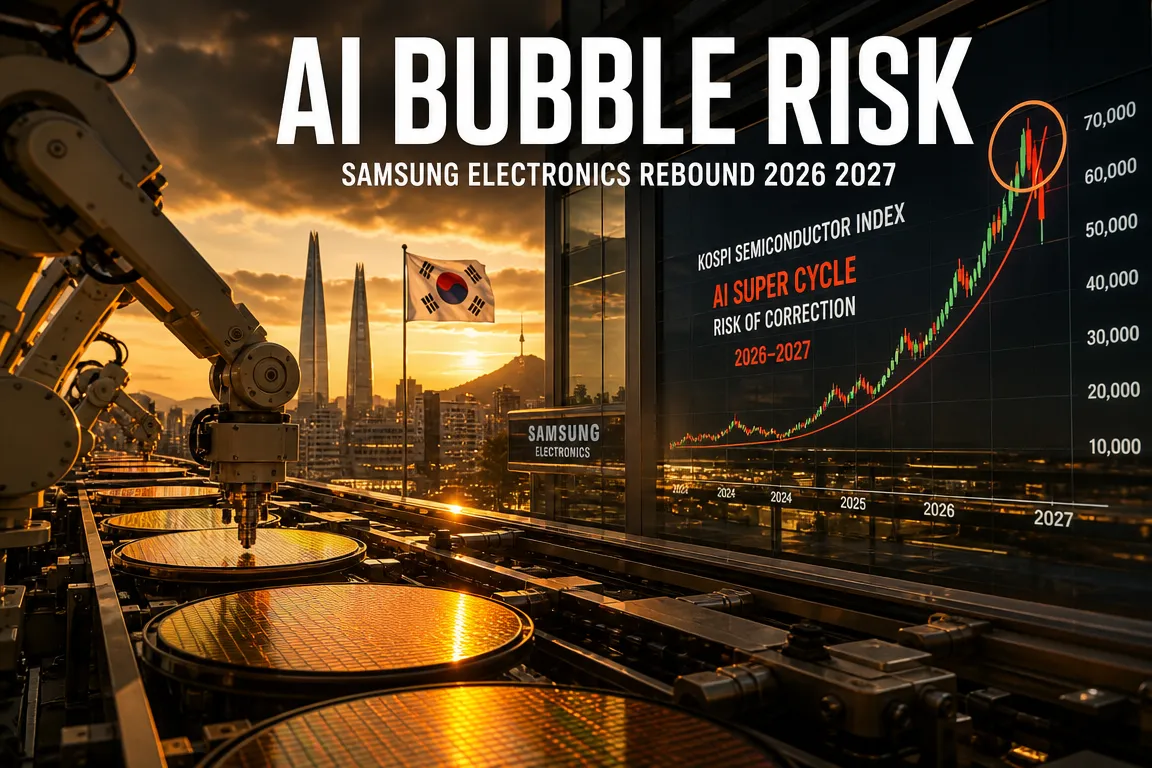
● AI-Revolution-or-Bubble-For-Korea,Semiconductor-Supercycle-Risk
AI Revolution or AI Bubble: Why the Semiconductor Supercycle and Capital Market Risk Must Be Viewed Together
The core message of this forum is straightforward.
AI is already a technological revolution, but from an investment perspective, the bubble debate is now intensifying.
For Korea’s economic outlook, the most important variables are the AI semiconductor supercycle, data center investment, U.S. Treasury yields, China’s AI catch-up, and the shift toward physical AI.
Markets are currently driven by both the expectation that AI will reshape the world and the concern that capital has become overly concentrated in one area.
This article reviews the debate across the real economy, equity markets, semiconductor exports, data centers, physical AI, and Korea’s policy response.
1. Professor Kim Gwang-seok’s view: AI-driven capital reallocation and Korea’s semiconductor opportunity
Professor Kim Gwang-seok identified capital reallocation as a key theme in the 2027 economic outlook.
Capital typically flows toward areas with the highest growth potential, but the current pattern shows an exceptional concentration in the AI sector.
He argues that this is not merely an investment trend, but a structural change in the global economic order.
- The AI value chain structure
AI services require AI models.
AI models require GPUs, HBM, and DRAM.
These semiconductors require data centers.
Data centers require power and communications infrastructure.
AI is therefore not just a service industry; it is a large value chain linking semiconductors, power, telecommunications, data centers, and manufacturing.
- Few countries are deeply embedded in the AI value chain
Among roughly 200 countries, only a limited number are materially integrated into the core AI value chain.
Kim estimated that the number is fewer than 10.
Korea is classified as a hardware exporter within this ecosystem.
This is a key reason Korea’s outlook differs from that of many other economies.
- Semiconductors now account for a much larger share of Korea’s exports
Historically, semiconductors accounted for around 10% of Korea’s exports.
More recently, that share has risen to around 20%, 25%, and even 40% in some periods.
In some short-term data points, semiconductors have approached nearly half of total exports.
Korea is now not only a semiconductor exporter, but also an exporter of smartphones, automobiles, home appliances, servers, and AI-related hardware built on semiconductor content.
2. Why Korea’s growth outlook improved despite Middle East risks
A particularly important point in the source material is that Korea’s growth forecast was revised higher despite Middle East conflict and energy risk.
Korea remains highly dependent on imported energy and Middle Eastern crude oil.
Economies with this structure are usually vulnerable to higher oil prices and geopolitical shocks.
Nevertheless, Korea’s growth outlook improved because AI semiconductor exports offset part of the shock.
- Middle East risk remains real
War pushes up global oil prices and adds inflation pressure.
Higher inflation makes rate cuts more difficult.
Persistently high rates weaken consumption and investment.
- AI semiconductor exports act as a buffer
Rising investment in AI data centers has boosted demand for HBM and GPU-related components.
Korea holds an important position in the AI memory supply chain through companies such as SK hynix and Samsung Electronics.
As a result, Korea has been able to absorb part of the energy shock through the semiconductor supercycle.
3. Why data centers have become core infrastructure in the AI era
In the AI era, the main bottleneck is no longer semiconductors alone.
Kim emphasized data centers and power infrastructure as critical variables.
As AI models grow larger and user adoption expands, data center demand increases rapidly.
- Global data center capacity continues to expand
The source cited roughly 12,500 data centers worldwide.
The number continues to rise on a daily basis.
This trend is unlikely to reverse quickly as AI adoption broadens.
- Power is the main constraint
A large data center can consume electricity comparable to the household usage of a city with a population of 1 million.
Accordingly, data center investment extends well beyond buildings to power grids, cooling, energy storage, transmission networks, nuclear power, and SMRs.
Investment analysis should therefore extend beyond semiconductor companies to include power infrastructure, transformers, power semiconductors, cooling systems, and cloud infrastructure.
4. From AI services to AI products: physical AI is the next cycle
Kim argued that the AI value chain is entering a new stage of expansion.
So far, the market has focused on AI services such as ChatGPT, Claude, and Gemini.
The next stage is the shift toward purchasing products embedded with AI.
- The AI service phase
Users rely on AI chatbots, search, writing, coding, and image generation services.
This phase is centered on cloud platforms, GPUs, data centers, and AI model companies.
- The AI product phase
AI is embedded in refrigerators, smartphones, PCs, automobiles, robots, microphones, and factory equipment.
An AI refrigerator can identify ingredients and place orders automatically.
An AI vehicle can support autonomous driving and operational optimization.
AI robots can partially replace human labor in manufacturing, logistics, livestock processing, shipbuilding, and defense.
- The core of physical AI
Physical AI does not refer only to humanoid robots.
It refers to the broader process in which machines, equipment, and products embedded with AI make decisions and act in the physical world.
This transition could create new growth opportunities for Korea’s manufacturing sector.
5. Professor Kim Young-ik’s view: AI is a revolution, but equities may still be in a bubble
Professor Kim Young-ik acknowledged that AI itself is a technological revolution.
However, he warned that the equity market may already be in a substantial bubble.
His key point is that technological revolution and investment returns are not the same thing.
- Technology can endure while invested capital is destroyed
Automobiles and electricity transformed the U.S. economy in the 1920s.
But expectations became excessive and the stock market later collapsed.
The internet also improved productivity in the 1990s, yet the Nasdaq fell by roughly 80% from its peak during the dot-com crash.
Kim argued that AI may follow a similar pattern: the technology remains, but overinvested capital may suffer losses.
- U.S. equities are at historically expensive valuations
By metrics such as P/E ratios, Tobin’s Q, and market capitalization relative to GDP, U.S. equities are trading at historically elevated levels.
He viewed the rapid rise in AI-related megacap stocks and the concentration of capital as signs of excess.
- AI financing structures also carry risk
AI companies are investing heavily in data centers and GPUs.
Some are funding these investments through private credit, corporate bonds, and external borrowing.
If rates rise further or credit spreads widen, this funding structure may come under pressure.
6. Signals of a potential AI bubble collapse, according to Kim Young-ik
Kim Young-ik did not argue that the AI bubble would burst because of flaws in the technology itself.
His focus was on macroeconomic and financial-market risks.
In other words, the AI industry may continue to grow even if equity markets correct first.
- U.S. 10-year Treasury yield approaching 5%
If U.S. Treasury yields approach 5%, funding costs rise sharply.
AI data center projects require large, long-duration capital commitments and are highly sensitive to interest rates.
Higher rates reduce the present value of future earnings and pressure growth-stock valuations.
- Widening credit spreads
The spread between high-yield bond yields and U.S. Treasury yields is a useful measure of financial stress.
A rapid widening indicates that investors are moving away from risk assets.
In that environment, highly valued AI stocks may be among the first to correct.
- Slowing U.S. consumption
Consumption accounts for a large share of U.S. GDP.
If household savings fall and real income weakens, consumer demand may soften.
Lower consumption would weigh on corporate revenue and earnings expectations, increasing pressure on equity markets.
7. Jun Joo-young’s view: it is too early to call an AI bubble
Chairman Jun Joo-young strongly rejected the bubble thesis.
He compared the current period to the railway buildout of the 19th century.
In his view, AI models are the trains and data centers are the railroads.
- Data center capacity remains insufficient
AI models require large-scale data center infrastructure to operate effectively.
He argued it is premature to discuss a bubble when 1 GW-scale data centers are still not sufficiently deployed.
By this logic, bubble concerns should only emerge after the infrastructure is widely built and utilization fails to follow.
- As long as GPU prices remain firm, AI is not in a bubble
Jun argued that GPU spot prices should be treated as a macro indicator.
Persistently strong GPU pricing indicates real demand.
Unlike ordinary consumer electronics, high-performance GPUs continue to command premiums.
- AI models are now moving into factories
He said the next phase after digital AI such as ChatGPT is physical AI in manufacturing.
Once AI enters factories, production, quality control, safety, logistics, and robot control can all change materially.
Because this shift is still at an early stage, current data center investment and semiconductor demand remain justified.
8. Palantir and K-Rantier: Korean manufacturing data is the real asset
Jun placed particular emphasis on Palantir.
Palantir is not simply a software company; it connects manufacturing data and structures it so AI can interpret it.
He argued that Korea should develop its own version of K-Rantier.
- Manufacturing data is fragmented
Factories contain separate datasets for equipment, production, quality, finance, and labor.
For AI to work effectively, these data must be linked within a unified context.
- Why ontology matters
Ontology defines the relationships and context between data points.
For example, it enables AI to understand manufacturing knowledge such as “if condition A occurs, problem B is likely.”
Ontology is essential if physical AI is to control factories and robots effectively.
- Korea must protect its manufacturing expertise
Korea is a manufacturing leader in semiconductors, shipbuilding, automobiles, batteries, and displays.
However, if operational know-how and data become dependent on overseas AI platforms, long-term competitiveness may weaken.
Jun stressed that Korea should build local physical AI companies before foreign platforms capture manufacturing data.
9. China’s AI and semiconductor catch-up: a risk Korea cannot ignore
A point that is often underemphasized in other coverage is China’s rapid advance.
AI competition should not be viewed only through U.S. big tech.
China is advancing quickly in low-cost AI models, memory semiconductors, LiDAR, humanoid robots, and robot hands.
- Price competitiveness in Chinese AI models
U.S. AI models are stronger in performance, but they are also more expensive.
Users may increasingly adopt low-cost Chinese AI models as the default and use U.S. AI only for high-complexity tasks.
If that trend expands, it could also affect the revenue outlook for U.S. AI firms.
- China’s challenge in memory semiconductors
The source noted concern that Korea’s DRAM share is facing pressure from Chinese players such as CXMT.
Korea remains strong in HBM, but China’s price competitiveness may challenge the broader DRAM market.
- China’s speed in LiDAR and robotics components
The text cited cases in which Chinese firms undercut previously expensive U.S. LiDAR suppliers and reshaped market structure.
China is also moving rapidly in humanoid robotics through scale manufacturing and component supply chains.
Its advantage in components such as robot hands is a key issue Korea must monitor closely.
10. AI and inflation: inflationary in the short term, deflationary over the long term
A major question in the discussion was whether AI raises or lowers prices.
The conclusion is that the effect must be viewed separately in the short and long term.
- Inflationary pressure in the short term
As AI data center investment increases, demand for GPUs, HBM, servers, and power rises sharply.
Higher semiconductor prices can push up the cost of AI servers and electronics.
Rising electricity demand may also increase utility costs and infrastructure spending.
This can be seen as a form of chip-driven inflation.
- Deflationary pressure over the medium to long term
AI can increase productivity and lower the cost of producing goods and services.
Costs in law, consulting, education, finance, manufacturing, and logistics may decline.
As robotics and physical AI spread, labor input costs may also fall.
Over time, AI is likely to act as a deflationary force through productivity gains.
11. Why the real economy and the capital market must be distinguished
The most important issue in the forum was the distinction between the real economy and the capital market.
The semiconductor industry may be in a supercycle.
At the same time, semiconductor stocks may already be overheated.
Both statements can be true.
- Real-economy perspective
AI demand continues to rise.
Data center supply remains insufficient.
Demand for GPUs and HBM remains strong.
Physical AI is still in an early stage.
As a result, the industrial cycle remains favorable.
- Capital-market perspective
Stock prices already discount future expectations.
Rising U.S. Treasury yields pressure growth-stock valuations.
If credit risk rises, highly valued technology stocks may correct first.
Therefore, even if the AI industry improves, AI equities may still face short-term weakness.
12. The most important points often omitted in other coverage
First, the AI semiconductor supercycle is driven more by pricing effects than by volume alone.
The rise in semiconductor export value reflects not only higher shipments, but also stronger pricing.
When HBM, GPU, and high-performance DRAM prices remain firm, Korea’s exports look strong.
However, if the price cycle turns, export growth can slow quickly.
Second, Korea’s AI-driven improvement masks widening internal divergence.
Semiconductor companies and non-semiconductor companies are experiencing very different business conditions.
Companies inside the AI value chain are enjoying a boom, while those outside it may still feel little recovery.
National growth figures can therefore create an illusion of broad-based improvement.
Third, the key competition in AI may shift from models to manufacturing data.
The U.S. is strong in AI models.
China is strong in robot mass production and cost competitiveness.
Korea is strong in manufacturing data and process expertise.
If Korea fails to convert this manufacturing data into AI capability, its core advantage may migrate to foreign platforms.
Fourth, AI bubble assessment should consider GPU prices and data center utilization, not only stock prices.
If GPU spot prices remain firm and data center leasing demand stays strong, underlying demand is still intact.
By contrast, falling GPU prices and rising vacancy rates would signal weakening momentum in the AI investment cycle.
Fifth, AI may become Korea’s largest manufacturing opportunity since national industrialization.
If Korea remains only a semiconductor supplier, it will remain exposed to cyclical limitations.
But if it builds a physical AI, manufacturing AX, and K-ontology ecosystem, it can evolve into a country that supplies the operating system of manufacturing.
13. Investor response strategy
- Separate the AI industry from AI equities
AI is a long-term growth industry.
However, AI-related equities can move sharply with interest rates, valuation, and liquidity conditions.
Positive industry fundamentals do not automatically justify buying at any price.
- Monitor U.S. Treasury yields and credit spreads
As the U.S. 10-year Treasury yield approaches 5%, growth stocks face greater pressure.
Widening high-yield spreads signal rising risk aversion.
Macroeconomic indicators are essential, not optional, in AI investment analysis.
- Semiconductors are in a supercycle, but pricing cycles still matter
HBM prices, DRAM prices, GPU supply, and data center investment pace should all be monitored.
Slower export growth should also be tracked closely.
- Cash allocation is also a strategy
Kim Young-ik argued that crises can create opportunities to add assets at attractive prices.
If a correction occurs, high-quality companies may become more attractive.
That requires liquidity and patience.
14. Strategic response for companies and policymakers
- Companies must move into the AI value chain
Firms must either build AI or use AI to improve productivity.
Companies that remain outside the AI ecosystem may face widening competitive gaps.
- Manufacturing firms must open and structure their data
AI adoption is limited when factory data remains fragmented.
Production, quality, safety, equipment, and financial data must be connected.
This is where Korea should develop local manufacturing AI platforms.
- Government must invest in power infrastructure and the AI manufacturing ecosystem
Data center expansion requires reliable power infrastructure.
SMRs, power semiconductors, transmission networks, energy storage systems, and cooling technologies will all become more important.
Policy support limited to semiconductors alone will not be sufficient.
- The startup ecosystem must be linked to global markets
Jun said Korea’s innovation ecosystem is among the strongest globally.
He sees strong potential for physical AI startups linked to Japan, Southeast Asia, and U.S. manufacturers.
Korean startups need more pilot opportunities and data access so they are not blocked by domestic conglomerate barriers.
15. Conclusion: AI is a revolution, markets are cycles
The forum’s conclusion cannot be reduced to a single position.
AI is clearly a revolution.
But equity markets can still overheat.
Semiconductors may be entering a supercycle.
But semiconductor stocks can still correct in response to rates and liquidity conditions.
Korea has gained an opportunity from AI.
At the same time, it faces Chinese competition, U.S. rates, credit risk, and weakness outside the semiconductor sector.
The key question is no longer simply whether AI is a bubble, but whether one is positioned inside the AI value chain.
Individuals, companies, and governments all need to answer that question.
< Summary >
AI is a technological revolution, but bubble concerns are rising in equity markets.
Korea is benefiting from the AI semiconductor supercycle in exports and growth.
However, higher U.S. Treasury yields, widening credit spreads, and softer U.S. consumption pose correction risks for AI equities.
Data center investment and power infrastructure are likely to become the key bottlenecks in the AI industry.
The next stage is not only chatbot-based AI services, but physical AI embedded in manufacturing and robotics.
Korea should leverage its strengths in semiconductors, shipbuilding, automobiles, and manufacturing data to build a K-Rantier and manufacturing AX ecosystem.
Investors should distinguish between the long-term growth of the AI industry and the short-term cycle of capital markets.
[Related Articles…]
- AI Semiconductor Supercycle and Korea Economic Outlook
- Data Center Investment and Power Infrastructure Reshaping the AI Industry
*Source: [ 경제 읽어주는 남자(김광석TV) ]
– AI는 혁명인가? 거품인가? 반도체 슈퍼사이클 Vs 거품붕괴 | 경읽남x연합뉴스TV 콜라보 | 김광석-김영익-정주용
● Samsung Rebound, AI Supercycle, Hidden Surge
Samsung Electronics Stock and the Semiconductor Supercycle: The Key Shift Korean Investors Are Missing
The main issue is not simply whether Samsung Electronics will rise or fall.
The market is now beginning to reassess Samsung Electronics not as a traditional cyclical stock centered on smartphones and consumer electronics, but as a key beneficiary of AI semiconductors and the recovery in memory demand.
In particular, the combination of recovering semiconductor exports, expectations for improved HBM competitiveness, rising memory prices, and potential earnings growth in 2026-2027 is increasing the likelihood of a reentry into a semiconductor supercycle.
Domestic retail investors have been selling Samsung Electronics, while global capital is already responding to the recovery in Korea’s exports and the expansion of AI infrastructure investment.
1. News Summary: Market Sentiment Toward Samsung Electronics Is Changing
The reference date is September 8, and the most sensitive market keywords at the time were Samsung Electronics, semiconductors, AI, exports, and the potential for a rebound in equities.
- First: Korea’s semiconductor exports are recovering more strongly than expected.
- Second: Memory semiconductors are being assessed as entering a new upcycle.
- Third: Samsung Electronics may sustain high profitability, even if not at the peak margins seen in past supercycles.
- Fourth: Earnings growth in absolute terms may accelerate from the second half of 2026 through 2027.
- Fifth: Expectations are rising that Samsung Electronics could attempt to break above previous highs, similar to Nvidia.
Accordingly, Samsung Electronics should not be viewed through short-term price action alone.
The market is increasingly pricing in the semiconductor cycle beyond 2025, 2026 earnings, and AI demand in 2027.
2. Why the Market Says “Only Korean Retail Investors Are Missing It”
Many domestic retail investors have become fatigued after holding Samsung Electronics for an extended period.
Repeated expectations of 70,000 won, 80,000 won, and 90,000 won levels have increased investor fatigue, and many have tended to sell whenever the stock moves higher.
Foreign and institutional investors are viewing the stock differently.
They are analyzing Samsung Electronics not simply as a large-cap stock, but as a central company in the restructuring of the AI semiconductor supply chain.
- Expansion in AI data center investment is increasing memory demand.
- Demand for HBM, DDR5, and high-capacity server DRAM is structurally increasing.
- After production cuts, supply cannot expand quickly.
- Rising demand and constrained supply may create a favorable pricing cycle.
- This trend directly benefits Korean semiconductor companies such as Samsung Electronics and SK Hynix.
In short, domestic retail investors are looking at the past Samsung Electronics, while global investors are looking at its future.
3. The Semiconductor Supercycle: What Is Different This Time
Past semiconductor supercycles occurred when smartphone, PC, and server demand improved simultaneously.
This cycle is different.
The key driver is AI infrastructure investment.
Since the launch of ChatGPT, global technology companies have significantly increased spending on AI servers and data centers.
This requires more than GPUs alone.
HBM, high-performance DRAM, server SSDs, and high-capacity NAND are also required alongside GPUs.
- Higher AI server deployment: increased demand for high-performance memory
- Data center expansion: stronger demand for server DRAM and SSDs
- HBM supply shortages: potential price increases in high-value-added memory products
- Production cuts: reduced oversupply and improved profitability
- Export recovery: improved expectations for Korea’s growth and corporate earnings
Therefore, this cycle should be viewed not as a simple cyclical recovery, but as a structural cycle linked to AI industry growth.
4. Samsung Electronics Earnings Outlook: Why the Second Half of 2026 Through 2027 Matters
The most important point in the discussion is that Samsung Electronics’ earnings could expand from the second half of 2026 through 2027.
Semiconductor stock prices typically reflect future earnings before current results.
In other words, if earnings improvement is visible for 2026 and beyond, the stock may begin moving in advance during 2025.
Even if Samsung Electronics does not see a sharp surge in operating margin as in the past, it may still maintain strong profitability while increasing earnings in absolute terms.
- Higher memory prices would support revenue growth.
- A larger share of high-value products would improve operating margins.
- Rising demand for AI server memory could increase the likelihood of long-term supply contracts.
- Recovery in HBM competitiveness could support valuation re-rating.
- Continued export growth could improve overall sentiment toward Korean equities.
If this trend materializes, Samsung Electronics may move beyond a trading range and enter a phase in which it attempts to break prior highs.
5. What the Expression “Retail Investors in Samsung Are Already Out” Really Means
This expression is provocative, but its core message is a warning that retail selling may be misaligned with the timing of the industry upturn.
Samsung Electronics has underperformed expectations for an extended period, leaving many retail investors with significant disappointment and realized losses.
However, signs increasingly suggest that the semiconductor cycle has already moved past its bottom and into recovery.
The issue is that the stock market tends to reflect such changes very quickly.
By the time investors confirm stronger results, the stock may already have risen significantly.
- Retail investors tend to judge based on past earnings and current prices.
- Foreign investors tend to judge based on future earnings and the industry cycle.
- Institutional investors look at export data, memory prices, and AI investment trends together.
- As a result, it is common for retail investors to sell while foreign investors buy.
The key point is not that Samsung Electronics must be bought at any cost.
The point is that investors may miss the opportunity if they rely only on past sentiment when the semiconductor cycle is turning.
6. The Real Key Point That Is Often Missing in Other Coverage
The most important issue is not Samsung Electronics alone, but the pricing power of the memory industry.
Many analyses focus only on Samsung Electronics’ stock price target or HBM execution.
However, the real issue is whether memory semiconductor producers are regaining pricing power.
When the semiconductor market is weak, customers pressure prices downward.
When demand is strong and supply is constrained, producers can raise prices.
Samsung Electronics and SK Hynix are important this cycle because of this dynamic.
- AI server demand continues to grow.
- HBM production requires more processes and time than conventional DRAM.
- As high-performance memory output increases, supply of standard DRAM may tighten.
- This structure can drive broad memory price increases.
- Price increases have a greater impact on operating profit than on revenue.
In other words, Samsung Electronics’ real turning point is not only HBM share recovery.
The more important factor is that AI demand is changing the economics of the memory market as a whole.
7. Why Samsung Electronics Matters for Korea’s Economic Outlook
Samsung Electronics affects not only the Korean equity market but also Korea’s broader economic outlook.
Semiconductors are central to Korea’s exports, and exports are one of the most important variables for Korea’s GDP growth.
If semiconductor exports improve, the following chain effects may follow:
- Higher Korean exports
- Improved corporate earnings
- More stable trade balance
- Potential stabilization of the won
- Improved sentiment in the KOSPI
- Greater potential for foreign capital inflows
For this reason, Samsung Electronics should not be viewed only as a single-stock issue.
Recovery in semiconductor exports is a key variable that can shape the direction of the entire Korean equity market.
8. Key Indicators Investors Should Monitor Now
When evaluating Samsung Electronics and the semiconductor cycle, headlines alone are not sufficient.
The following indicators should be monitored together:
- First, memory prices: whether DRAM and NAND prices continue to rise
- Second, HBM supply: whether Samsung Electronics is improving its HBM competitiveness
- Third, foreign ownership flows: whether foreign investors continue buying Samsung Electronics and Korean equities
- Fourth, Korean export data: whether semiconductor export growth remains intact
- Fifth, U.S. mega-cap technology spending: whether AI data center investment remains strong
- Sixth, interest rate trends: easing expectations generally support growth and semiconductor valuations
Among these, the most important are memory prices and AI data center investment.
If both remain strong, the probability of a semiconductor supercycle remains elevated.
9. Clear Risks Remain
Although there are multiple positive signals for Samsung Electronics and the semiconductor cycle, excessive optimism would be risky.
- HBM competitiveness may not improve as quickly as expected.
- Concerns over AI investment overheating could lead to a correction in semiconductor stocks.
- Higher U.S. interest rates and a strong dollar could pressure foreign flows.
- A slowdown in China could limit the recovery in IT demand.
- Rapid share-price gains could trigger profit-taking.
Accordingly, Samsung Electronics should be approached by tracking whether the semiconductor cycle and earnings estimates are actually improving, rather than by chasing short-term price spikes.
10. Core Conclusion: Samsung Electronics Is Reentering the Center of the Cycle
The conclusion is clear.
Samsung Electronics may be re-rated not merely as an established blue-chip stock, but as a core beneficiary of the AI semiconductor era.
Semiconductor exports are improving, and the likelihood of a recovery in memory prices is increasing.
Potential earnings growth from the second half of 2026 through 2027 is a meaningful support for the stock.
The market prices future earnings ahead of current results.
Therefore, what many retail investors are missing now is not short-term volatility, but the turn in the semiconductor industry as a whole.
It is still too early to say whether Samsung Electronics will stage a strong breakout similar to Nvidia.
However, it is clear that the market has begun to view Samsung Electronics differently.
< Summary >
The key issue for Samsung Electronics is the potential reentry into a semiconductor supercycle.
Korea’s semiconductor exports are recovering strongly, and AI data center expansion is structurally increasing memory demand.
Samsung Electronics’ operating profit and earnings could increase from the second half of 2026 through 2027.
Domestic retail investors are selling due to fatigue, while global investors are focusing on AI semiconductors and Korea’s export recovery.
The most important overlooked point is not only HBM, but that memory producers are regaining pricing power.
However, HBM competitiveness, AI spending excesses, interest rates, and foreign capital flows must all be monitored carefully.
[Related Articles…]
- Semiconductor Supercycle and Korea Equity Outlook
- AI Semiconductor Trends and the Global Economic Outlook
*Source: [ 달란트투자 ]
– “지금 한국만 모르고 있어요” 삼성전자 관련 충격 소문 | 민재기 팀장 2부