● Fed Shock, AI Boom, Market Risk
Key Pre-FOMC Checks for U.S. Equities: Inflation, Rate Hikes, Nvidia, Tesla, and AI Investment Risks Investors Often Miss
The main point of this piece is not simply whether the FOMC will raise or cut rates.
What matters more is why markets rise even after CPI data, why Treasury yields do not fall easily, and why Fed rate hikes may not fully contain inflation.
In particular, while much of the news flow and commentary focuses on surface-level topics such as oil, CPI, carry trades, and Michael Burry’s long or short positions, a more important set of variables is driving the U.S. equity market.
This review covers the structure of U.S. inflation ahead of the FOMC, upward pressure on Treasury yields, the AI data center investment cycle, diesel prices and logistics costs, technical interpretation of Nvidia and Tesla, and common macro misreads among investors.
1. What the Market Fears Before the FOMC Is Not “Rates” but a Structural Shift in Inflation
Ahead of the FOMC, investors usually focus on the policy rate decision.
However, the core message from the source material is that U.S. inflation is not over yet.
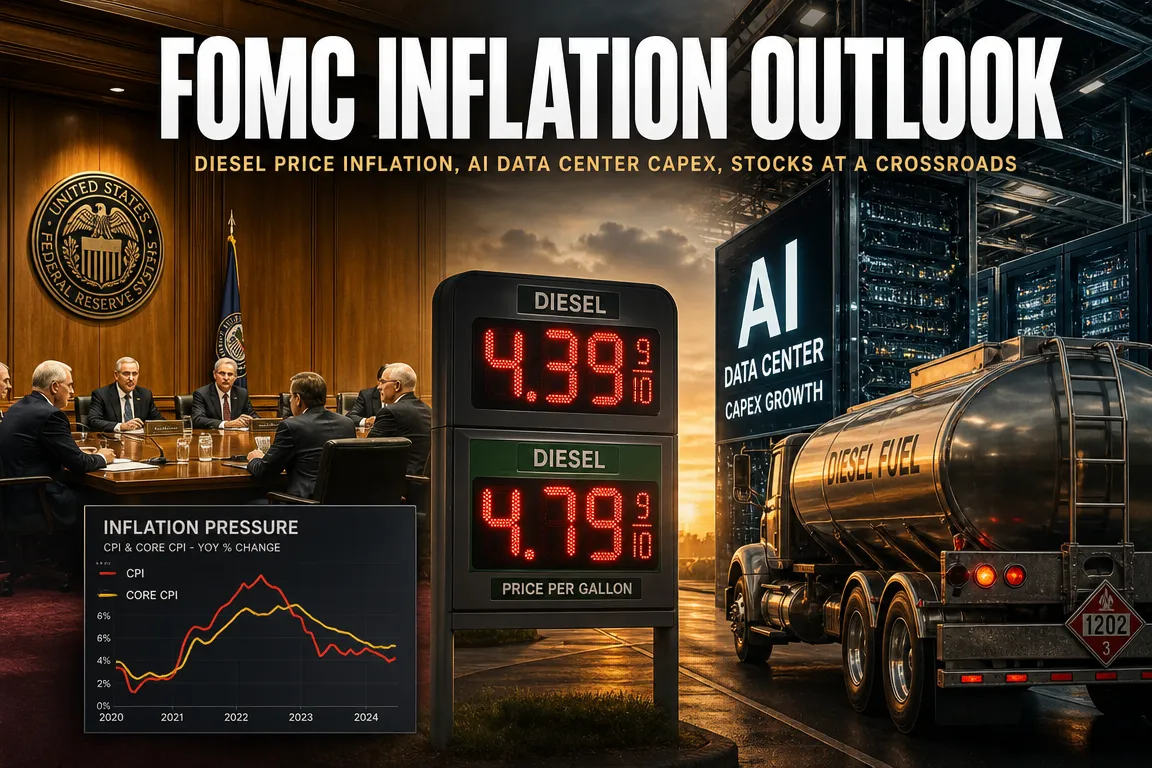
The key issue is that inflation is no longer explained by oil alone.
Many headlines say inflation rises when oil rises and stabilizes when oil falls.
Oil does affect prices.
But current U.S. price pressure reflects structural drivers that are difficult to explain with oil alone.
- Higher diesel prices
- Higher trucking costs
- Higher air-freight rates
- Higher electricity costs
- Rising power demand from AI data centers
- Tariffs and supply-chain costs
- Potential expansion in government spending
These factors do not disappear after a single rate hike.
In other words, the key issue is not whether the Fed raises rates, but whether inflation is becoming more difficult for the Fed to control.
2. The CPI Interpretation Trap: Why Stocks Can Rise Even When Inflation Is Higher
U.S. equities sometimes rise even when CPI comes in above expectations.
Common explanations include:
“Energy inflation is temporary.”
“Core CPI is still manageable.”
“The market has already priced in the bad news.”
These views are not necessarily wrong, but they are incomplete.
The source material emphasizes that market sentiment and technical support levels can matter more than CPI alone.
For example, if a key support level in Nasdaq 100 futures holds, the market may rebound even after a somewhat unfavorable CPI reading.
Conversely, even a benign CPI print may not prevent weakness if a major support level breaks.
In other words, assuming that higher inflation automatically means lower stock prices is too simplistic.
U.S. equities are driven by more than data releases.
Sentiment, positioning, options expiration, futures support levels, liquidity, and sector rotation all interact.
3. Why Relying Only on Core CPI Can Be Misleading
The source material is critical of excessive reliance on core CPI.
Core CPI excludes food and energy.
Economically, this is intended to remove volatile items and identify the underlying trend.
However, in daily life, food and energy are essential.
People eat, travel, and consume electricity every day.
As a result, even if core CPI appears stable, consumers may continue to experience elevated inflation.
Inflation is cumulative.
A lower inflation rate does not mean prices are falling.
It means prices are still rising, but at a slower pace.
When prices are already high, another 0.3% or 0.4% monthly increase still creates substantial pressure.
Investors ahead of the FOMC should understand this distinction.
There can be a gap between what the Fed sees in the data and what consumers experience in practice.
4. Why Rate Hikes May Not Be Enough to Contain Inflation
One of the most important points in the source material is that rate hikes cannot solve all forms of inflation.
Higher policy rates can reduce demand by restraining consumption and investment.
But inflation driven by supply-side factors is much harder to address through rates alone.
Examples include oil rising due to Middle East risk, diesel prices increasing because of Russian export constraints, or import costs rising due to tariffs.
The Fed cannot remove geopolitical risk with a rate hike.
The Fed cannot resolve diesel supply disruptions with a rate hike.
The Fed cannot stop AI data center construction simply by tightening policy.
That is the key point.
Current U.S. inflation pressure is not only the result of excessive demand.
It also reflects AI investment, power demand, logistics costs, geopolitical risk, and fiscal spending.
5. The AI Investment Boom Will Not Easily Stop Because of Higher Rates
AI data center investment is now a central driver of the U.S. economy and the semiconductor market.
Nvidia, AMD, Micron, Broadcom, and SK Hynix sit at the center of the AI infrastructure cycle.
The source material cites a CNBC view that expected returns from AI investments are far above funding costs, making it difficult to halt spending even as rates rise.
This is an important distinction.
Ordinary consumers reduce borrowing when rates rise.
Home purchases become harder, auto financing becomes more expensive, and credit card costs increase.
Large technology companies behave differently.
AI data centers, GPUs, HBM, power infrastructure, and cloud server investment are tied to competitive survival.
A modest increase in rates is unlikely to stop Microsoft, Google, Amazon, or Meta from continuing AI spending.
As a result, rate hikes may pressure consumers and real estate, but they may not immediately interrupt the AI investment cycle.
This is highly relevant when assessing semiconductor stocks after the FOMC.
6. Diesel Prices Are the Hidden Inflation Variable
Another point emphasized more strongly than other headlines is diesel prices.
Most investors focus on WTI crude.
But diesel has a more direct effect on U.S. logistics, agriculture, aviation, and trucking.
Large trucks, farm equipment, and logistics systems in the U.S. depend heavily on diesel.
When diesel prices rise, agricultural production costs increase.
Transportation costs increase.
Retail prices can rise.
Higher fuel and freight costs can also affect airfares.
In short, higher diesel prices can spread through consumer prices more broadly.
This is easy to miss if one only watches the oil chart.
To assess U.S. inflation properly, investors should track diesel, freight, electricity, and logistics costs alongside WTI.
7. Why Treasury Yields Are Not Falling Easily
U.S. Treasury yields are one of the most important variables around the FOMC.
Higher Treasury yields pressure valuation multiples, especially for growth stocks such as Nasdaq names, AI semiconductors, and Tesla.
The source material warns that it is risky to assume Treasury yields will fall simply because the U.S. Treasury is buying back debt or attempting to stabilize rates.
The reason is straightforward.
The U.S. government must issue a very large volume of debt.
If new issuance and market supply exceed buyback activity, yields are difficult to suppress.
In addition, if foreign holders such as China and Japan reduce their Treasury exposure, supply pressure increases further.
If the government also expands fiscal spending ahead of elections, issuance pressure may intensify.
Ultimately, Treasury yield stability is not solved simply by expecting the Fed to cut rates soon.
Fiscal deficits, debt issuance, foreign demand, and inflation expectations must all be considered.
8. Carry Trade Panic May Be Overstated
The market has recently discussed concerns about Japanese rate hikes and the unwinding of yen carry trades.
A yen carry trade involves borrowing in low-yielding yen and investing in higher-return assets.
The argument is that if Japanese rates rise, this capital may reverse and pressure U.S. equities.
However, the source material advises against taking this concern too literally.
When U.S. equities sell off, the capital leaving the market is not only carry-trade money.
Capital from Korea, Europe, Canada, institutions, and hedge funds may also move at the same time.
In other words, it is risky to explain market weakness solely through yen carry-trade unwinding.
The more important factors are U.S. market fundamentals, liquidity, rates, and investor sentiment.
Using Japanese rate-hike headlines alone to make a U.S. equity decision is too narrow an approach.
9. How to View the Michael Burry, Lululemon, and Nvidia Short-Covering Narrative
The source material also addresses Michael Burry’s long position in Lululemon and the reduction of his Nvidia short exposure.
The main point is that investors should not blindly follow famous investors.
When headlines say Michael Burry bought Lululemon, many investors begin to analyze the company immediately.
But the source material suggests that consumer names such as Lululemon may already reflect slowing demand, brand fatigue, and prior price weakness.
Stocks that have already fallen significantly can stage technical rebounds.
But a rebound does not necessarily imply a durable recovery.
Some names, such as PayPal, have fallen sharply without fully recovering.
Therefore, buying simply because a stock has declined is not a reliable strategy.
The same applies to Nvidia.
A reduction in Michael Burry’s short position should not be interpreted in isolation.
If Nvidia weakens, it may reflect not only the stock itself but also the broader semiconductor complex, the AI investment cycle, and Nasdaq sentiment.
Because Nvidia is central to the AI cycle, short-selling headlines alone are not sufficient for judgment.
10. Tesla: FSD, Cybercab, and the Non-Rare-Earth Motor Issue
For Tesla, the source material refers to the potential launch of FSD in Germany and a motor-related issue for Cybercab.
In particular, a new motor for Cybercab may be smaller, lighter, and potentially free of rare earth materials.
If confirmed, this would matter for Tesla’s cost structure and supply-chain risk.
Reducing rare-earth dependence would lower exposure to Chinese supply-chain risk.
A smaller, lighter motor could also improve vehicle efficiency and manufacturing costs.
That said, the source material treats this as unconfirmed information.
Investors should focus not only on whether Tesla issues good news, but on when and to what extent it can be reflected in earnings and margins.
From a technical perspective, the source material highlights support near $360 and the possibility of a retest near $330 if that level fails.
This is a technical view from the source, not investment advice.
11. SK Hynix and Semiconductors: The AI Cycle Requires Both Upside and Risk Assessment
SK Hynix is mentioned in the title, although the body of the source provides limited company-specific analysis.
Even so, if AI investment and the Nvidia semiconductor cycle are considered together, SK Hynix becomes an important name.
SK Hynix is widely viewed as a key supplier in the HBM market.
Strong demand for AI servers and GPUs can support demand for HBM.
However, semiconductor stocks can decline even when earnings are strong, and they can rise on expectations even when results are mixed.
As a result, memory semiconductor names such as SK Hynix and Micron should be evaluated alongside AI demand, HBM pricing, customer investment plans, Treasury yields, and Nasdaq trends.
If rates move sharply after the FOMC, semiconductor valuations may react quickly.
12. SpaceX and Rocket Lab: The Space Industry Is a Funding Game, Not Just a Theme
The title also mentions SpaceX, while the body of the source discusses Rocket Lab from a chart perspective.
SpaceX is a private company and is not directly accessible to most investors.
Still, its growth influences sentiment toward the broader space industry.
Listed space companies such as Rocket Lab may benefit from that sentiment.
However, the space industry is too volatile to treat as a simple long-term theme.
Higher rates increase the discount rate on future cash flows and can pressure unprofitable growth stocks.
Accordingly, Rocket Lab should be assessed not only for technology but also for cash flow, orders, launch schedules, and financing risk.
The source material repeatedly refers to specific price zones for Rocket Lab, but for small-cap growth names, entry levels and stop-loss discipline matter.
13. Gold and Commodities: The Simple View That “Weak Equities Mean Strong Gold” Is Risky
The source material also takes a cautious view on gold.
Gold is influenced by the dollar, real yields, inflation expectations, and geopolitical risk.
However, it is risky to assume that weak U.S. equities automatically lead to stronger gold, or that commodities will simply rise across the board.
If the U.S. equity market sells off sharply and recession fears rise, commodity demand can weaken as well.
Gold has safe-haven characteristics, but it does not outperform in every downturn.
To assess gold properly, investors should examine the direction of the dollar, Treasury yields, real yields, central bank buying, and geopolitical risk.
The source material concludes that no clear high-conviction view on gold is visible at present.
14. More Important Than Individual Names Is Where You Buy and How You React
A repeated message in the source material is that entry level and response strategy matter more than company analysis alone.
Company analysis is still necessary.
But individual investors cannot fully analyze every business detail.
Even good companies can be difficult to hold if purchased at the wrong valuation.
Conversely, even an imperfect company can generate a short-term gain when bought near an important support area.
Therefore, U.S. equity investing should follow this sequence:
- First, identify the broad market trend.
- Second, check Nasdaq and S&P 500 futures support levels.
- Third, assess the sector backdrop.
- Fourth, review the stock’s price structure and volume.
- Fifth, factor in earnings and FOMC-related event risk.
- Sixth, define an exit or response plan before entering the position.
Ultimately, investing is not about predicting perfectly; it is about responding effectively.
15. Key Indicators to Watch Before the FOMC
Before the FOMC, investors should look beyond the policy-rate forecast.
The following indicators should be checked as well:
- Direction of the U.S. 10-year Treasury yield
- Dollar index trends
- WTI crude and diesel prices
- Nasdaq 100 futures support levels
- S&P 500 mini futures trends
- Semiconductor index performance
- Order flow in AI-related stocks
- Detailed CPI and PCE components
- Tone of Fed officials’ comments
- U.S. Treasury issuance schedule
The source material also emphasizes the importance of monitoring S&P 500 mini futures and Nasdaq futures in real time.
U.S. traders typically monitor /ES and /NQ as reference points.
However, free platforms may have a delay, so investors should verify whether the data is truly real time.
16. The Most Important Point Rarely Emphasized by Other News or Videos
The most valuable part of the source material is the warning that inflation should not be reduced to oil alone.
Most news coverage repeats oil and CPI.
But the hidden drivers of U.S. inflation include diesel, logistics, power, AI data center investment, tariffs, and government spending.
In particular, the AI investment boom may not be easily halted by higher interest rates.
Large technology companies may continue spending on data centers because falling behind in AI could threaten long-term corporate value.
That process can raise power demand, increase infrastructure costs, and eventually add pressure to inflation and Treasury yields.
In other words, the AI revolution is a growth driver for equities, but it may also become a new source of inflation pressure for the macro economy.
This duality is a central theme for U.S. equities going forward.
17. Simplistic Interpretations Investors Should Avoid
- Following Michael Burry simply because he bought is risky.
- Assuming stocks must fall whenever CPI is high is too simple.
- Believing that rate hikes alone will solve inflation is not consistent with current conditions.
- Explaining U.S. equity weakness solely through carry-trade unwinding is overstated.
- Assuming AI spending will stop immediately because of higher rates is also premature.
- Watching only oil can cause investors to miss diesel and logistics costs.
- Buying a quality company at an excessive price can still lead to prolonged underperformance.
18. U.S. Equity Strategy After the FOMC
After the FOMC, the market reaction matters more than the policy decision itself.
Even if rates are left unchanged, a hawkish Powell tone can pressure markets.
Even if rates are raised, markets can rebound if the decision was already expected.
Investors should therefore focus less on prediction and more on response rules.
- Check whether Nasdaq 100 futures hold key support.
- Monitor whether Treasury yields spike sharply.
- Track whether the dollar strengthens abruptly.
- Observe whether Nvidia and other semiconductor leaders hold up.
- Review flows into Tesla, Meta, and AMD.
- For smaller growth names, wait for pullbacks and clear support areas rather than chasing strength.
- For stocks approaching earnings, account for event risk.
In practice, the FOMC is not a prediction event; it is a risk-management event.
19. Key Stock-Level Watch Points
Nvidia is the core of the AI investment cycle.
Focus on data center spending, GPU demand, and the broader semiconductor complex rather than short-selling headlines.
Tesla has long-term catalysts in FSD, robotaxis, Cybercab, and the non-rare-earth motor narrative.
In the near term, technical support and market sentiment are more important.
SK Hynix is a key beneficiary of HBM demand and AI server growth.
However, memory semiconductors must be assessed through pricing, supply-demand balance, and customer capex plans.
Micron reflects the U.S. semiconductor cycle and HBM expectations.
Volatility can increase around earnings releases.
Broadcom is tied to AI networking and custom chip demand.
After strong advances, support levels become important.
Rocket Lab may benefit indirectly from the sentiment created by SpaceX and the broader space sector.
However, as a small-cap growth name, it carries significant volatility and financing risk.
Lululemon combines consumer slowdown risk with rebound potential.
A stock that has fallen sharply is not automatically a durable long-term recovery candidate.
20. Conclusion: The Real Pre-FOMC Question Is Not the Rate Forecast Table
Before the FOMC, many investors focus on rate-probability tables.
But the more important issue is which risks the market has already priced in and which risks remain underappreciated.
Potentially underestimated risks include diesel prices, logistics costs, AI power demand, debt-issuance pressure, and the possibility of greater fiscal spending.
Potentially overstated risks include carry-trade panic, a single CPI print, and headlines about famous investors’ buys or sells.
The U.S. equity market is becoming more complex.
In that environment, a framework and a response plan matter more than a simple forecast.
After the FOMC, whether the market moves up or down, the key question is not why it moved, but what price and what rules will guide your response.
This is not investment advice, and all investment decisions and responsibility rest with the investor.
< Summary >
The main pre-FOMC focus is not the rate decision itself, but the changing structure of inflation.
U.S. inflation is being driven not only by oil, but also by diesel, logistics, electricity costs, AI data center investment, tariffs, and government spending.
Fed rate hikes can reduce demand, but they cannot quickly stop supply-driven inflation or the AI investment boom.
Stocks can rise even after a high CPI reading because market sentiment and technical support levels also matter.
Relying solely on carry-trade fears, famous investor trades, or a simple oil narrative can cause investors to miss the real drivers.
Nvidia, Tesla, SK Hynix, and Rocket Lab should be evaluated through AI investment trends, rates, Treasury yields, and chart support levels.
After the FOMC, response discipline is more important than prediction.
[Related Articles…]
- U.S. Equities and the Key Rate Variable After the FOMC
- The Next Growth Cycle in AI Investment and Semiconductors
*Source: [ 미국주식은 훌륭하다-미국주식대장 ]
– 대부분의 투자자들이 놓치는 것들, FOMC 전에 꼭 보세요. 테슬라 SK 하이닉스 스페이스X