● KOSPI Panic, 1 Barrier, FOMO Selloff
The Real Reason Behind the KOSPI 9,300 Correction: Why a KOSPI 10,000 Breakout May Be Unlikely in the Near Term, Viewed Through Behavioral Economics
The main issue in this article is not simply why the KOSPI declined.
It examines the sharp correction and subsequent range-bound trading after the KOSPI reached the 9,300 level, connecting behavioral economics, investor sentiment, liquidity-driven rallies, ETF investing, and structural changes in the semiconductor industry.
In particular, the key point often missed when most reports focus on National Pension Service rebalancing, leveraged ETFs, or profit-taking is the following.
Investors collectively shared the belief that they should sell before the KOSPI reaches 10,000.
This sentiment may become a key factor slowing the market’s upside pace.
1. The Apparent and Underlying Reasons the KOSPI Failed at 9,300
The central scenario is as follows.
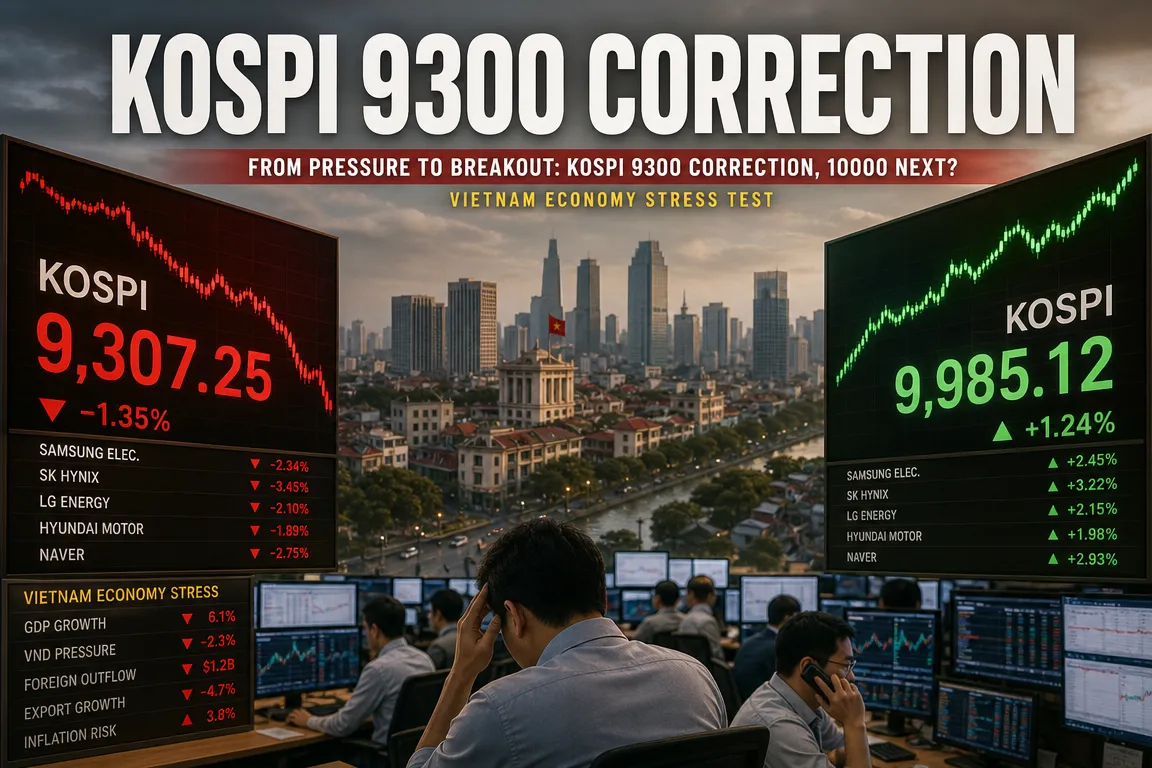
After a strong rally to around 9,300, the KOSPI underwent a sharp correction and later traded in a range around 6,500 to 7,000.
Many investors are asking, “Will the KOSPI reach 10,000?”
However, a near-term break above 10,000 appears difficult.
- First, the memory of the prior deep correction remains strong among investors.
- Second, investors who expected the KOSPI to reach 10,000 are now inclined to sell before that level.
- Third, profit-taking pressure increases as the index rises, reducing the slope of further gains.
- Fourth, capital may continue shifting more rapidly toward U.S. equities than toward Korean equities.
In other words, the correction at 9,300 was not only a flow-driven event, but also a structural change in sentiment shaped by the memory of losses.
2. Collective Profit-Taking Driven by the “Sell Before 10,000” Mindset
The more investors expect the KOSPI to reach 10,000, the harder that level may be to break.
The reason is straightforward.
If everyone plans to sell at 10,000, more cautious investors will sell at 9,500.
More defensive investors may take profits around 9,300 or 9,000.
As a result, the 10,000 level becomes both a target and a major psychological resistance zone.
This is the key behavioral economics point.
- Rising expectations for 10,000 also increase the incentive to sell early.
- The correction at 9,300 taught investors that holding too long may be risky.
- As a result, short-term profit-taking may remain stronger than long-term holding.
- Consequently, Korean equities may continue rising, but at a slower pace than U.S. equities.
This point is more important than simple technical analysis.
Markets appear to move by numbers, but in practice they move through memory, fear, greed, and regret.
3. Behavioral Economics Concept ① Availability Bias: Recent Shocks Dominate Future Judgment
The article draws on Eric Angner’s book, How Economics Can Save the World, to explain availability bias.
Availability bias refers to the tendency to overestimate the likelihood of events that are easy to recall.
For example, images of wolves or polar bears attacking people are strongly reinforced by films and stories.
In reality, such events are far less common than people assume.
Nevertheless, vivid imagery makes the risk feel larger.
The same pattern applies to investing.
Investors who directly experienced the sharp decline after the 9,300 peak are more likely to think, “It could collapse again.”
As a result, profit-taking tends to increase at each new threshold of 7,000, 8,000, and 9,000.
- Recent correction experiences become the reference point for future decisions.
- As the index rises, fear of another pullback may outweigh return expectations.
- Investors may reduce exposure to semiconductor stocks and rotate into growth stocks, biotech, or ETFs.
- When this sentiment accumulates, it can delay a KOSPI move to 10,000.
In other words, the reason the KOSPI may struggle to advance is not fully explained by corporate earnings or interest rate expectations.
The market is also being constrained by the memory of a prior large loss.
4. Behavioral Economics Concept ② FOMO and JOMO: Why Investors Buy at the Top and Sell at the Bottom
Another central theme is FOMO.
FOMO, or Fear of Missing Out, is the anxiety of being left behind while others gain.
As the KOSPI rises from 5,000 to 6,000, 7,000, 8,000, and 9,000, reports of profits become increasingly common.
As a result, even those who were not originally investing in equities may feel pressure to enter the market.
The question becomes, “What if I do not invest now and fall behind?”
At that stage, investors tend to act on impulse rather than analysis.
They buy after the market has already risen significantly and sell when a correction creates fear.
JOMO, by contrast, stands for Joy of Missing Out.
It refers to the feeling of relief from avoiding a market decline.
However, strong JOMO can also indicate an attractive entry point.
- When FOMO is strong, the market may be approaching overextended conditions.
- When JOMO is strong, sentiment may have become excessively pessimistic.
- Most retail investors buy during FOMO and sell or stay out during JOMO.
- More disciplined investors need to think against the crowd.
The answer to the question, “Why does the market fall after I buy and rise after I sell?” often lies in FOMO and JOMO.
5. Why Capital May Favor U.S. Equities Over Korean Equities
The article argues that after a major correction, especially in the second half of 2026, more capital may flow toward U.S. equities.
The core logic is the interaction between interest rate expectations and liquidity flows.
- The United States may find it difficult to continue raising rates aggressively.
- Korea may face relatively stronger pressure to maintain tighter policy.
- Global liquidity tends to move toward markets with more favorable growth and policy conditions.
- As a result, U.S. equities may continue to lead, even if Korean equities also rise.
This does not mean Korean equities are weak.
Korean markets can also benefit from broader global liquidity cycles.
However, when investor trauma, profit-taking behavior, rate conditions, and industrial structure are considered together, U.S. equities may still have a structural advantage.
6. Why ETF Investing Attracts Capital: A Shared Conclusion Among Economists and Behavioral Analysts
The latter part of the article discusses ETF investing and index funds.
Economists generally recommend long-term ETF investing rather than concentrated bets on individual stocks.
The appeal of ETFs is clear.
- First, they offer broader diversification than single-stock investments.
- Second, they often carry lower costs than active funds.
- Third, they provide indirect exposure to the growth of a specific industry or country.
- Fourth, they may help individual investors capture market-average returns over the long term.
- Fifth, they address the difficulty of identifying the eventual winner in advance.
That said, not all ETFs are low risk.
In particular, single-stock leveraged ETFs can amplify volatility and increase market instability.
The article also raises concerns about such products.
Accordingly, the key distinction is not whether an instrument is an ETF, but what type of ETF it is.
Long-term diversified ETFs and high-risk leveraged ETFs are fundamentally different products.
7. China Semiconductor ETFs and the AI Trend: Why Humanoid Robots Could Reshape Semiconductor Demand
One of the most notable sections addresses the Chinese semiconductor industry.
The article notes that firms such as ChangXin Memory Technologies are rapidly increasing their share in the memory semiconductor market.
This is a material development for the Korean semiconductor industry.
China’s presence in memory semiconductors was limited in the past, but rising market share could alter the global supply-chain structure.
The United States is strengthening its semiconductor value chain around Micron, while China is building an indigenous semiconductor ecosystem.
In that process, Korea may find it increasingly difficult to maintain the same export structure to both the U.S. and China.
The AI trend is closely linked to this shift.
Smartphones contain roughly 100 to 200 semiconductors, and electric vehicles contain substantially more.
Autonomous electric vehicles may require thousands of semiconductor components.
The question is how many semiconductors humanoid robots will require.
Humanoid robots require AI inference, sensors, motor control, communications, power management, and real-time decision-making.
As AI develops, semiconductor demand will extend beyond data-center GPUs.
Demand will expand into robotics, autonomous driving, smart factories, defense AI, and edge computing.
- Capital flows into Chinese semiconductor ETFs because they provide indirect exposure to companies that are difficult to access directly.
- If direct investment in firms such as ChangXin Memory is difficult, ETFs may offer a practical alternative.
- AI and humanoid robot adoption are key long-term drivers of semiconductor demand.
- However, Chinese semiconductor ETFs also carry geopolitical, regulatory, and volatility risks.
This is not simply a view that “Chinese semiconductors are rising.”
The core issue is that semiconductor self-sufficiency has become a strategic priority in the competition for AI-era industrial leadership.
8. The Risk of Overconfidence: A Forecast Can Be Right and Still Lead to a Wrong Investment Decision
One of the most important messages is that investors should remember they can always be wrong.
Economics is less a discipline that provides final answers than one that continuously tests whether our assumptions are mistaken.
For example, suppose a liquidity-driven rally could emerge from mid-September into October.
That does not mean equities will necessarily rise.
There are countervailing factors.
- Large tax payments in September may reduce market liquidity.
- Investors may sell equities to meet tax obligations.
- Increased Treasury issuance may raise concerns about who will absorb supply.
- Interest rate expectations, exchange rates, U.S. political events, midterm elections, and geopolitical risks may all affect markets.
Therefore, the more important issue is not whether the liquidity rally thesis is valid, but whether investors are prepared if it proves wrong.
This is what the article describes as epistemic humility.
9. AI-Impersonation Investment Scams: A Growing Financial Market Risk
The article also addresses AI-generated impersonation content, including fake YouTube channels, fake KakaoTalk rooms, fake Band groups, and investment solicitation scams.
This is likely to become a more serious market risk.
As AI advances, it becomes easier to imitate the voice, face, and speech patterns of well-known financial figures.
For investors, distinguishing real from fake is becoming harder.
Messages such as “buy this stock,” “join this room for guaranteed profits,” or “the expert will manage everything” should be treated as high-risk signals.
- Claims that a financial expert is directly pushing a specific stock should be questioned.
- Terms such as guaranteed returns, principal protection, or private recommendation stocks are major warning signs.
- AI deepfake videos are likely to be used more frequently to manipulate investor sentiment.
- Investment decisions should be made according to an investor’s own framework, not delegated to others.
AI is not only a productivity enhancer; in financial markets, it is also a source of trust-related risk.
Investors will need not only financial knowledge, but also digital literacy and information verification skills.
10. The Most Important Point That Other Videos and News Often Miss
Many reports explain the KOSPI correction through supply and demand, interest rates, exchange rates, foreign selling, National Pension Service rebalancing, and leveraged ETFs.
These factors are important.
However, a more important point is that investor memory can define the market ceiling.
Investors who experienced the correction after 9,300 are likely to think, at every subsequent rally, that the market may fall again.
This sentiment translates into actual sell orders.
Those sell orders reduce the market’s upside speed.
In this sense, the constraint on a move to 10,000 is not just a numerical resistance level.
It is a psychological resistance level formed by collective memory, loss aversion, availability bias, FOMO aftereffects, and habitual profit-taking.
The implications for investors are clear.
- First, investors should check whether they are acting under FOMO when markets rise.
- Second, they should assess whether JOMO or fear is causing them to miss opportunities during declines.
- Third, they should avoid assuming that “this time is different” without evidence.
- Fourth, they should consider long-term industrial change and ETF strategies alongside short-term themes.
- Fifth, they should compare Korean and U.S. market trajectories through the lens of liquidity, rate expectations, and investor sentiment.
11. Immediate Checklist for Investors
- Check whether your portfolio is overly concentrated in a single stock or sector.
- Assess whether you are chasing recently rallied assets because of FOMO.
- Determine whether you are overly focused on symbolic levels such as KOSPI 10,000.
- Separate the risk profiles of U.S. equities, Korean equities, China semiconductor ETFs, and AI-related industries.
- Do not treat leveraged ETFs and long-term diversified ETFs as equivalent products.
- Evaluate both the possibility and the failure case of a liquidity-driven rally.
- Be alert to AI-generated investment impersonation content.
- Actively seek out views that contradict your own and test whether you can rebut them.
[Related Articles…]
- AI Era Semiconductor Industry Power Competition and Investment Strategy
- U.S. Rate Outlook and Global Liquidity Cycle Analysis
*Source: [ 경제 읽어주는 남자(김광석TV) ]
– [풀버전] 코스피 9300에서 무너진 이유, 행동경제학적 관점 | 김광석의 북리뷰 | 어떻게 경제학을 사랑하지 않을 수 있을까?
● Samsung, Vietnam, VinFast, Debt, Shock
Samsung Exit Rumors vs. the Bigger Issue: Why Vietnam’s Economy Is Under Pressure and the VinFast Debt Risk
The core issue is not whether Samsung will leave Vietnam, but whether the growth model that has supported Vietnam’s economy is approaching its structural limits.
Vietnam’s success model, built on low-cost labor, foreign direct investment, China-plus-one manufacturing, and export-oriented industry, is now facing combined pressure from rising costs, debt burdens, weak power and infrastructure capacity, sluggish electric vehicle demand, and global supply chain reconfiguration.
In particular, shifts in investment strategy by global firms such as Samsung Electronics and the widening losses at VinFast should be viewed not as isolated corporate developments, but as leading indicators for Vietnam’s economic outlook.
When combined with the historical tensions between Vietnam and China, local sentiment toward Korean companies, and the transition toward AI-based smart factories, the current challenges facing Vietnam become materially more complex.
1. The Substance of the Samsung Exit Rumor: Investment Reallocation Matters More Than an Actual Exit
First, the more sensational framing should be clarified.
Claims that Samsung is leaving Vietnam are, at present, difficult to support conclusively.
Samsung remains a central foreign investor and a major contributor to Vietnam’s manufacturing and export base.
However, what matters is that global companies like Samsung are no longer viewing Vietnam as an unconditional core production base.
- Slower smartphone demand has increased the importance of production efficiency.
- Alternative production bases such as India, Indonesia, and Mexico are gaining prominence.
- Since the U.S.-China conflict intensified, global supply chains have shifted from concentration in one country to diversification across multiple locations.
- Rising wages and operating costs in Vietnam have reduced its earlier cost advantage.
- Recurring concerns remain over power supply, logistics, administrative procedures, and the shortage of skilled labor.
In other words, the key issue is not Samsung’s immediate withdrawal, but the fact that Vietnam’s bargaining power is weakening.
Previously, global firms actively selected Vietnam as a substitute for China in manufacturing.
Now Vietnam must compete by improving tax incentives, infrastructure, workforce capability, regulatory efficiency, and power stability.
2. Why Vietnam’s Growth Model Is Under Strain
Vietnam’s economy has grown rapidly in recent years on the back of foreign direct investment and export manufacturing.
In particular, escalating tensions between the U.S. and China positioned Vietnam as a leading China-plus-one production base.
However, this model has several structural weaknesses.
2-1. Low-Cost Manufacturing Alone Is No Longer Sufficient
Vietnam’s principal advantage has been inexpensive labor.
But as an economy develops, wages inevitably rise.
Higher wages reduce profitability in simple assembly-based manufacturing.
Vietnam must therefore move from a basic production base to higher value-added manufacturing, semiconductor back-end processes, batteries, AI-enabled smart factories, and research and development.
The challenge is that this transition is difficult in practice.
It requires skilled engineers, stable power grids, a sophisticated supplier ecosystem, financial depth, and legal stability.
2-2. High Export Dependence Makes the Economy Vulnerable to Global Slowdowns
Vietnam’s economy is heavily export-oriented.
When consumption in the U.S., Europe, or China weakens, Vietnam’s manufacturing sector is affected quickly.
When global interest rates, dollar strength, demand weakness, and inventory corrections occur simultaneously, order volumes fall and factory utilization declines.
Under such conditions, domestic demand alone is insufficient to absorb external shocks.
2-3. Power and Infrastructure Constraints Are Affecting Manufacturing Competitiveness
For global companies, power stability is one of the most important operational factors.
Even low labor costs cannot compensate for unreliable electricity when production schedules are disrupted.
Smartphones, semiconductors, electric vehicle components, and batteries all require high power quality and stable supply.
To move into higher value-added manufacturing, Vietnam must improve roads, ports, power grids, data centers, cloud infrastructure, and related systems.
If these improvements lag, Vietnam’s attractiveness in global supply chains could deteriorate quickly.
3. The VinFast Risk: More Than a Single Company Issue
The most prominent company in the original text is VinFast, Vietnam’s domestic electric vehicle manufacturer.
VinFast has been promoted as a symbol of Vietnam’s ambition to build a global electric vehicle brand.
However, the EV market is far more competitive and unforgiving than many expect.
- Even Tesla, which combines technology and brand strength, faces intense price competition.
- Chinese EV manufacturers are aggressively lowering prices through government support, battery integration, and scale economics.
- Established automakers are also investing heavily to transition into EVs.
- Consumers are highly sensitive to charging infrastructure, resale value, battery reliability, and brand trust.
In this environment, VinFast’s continued production despite losses is not simply a matter of growing pains.
When demand is insufficient but output expands, inventories accumulate.
When inventories rise, prices must be cut.
When prices are cut, losses widen.
When losses widen, additional financing is required.
This cycle can become self-reinforcing and financially burdensome.
3-1. VinFast’s Core Problem Is Its Role as a National Brand Project
If VinFast were a standard startup, market discipline could force an orderly exit.
But VinFast has been treated as part of Vietnam’s industrial upgrading and national branding strategy.
As a result, it is difficult to scale back even when losses widen.
The risk is that corporate debt, bank lending, property-sector exposure, and policy obligations can become intertwined, turning a company-level problem into a broader confidence issue for the economy.
3-2. What the EV Market Slowdown Signals for Vietnam
The EV sector remains a growth industry, but it is not a market where all participants will survive.
Companies with weak battery technology, software capability, autonomous driving data, supply chain management, brand credibility, or financing capacity are likely to fall behind.
VinFast illustrates the practical constraints Vietnam faces as it tries to move beyond basic manufacturing and into higher value-added industries.
Building factories and building a global brand are fundamentally different tasks.
4. Vietnam’s Debt Risk: Property, Corporate Credit, and Consumer Sentiment Could Weaken Together
Another important factor in Vietnam is leverage.
Fast-growing emerging markets typically experience credit expansion.
Companies borrow to build factories, property developers expand projects, and consumers increase spending in anticipation of future income.
When growth is strong, this structure appears to function as an engine of expansion.
But when interest rates rise, exports slow, and property transactions weaken, the burden can increase rapidly.
- Cash flow at property developers may deteriorate.
- Debt repayment pressure from corporate bonds may increase.
- Concerns over bank asset quality may rise.
- Weaker consumer sentiment could delay domestic recovery.
- Foreign investors may become more sensitive to exchange-rate and financial stability risks.
For that reason, Vietnam should not be assessed only by GDP growth rates.
FDI inflows, export growth, manufacturing PMIs, property bond maturities, non-performing loans, the dong exchange rate, and foreign exchange reserves must also be monitored.
5. Why Vietnam Is Cautious Toward China Despite Shared Political System Characteristics
Another important point in the original text is the relationship between Vietnam and China.
Although both are governed by communist parties and are geographically close, Vietnam has historically viewed China with caution.
This is driven less by ideology than by history, territorial concerns, sovereignty, and fears of economic dependence.
- Vietnam has long worked to preserve independence in the face of Chinese influence.
- Disputes in the South China Sea remain a central source of tension.
- There is concern over Chinese capital and products dominating the Vietnamese market.
- China’s status as a large neighboring power creates a structural strategic burden.
- Vietnam seeks to balance China with the U.S., Korea, Japan, and Europe.
This context is also important for Korean companies.
Vietnam needs Korean firms, but it also maintains caution toward foreign investors.
If Korean companies neglect local employment, wage expectations, labor practices, technology transfer, or community engagement, reputational risk can emerge quickly.
In Vietnam, a low-cost production approach alone is no longer sufficient.
6. The Key Point Often Missed in Mainstream Coverage: Vietnam’s Problem Is Not Growth Rate, but the Growth Model
Many reports on Vietnam focus on GDP growth, exports, and FDI inflows.
However, the more important question is whether Vietnam is prepared for the next stage of development.
Vietnam now faces three strategic choices.
- First, remain a low-cost assembly base.
- Second, remain only a China-plus-one manufacturing location.
- Third, move toward a higher value-added economy centered on AI, semiconductors, electric vehicles, batteries, and smart factories.
If it fails to move to the third stage, Vietnam may become a country that appears to grow but generates limited profitability.
That is the key issue, and it is more important than the Samsung exit rumor.
Global companies do not move based on sentiment.
They allocate capital based on cost, productivity, stability, tax efficiency, infrastructure, political risk, exchange rates, and supply chain efficiency.
If Vietnam becomes less competitive in that calculation, companies will gradually shift output elsewhere.
That may not appear as an exit, but it would still mean a loss of investment priority.
7. Signals Korean Companies and Investors Should Monitor
For Korea, Vietnam remains an important production base and consumer market.
However, the outlook now requires more nuanced risk assessment rather than broad optimism.
7-1. Key Issues for Korean Manufacturers
- Assess whether production is excessively concentrated in Vietnam.
- Compare Vietnam with alternative production bases such as India, Indonesia, Mexico, and Thailand.
- Review the stability of local power supply and logistics networks.
- Reflect wage inflation and changes in labor regulations.
- Determine whether profitability remains sustainable if tax incentives decline.
- Evaluate the financial health of local suppliers.
7-2. Key Issues for Investors
- Monitor volatility in the Vietnamese dong.
- Track trends in property developers and bank non-performing loans.
- Review the losses and funding structure of major companies such as VinFast.
- Assess whether FDI commitments are translating into actual investment execution.
- Consider how U.S. and China growth trends affect Vietnamese exports.
Vietnam’s economy is not yet in a state that can be described as collapse.
However, it is increasingly risky to treat the country as a market that will continue growing automatically.
Attention should shift from growth rate alone to the quality of structural transition.
8. AI Trend Perspective: Vietnam’s Next Competitive Frontier Is the Smart Factory
To preserve manufacturing competitiveness, Vietnam will ultimately need to adopt AI and automation.
As wages rise, productivity gains will depend less on adding labor and more on analyzing production data, reducing defects, and improving energy efficiency.
In this context, AI vision inspection, robotics automation, predictive maintenance, digital twins, manufacturing data platforms, and energy management systems become increasingly important.
This creates an opportunity for Korean companies.
The next phase is no longer only about manufacturing in Vietnam, but about exporting solutions that upgrade Vietnamese factories through AI.
Demand for smart factory systems may continue to grow in semiconductor back-end operations, electronics components, battery parts, and auto parts manufacturing.
Whether Vietnam remains a China substitute or evolves into a higher value-added manufacturing hub will depend in part on the speed of AI-driven manufacturing transformation.
9. Conclusion: Vietnam’s Risk Is More About Transition Failure Than Collapse
This issue should not be reduced to “Samsung is leaving Vietnam,” “VinFast is failing,” or “Vietnam’s economy is collapsing.”
The real issue is that Vietnam is facing pressure to move beyond its previous growth formula.
Samsung functions as a temperature gauge for Vietnam’s economy.
VinFast serves as a stress test for industrial upgrading.
Tensions with China represent a constant geopolitical risk.
Debt reflects the financial vulnerabilities hidden behind rapid growth.
AI and smart factories are among the few viable paths to sustaining productivity gains.
Accordingly, Vietnam should now be judged less by “what is the GDP growth rate?” and more by “is the country still attractive enough for foreign companies to remain?”
Once that answer begins to weaken, the outlook for Vietnam’s economy will change accordingly.
< Summary >
The Samsung Vietnam exit rumor remains unconfirmed, but global companies may increasingly reallocate investment away from Vietnam.
Vietnam’s economy is confronting the limits of its low-cost manufacturing, FDI-driven, export-led growth model.
VinFast’s losses and debt burden are not just a single-company issue, but a sign of the fragility in Vietnam’s industrial upgrading effort.
Vietnam does not view China simply as another communist country, but as a historical threat and economic competitor.
Korean companies should continue to view Vietnam as an important market, while also preparing for production diversification and AI-based smart factory transformation.
The central risk for Vietnam is not collapse, but the possibility that it fails to complete its transition to a higher value-added economy.
[Related Articles…]
- Vietnam Economic Stress and Global Supply Chain Reconfiguration
- EV Market Slowdown and VinFast Risk Analysis
*Source: [ 달란트투자 ]
– “무시받던 삼성 결국 철수?” 베트남 경제의 몰락 시작됐다 | 장준영 교수 3부