● Tesla-Roadster,SpaceX-Tease,Mega-Event
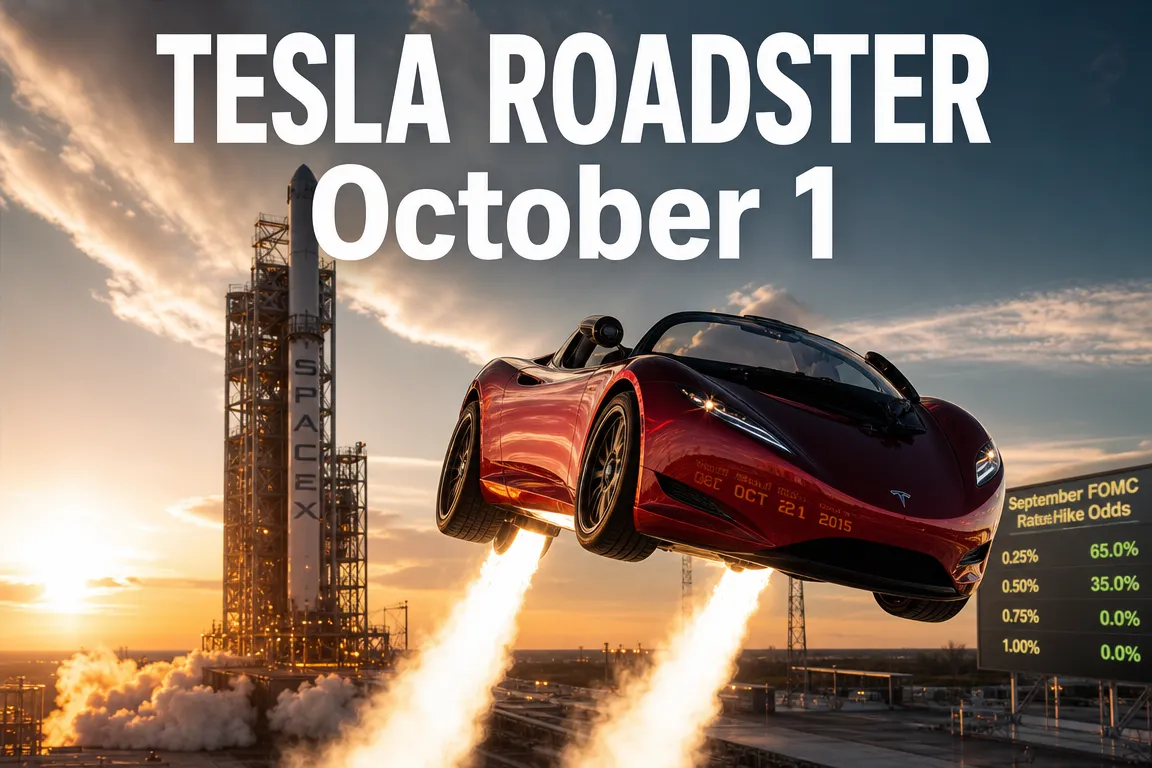
Tesla Roadster Launch Expected on October 1: 9-Year Delay, but the Key Issue May Be SpaceX Technology
The central point in this Tesla Roadster story is not simply that a new sports car is finally about to be unveiled.
The official image released by Tesla, the event location in Waco, Texas rather than a factory, SpaceX’s McGregor engine test site, and rumors surrounding the A71 cold-gas thruster all point to a different narrative.
This event could affect Tesla’s stock, the EV market, autonomous driving sentiment, overseas equity investor positioning, and the long-term strategic overlap between Tesla and SpaceX.
In particular, while other coverage focuses only on the Roadster reveal, the key question is whether Tesla will place SpaceX technology and branding on a consumer product for the first time.
1. A Hidden Message in Tesla’s Official Image
On September 12 U.S. time, Tesla’s official account posted a dark image without explanation.
The image carried a “Go launch” style message and displayed only the date “10.01” at the bottom.
No car name, no location, and no direct product description were provided.
However, people who brightened the image discovered a hidden phrase.
The phrase was “where we are going.”
The significance of this phrase is that it recalls the famous line from Back to the Future: “Where we’re going, we don’t need roads.”
Literally, it means that roads are unnecessary where the vehicle is headed.
Tesla’s decision to hide this phrase has been interpreted as an implication that the Roadster may be more than a high-performance electric car for public roads, and could be connected to aerial movement or rocket propulsion technology.
2. A Real Invitation Was Sent for the October 1 Event
The most important difference between this event and earlier rumors is that invitations were actually sent.
Roadster reservation holders reportedly received digital ticket invitations.
The event date is October 1 U.S. time.
The time is 8:30 p.m. Eastern Time.
In Korea, the event will take place at 9:30 a.m. on October 2, Friday.
Admission is restricted to guests aged 21 and over, and invitations are non-transferable.
Tesla has not yet officially confirmed whether the event will be livestreamed.
However, the fact that reservation holders have reached the stage of preparing flights and hotels suggests that this is materially different from a typical Musk-style teaser.
3. Why Waco, Texas, Instead of a Tesla Facility
The most unusual part of the invitation is the venue.
The event is reportedly being held in Waco, Texas.
Waco is roughly a 1.5-hour drive north of Austin, where Tesla’s headquarters and Gigafactory Texas are located.
Tesla has typically held major events at or near its own facilities.
The Cybertruck, Semi, and Cybercab were also largely unveiled in Tesla-controlled locations.
This Roadster event, however, is not being held at a Tesla factory.
That raises the relevance of SpaceX’s McGregor engine test site.
McGregor is a core SpaceX facility for rocket engine testing.
Accordingly, the venue choice points not just to a Tesla car event, but potentially to a Tesla event accompanied by a SpaceX technology demonstration.
4. The 2017 Roadster Reveal and the Original Promises
The second-generation Tesla Roadster was first revealed as a surprise at the end of the Semi truck event on November 16, 2017.
Tesla’s original specifications were highly aggressive.
-
0-60 mph acceleration was stated at 1.9 seconds.
-
The quarter-mile time was described as in the 9-second range.
-
Top speed was stated at above 250 mph.
-
Driving range was described at approximately 620 miles.
-
Battery capacity was estimated at around 200 kWh.
-
Production was originally scheduled for 2020.
The price was also substantial.
The base version was said to be around $200,000.
The Founder Series was priced around $250,000.
That translated to roughly KRW 268 million to KRW 335 million.
The reservation deposit was also unusually large.
Base-model reservations required a total of $50,000.
Customers first paid $5,000 by credit card and then wired the remaining $45,000 within 10 days.
In Korean won terms, that was equivalent to roughly KRW 67 million in reservation money in 2017.
5. A 9-Year Delay, but Why This Time May Be Different
The Roadster has been delayed multiple times.
Tesla said in 2017 that production would begin in 2020.
The schedule was later pushed to 2021, 2023, and beyond.
At last year’s shareholder meeting, Elon Musk said a demonstration would happen around April, but nothing occurred on April 1.
As a result, investors have a reasonable basis to remain skeptical about another delay.
However, there are clear differences this time.
-
First, invitations were actually sent to reservation holders.
-
Second, the event date and time were specified.
-
Third, the location was identified.
-
Fourth, a countdown appeared on the Roadster order page.
-
Fifth, the venue’s proximity to SpaceX’s engine test site increases the likelihood of a technical demonstration.
If Tesla has actually asked reservation holders to travel to Texas, the probability of cancellation is likely lower than in prior cases.
6. Core Technology: SpaceX Cold-Gas Thrusters and A71
The main issue in this Roadster story is whether SpaceX technology will be used.
Elon Musk previously said the Roadster would include SpaceX cold-gas thrusters.
A cold-gas thruster does not work by burning fuel.
It moves an object by releasing compressed air or gas at high pressure, creating thrust through reaction force.
SpaceX uses similar propulsion methods for rocket attitude control.
Musk said the rear two seats would be removed and replaced with thrusters and a high-pressure tank.
The internal designation for this system is reportedly A71.
The A71 name is believed to reference the SR-71 Blackbird, a high-speed reconnaissance aircraft.
Reports suggest the system may include around 10 thrusters and a high-pressure tank.
However, a vehicle equipped in this way may face difficulty meeting ordinary road-legal certification requirements.
In other words, it may be more of a technical demonstration vehicle or a limited configuration than a standard consumer car intended for public road use.
7. Is “Hovering” Actually Possible?
Elon Musk previously said on Joe Rogan’s podcast that he wanted the Roadster to hover about 1 meter above the ground.
That statement has sustained rumors about Roadster hovering for years.
The problem is that cars are not rockets.
Rockets are engineered around fuel-to-weight ratio, thrust, and flight-oriented structure.
Cars, by contrast, must also accommodate batteries, motors, chassis, suspension, tires, and safety systems.
Enabling hovering for an already heavy vehicle would require major solutions for thruster output, tank stability, noise, thermal management, and safety distance.
Some reports have suggested that a remote-controlled Roadster hover demonstration was being prepared at McGregor.
Observers were reportedly to be kept hundreds of yards away because thruster noise could be intense enough to cause hearing damage.
Accordingly, if a real hovering demonstration appears on October 1, it would be more than a car unveiling; it would be a Tesla-SpaceX technology showcase.
8. Signals from Patents and Trademark Filings
Tesla reportedly filed a Roadster-related trademark application in February this year.
Notably, the trademark image included a vehicle silhouette different from the 2017 design.
Tesla is also said to have filed a patent for a one-piece molded composite seat.
Tesla Vice President Lars Moravy and Franz von Holzhausen said in May that the Roadster would be manufactured at Gigafactory Texas.
They also said prototype testing was underway inside Tesla.
Patent No. US12377920 has also drawn attention.
It is described as an “adaptive vehicle aerodynamic device for downforce.”
Downforce is the force that pushes a vehicle toward the road surface.
The patent image shows rear airflow channels and fan structures.
Some overseas media have noted that the four-fan structure in the patent image resembles the form seen in Tesla’s dark official image.
Importantly, this device may be intended not to lift the car, but to press it more firmly against the road.
Accordingly, the Roadster may be interpreted both as a vehicle that “lifts off” and as one that is designed for extreme road grip.
9. What Investors Should Focus On
The Roadster itself may not materially change Tesla’s revenue profile.
It is a high-priced, limited-production sports car.
However, its impact on Tesla’s stock and overseas investor sentiment could be far greater than the sales volume would suggest.
The market no longer views Tesla solely as an EV manufacturer.
It is increasingly being valued as a technology platform spanning AI robotics, autonomous driving, energy storage, robotaxi development, and the Optimus humanoid robot.
If the Roadster is presented as a product combining SpaceX technology, Tesla’s technology premium could expand again.
In an environment shaped by slower global growth and uncertainty around interest-rate policy, growth stocks can remain highly sensitive to a single event.
If Tesla merely unveils an expensive sports car, the market reaction may be limited.
If Tesla demonstrates a product that visibly combines Tesla and SpaceX technologies, Wall Street may revisit its valuation framework for the company.
10. The Most Important Point Missed by Other Coverage
The key issue is not the Roadster launch schedule.
The real question is whether Tesla and SpaceX will appear together for the first time on a consumer-facing product.
Until now, collaboration between the two companies has mainly taken the form of internal technology transfer.
SpaceX manufacturing methods influenced Tesla production processes, and Tesla personnel contributed to SpaceX-related projects.
If the Roadster actually carries SpaceX branding, however, the situation changes.
That would mean the two companies have created a consumer product under a shared technology brand.
This could revive speculation about a possible merger or a deeper strategic linkage between Tesla and SpaceX.
Former Tesla President Jon McNeill has interpreted the Roadster demonstration as an attempt to connect the two companies.
By contrast, investors such as Gary Black have argued that a Tesla-SpaceX merger would not be positive for shareholders.
Even so, if the October 1 stage strongly highlights the technical integration of the two firms, the market may respond in terms of “Musk ecosystem integration” even without a formal merger.
That is the most important issue in this Roadster event.
11. Key Items to Confirm at the October 1 Event
-
Whether the Roadster includes SpaceX logos or branding.
-
Whether SpaceX representatives appear on stage.
-
Whether the A71 cold-gas thruster system is included in the product presentation.
-
Whether a hovering demonstration is actually shown.
-
Whether the event presents only acceleration performance or a rocket-propulsion demonstration.
-
How the price compares with the 2017 guidance.
-
Whether production is again described as 12-18 months away.
-
Whether Gigafactory Texas production plans are clarified.
-
Whether a standard road-legal model and a thruster-equipped model are separated.
-
Whether Tesla stock reacts only as a short-term event trade or begins to reflect a longer-term technology premium.
12. What the Roadster Means for Tesla’s Business Strategy
The Roadster is not a mass-market electric vehicle.
It is not expected to change EV market share in the way the Model 3 or Model Y can.
For Tesla, however, the Roadster is a brand symbol.
If the first Roadster introduced Tesla to the world, the second-generation Roadster may show how far Tesla can push technology.
As Tesla expands into autonomous driving, robotaxis, Optimus, and energy products, the Roadster can reinforce the message that the company still delivers extreme innovation in hardware.
For shareholders, this event is more important for brand value and the technology narrative than for near-term revenue.
In a high-rate environment with recession concerns, growth stocks need a credible future narrative to regain premium valuations.
The Roadster may serve that function if it delivers a compelling demonstration.
13. Conclusion: A Luxury Toy, or the First Scene in Tesla-SpaceX Integration?
If the Roadster reveal is viewed only as a delayed high-performance electric sports car, expectations will remain limited.
The price is high, and production volume is likely to remain small.
It is unlikely to directly alter mainstream EV purchasing behavior.
But when viewed alongside SpaceX thrusters, the McGregor test site, the hidden Back to the Future reference, the A71 system, and the possibility of a hovering demonstration, the event takes on a different meaning.
This may be the moment Tesla repositions itself beyond the boundaries of an automotive company and toward a mobility business linked to space technology.
For that reason, on October 1, investors should pay closer attention to which company names appear on stage than to the car’s design alone.
If SpaceX appears prominently, this event could become an important turning point in Tesla’s history.
< Summary >
Tesla has sent Roadster event invitations to reservation holders after nearly nine years of delay.
The event is scheduled for October 1 U.S. time and 9:30 a.m. on October 2 in Korea.
The venue is reportedly Waco, Texas, rather than a Tesla facility, with SpaceX’s McGregor engine test site nearby.
Tesla’s official image included the hidden phrase “where we are going,” which has been interpreted as a reference to hovering or rocket-propulsion technology.
The main points to watch are the SpaceX cold-gas thruster A71, a possible hovering demonstration, and any SpaceX branding.
This event could be more than a sports car unveiling and may instead showcase a Tesla-SpaceX technology combination.
Investors should focus less on near-term stock reaction and more on whether Tesla is re-rated as a broader technology platform.
[Related Articles…]
- Tesla Roadster Reveal and SpaceX Technology Collaboration Outlook
- Electric Vehicle Market Shifts and Key Tesla Stock Investment Points
*Source: [ 오늘의 테슬라 뉴스 ]
– 테슬라 주주가 9년 기다린 로드스터, 드디어 초대장이 나갔습니다 — 그런데 장소가 테슬라 공장이 아닙니다 ?
● Fed Split on Rates-Easing Bets Rise, Hike Odds Fade
September FOMC Immediate Analysis: Why Rate Hold Is Gaining More Support Than a Rate Hike
The key issue in this September FOMC meeting is not simply whether the Fed will raise rates or hold them.
More important is whether the recent CPI report signals a genuine reacceleration in inflation, what U.S. Treasury yields were discounting first, and how Fed officials are likely to respond to incoming data.
In particular, this report examines why the case for holding rates remains intact even though markets have sharply increased the odds of a hike.
Most coverage stops at “CPI came in hotter than expected, so a rate hike is more likely.” In practice, the full picture requires a broader read of year-over-year CPI trends, core PCE direction, inflation expectations, real policy rates, and whether energy price shocks are transmitting into the broader economy.
1. Market Sentiment Ahead of the September FOMC: Expectations Have Shifted Sharply Toward a Hike
Markets have recently moved toward the view that the Fed could raise rates at the September FOMC.
Following the August CPI release, the CME FedWatch tool showed a sharp increase in the implied probability of a hike, raising concern that the Fed may be shifting back toward tightening.
- Headline CPI year over year matched market expectations.
- Headline CPI month over month also matched expectations.
- Core CPI year over year matched expectations.
- However, core CPI month over month came in at 0.3%, above the 0.2% forecast.
On the surface, one stronger-than-expected monthly reading was enough to push markets toward an inflationary interpretation.
However, the Fed does not base policy on a single monthly print.
It also places greater weight on PCE inflation, especially core PCE, and whether those measures continue moving toward the 2% target.
2. Why Year-over-Year CPI Matters More Than Month-over-Month Data
The part of the CPI report that drew the most market attention was the 0.3% rise in core CPI month over month.
That reading should not be dismissed.
But from a policy perspective, year-over-year inflation trends matter more than short-term monthly fluctuations.
Month-over-month data captures near-term price changes.
Year-over-year data reflects the broader direction of inflation.
The Fed’s 2% inflation goal is also more closely aligned with the year-over-year concept.
For that reason, the latest CPI report is difficult to classify as a clear inflation shock.
Most major indicators were in line with expectations, and core CPI year over year continued to soften.
In that context, the data provides more room for the Fed to wait than to justify an immediate hike.
3. Why FedWatch Should Not Be Taken at Face Value
The rise in hike odds in CME FedWatch is an important market signal.
But FedWatch is not the Fed’s official forecast.
It is derived from pricing in 30-day federal funds futures.
In effect, it reflects market positioning and trading expectations.
As a result, FedWatch captures sentiment, not policy intent.
U.S. Treasury yields, particularly the 10-year and 2-year notes, should also be monitored.
Notably, both the 10-year and 2-year Treasury yields fell after the CPI release.
That suggests bond markets did not interpret the report as a straightforward inflation shock.
This divergence matters.
FedWatch priced in a higher probability of a hike, while Treasury yields moved lower after the release.
The market is not fully aligned on the interpretation of the data.
4. The Broader Trend Still Points to Disinflation in the U.S.
U.S. consumer inflation peaked at 9.1% in June 2022.
That was the highest inflation rate in roughly four decades and required a rapid policy response from the Fed.
The rationale for aggressive tightening at that time was clear.
The current environment is different.
Even if inflation has recently rebounded in some areas, it is not comparable to the 2022 peak.
The more appropriate framework is disinflation, not renewed broad-based inflation.
Disinflation does not mean prices are falling.
It means prices may still rise, but at a slower pace.
The Fed’s objective is to bring inflation back toward 2%, not to reverse prices to prior levels.
5. The Main Driver of the Recent Rebound: Energy, Not Broad-Based Inflation
The most important issue in the current inflation debate is the source of the price increase.
The recent rebound was driven largely by crude oil and energy prices.
Geopolitical tensions, Middle East risk, and supply concerns supported higher energy prices and pushed headline CPI higher.
However, that does not automatically imply broad-based inflation.
Inflation is a persistent and widespread rise in prices across many categories, not a move concentrated in a single component.
- Energy prices rose, but the impact on core services inflation remained limited.
- Core goods inflation did not show a broad reacceleration.
- Food inflation did not reflect a structural surge.
- Wage growth has slowed, reducing pressure on services inflation.
In other words, the current rise in inflation may be better described as an energy-driven price shock rather than a renewed inflation cycle.
That distinction is critical for policy interpretation.
6. Slower Shelter Inflation and Wage Growth Support the Case for a Hold
Shelter is one of the most important components of U.S. inflation.
One reason inflation remained sticky after the pandemic was the persistent rise in housing-related costs.
However, shelter inflation has recently slowed meaningfully.
That is a constructive sign for the overall inflation outlook.
Wage growth is also important.
Rapid wage gains tend to keep services inflation elevated.
Recent wage data, however, also points to moderation.
That supports lower consumer inflation over time.
If shelter and wage pressures are easing, the Fed has less reason to respond with another hike.
7. Inflation Expectations Also Favor a Hold Over a Hike
The Fed is concerned not only with actual inflation but also with inflation expectations.
If households and businesses expect higher inflation in the future, wage and price setting can reinforce inflation persistence.
At present, U.S. inflation expectations do not appear to be destabilized.
Stable expectations reduce the need for the Fed to tighten policy preemptively.
More importantly, if expectations were rising, a hike would be easier to justify.
But if expectations are easing, raising rates would raise questions about policy consistency.
8. The Core Policy Mechanism: Real Policy Rates
Rate decisions should not be evaluated based on nominal policy rates alone.
The key variable is the real policy rate after adjusting for inflation.
The U.S. already maintains a relatively high policy rate.
As inflation slows, the real policy stance becomes more restrictive even if nominal rates are unchanged.
In practical terms, holding rates steady while inflation declines can tighten financial conditions further.
That increases the risk of unnecessary economic slowdown if the Fed hikes again.
For that reason, a high-rate environment in the U.S. can justify a different response from other economies with lower rates and higher inflation.
Monetary policy is inherently country-specific.
9. FOMC Voting Dynamics: Data Matters More Than Politics
The September FOMC decision will depend on the views of Fed governors and regional bank presidents.
The voting structure includes 7 Board members and 5 regional Federal Reserve Bank presidents, with the New York Fed president holding a permanent vote and the remaining votes rotating.
The original analysis divides Fed officials into three broad groups:
- Officials perceived as politically anti-Trump
- Officials perceived as politically pro-Trump
- Officials who are primarily data dependent
The key point is that, despite any political framing, the actual decision may be determined by data-dependent judgment.
Some officials who favored a hike in July may be more cautious in September after reviewing the latest inflation data and the broader disinflation trend.
This meeting is therefore better understood as a disagreement over data interpretation than a purely political confrontation.
10. The Main Case for a Rate Hold
The logic behind a hold is straightforward.
The U.S. economy does not appear to be in a broad inflation regime that clearly requires another hike.
- Core CPI year over year matched expectations.
- The long-term inflation trend remains lower than the 2022 peak.
- The recent rebound was driven mainly by energy prices.
- Shelter inflation is slowing.
- Wage growth is moderating.
- Inflation expectations remain relatively stable.
- Real policy rates are already restrictive.
Under these conditions, a hold is more defensible than an additional hike.
For a data-driven central bank, one monthly CPI print is not enough to justify tightening.
11. Why a Hike Is Still Possible
A strong case for holding rates does not eliminate the possibility of a hike.
The Fed may still choose to act preemptively.
If policymakers believe geopolitical tensions could trigger another sharp rise in oil prices, they may opt for a precautionary hike.
The logic would be to contain a larger problem before it develops.
In addition, concerns about Fed credibility could also push the Committee toward a stronger tightening signal.
As a result, a hike cannot be ruled out.
Still, from a monetary policy perspective, a hold remains the more natural conclusion at this stage.
12. How Markets Could React to a Rate Hold
If the Fed holds rates steady, markets could react in two different ways.
Scenario A: Treasury Yields Rise on Concerns About Fed Credibility
If investors conclude that the Fed should have hiked but chose not to, Treasury yields may rise.
In that case, longer-term yields could move higher as markets price in credibility risk and inflation concerns.
That would likely weigh on equities and increase volatility in the dollar.
Scenario B: Treasury Yields Stabilize as Hike Risk Fades
If markets interpret the decision as evidence that the Fed is correctly reading disinflation, Treasury yields may stabilize.
If the prospect of another hike was already largely priced in, a hold could become an easing of risk rather than a negative surprise.
That would be supportive for growth stocks, technology shares, and AI-related equities.
Ultimately, the more important factor is not the decision alone, but the message delivered by the Fed Chair in the press conference.
If the Chair leaves open the possibility of further hikes, markets may treat the decision as hawkish.
If the Chair emphasizes progress on inflation, the market reaction may be more constructive.
13. The Real Issue Missed by Most Coverage
The most important question is not the hike probability itself.
The real issue is whether the Fed sees current inflation as a structural problem or as a temporary energy-driven shock.
If the Committee views higher energy prices as a limited move that has not spread into other categories, a hold is justified.
If it believes energy inflation could flow into expectations, wages, and services prices, a hike becomes more plausible.
Another key variable is the real policy rate.
Because U.S. rates are already high, holding steady may still produce additional tightening in real terms as inflation slows.
This is one of the most overlooked aspects of the debate.
In other words, not hiking does not mean policy is loose.
Maintaining a high nominal rate is still restrictive.
14. Key Points for Investors
- Monitor whether the FOMC statement strengthens its inflation language.
- Assess how strongly the Chair keeps the door open to another hike.
- Check whether the dot plot shifts higher for the policy path ahead.
- Watch the post-meeting response in U.S. 10-year Treasury yields.
- Track the dollar index and USD/KRW reaction as well.
- AI semiconductors, growth stocks, and large-cap tech are sensitive to long-term yields.
AI and other long-duration growth sectors are particularly sensitive to changes in discount rates.
As a result, Treasury yields and real rates may matter more than the policy rate headline itself.
15. Final Assessment: Hold 55%, Hike 45%
This September FOMC remains a close call.
Markets have moved toward a hike, but the policy case for holding rates remains strong.
My assessment gives a modest edge to a rate hold.
That said, a combination of higher oil prices, geopolitical risk, inflation expectations, and concerns about Fed credibility could still result in a hike.
The goal is not to predict the outcome as a betting exercise.
The more important task is to understand how the Fed evaluates the data and frames its decision.
That is what allows investors to interpret the implications for equities, bonds, foreign exchange, and the broader macro outlook after the meeting.
< Summary >
September FOMC expectations are split between a rate hike and a rate hold.
In the August CPI report, core CPI month over month was above expectations, but most year-over-year readings were in line with forecasts.
FedWatch priced in a higher probability of a hike, while U.S. Treasury yields fell after the CPI release.
That suggests markets did not treat the report as a clear inflation shock.
The U.S. remains in a disinflationary trend, with the recent rebound driven largely by energy prices.
Slower shelter inflation, moderating wage growth, stable inflation expectations, and high real policy rates strengthen the case for a hold.
However, another hike remains possible if energy prices rise further or if the Fed seeks to reinforce its anti-inflation credibility.
The key question is whether the Fed views inflation as structural or as a temporary energy-driven impulse.
[Related Articles…]
- September FOMC Rate Outlook and Market Positioning
- U.S. Inflation Deceleration and Treasury Yield Dynamics
*Source: [ 경제 읽어주는 남자(김광석TV) ]
– 금리인상 Vs 금리동결. 통화정책 메커니즘으로 본 9월 FOMC [즉시분석]