● Currency-War After Tariffs, Dollar Drop, Small-Biz Crisis
Tariff conflict, then currency conflict: why a weaker dollar and the strain on self-employed businesses must be viewed together
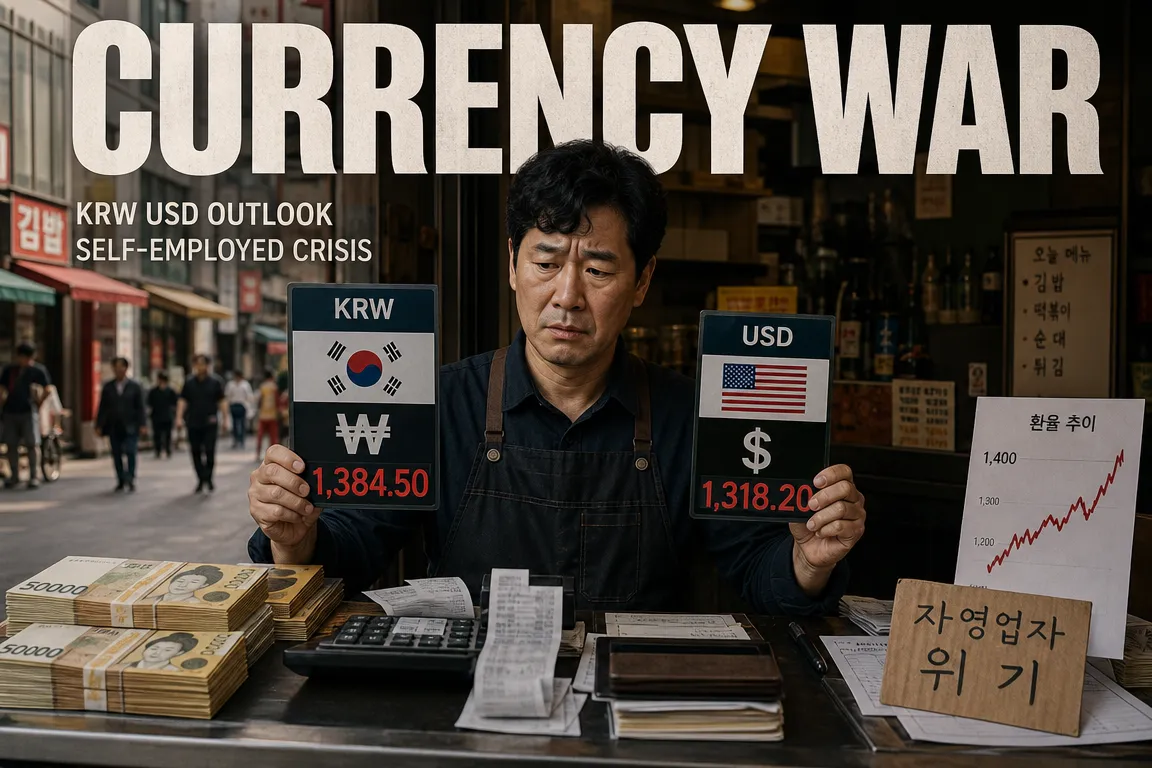
The key issue is not simply whether the exchange rate rises or falls.
The broader question is why the United States may seek to suppress the dollar after the tariff conflict, how a lower dollar exchange rate connects to foreign investment into the U.S. and midterm election strategy, and why benchmark rates and lending rates are a survival issue for self-employed businesses in Korea.
Many reports discuss the exchange-rate outlook separately from the self-employed sector, but in practice exchange rates, benchmark rates, small-business loans, weaker consumption, and startup strategy are part of the same chain.
1. Why the next phase after the tariff conflict is a currency conflict
The tariff conflict is closer to a beginning than an end.
The U.S. uses tariffs not only to raise the cost of imports.
The core objective is to pressure global companies to relocate manufacturing to the United States.
This strategy is intended to pull auto, electronics, IT, semiconductors, battery, defense, and energy value chains into the U.S.
The key variable is the dollar’s value.
For products manufactured in the U.S. and sold globally, a weaker dollar is more favorable than a stronger dollar.
If the dollar is too strong, U.S.-made goods lose price competitiveness.
Conversely, a weaker dollar supports overseas sales of U.S.-made products and reinforces the political case for reviving U.S. manufacturing.
For that reason, the next stage after the tariff conflict is often framed as a currency conflict.
The sequence is pressure through tariffs, then improved manufacturing and export competitiveness through exchange-rate policy.
2. The purpose of dollar suppression: U.S. manufacturing and midterm strategy
The central view in the source is that the U.S. is intentionally trying to lower the dollar’s value.
This can be described as dollar suppression.
The rationale has three main parts.
First, to improve U.S. manufacturing export competitiveness.
Companies that move factories to the U.S. need a weaker-dollar environment to generate export results.
For products made in the U.S. and sold abroad, a lower dollar improves price competitiveness.
Second, to make U.S.-bound investment appear larger.
When exchange rates decline, Korean companies can make larger dollar-denominated investments with the same won funding burden.
For the same financial outlay, they can announce larger U.S. investment commitments when the won-dollar exchange rate is lower.
For the U.S., this supports the narrative that tariff policy has attracted large-scale investment.
Third, to support 3Q U.S. GDP and the midterm-election narrative.
Stronger 3Q GDP data, typically released in late October, would be politically favorable ahead of the November midterm election.
Corporate capital expenditure remains important to U.S. growth, especially investment by hyperscalers in AI data centers and related infrastructure.
3. Why hyperscaler CAPEX and Treasury yields matter for the exchange-rate outlook
Major U.S. AI leaders are continuing large-scale CAPEX investment.
Data centers, GPUs, power infrastructure, cloud servers, and network equipment all require ongoing spending.
The issue is cash flow.
The source notes that some hyperscalers have seen weaker free cash flow, and continued CAPEX may require bond issuance.
Treasury yields are therefore important.
When Treasury yields are high, investors have less incentive to buy riskier corporate bonds.
That forces companies to offer higher corporate-bond yields, increasing funding costs.
As a result, AI infrastructure investment could slow.
From the U.S. government’s perspective, lower Treasury yields and easier financial conditions are desirable.
Lower Treasury yields are also associated with a weaker dollar.
The AI investment cycle, Treasury yields, the dollar exchange rate, and the U.S. economic outlook are therefore closely linked.
4. Why buybacks, the TGA, and stablecoins are being discussed
The source suggests that the U.S. may use several tools to support dollar suppression.
These include a Treasury buyback program, use of the TGA balance, and expansion of stablecoins.
Treasury buybacks refer to repurchasing outstanding Treasury securities from the market.
This can be used to manage supply and ease upward pressure on yields.
The TGA balance is the U.S. Treasury’s cash account.
How it is managed can affect liquidity conditions in the financial system.
Stablecoins may serve as a way to expand a dollar-based digital asset ecosystem.
They are relevant because they can preserve dollar dominance while changing the structure of liquidity in financial markets.
In other words, the currency conflict should not be viewed only as direct foreign-exchange intervention.
It is better understood as a broader strategy linking the Treasury market, liquidity, and digital-dollar infrastructure.
5. Two key variables in the KRW/USD exchange-rate outlook
The source stated that even when the won-dollar exchange rate rose to the 1,550 range, it could stabilize over the long term toward the 1,300 range.
The two main variables behind that view were the following.
5-1. Korea-U.S. benchmark interest-rate gap
The first variable is the Korea-U.S. benchmark interest-rate gap.
One major driver of won weakness and dollar strength has been the interest-rate differential between the U.S. and Korea.
When the U.S. raises rates faster and more aggressively, dollar assets become more attractive and the won faces depreciation pressure.
However, if the Bank of Korea becomes more restrictive, the picture can change.
If the Bank of Korea’s policy rate rises from 2.5% to 2.75% or 3.0%, with room for further increases, the rate gap may narrow.
As the gap narrows, the exchange rate is more likely to stabilize rather than continue rising sharply.
5-2. The pace of money supply growth in the U.S. and Korea
The second variable is money supply.
When more liquidity is injected into an economy, that currency tends to weaken.
The key question is which country expands liquidity faster, the U.S. or Korea.
In the first half of the year, Korea was seen as having expanded liquidity faster, which supported won weakness.
In the second half, however, the U.S. may expand money supply faster than Korea.
If U.S. liquidity growth outpaces Korea’s, the dollar may weaken and the won-dollar exchange rate may stabilize.
6. Why some describe this as a de facto second Plaza Accord
The source argues that the U.S. is effectively seeking currency coordination with Japan and other major economies.
If the U.S. pressures other countries to raise rates and allows their currencies to strengthen, the dollar weakens relatively.
The dollar index compares the dollar with major currencies such as the euro, yen, pound, Swiss franc, and Swedish krona.
If the yen and euro strengthen, the dollar index comes under downward pressure.
This resembles the logic of the Plaza Accord.
Whether or not there is a formal agreement, markets may interpret the situation as an international effort to weaken the dollar.
This is the core of the currency conflict.
7. Korea’s self-employed crisis: the real issue is the simultaneous hit from lower sales and higher rates
Equally important is the outlook for self-employed businesses in Korea.
The latter part of the source, through a conversation with the owner of Namsan Tonkatsu, highlights the concrete difficulties facing the sector.
The main problem is insufficient sales.
When revenue declines, labor costs, ingredient costs, rent, and loan interest continue to rise.
This creates a structure in which income falls while expenses increase.
For a kimbap shop, ham, pickled radish, seaweed, and labor costs all rise.
Raising prices risks losing customers.
Not raising prices compresses margins.
This is the core dilemma facing food-service and small-business operators.
8. Why small-business borrowing, multiple debt holdings, and vulnerable borrowers are becoming more serious
Self-employed business owners often carry heavier debt burdens than wage earners.
They may borrow not only for housing, but also for deposits, interior work, operating capital, raw materials, and payroll.
When the policy rate rises, market rates and lending rates follow.
Higher lending rates immediately raise the interest burden on self-employed borrowers.
The problem becomes more severe when falling sales force businesses to rely on additional borrowing for working capital.
This can lead to multiple simultaneous loans.
Borrowers with several debts, low income, or weak credit are classified as vulnerable borrowers.
The source suggests that many vulnerable borrowers are likely to be small self-employed operators.
They are the first weak point in a rising-rate environment.
9. Rising vacancies, weaker startup activity, and structural change in the food-service market
In the past, desirable retail locations were quickly leased.
Now, even prime locations are increasingly difficult to fill.
This is not simply because would-be entrepreneurs are cautious.
It reflects weaker consumer demand and lower expectations for startup success.
Department stores, outlet malls, specialized retail zones, and street-facing commercial areas are all affected by the slowdown in consumption.
The self-employed crisis is therefore not just an issue for individual business owners; it reflects the broader health of domestic demand in Korea.
10. Why Namsan Tonkatsu still grew
One notable point is that not all brands decline when the self-employed sector weakens.
According to the source, Namsan Tonkatsu grew 160% last year and is expected to grow about 80% this year.
That is unusually strong relative to overall economic growth.
Several factors explain it.
First, tonkatsu is a stable, non-trendy menu item.
Trend-driven concepts can grow quickly, but their cycles are short and can reverse sharply.
By contrast, tonkatsu remains consistently consumed across generations.
Second, the brand has history and emotional familiarity.
A 30-year legacy and the symbolic value of the Namsan location turn the product into an experience rather than a simple meal.
A parent generation’s memory can carry through to children and then to the next generation.
Third, tourism and content exposure support demand.
Brands connected to Namsan, the cable car, and tourism routes benefit from foreign visitor traffic.
K-content and tourism demand can also support food-service brands.
Fourth, it performs well in rest areas and specialty commercial zones.
Tonkatsu is a relatively accessible menu item for highway rest areas, malls, and department-store food courts.
It appeals broadly across age groups.
11. Four survival strategies for self-employed operators
The most practical guidance in the source concerns startup strategy.
In a high-rate, high-cost, low-growth environment, launching a large-scale business from the outset is risky.
11-1. Choose stable categories over trendy items
The most important factor in choosing a concept is durability.
Trend-based items can generate strong early sales, but competition intensifies quickly and demand can fade.
By contrast, categories such as tonkatsu, soup rice, bunsik, chicken, and coffee can support repeat consumption and longer survival.
11-2. The operating model must be simple
Complex operations increase labor dependency.
Higher labor dependency raises wage and training costs.
At a time when hiring is difficult, simple operational structures matter.
In the Namsan Tonkatsu case, the meat is not manually pounded in-store; it is partially processed at the headquarters and delivered to the store.
This simplifies cooking and improves turnover.
A simple menu and limited side dishes also improve efficiency.
11-3. Lean startup capital is necessary
Starting with excessive investment is risky.
Large costs for interiors, key money, deposits, and equipment make recovery difficult if the business fails.
In an environment where small-business borrowing costs are elevated, heavily leveraged startups are especially risky.
A lighter launch with gradual expansion is more realistic.
11-4. A system that reduces labor costs is required
Labor is one of the largest cost burdens in food service.
The source refers to a proposal for a tonkatsu training program linked to multicultural families and internships.
If the franchisor supports recruitment and training, the burden on store owners can be reduced.
Future franchise competitiveness will depend on more than brand recognition.
It will also depend on ingredient supply, menu standardization, labor training, operational automation, and support for financing pressures.
12. The most important points often missed in other coverage
First, a weaker won is not automatically good for Korea.
A lower KRW/USD rate can help overseas travel, import prices, and raw-material costs.
But if the U.S. is suppressing the dollar to encourage foreign investment and manufacturing relocation, Korean companies may face new pressures.
Exchange-rate stability may mask industrial relocation pressure.
Second, the U.S. weaker-dollar strategy is tied to financial policy aimed at sustaining the AI investment cycle.
Most coverage treats exchange rates as a foreign-exchange issue alone.
In reality, U.S. Treasury yields, big-tech bond issuance, AI data-center CAPEX, 3Q GDP, and the midterm election are all connected.
Any exchange-rate outlook should include the AI investment cycle.
Third, the self-employed crisis may be a leading warning signal rather than a lagging indicator.
Self-employed operators feel weaker demand, higher labor costs, higher raw-material costs, and higher interest rates first.
Rising vacancies and weaker startup activity are field evidence of weakening domestic demand in Korea.
The self-employed crisis is therefore a key signal for the overall economic outlook.
Fourth, the correct startup goal is survival, not a quick breakout.
In a high-rate environment, staying in business matters more than rapid profit growth.
Stable categories, simple operations, low initial investment, and a reduced labor-cost structure improve the odds of survival.
13. What investors and self-employed operators should monitor
Investors should monitor not only the KRW/USD exchange rate, but also the dollar index, U.S. Treasury yields, AI CAPEX, and the Korea-U.S. rate gap.
A falling exchange rate does not remove risk.
If weaker dollar policy is being used to support U.S. manufacturing and the AI cycle, related financing conditions must also be tracked.
Self-employed operators should first review their cost structure, not only sales recovery.
Expanding aggressively during a period of rising borrowing costs is risky.
The breakeven point should be recalculated by fully accounting for ingredients, labor, rent, delivery fees, and interest expense.
Prospective founders should evaluate the business structure, not just the product.
More important than taste is whether demand is repeatable, operations are simple, initial capital is low, and labor risk is limited.
If a concept fails these four tests, it will be difficult to survive in the current environment.
< Summary >
After the tariff conflict, the next U.S. strategy may shift into a currency conflict.
The U.S. has incentives to suppress the dollar to support reshoring, foreign investment into the U.S., midterm-election positioning, and the AI CAPEX cycle.
The main variables for the KRW/USD outlook are the Korea-U.S. rate gap and the relative pace of money-supply growth in the U.S. and Korea.
A weaker dollar is not unambiguously positive for Korea; it also raises the risk of higher investment pressure and manufacturing relocation.
Self-employed businesses are under strain from falling sales, rising labor and ingredient costs, and higher borrowing costs.
For new ventures, stable categories, simpler operations, and leaner capital structures are more important than trend-driven concepts.
To assess the economic outlook, exchange rates, benchmark rates, small-business lending, the AI investment cycle, and domestic consumption should be viewed together.
[Related Articles…]
- KRW/USD Exchange Rate Outlook and Global Capital Flows
- Small-Business Stress and Survival Strategies in a High-Rate Environment
*Source: [ 경제 읽어주는 남자(김광석TV) ]
– [풀버전] 관세전쟁 다음은 ‘환율전쟁’입니다… 매출은 줄고 금리까지 오르는 자영업, 지금 살아남는 법 | 경제 한 접시 | 환율·자영업