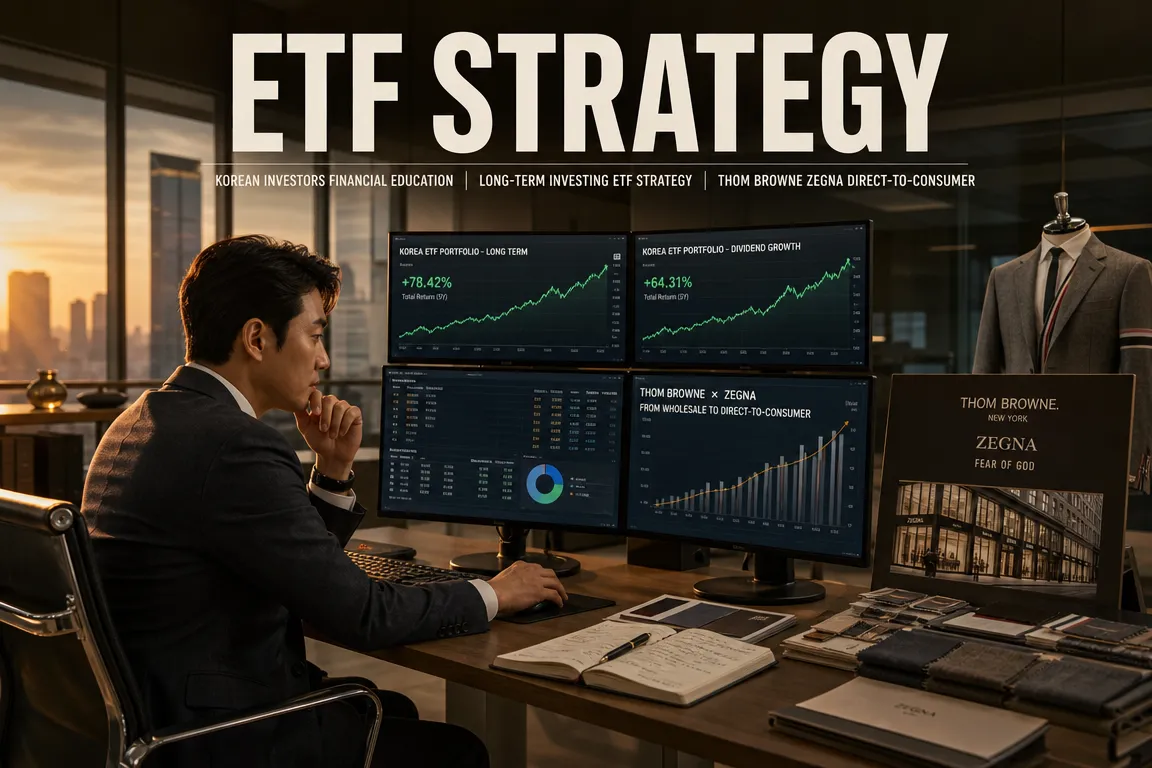
● Money Habits Shock, Korea Invests Wrong
“When money should be working, but I am the one working”: Why Korean investors remain vulnerable
The core of this discussion was not simply “hold stocks for the long term.”
It connected the misperception of private education spending as investment, the psychological tendency to rely on children for retirement, the short-term trading culture in Korea, and the need to reform financial education if Korea is to become a true financial powerhouse.
The key point is straightforward:
Korea must move away from a structure in which people continuously work for income and toward one in which money works on its own within innovative companies and capital markets.
From this perspective, the stock market, long-term investing, ETFs, retirement accounts, and financial education are not separate topics. They are central to redesigning Korea’s asset management system.
1. When private education spending is treated as “investment,” retirement planning weakens
One of the strongest points raised in the discussion was the mistaken belief that private education spending is an investment.
Many parents assume that if they spend heavily on their children, the children will succeed and the parents’ retirement will ultimately be secure.
However, this was described as financial illiteracy.
-
Private education spending is often consumption, not asset-building investment.
-
Assuming a child’s success will solve the parents’ retirement problem is highly risky.
-
Instead of money working, both parents and children end up working continuously.
The point is not that private education is inherently bad.
The problem is that households often allocate most of their cash flow to education while leaving retirement accounts, ETF investments, and long-term assets underfunded.
If this pattern continues, both generations face economic pressure: children struggle to build financial independence, and parents remain exposed to retirement poverty.
2. Japan’s elderly poverty offers a warning for Korea
The discussion also referenced Japan.
Japan previously shared a similar mindset with Korea: study hard, secure a good job, and remain stable.
One outcome has been severe elderly poverty.
-
Older workers are commonly seen in Japanese convenience stores.
-
In some households, grandparents, parents, and children all work to support living expenses.
-
The root issue is not only aging, but the failure to build assets that work over time.
Korea is aging rapidly as well.
At the same time, private education costs remain high, financial education remains weak, and investment behavior is still dominated by short-term returns.
If this trend is not reversed, Korea could become a society where people work hard but still need to work again in old age.
3. The core of Jewish financial education is: do not follow the crowd
The speaker compared Jewish education with Korea’s approach.
Jewish education does not simply tell people to obtain a good job.
It emphasizes doing what one wants to do, building a business, and choosing paths that others do not take.
-
Korean education tends to prioritize stable employment.
-
Jewish education places greater weight on capital, business, investment, and differentiated choices.
-
Wealth may be created not in the most competitive area, but in areas others overlook.
A representative example was Levi Strauss, founder of Levi’s.
During the gold rush, most people tried to mine gold.
Levi Strauss instead made durable pants for miners.
While others searched for gold, he sold the product needed by those mining it.
This matters today for a clear reason.
When everyone moves into the same occupation, exam, or sector, the real opportunity may lie in the surrounding ecosystem.
That is also why the AI value chain must be viewed broadly, including AI infrastructure, data centers, power, software, security, cloud, and robotics, rather than focusing only on AI semiconductors.
4. For Korea to become a true financial powerhouse, it needs financial software, not just hardware
The discussion noted that Korea already has the conditions to become a financial powerhouse, but financial understanding remains limited.
Koreans have high educational attainment, strong technological capabilities, and a solid industrial base.
However, the ability to understand money and allocate capital remains underdeveloped.
-
Korea has strengths in manufacturing and IT infrastructure.
-
However, asset management, investment banking, and long-term capital formation remain weak.
-
A Singapore-style view of finance as a national growth strategy is needed.
This is also linked to Korea’s next growth drivers.
Even if semiconductors, batteries, biotech, and AI expand, the gains may remain concentrated unless households participate in capital markets.
Financial education is therefore not only a personal finance issue, but also a matter of national competitiveness.
5. Wealth is not created by frequent trading
The investment philosophy was clear.
People do not become wealthy by timing purchases and sales. They become wealthy by holding good assets for a long time.
-
Investing is not a short-term profit game.
-
Starting early matters.
-
Staying invested matters.
-
Ultimately, the person who does not sell until the end benefits from compounding.
Many investors say they believe in long-term investing, but then ask what happens if the stock is delisted or whether returns can be guaranteed in 10 years.
There is no guarantee.
However, putting all capital into a single speculative stock is not long-term investing; it is speculation.
Real long-term investing requires diversification, consistency, asset allocation, and tax-advantaged accounts.
6. The sequence for long-term investing: start with retirement accounts and move toward ETFs
The speaker emphasized that investing also has a sequence.
The first priority is tax-advantaged retirement accounts.
Retirement savings plans and individual retirement accounts provide structures that are favorable for long-term investing.
-
Step 1: Use tax-advantaged accounts first.
-
Step 2: Do not leave cash idle; invest through ETFs or funds.
-
Step 3: Determine the allocation between equities, bonds, domestic, and overseas assets.
-
Step 4: Contribute a fixed amount every month.
For example, a 25- or 30-year-old employee may invest KRW 1 million per month.
That investor may choose an equity ETF allocation of 70-80%, divide exposure evenly between U.S. and Korean ETFs, or include some bond exposure, depending on risk tolerance.
The key is not to concentrate all capital at once.
It is also not to try to predict the market every day.
7. The real issue behind fear of delisting
An important point was raised regarding delisting risk.
In practice, most losses are incurred by investors who bought stocks based on someone else’s recommendation or who approached the market with the goal of making a large amount of money quickly.
-
Buying because “someone said it is good” is not investment judgment.
-
Trying to turn KRW 50 million into KRW 30 million quickly is closer to gambling than investing.
-
Buying without understanding the business and focusing only on price is not long-term investing.
Long-term investing does not mean holding any stock for a long time.
It means investing with an understanding of competitiveness, industry growth, financial stability, market position, and innovation potential.
For that reason, ETFs may be a more practical choice for individual investors than single stocks.
8. Stocks rise over the long term not just because of liquidity, but because of innovation
In the latter part of the discussion, an important issue was raised.
The question was whether asset prices rise only because of inflation and liquidity.
The speaker argued that the answer requires a broader perspective.
Holding cash leaves investors exposed to inflation.
The real power to outperform inflation comes from innovative companies.
-
Companies can raise prices.
-
Companies can improve productivity.
-
Companies can create new markets through technological innovation.
-
Individuals struggle to escape inflation, but innovative companies can move beyond it.
This perspective is also consistent with the current global economic outlook.
Although many argue that the global economy has entered a low-growth phase, companies in the AI value chain are following a different growth path.
AI semiconductors, cloud services, data centers, power infrastructure, and software platforms continue to generate structural demand even in a slowing economy.
For that reason, the essence of long-term investing is not forecasting index levels, but understanding where innovation is happening.
9. A common mistake among Korean investors: confusing the market with the investment itself
The speaker summarized stock investing as investing in companies, not in the market.
This distinction is important.
Many investors focus on whether the KOSPI will rise this week, when the U.S. Federal Reserve will cut rates, or what the Fed chair will say.
Macroeconomic trends matter, but trading based on daily headlines often weakens investment discipline.
-
Company value and market price do not always move together.
-
The market often rises too much or falls too much in the short term.
-
Trying to predict these moves exhausts investors quickly.
-
Investing a fixed share of monthly income is often more realistic.
The discussion also noted that many Americans do not know who the Fed chair is.
By contrast, Korean investors closely follow rates, exchange rates, the Fed, inflation, and index forecasts.
However, they often have weaker discipline in long-term investing and asset allocation.
10. Korea’s long-term stock market growth: a 1,000-fold expansion in 42 years
One of the most notable figures mentioned was the long-term growth of Korea’s stock market capitalization.
It reportedly expanded from around KRW 4 trillion to approximately KRW 5,000 trillion.
The emphasis was not on a 1,000% gain, but on a more than 1,000-fold increase.
-
The Korean market has faced multiple crises over time.
-
It has weathered the Asian financial crisis, the global financial crisis, the pandemic, and rate-hiking cycles.
-
Despite volatility, the market expanded over the long term.
Past performance does not guarantee future results.
However, capital markets tend to expand over time as companies grow, prices rise, productivity improves, and technology advances.
Investors should therefore focus less on short-term index moves and more on long-term structural trends.
The most important point rarely emphasized in other news or video content
The real message of this discussion is not simply “buy stocks,” but “change the structure of your life.”
Much of the available content focuses on which stocks to buy, where the KOSPI may go, or when U.S. interest rates will decline.
But the more important questions are these:
-
Am I building a structure in which money works for me?
-
Is part of my monthly income being converted into assets?
-
Is private education and consumption delaying my retirement planning?
-
Am I teaching children only about job stability, while remaining silent about capital, business, and investment?
-
Am I investing in market prices, or in the future of innovative companies?
The investment challenge for Koreans is not only a lack of stock-picking skill.
More fundamentally, it is the tendency to treat money, education, retirement, work, consumption, and children’s future as separate issues.
In reality, they are all connected.
Excessive private education spending reduces retirement savings, weaker retirement savings increase dependence on children, and that dependence pushes the next generation back into stability-seeking career competition rather than entrepreneurship and innovation.
Financial education is therefore not merely a personal finance skill; it is a tool for breaking intergenerational poverty.
Checklist for Korean investors
-
Are at least 10% of monthly earnings allocated to long-term investing?
-
Are tax-advantaged retirement accounts being used?
-
Is idle cash being invested through ETFs or funds?
-
Is there an independent investment framework rather than reliance on stock tips?
-
Are children being taught about money, business, investment, and compounding?
-
Is consistent investing prioritized over excessive attention to macro news?
-
Are AI, semiconductors, cloud, and data centers being viewed from a long-term perspective?
Core investment message
Korean investors are vulnerable not only because markets are complex, but because financial education remains insufficient.
Private education spending is often mistaken for investment, weakening retirement preparation and increasing dependence on children.
Wealth is built through long-term investing and compounding, not frequent trading.
Retirement accounts, ETFs, and asset allocation should be used to convert part of monthly income into long-term assets.
Stock investing is not about predicting the market; it is about allocating capital to innovative companies.
For Korea to become a financial powerhouse, it must move beyond financial illiteracy and teach the next generation both financial literacy and entrepreneurship.
< Summary >
The main reason Korean investors remain vulnerable is insufficient financial education.
When private education spending is mistaken for investment, retirement preparation weakens and dependence on children can be repeated across generations.
Wealth is created through long-term investing and compounding, not short-term trading.
Using retirement accounts, ETFs, and asset allocation to invest a portion of monthly income is essential.
Stock investing is not about forecasting the market, but about allocating capital to innovative companies.
To become a financial powerhouse, Korea must move beyond financial illiteracy and teach children both financial literacy and entrepreneurship.
[Related Articles…]
*Source: [ 경제 읽어주는 남자(김광석TV) ]
– “돈이 일해야 하는데 내가 일하고 있습니다” 한국인이 투자에서 계속 흔들리는 이유 | 경읽남과 토론합시다 | 존리 대표님 [3편]
● Luxury, Turnaround, Shock
Thom Browne is a New York brand, but the money flows to Italy’s Zegna: investment points behind New York Fashion Week
The most interesting scene at this New York Fashion Week was not the runway, but the flow of capital.
Thom Browne started in New York and closed the final show of New York Fashion Week, but 92% of the equity is held by the Italian luxury group Zegna.
The clothes are sold in Korea, the United States, and Japan, the brand image is built in New York, the financial results are recorded in Italy under Zegna’s numbers, and the stock is valued on the New York Stock Exchange.
The key issue is not simply whether Thom Browne is selling well.
Zegna is currently shifting Thom Browne from a wholesale-led department store brand to a direct-to-consumer brand, and while revenue has shown signs of recovery, profitability has turned negative.
In particular, Thom Browne’s business unit posted an adjusted operating loss of approximately 8.3 million euros in the first half of this year.
What looked like a glamorous fashion show on the surface is, for investors, a useful case for reading luxury stocks, overseas equities, U.S. stocks, the New York market, and consumer demand trends at once.
1. Thom Browne and the significance of closing New York Fashion Week
This year, Thom Browne was selected for the final show of the official New York Fashion Week schedule.
Founder Thom Browne is also the chairman of the Council of Fashion Designers of America, or CFDA.
Given the brand’s symbolic status and industry position, the final-show placement was a natural decision.
New York Fashion Week itself was created because of Europe.
In 1943, during World War II, U.S. reporters could not travel to Paris collections, so New York launched a runway platform for American designers.
New York created a fashion stage because Europe was inaccessible, but more than 80 years later, the flagship New York brand’s majority owner is an Italian luxury company.
This illustrates both the irony and the reality of the global luxury industry.
The brand may be born in New York, the capital may belong to a European luxury group, and the core consumers may be in Korea, Japan, and the United States.
2. Who owns Thom Browne: Zegna holds 92%
Thom Browne began in New York, but 92% of the company is now owned by Italy’s Ermenegildo Zegna Group.
Zegna is a luxury group listed on the New York Stock Exchange under the ticker ZGN.
Zegna acquired 85% of Thom Browne in 2018.
It later purchased an additional 5% in 2021, and in 2024 acquired another 2% following Thom Browne’s exercise of a put option.
Zegna’s ownership in Thom Browne therefore stands at 92%.
The remaining 8% is still held by founder Thom Browne.
That 8% is also structurally expected to be acquired by Zegna over time.
Zegna plans to buy out the remaining stake based on Thom Browne’s results in 2028 and 2030.
In practical terms, Thom Browne’s brand identity remains strongly tied to New York, but financially it should be viewed as a Zegna asset.
3. Thom Browne results in numbers: revenue recovery, profit loss
Thom Browne’s revenue in the second quarter was around 65 million euros.
On a euro basis, this was roughly flat year on year, but excluding currency effects, revenue increased 2.7%.
In the first quarter, revenue declined 3% on the same basis, so the second-quarter return to positive territory is a clear sign of recovery.
The issue is that this recovery has not yet translated into profit.
In the first half of this year, Thom Browne posted an adjusted operating loss of approximately 8.3 million euros.
In the same period last year, it reported an adjusted operating profit of about 4.5 million euros.
In other words, the business moved from profit to loss in just one year.
Zegna attributed the result to adverse foreign exchange movements and investment required for the shift toward a retail-first strategy.
That retail-first strategy is the core of Thom Browne’s current transformation.
4. Why revenue rose but profit fell: the cost of the direct-sales transition
To understand Thom Browne’s results, it is necessary to distinguish between wholesale and direct sales.
In wholesale, department stores or multi-brand retailers buy Thom Browne products first and then sell them to consumers.
Under that structure, Thom Browne recognizes revenue when goods are sold to the retailer.
Inventory risk is lower, and the brand does not bear most store operating expenses directly.
By contrast, direct sales mean Thom Browne sells directly to consumers through its own stores and online channels.
In that model, the brand directly controls pricing, inventory, customer data, and the retail experience.
However, it must also absorb inventory risk, store operating costs, labor, marketing, and logistics.
For Zegna, expanding direct sales is the correct long-term approach if Thom Browne is to become a stronger brand.
But in the short term, costs come first and earnings follow later.
That is why this year’s results show both revenue recovery and weaker profitability.
5. The key second-quarter metric: direct sales rose 16%
The most important second-quarter figure for Thom Browne was direct-sales revenue.
Direct sales were approximately 52 million euros, up 16% excluding currency effects.
By contrast, wholesale revenue was about 13 million euros, down 29.3%.
At first glance, the wholesale decline may appear negative.
However, Zegna is intentionally reducing wholesale exposure.
Selling more through department stores is less important than directly reaching consumers and controlling pricing over the long term.
For the first half of the year, 83 euros out of every 100 euros of Thom Browne revenue came from its own stores and online channels.
At this point, Thom Browne is no longer a wholesale-led brand but has substantially shifted toward a direct-sales model.
Zegna’s stated direct-sales growth markets are the Americas, Korea, and Japan.
Korea is especially important: since the launch of Thom Browne Korea in 2023, 17 domestic stores have been converted from wholesale to direct-sales operations.
Korean consumers are therefore not only a sales base, but also an important test market in Zegna’s global retail strategy.
6. Thom Browne revenue trend: slowdown after the 2023 peak
Following Zegna’s acquisition, Thom Browne grew rapidly.
Revenue reached about 378 million euros in 2023.
In 2024, it fell to around 315 million euros, and the 2025 figure cited in the source was about 268 million euros.
That represents a decline of roughly 29% over two years.
This should not be interpreted as a pure decline in brand demand.
Luxury consumption has slowed, China has weakened, and foreign-exchange pressures have also weighed on results, but a significant part of the decline reflects Zegna’s deliberate reduction of wholesale partners.
In other words, Thom Browne is less a “weakening brand” than a “brand changing its sales model.”
For investors, however, the key question is when this transition will begin to improve profitability.
7. Zegna Group as a whole remains in better shape
Thom Browne alone shows a clear deterioration in profitability.
But at the group level, Zegna still remains on a growth path.
In the first half of this year, Zegna Group revenue increased 9.3% excluding currency effects.
Adjusted operating profit also rose 8.4%.
In other words, Zegna’s core business is still generating profits.
The issue is that Thom Browne is now in an investment phase, weighing on group profitability rather than acting as an immediate earnings driver.
This explains why Zegna’s share price did not react strongly to Thom Browne’s second-quarter revenue rebound.
Markets are focused less on “revenue is growing again” and more on “when will profitability return?”
8. Why the remaining 8% stake matters: a variable that can move reported earnings and costs
One detail many investors may overlook is the remaining 8% stake held by founder Thom Browne.
Zegna is expected to acquire this stake later, and the expected purchase price will depend on Thom Browne’s future earnings outlook.
This creates an interesting accounting effect.
If Thom Browne’s future valuation declines, the amount Zegna will need to pay later also falls.
That can reduce liabilities and create an accounting gain.
Conversely, if Thom Browne’s future outlook improves or if exchange rates move unfavorably, Zegna may have to pay more later.
That would create an accounting expense.
In fact, profit and loss from the Thom Browne put option shifted from a gain of about 28.3 million euros last year to a cost of about 3.9 million euros this year.
As a result, although Zegna Group’s adjusted operating profit increased, net profit fell from around 47.9 million euros to about 28.4 million euros.
This is not necessarily immediate cash outflow, but an accounting effect driven by changes in the estimated future price of the remaining stake.
For investors, this is an important point.
Improving brand value can appear as a near-term expense in reported earnings.
In other words, brand value and short-term accounting profit do not always move in the same direction.
9. Zegna’s share price on the New York Stock Exchange: the market remains unconvinced
Zegna listed on the New York Stock Exchange in 2021 through a SPAC merger.
Zegna’s share price fell from around $15.25 on August 3 to $12.56 on September 2, the day before earnings were released.
That represents a decline of about 17.6% in roughly one month.
On the earnings release day, the stock rose only about 0.7%, and later moved back into the $11 range.
This suggests that the market did not materially re-rate Zegna based solely on Thom Browne’s second-quarter recovery.
For U.S. equity investors, profitability recovery matters more than brand strength alone.
In a global luxury market shaped by slower consumption and interest-rate pressure, even luxury names that resemble growth stocks must demonstrate earnings visibility.
In short, the market now requires a number-based turnaround, not just a visually appealing runway show.
10. The significance of Korea: a growth market and a brand-risk market
Korea is a complex market for Thom Browne.
The brand once had a strong luxury image among celebrities and fashion influencers in Korea.
Its tailored silhouettes, signature stripe detailing, and precise shirts and cardigans offered a distinct design identity.
But as consumption broadened, the brand also came to be seen by some as less exclusive.
As the style spread among younger consumers and imitators, some buyers began to view it as less scarce.
For luxury brands, broader adoption is a double-edged sword.
Higher sales support revenue, but too much ubiquity can weaken premium positioning.
That is another reason Zegna is shifting to direct sales.
To protect brand equity over the long term, the company must directly manage pricing, distribution, store experience, and customer mix.
Converting the 17 Korean stores to a direct-sales model is therefore not just a distribution change, but an effort to regain control over brand positioning.
11. The role of fashion shows has changed: direct purchase conversion now matters more than wholesale orders
In the past, the main audience for fashion shows was department store buyers.
When buyers placed orders after a show, those orders translated directly into revenue.
But Thom Browne’s current structure is different.
As wholesale declines and direct sales expand, the key question is whether consumers who see the runway actually buy at full price through stores or online.
In other words, New York Fashion Week is no longer just an industry event; it is part of the customer acquisition cost.
The show must raise brand awareness, awareness must drive store visits, and store visits must convert into full-price purchases.
If that chain is weak, the fashion show becomes an expensive marketing exercise.
If that chain is strong, the direct-sales strategy can improve profitability more quickly.
Going forward, the core issue for Thom Browne is not runway quality, but how effectively the runway converts into sales.
12. The most overlooked point: Thom Browne is becoming a data-transition company, not just a fashion brand
Thom Browne discussions typically focus on fashion shows, celebrities, pricing, and brand image.
But from an investment perspective, the most important change is customer data.
Under a wholesale structure, the department store owns the customer relationship.
The brand has only limited visibility into who bought what, how often they buy, at what price they stop buying, or which regions respond best.
Under direct sales, that data flows to Thom Browne and Zegna.
Purchase history, size preferences, category preferences, repeat-purchase cycles, and online behavior data can all be collected.
This data can then be used for AI-driven demand forecasting, inventory optimization, personalized marketing, and pricing strategy.
The luxury industry cannot avoid AI transformation.
For a brand with strong design identity like Thom Browne, excessive inventory can lead to discounting pressure and damage brand value.
If AI-based inventory management and customer segmentation work properly, they can reduce the cost burden of the direct-sales transition and support margin recovery.
Ultimately, Thom Browne’s retail transition is not simply about selling directly instead of through department stores.
It is about reclaiming customer data and building a more precise profit model on top of that data.
That is the key variable that could eventually move Zegna’s share price again.
13. Three metrics to watch at Zegna and Thom Browne
First, monitor whether direct-sales revenue continues to grow at a double-digit pace.
In the second quarter, direct-sales revenue increased 16% excluding currency effects.
The key question is whether this was a one-time result or the start of a structural shift.
If direct-sales growth slows, it becomes difficult to justify the current cost burden.
Second, monitor whether total revenue remains positive excluding currency effects.
In the second quarter, total revenue increased 2.7% excluding currency effects.
But it declined in the first quarter.
At least several consecutive quarters of positive growth are needed before a true turnaround can be confirmed.
Third, monitor how quickly the first-half loss of 8.3 million euros narrows.
Early losses from the direct-sales transition are unavoidable.
However, if the loss does not narrow over time, the market may begin to discount the strategy as unsuccessful.
Investors should focus more on the pace of loss reduction than on revenue growth alone.
14. Investment takeaway: Zegna is currently paying the cost of rebuilding Thom Browne
For Zegna, Thom Browne remains an attractive asset.
It has a strong design identity, global recognition, a substantial presence in Korea and Japan, and symbolic importance at New York Fashion Week.
However, these strengths are not translating directly into group earnings at present.
Instead, the transition to stores, inventory management, staffing, marketing, and customer-data acquisition is producing upfront costs.
That is why Zegna’s share price did not move significantly on Thom Browne’s revenue recovery.
Luxury investing is not simply about brand fame.
Investors need to assess brand recognition, distribution structure, margins, inventory, foreign exchange, consumer demand, and accounting treatment together.
For overseas luxury stocks, the key issue is not where the brand originated, but which company ultimately captures the earnings.
Thom Browne’s clothing attracts attention in New York, sells in Korea, is reflected in Zegna’s financial statements, and is valued on the New York Stock Exchange.
Understanding that structure is essential to identifying the real investment case.
< Summary >
Thom Browne is a New York brand, but 92% of the equity is held by Italy’s Zegna Group.
In the second quarter, Thom Browne revenue increased 2.7% excluding currency effects, and direct-sales revenue rose 16%.
Wholesale revenue fell 29.3%, reflecting Zegna’s deliberate shift toward a direct-sales model.
The issue is profitability.
In the first half of this year, Thom Browne posted an estimated loss of 8.3 million euros.
Zegna Group remains in growth mode overall, but Thom Browne is currently a phase of investment that is weighing on group earnings.
The accounting effect of the remaining 8% stake held by the founder is also a variable affecting Zegna’s net profit.
Going forward, the key indicators are whether direct sales continue to grow at a double-digit pace, whether total revenue remains positive excluding currency effects, and how quickly losses narrow.
The most important point is that Thom Browne is evolving from a fashion brand into a retail and AI-driven business focused on direct customer-data acquisition.
[Related Articles…]
- Luxury retail transition and its impact on stock performance
- Key earnings signals for investors in global consumer stocks
*Source: [ Maeil Business Newspaper ]
– [어바웃 뉴욕] 패션위크 폐막 맡은 톰브라운, 92%는 이탈리아 회사 | 이나연 특파원