The content is lengthy and complex, but I’ve restructured it and organized it by key points. The main theme is political situation and economic approaches. Below, I have grouped the information and clearly defined the main messages.
1. South Korea’s Political Situation and Issues
Concerns about Communist Trends
- The assertion that South Korean society is generally trending towards communist characteristics.
- The perception that systems like the basic income policy, which increases reliance on state subsidies, resemble communist traits.
- Mentioning failed overseas cases of basic income systems (e.g., some European countries, partial attempts in Canada).
Jeon Han-gil’s Principled Statements
- Expressing agreement with Jeon Han-gil’s uncompromising stance and principled statements, despite earning 6 billion won annually.
- His statements are not politically neutral but lean towards being a “common sense” advocate.
- Commending his actions in expressing these views even at the expense of his stable income as a lecturer.
Concerns about Political Chaos and Radical Changes
- Rejecting political ideological battles (left/right) and emphasizing the importance of common-sense judgments and policies.
- The need to improve Yoon Seok-yeol’s government’s issues or flawed decisions (e.g., statements on reforms or declaring martial law).
- However, acknowledging the practical consideration that the lack of a suitable alternative to Yoon may work in a positive way.
2. Analysis from an Economic Perspective
Policy and Economic Interconnections
- Raising the issue of minimum wage increases → inducing inflation → increased operating costs for small businesses and companies.
- Observing that South Korea is wasting resources and time on political disputes rather than on technological or economic development.
Comparison with Global Trends
- Major countries like the United States and China are diving into AI technology, semiconductor development, and strategic technology investments.
- In the United States, over 700 trillion won in AI-related investments are being discussed.
- China is trying to gain a technological advantage through efficient chip production.
- Expressing concerns that South Korea is at risk of falling behind in these crucial competitions.
South Korea’s Future Economic Vision
- South Korea must focus on improving its economic structure and technological innovation.
- The consumption of energy due to political turmoil, impeachment debates, and factional conflicts is highly likely to have a negative economic impact.
3. Personal Conclusion and Recommendations
-
The Importance of Principle and Common Sense
- Individuals like Jeon Han-gil who have principles are needed, and more people need to participate.
- Especially, an approach of “seeing the forest for the trees” is needed. Focus must be on increasing South Korea’s competitiveness.
-
Economic Recovery is the Top Priority
- The most important factor for stabilizing the lives of citizens and relieving economic pressure is focusing on economic stabilization rather than political conflicts.
- For this, the government must focus on policies designed for technological investments and in alignment with global technological trends.
-
Political Change is the People’s Choice
- The citizens must use their current freedom and political choices but must also make wise decisions with an understanding of the overall context.
- Decisions that consider the sustainable development of the nation, rather than excessive ideological confrontations, are needed.
4. Intended Message
- Jeon Han-gil’s principled statements are not just a personal expression of opinion but contain a serious message about the direction of society.
- South Korea must not miss crucial economic turning points despite fears of communism or political instability.
- The general public must also not be passive, but should participate in politics and the economy with common sense and ownership.
[Related Articles at Next-Korea.com]
*Source : [비아토르 VIATOR in NY] 강건너 불구경해서 죄송하지만 채널 날릴 각오하고 할말은 하겠습니다.

Global Economic Landscape: Exchange Rates, Japanese and Korean Economies, Future Outlook, and Countermeasures
1. Exchange Rates and Japan's Monetary Policy
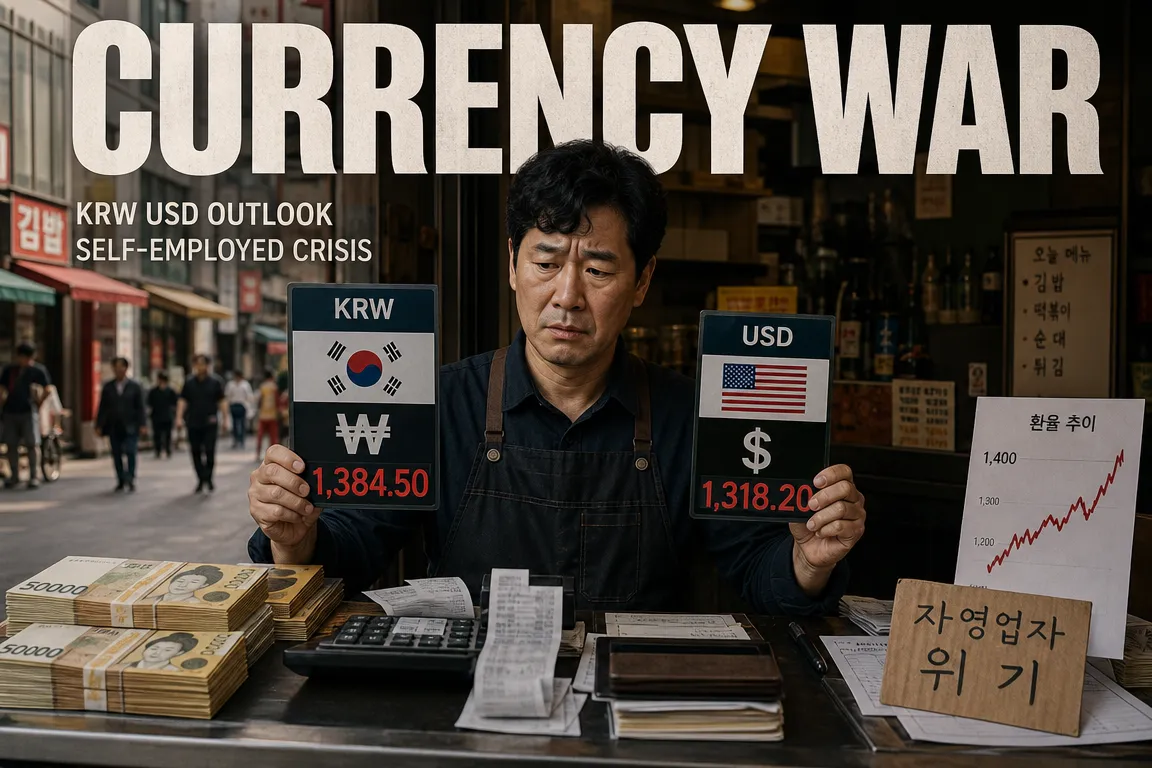
- In 2024, a weakening of the Japanese Yen and a decline in the Korean Won were observed.
- Key factors include the significant interest rate differential between Japan and the United States, and Japan's structure of not actively raising interest rates.
- In 2025, the Bank of Japan is expected to proceed cautiously with changes in its monetary policy, and given the global economic turmoil, the likelihood of changes in Japan's monetary policy seems low.
- There are signs of exchange rate defense around the 160 yen level, and the possibility of direct interest rate policy adjustments will be considered.
2. Korean Won Value and Political Issues
- One of the reasons for the recent sharp decline in the value of the Korean Won is attributed to political risks and the foreign investment environment.
- From the perspective of foreigners, political turmoil in Korea creates a background of increased investment uncertainty.
- Internal events such as 'emergency martial law declarations' and impeachment have led external investors to overestimate the risks in Korea.
3. The Debate of the Lost Decade and Three Decades
- Japan's Lost Decade (and three decades) is often cited as a case where the low growth of the entire Japanese economy became entrenched.
- In the 1990s, Japan experienced a slowdown in growth, along with a large increase in suicide rates and a growing sense of loss.
- Through this, Japan accepted low growth and sought a direction to cope with it. This process required a long time for business restructuring and industrial changes.
- The Korean economy is also solidifying low growth in a similar pattern.
4. The Importance of Business Restructuring
- One of Japan's mistakes was the delay in business restructuring.
- In the past, Japan was successful in semiconductors, electronics, and steel, but failed to prepare for the strengthening of competitiveness in the United States and China, and did not solve its unique problems (industrial structure, regulations).
- Korea is in a similar situation, facing threats to its competitiveness in semiconductors and batteries from China and globally.
- In particular, South Korea needs to secure a new opportunity to change its main industrial structure and strengthen its global competitiveness.
5. The Aging Population Issue and the Role of Companies
- The aging population problem is not unique to Japan, but is a similar crisis in Korea.
- A strong performance by companies is essential to maintaining the national economy, such as employment, unemployment rates, and consumption, and the necessary policies need to be tailored to each industry.
< Summary >
- The past "Lost Decade" of the Japanese economy serves as a warning for the recent situation of the Korean economy.
- Complex risks are at play in the economic outlook, including exchange rates, political risks, and industrial crisis factors.
- Business restructuring and the development of promising future industries are key to escaping low growth.
- It is a time that requires a response to issues such as the aging population and the intensification of domestic and international competition.
[More…]
- Survival Strategies in an Era of Economic Low Growth
- Comparative Analysis and Lessons of the Korean and Japanese Economies
*YouTube Source: [경제 읽어주는 남자(김광석TV)]
– [풀버전] ‘잃어버린 10년’ 경고: 한국의 일본화 돌파법, 이제는 정말 마지막 기회 | 경읽남과 토론합시다 | 박상준 교수