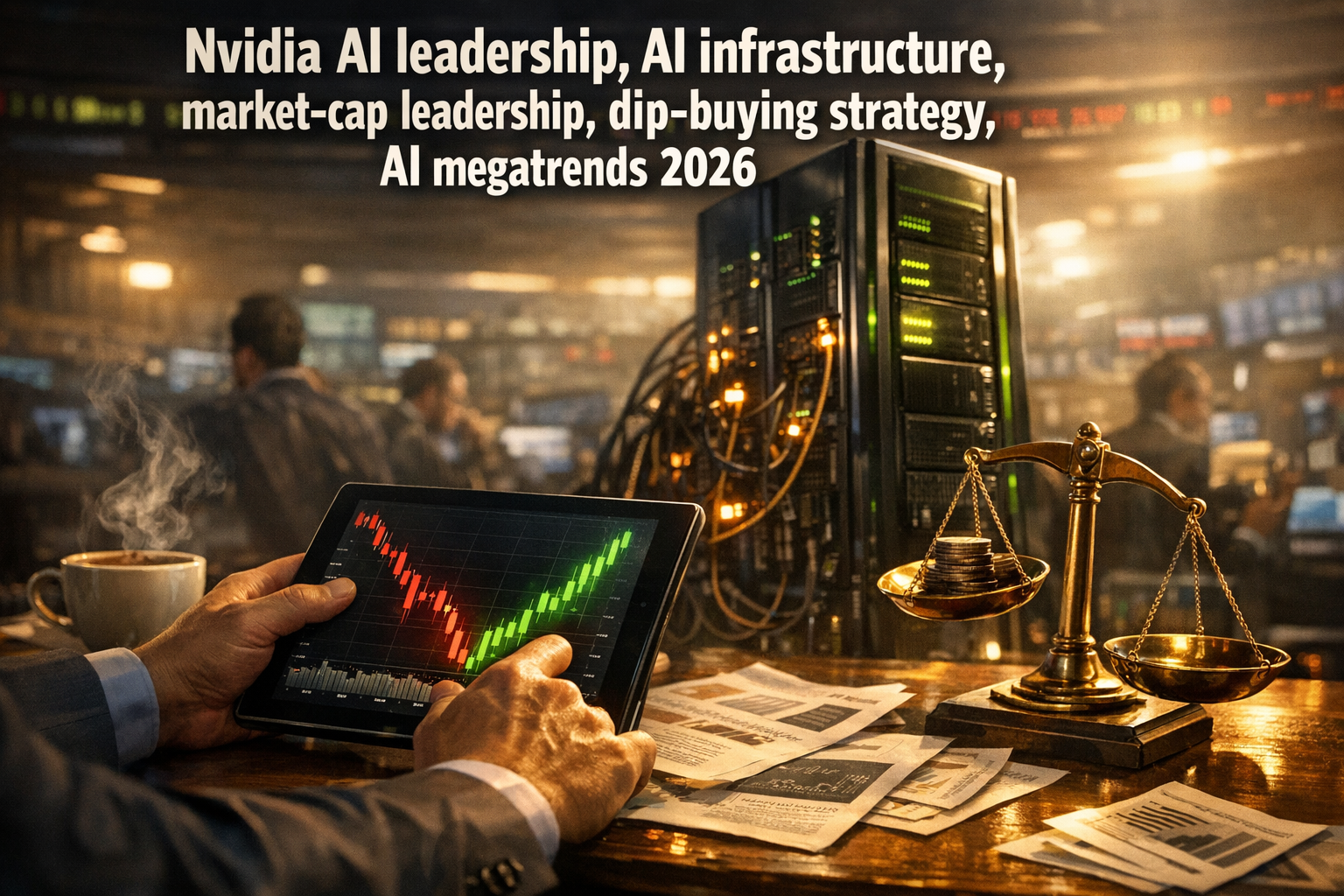
● AI Power-Grab, Nvidia Tops Big-Tech, Dip-Buy Blueprint
2026 Core Equity Map to Accumulate on Every Downturn: AI, Semiconductors, and Defense Megatrends Interpreted Through Market-Cap Rank Shifts
This report covers:1) Winners and losers of the AI cycle as indicated by early-2026 U.S. Top 10 market-cap ranking changes
2) A checklist for what to accumulate during pullbacks (and the underlying rationale)
3) 2026 investment signals derived from new entrants, sharp risers, and sharp decliners within the Top 100 by market cap, segmented by industry
4) Implications of the statistic that only 27% of funds outperformed the S&P 500 for individual investor strategy
5) A key 2026 inflection: AI shifting from training to inference, with a corresponding change in beneficiaries
1) News Brief: Early-2026 Market-Cap Rankings Indicate a Structural Reallocation of Capital
Key headline: Nvidia reached the No. 1 market-cap position on an annual closing basis for the first time.
This reflects a market premium concentrated in AI infrastructure, particularly semiconductors, rather than a purely price-driven move.
1-1. Three Signals from the Top 10
(1) Nvidia at No. 1: AI has transitioned from a theme to a structural regime
As with prior multi-year technology cycles (telecom, PCs, smartphones), the leading platform often sustains dominance over extended periods. AI has moved into a “lead industry” phase centered on GPUs and accelerators.
(2) Alphabet overtaking Microsoft
This signals an intensifying competition over AI monetization channels (search/advertising, cloud, models, and agents), rather than a short-term relative performance swing.
(3) No new names in the Top 10: concentration is entrenched
In a high-volatility regime, new entrants typically emerge. The absence of new Top 10 constituents suggests capital has preferred established mega-cap platforms and infrastructure providers over higher-risk alternatives.
2) The 2026 “Core Basket” to Accumulate During Pullbacks
A practical takeaway is that mega-cap technology and high-quality large-cap leaders may appear low-volatility, but they remain difficult to outperform on a full-year basis.
The Top 10’s average return was cited at approximately 28.5%, versus roughly 18% for the broader market. A high-expectation approach is to prioritize incremental accumulation of the highest-quality, largest-cap names during corrections.
2-1. Why “Buy the Dip and Accumulate” Can Work in 2026
(A) When rate and recession concerns rise, capital rotates toward earnings visibility
Large platforms and semiconductor infrastructure tend to benefit from capex visibility, order cycles, and ecosystem lock-in, which can support earlier re-rating during recovery phases.
(B) AI spend is multi-layered and sequential
AI investment propagates across data centers, power, networking, memory, and security. Corrections may reflect valuation resets more than demand destruction, making staged accumulation potentially advantageous.
(C) Structural difficulty of outperforming professional managers
If only 27% of funds beat the S&P 500, most active approaches fail to exceed the benchmark. For individual investors, a foundation of index exposure plus core high-quality leaders can be a rational baseline.
3) 2026 Sector Signals from 2025 Year-End: “AI + Defense”
Market-cap rank increases can indicate durable capital reallocation rather than transient price momentum.
3-1. Common Drivers Among New Entrants and Sharp Rank Advances Within the Top 100
AI (majority), defense (some), financials (some), advertising (some)
(1) AI infrastructure
Examples cited include AMD (accelerators), Micron (memory), Applied Materials (semiconductor equipment), power/utilities (data-center electricity), and construction/heavy equipment (infrastructure). The key point is that monetization is spreading across the supply chain, not limited to AI software.
(2) AI-enabled defense
Defense-adjacent AI platforms such as Palantir were highlighted. With persistent geopolitical risk and deeper AI adoption in defense and intelligence, the trend may retain durability.
(3) Financials (large investment banks/cards, etc.)
Certain rate and cycle conditions can improve earnings dynamics. Financials may also gain relevance as AI infrastructure investment scales.
3-2. 2026 Risk Signals from Sharp Rank Declines
Weakness was summarized in consumer discretionary (apparel/dining/travel), parts of healthcare, and energy. The underperformance may reflect forward pricing of macro and policy risks.
(1) Consumer slowdown sensitivity
Nike, Starbucks, and lodging/booking businesses were referenced as consumer-sentiment sensitive. If recession probability increases, these names often face earlier multiple compression due to lower earnings visibility.
(2) Policy risk (“Trump-sensitive” sectors)
Healthcare (pharma/insurance) and energy (price pressure) were flagged as potentially exposed to policy-driven volatility.
4) ETF/Index Framing: A Realistic Portfolio Backbone for 2026
The message was explicit: if single-name exposure is burdensome, index and mega-cap bundles can be sufficient.
2025 performance summary (as cited):
Semiconductors showed strong relative performance (high beta in up markets); Nasdaq/mega-cap technology outperformed the broader market. A staged approach to accumulating indices and core sectors during pullbacks was presented as a reasonable 2026 framework.
5) Key 2026 Inflection: AI Shifts from Training to Inference
A central claim was that Nvidia is positioned for the training era, while inference winners could shift toward networking and custom silicon (e.g., Broadcom).
This matters because 2026 investment positioning may diverge here.
Training-focused phase
Large GPU clusters, new data-center builds, and an early capex surge.
Inference-focused phase
Operational deployment and monetization at scale. Efficiency, networking, custom chips (ASICs), power optimization, and data movement become increasingly decisive.
Conclusion: During 2026 pullbacks, exposure may broaden beyond GPUs toward inference enablers (networking/ASICs/memory/power/optical interconnects).
6) 2026 Practical Checklist: Avoid Indiscriminate Dip-Buying
(1) Maintain priority on mega-cap platforms and infrastructure
In drawdowns, the largest, highest-quality businesses often recover earlier.
(2) Track industries with improving market-cap ranks
Rank progression can provide a clearer signal of long-duration market preference than price alone.
(3) Treat AI as a supply-chain basket, not a single stock
Allocate across compute (semiconductors), memory (storage), networking (transfer), and power (operations), using staged accumulation.
(4) Apply stricter timing discipline to policy-sensitive sectors
Healthcare/energy/consumer discretionary can remain “cheap” longer; valuation alone may be insufficient for entry timing.
< Summary >
Early-2026 market-cap ranking changes indicate continued concentration around AI infrastructure and large-cap leaders. Nvidia’s ascent to No. 1 and sustained rank gains across semiconductors and AI infrastructure support the view that accumulating top-tier franchises during corrections remains a viable approach. A key 2026 consideration is the shift from AI training to inference, expanding potential beneficiaries from GPUs to networking, ASICs, memory, and power. The statistic that only 27% of funds outperformed the S&P 500 suggests that index exposure complemented by staged accumulation of core high-quality equities can be an efficient strategy for individual investors.
[Related Articles…]
AI investment trend: A beneficiary map opened by the 2026 inference market
https://NextGenInsight.net?s=AI
Semiconductor cycle outlook: Why memory, equipment, and networking may move together in 2026
https://NextGenInsight.net?s=Semiconductors
*Source: [ 소수몽키 ]
– 순위 변화로 보는 2026년 하락이 올 때마다 사 모을 주식들
● Trump Liquidity Blowout, 2026 Midterm Pump, Fed Rate-Cut Frenzy, Tariff Shockwave, Korea FX Whiplash
Trump “Liquidity Party” Scenario: What Changes for U.S. and Korean Asset Markets in 2026 (Midterms, Fed, Tariffs)
This report covers four areas:1) Why the U.S. has strong incentives to present a “strong growth” backdrop in 2026 (midterm-election incentives).
2) Why that backdrop could be powered by a combination of large-scale liquidity provision and rate cuts (Fed/Treasury/USD interplay).
3) Why asset rallies can be powerful yet still vulnerable to a later drawdown (Nixon-era parallels and stagflation risk).
4) Korea-specific implications for USD/KRW, exports, capital flows, and risk-managed positioning.
1) News Briefing: Why the Probability of a “U.S.-Driven Liquidity Shock” Is Rising
Key point: U.S. political timing (midterms) can increase incentives for a policy package that lifts growth, employment, and asset prices over a short horizon.
(1) Midterms can set the pace of policy
Ahead of midterms, improved household perception of employment, equities, and housing is politically advantageous. This increases the appeal of short-cycle stimulus, with asset-price appreciation often transmitting quickly to voter sentiment.
(2) Liquidity expansion is the fastest channel into asset markets
Lowering the real purchasing power of the currency and raising the nominal prices of equities, real estate, gold, and crypto is a typical transmission mechanism. The “debasement” narrative is central to this framing.
(3) Tariff pressure can, paradoxically, attract U.S.-bound investment
If tariffs are perceived as a durable risk, corporates may reallocate toward U.S.-based production and capital expenditure. Such inflows can support near-term employment and GDP.
(4) Markets favor the combination of higher growth expectations and rate-cut expectations
If U.S. growth forecasts rise while expectations for policy easing also build, the rationale for a strong risk-asset rally strengthens. The key market question becomes whether stimulus re-accelerates inflation.
2) Mechanism: How a “Liquidity Party” Could Materialize (Four Policy Channels)
(1) Concurrent monetary and fiscal impulse
The scenario assumes capacity for materially larger liquidity provision than markets may initially price. The impact is larger when monetary policy is reinforced by fiscal actions (tax cuts, spending, issuance).
(2) The Fed and perceived distance from politics
Fed independence is a formal principle, but markets may price the probability of political influence. Even shifts in expectations around Fed leadership or policy stance can move long yields, the USD, and equities in advance.
(3) A weaker-USD signal combined with forced capital attraction
A weaker USD can support export competitiveness but may reduce the relative appeal of USD assets. A Trump-style approach can aim for a weaker USD while using tariffs, regulation, and investment incentives to pull foreign capital in. If effective, the U.S. may increasingly finance trade deficits via the financial account (capital inflows).
(4) Using energy prices to contain headline inflation
Energy-price stability affects consumer inflation perception rapidly. Ahead of midterms, managing energy as a narrative lever for “inflation control” can be politically and economically consequential.
3) “No Inflation” vs. “Inflation Later” Debate: Core Issues
Both views can be partially correct:
Near-term (YoY) inflation can appear stable, while medium-term (cumulative liquidity and asset-bubble risk) can rise.
(1) YoY base-effect optics: tariffs can be a one-time level shock
If tariff levels stabilize after an initial increase, the YoY inflation impulse can fade mechanically. This supports the argument that tariff escalation does not necessarily produce immediate inflationary spirals.
(2) Liquidity and asset-market accumulation risk remains
Liquidity does not flow exclusively into productive capacity. If it concentrates in equities, real estate, and crypto, the economy can appear strong while imbalances build, increasing the risk of a later correction.
(3) Nixon-era parallel: pre-election stimulus followed by later shocks
Historical reference points include a mix of easing, tariffs, and price controls that initially improved conditions but later coincided with structurally higher inflation and slower growth. A similar sequence remains a non-zero risk.
4) Asset-Market Implications: The Rally May Be More About Liquidity Than Growth
(1) Equities
Some rallies are earnings-led; others are valuation-led via liquidity-driven multiple expansion. Liquidity-led phases can reverse more abruptly if the policy regime changes.
(2) Real estate
Rate-cut expectations can transmit quickly, though the realized impact varies by region, income dynamics, and fixed-rate mortgage prevalence. Political incentives generally favor stable-to-rising housing prices.
(3) Gold and crypto
Under a debasement narrative, gold and Bitcoin may co-move as currency-hedge assets. Late-cycle liquidity rallies typically carry higher volatility.
5) Korea: Risk Checklist for USD/KRW, Exports, and Capital Flows
A stronger U.S. cycle can be neutral-to-negative for Korea if driven by liquidity and capital absorption rather than productivity.
(1) USD/KRW: a weaker USD does not guarantee KRW strength
Even with broad USD softness, KRW appreciation can be constrained by trade conditions, the semiconductor cycle, and external risk. If capital is pulled toward the U.S. (FDI, USD-asset preference), KRW may still face pressure.
(2) Exports: direct hit from tariffs and reshoring
Tariffs encourage U.S.-based production. Korean corporates may respond via U.S. investment, potentially reducing domestic capex and employment at the margin.
(3) Capital flows: higher volatility in Korea’s USD inflows/outflows
If the U.S. combines higher growth with easier policy, global capital may concentrate in U.S. markets. Korea could see more volatile foreign investor positioning in equities and bonds.
(4) Policy dilemma: growth support vs. inflation and FX stability
U.S. easing can increase pressure for domestic easing, but FX and inflation constraints may limit policy flexibility, complicating central-bank trade-offs.
6) Underemphasized Core Points
Core 1: Not “no inflation,” but “delayed inflation” or a different transmission channel
YoY inflation stability is politically favorable, but asset prices and credit expansion often appear with a lag in official inflation measures. When stress emerges, it can initially surface as financial instability (asset drawdowns, spread widening).
Core 2: The U.S. external balance may be managed more via capital inflows than trade adjustment
If trade-balance improvement is limited, attracting more foreign capital becomes the balancing mechanism. This can increase pressure on allies (Korea, Japan, Europe) regarding investment, supply chains, and technology transfer.
Core 3: Late-rally sensitivity shifts from macro data to political calendar and policy headlines
Around midterms, a change in policy tone can turn markets even if economic data remains strong. Political-event risk may become as important as macro analysis.
Core 4: Korea should stress-test the breakdown of “U.S. boom = Korea boom”
If U.S. strength reflects liquidity and capital absorption rather than productivity, spillovers can be less supportive for Korea, with pressure concentrated in FX, exports, and foreign flows.
7) 2026 Monitoring Framework: Signals of Continuation vs. Regime Shift
(1) Beyond YoY CPI: re-acceleration in services inflation and wages
(2) U.S. 10-year yield: confidence in easing vs. concern about fiscal and inflation risk
A renewed rise in long yields increases the “cost of the party.”
(3) Dollar index and EM flow dynamics
If the USD weakens but EM inflows do not improve, the regime may be “U.S. concentration” rather than broad risk-on.
(4) Tariff levels, exemptions, and negotiation tempo (especially U.S.-China)
Whether negotiations ease in operational terms matters for near-term inflation optics.
(5) Breadth of asset inflation
Simultaneous overheating across equities, real estate, and crypto is a typical late-stage liquidity signal.
[Related]
https://NextGenInsight.net?s=exchange-rate
https://NextGenInsight.net?s=inflation
*Source: [ 경제 읽어주는 남자(김광석TV) ]
– 트럼프의 선거 전략, 미국발 유동성 파티 시작된다. 유동성 폭탄과 자산 랠리의 본질 | 심층토론 – 김대호, 노영우 5편
● South Korea Nuclear Sub Blitz Enrichment Reprocessing Powerplay
“South Korea’s Nuclear-Powered Submarine Becomes a Practical Option Sooner Than Expected” — Why SSN + Enrichment/Reprocessing Are Linked, and the Economic/Industrial Spillovers
This note covers:1) Why “nuclear-powered submarines (SSNs)” are consistently discussed together with “enrichment and reprocessing rights”2) What “rapid, parallel progress starting next year” implies as a policy and diplomatic pathway3) Structural differences between Australia (AUKUS) and South Korea in pursuing SSNs4) Industrial impacts across South Korea’s shipbuilding, defense, and nuclear power value chains (supply chain, R&D, export-control risk)5) The single most decision-relevant point often missed in mainstream news and commentary
1) News Briefing: Translating the Core Statements into Policy Agendas
The central claim is significant because it links “nuclear-powered submarines” with “enrichment and reprocessing rights,” argues that multiple tracks could proceed in parallel beginning next year, and asserts that South Korea could move faster than Australia due to existing technical foundations.
Translated into policy agendas:
- A signal that the objective is not only the “platform (SSN)” but also “fuel sovereignty (enrichment) + back-end cycle (reprocessing)” as a combined package
- “Operational autonomy” implies not just possession, but independent long-term operations, maintenance, and fuel supply
- “Contingency preparedness” is framed as both a military option and a source of diplomatic leverage (deterrence)
2) Why SSN Discussion Is Bundled with Enrichment/Reprocessing (Fuel Cycle)
2-1. For SSNs, Fuel Control Often Matters More Than Hull Construction
An SSN program is not complete with hull and propulsion alone. Practical autonomy depends on:
- The regulatory and contractual framework governing reactor fuel supply
- Control and oversight of nuclear material and fuel management during operations
Sustained operations typically require linkage to both:
- Access to fuel production (enrichment)
- A back-end solution for spent fuel (reprocessing and associated management)
2-2. What Enrichment Signifies: Industrial and Technical Leverage Over Fuel Supply
The stated rationale—“enrichment enables domestic fuel production”—targets reduced external dependence for SSN fuel.
However, enrichment is tightly coupled to nonproliferation controls internationally. As a result, diplomacy, regulation, and alliance coordination tend to be decisive constraints.
2-3. What Reprocessing Signifies: Cost Structure and Long-Term Operational Design
Reprocessing directly addresses spent fuel disposition. Because SSN lifecycles are measured in decades, the back-end cycle (storage, treatment, and potential recycling) must be incorporated into program design.
3) Practical Interpretation of “Parallel Progress Starting Next Year”: Three Tracks Move Together
Operationally, “rapid and parallel” implies concurrent execution across:1) Military track: SSN (or SSN-enabling) R&D and detailed requirements definition
2) Diplomatic/regulatory track: alignment with bilateral nuclear frameworks, international norms, IAEA safeguards, and fuel-form arrangements
3) Industrial track: restructuring of shipbuilding/nuclear/defense supply chains and establishment of workforce, quality, and safety governance
“Speed” is driven less by engineering alone and more by whether policy decisions and international coordination advance as a single integrated package.
4) “Unlike Australia, We Already Have the Technology” — Structural Differences vs. AUKUS
4-1. Australia: Acquisition/Transfer Model; South Korea: Domestic Integration Model
AUKUS is primarily an alliance-based pathway involving staged transfer and acquisition of SSN capability. Australia faces a substantial build-out requirement in operations, maintenance, and workforce systems.
South Korea’s established capabilities in shipbuilding, nuclear engineering, and defense manufacturing support the argument that platform production capacity could scale faster.
4-2. The Core Differentiator Is Political and Regulatory Friction Cost
Independent enrichment/reprocessing rights are high-sensitivity issues under the global nonproliferation regime. For a South Korea-led pathway, diplomacy and rules design may be the primary bottleneck, independent of technical feasibility.
5) Economic and Industrial Implications: Not Only a Defense Headline
5-1. Shipbuilding and Defense: High-Value R&D and Supply-Chain Upgrading
Compared with conventional submarines, SSNs impose materially higher standards for:
- Quality assurance (QA)
- Safety requirements
- Localization of critical components
- Long-term sustainment and MRO systems
Expected expansion areas include:
- Special steels and advanced materials
- Precision machining, welding, and non-destructive testing
- Signature reduction, sensors, and communications
- Cybersecurity
These requirements may drive productivity-linked investment in advanced manufacturing and support defense-export competitiveness, subject to regulatory constraints.
5-2. Nuclear Power Value Chain: The Fuel Cycle Becomes a Central Industrial Agenda
If enrichment and reprocessing advance as part of the same agenda, the nuclear industry shifts from plant construction/export to full-scope “package competitiveness,” including:
- Fuel services
- Safety and compliance
- Long-term waste and back-end policy architecture
This aligns with energy-security driven supply-chain realignment trends among allied partners.
5-3. Macro and Markets: Geopolitical Risk Premium Could Reprice Volatility
SSN-related developments can raise geopolitical risk in the near term, potentially affecting:
- KRW/USD exchange rates
- Commodity pricing
- Supply-chain stability assumptions
In an environment where inflation reacceleration risks persist, incremental geopolitical shocks can become catalysts for market volatility.
6) The Most Material Point Often Underemphasized in Commentary
6-1. The Core Issue Is Not the Submarine Platform, but the Extent of Fuel Sovereignty
Public debate often centers on whether an SSN can be built. In practice, the decisive factor is the governance of fuel supply and nuclear material control.
To achieve operational autonomy:
- Fuel-cycle access (enrichment/reprocessing) becomes structurally linked
- The issue transitions from technology to diplomacy, norms, and compliance design
6-2. “We Have the Technology” Requires Workforce, Safety Culture, and Oversight Systems
In nuclear domains, capability requires more than engineering:
- Trained personnel pipelines
- Safety culture and supervisory frameworks
- QA regimes and incident-response protocols
These are prerequisites for domestic and international credibility.
6-3. “Parallel Progress” May Signal a Package Deal, Not a Simple Speed Push
If multiple lines advance simultaneously, the initiative likely reflects a national-level package integrating security, diplomacy, and industrial policy rather than a single-agency project.
7) Monitoring Checklist (Investor-Focused)
1) Whether SSN discussions remain platform-only or formally include the fuel cycle
2) How enrichment/reprocessing alignment is designed under international norms and safeguards
3) Which specific processes and components within shipbuilding/defense supply chains become beneficiaries
4) Whether geopolitical risk transmits into short-term FX, commodity, and logistics shocks
5) How energy-security framing reshapes nuclear export competitiveness as a full-service package
The SSN debate is driven more by fuel sovereignty (enrichment) and back-end cycle authority (reprocessing) than by platform construction alone. “Parallel progress starting next year” implies an integrated approach across technology development, diplomacy/regulation, and industrial readiness. South Korea’s industrial base is a relative advantage, while key constraints likely reside in nonproliferation norms and alliance coordination. Industrial spillovers may include supply-chain upgrading across shipbuilding/defense/nuclear, while geopolitical risk could influence macro variables such as FX, inflation expectations, and supply-chain stability.
[Related Articles…]
-
https://NextGenInsight.net?s=SSN
Comprehensive review of SSN impacts on the defense and shipbuilding value chain -
https://NextGenInsight.net?s=enrichment
Key issues in enrichment-rights discussions: balancing energy security and international norms
*Source: [ 달란트투자 ]
– “핵잠 진행 수준 상상초월” 한국 핵잠 진짜 무서워진다 | 조한범 박사 5부