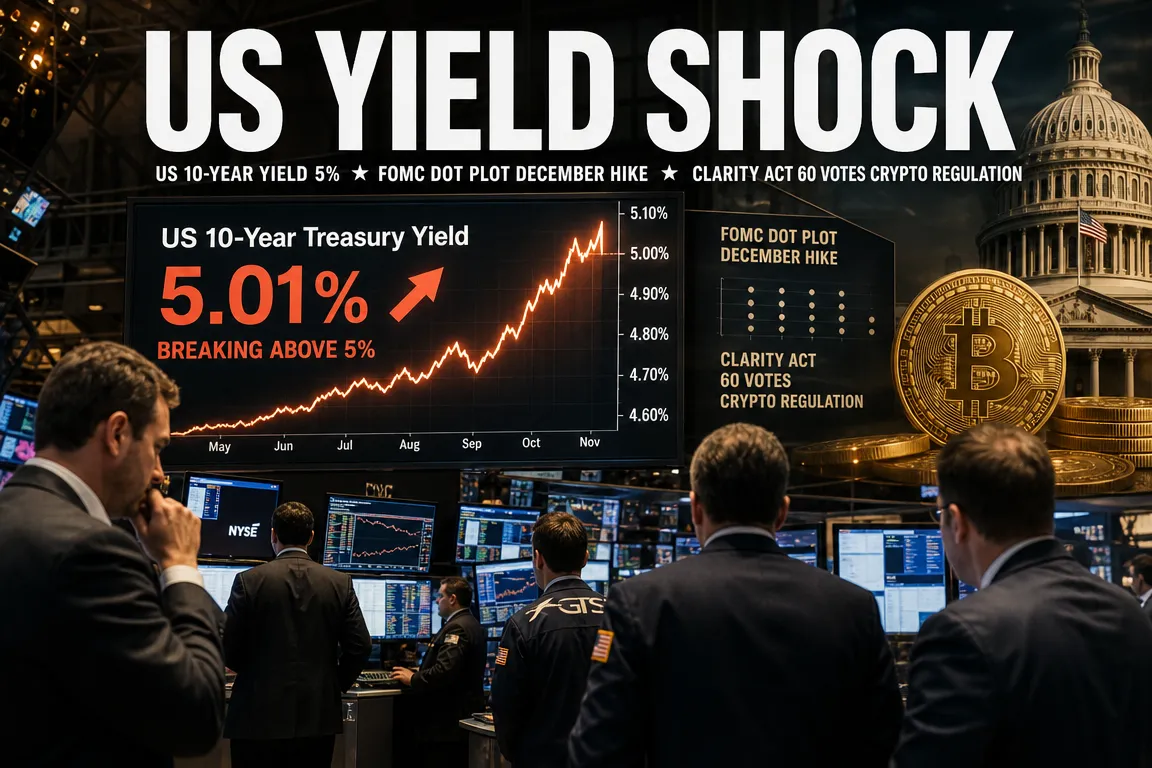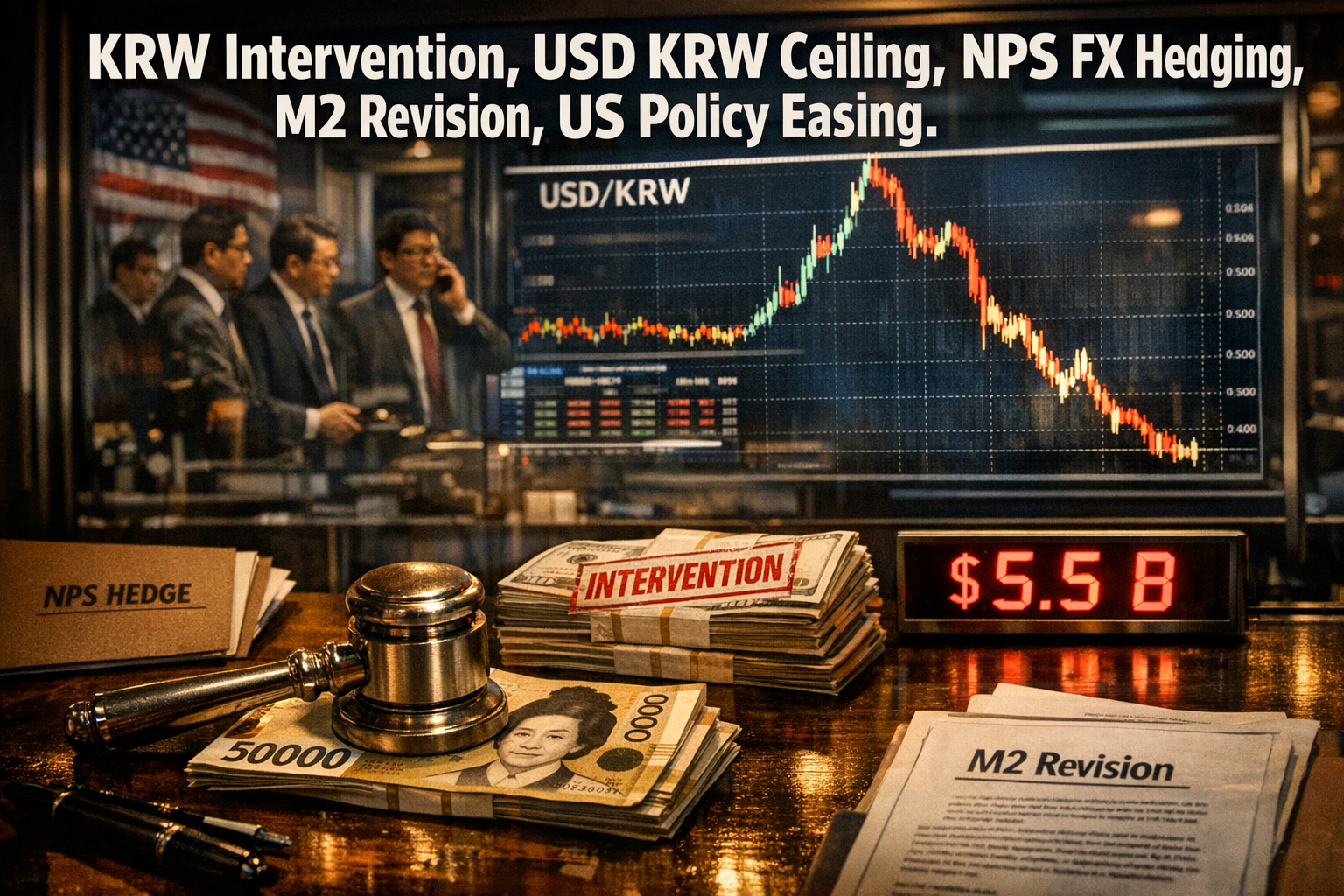
● 55B-Dollar FX Blitz, 1480-Won Ceiling Signal, 2026 Slide to 1350 Driven by Fed Pivot and NPS Swap Shock
FX Authorities’ USD 5.5bn+ Market Intervention: Signaling a 1,480 KRW Ceiling? Reframing the 2026 USD/KRW Outlook Around the “True Variables”
This report covers:
- Estimated intervention scale (USD 5.5bn+), and why quarterly disclosure can amplify market uncertainty
- The core logic behind a potential move toward 1,350 KRW in 2026 (US monetary policy and liquidity)
- The practical market impact of the National Pension Service’s FX hedging and FX swaps
- Key points that are often underemphasized in mainstream coverage
1) News Briefing: Key Facts From the FX Market
1-1. Size of FX Market Intervention: At Least USD 5.5bn (Q1–Q3)
- The key figure is cumulative net USD selling of approximately USD 5.5bn during 2025 Q1–Q3.
- At an assumed USD/KRW of 1,400, this is roughly KRW 7.7 trillion.
- Q4 data is not yet disclosed, so the annual total is not confirmed.
- Market participants generally assume interventions continued in Q4, implying a larger full-year footprint.
1-2. Intervention Mechanism: Primarily USD Selling / KRW Buying
- When the government/central bank supplies USD to the market (sells USD), it typically suppresses upward moves in USD/KRW (limits KRW depreciation).
- This constitutes a stabilization action oriented toward near-term KRW support.
1-3. Post-2018 Pattern: Net USD Selling Has Been More Frequent
- Since disclosure of “market stabilization actions” began in the second half of 2018, net USD selling periods have been more common.
- This indicates interventions have largely aimed to mitigate KRW weakness.
2) Why Intervention Has Increased: Three Market-Cited Drivers
2-1. Prolonged High USD/KRW as a Macro and Market Headwind
- While a higher USD/KRW can benefit exporters, it raises burdens for domestic demand, import prices, corporate costs, and household inflation expectations.
- Given Korea’s high reliance on energy and raw material imports, FX volatility transmits rapidly to costs.
- This increases incentives to deploy reserves to smooth the pace of moves.
2-2. Market Sensitivity to Timing, Including Perceived “Close Management”
- Market focus is less on the headline amount and more on where, when, and how persistently authorities act.
- This shapes expectations of implicit resistance levels and market positioning.
2-3. Intervention Repetition Likely Until Structural Drivers Shift
- Intervention generally reduces volatility rather than altering the structural FX path.
- If underlying global drivers remain unchanged (US rates, USD strength, capital flows), upward pressure can re-emerge.
3) 2026 FX Outlook: Framework Behind a “1,350 KRW” Scenario
3-1. Core Assumption: US Policy Easing and Added Liquidity, Pressuring the USD
- The scenario assumes accelerated US rate cuts and increased liquidity provision in 2026.
- If realized, this could weaken the USD index and create scope for USD/KRW to decline.
- The mechanism is primarily USD weakness rather than domestic KRW strength.
3-2. FX Is a Multi-Variable Outcome
- USD/KRW is not determined by interest differentials alone.
- Trade balance, geopolitics, foreign investor flows, corporate USD demand, hedging demand, and risk sentiment all contribute.
- The credibility of any forecast depends on which variables are prioritized.
3-3. Perceived “Upper-Bound Management”: Intervention Signal Near 1,480 KRW
- Market interpretation suggests authorities may intervene around 1,480 KRW.
- A clearly inferred level can anchor positioning across exporters, importers, global investors, and systematic strategies.
- This can function as an informal band.
4) M2 Statistical Revision: A Shift in the FX Narrative Framework
4-1. What Changed: M2 Components Adjusted Toward International Standards
- The central bank revised M2 composition, including excluding certain investment securities such as some MMF-type items.
- As a result, reported M2 growth can appear lower than prior readings.
4-2. Why It Matters: “High FX Rate Drivers” Debate Reframes
- A prior narrative emphasized faster domestic liquidity growth versus the US as a KRW weakness driver.
- With revised metrics, that argument may weaken based on headline comparisons.
- Market interpretation can shift policy communication and expectations.
4-3. Key Risk Is Timing and Credibility, Not Allegations of Manipulation
- In periods of sensitivity around FX, inflation, and policy credibility, revisions can be perceived as narrative management regardless of intent.
- This can feed into FX volatility and confidence dynamics.
5) Why the National Pension Service’s FX Hedging / FX Swaps Function Like Intervention
5-1. Expanded Hedging Alters Structural USD Supply-Demand
- As the pension fund increases hedging on foreign assets, the form of USD demand/supply changes.
- Given its scale, this can be priced as a quasi-policy variable rather than purely private flow.
5-2. FX Swaps Reduce Immediate Spot USD Buying Pressure
- If foreign investment requires USD purchases in the spot market, it can push USD/KRW higher.
- Utilizing FX swaps with the central bank can reduce spot-market demand, acting as a buffer for the market.
6) Currency Manipulation Debate: Distinguishing “Intervention” From “Manipulation”
6-1. Intervention Typically Targets Volatility Smoothing
- Measures include verbal guidance and direct market operations.
- The stated function is commonly to slow extreme moves rather than fix direction.
6-2. Manipulation Allegations Typically Require Persistent, Large, Directional Action for Trade Gain
- The relevant framework emphasizes whether a country intentionally weakens its currency to gain trade advantage.
- Net USD selling to resist KRW weakness is not aligned with a standard “competitive devaluation” profile.
7) Underemphasized Points: Key Takeaways for Investors
7-1. More Important Than “USD 5.5bn” Is the Defended Level
- The market assigns greater weight to the level repeatedly defended than to the cumulative amount spent.
- A level such as 1,480 KRW can function like an options barrier, reshaping corporate hedging, foreign flows, and systematic trading behavior.
- Intervention can therefore redraw market “price mapping,” not merely incur a fiscal or reserve cost.
7-2. The M2 Revision Is a Communication Regime Change
- Lower-looking M2 growth weakens a “liquidity-driven FX weakness” narrative and reallocates attention toward flows, sentiment, and external drivers.
- This can increase reliance on short-term flow management tools (intervention, swaps, guidance) relative to structural policy responses.
7-3. A 2026 USD/KRW Decline May Not Be “High-Quality KRW Strength”
- If driven by USD weakness amid global liquidity expansion, asset prices may rise faster than real activity.
- This divergence can widen distributional outcomes and reduce monetary policy flexibility.
< Summary >
- FX authorities conducted at least USD 5.5bn of net USD selling in 2025 Q1–Q3.
- Intervention primarily functions as volatility smoothing rather than a structural solution.
- A 2026 move lower in USD/KRW (e.g., toward 1,350) is more consistent with USD weakness from easier US policy than with domestic KRW-driven strength.
- The M2 statistical revision can shift causal narratives and policy communication, with implications for credibility and volatility.
- The National Pension Service’s hedging and FX swaps can reduce spot USD demand and operate as quasi-intervention.
- The critical market variable is the defended FX level (e.g., around 1,480), which can re-anchor positioning and market microstructure.
[Related]
- https://NextGenInsight.net?s=exchange-rate
- https://NextGenInsight.net?s=stablecoin
*Source: [ 경제 읽어주는 남자(김광석TV) ]
– [LIVE] 외환당국의 시장개입, 55억 달러 이상. 2026년 환율전망 [즉시분석]