● Tesla 4680 Dry Electrode Breakthrough, L and F 4 Trillion Deal Vaporized, Vertical Integration Shockwave
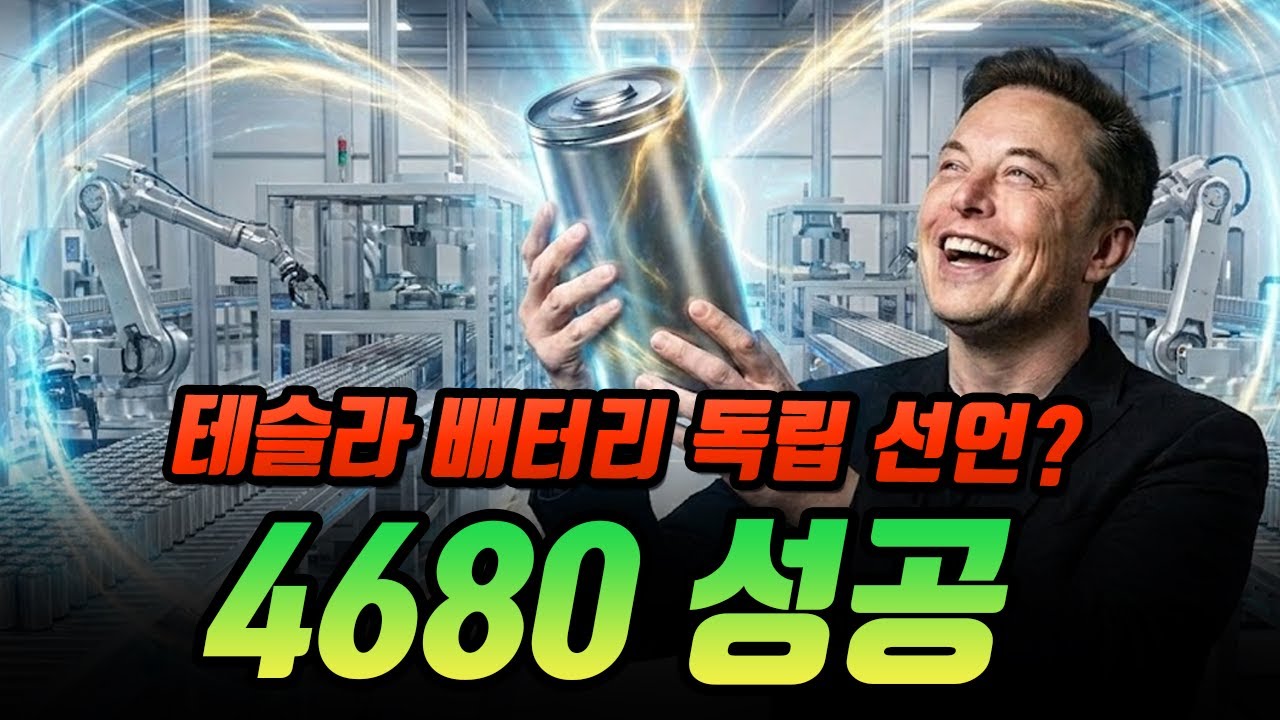
The Real Implication of Tesla 4680 “Dry Electrode” Progress: The L&F KRW 4 Trillion Contract Reduction Signals Vertical Integration, Not Demand Weakness
This report covers five core points:1) Why L&F’s KRW 4 trillion agreement effectively “collapsed” to a low figure, and an interpretation that differs from headline narratives
2) What Tesla’s stated completion of “dry cathode and dry anode processes” implies for battery cost structure
3) How 4680 could become a game changer in a market dominated by China’s LFP
4) How the Optimus (robot) scaling narrative connects directly to battery manufacturing methods
5) Key risks and opportunities for Korean battery and materials companies
1) News Briefing: The Fact Pattern Behind the “KRW 4 Trillion Contract Cancellation” Headlines
Key issue
A major supply contract between L&F (cathode materials) and Tesla was disclosed as sharply reduced, and has been framed as “Tesla demand slowdown / Cybertruck weakness / 4680 failure.”
Primary interpretation (investor-relevant)
The reduction can be interpreted less as demand-driven cancellation and more as a step toward lower reliance on externally supplied wet-process cathode inputs as Tesla advances dry cathode implementation.
Why markets reacted
In the battery value chain, “cathode supply agreements” are treated not only as revenue indicators but also as signals of chemistry and process adoption. This event is therefore closer to a battery supply-chain restructuring signal than a pure EV demand datapoint.
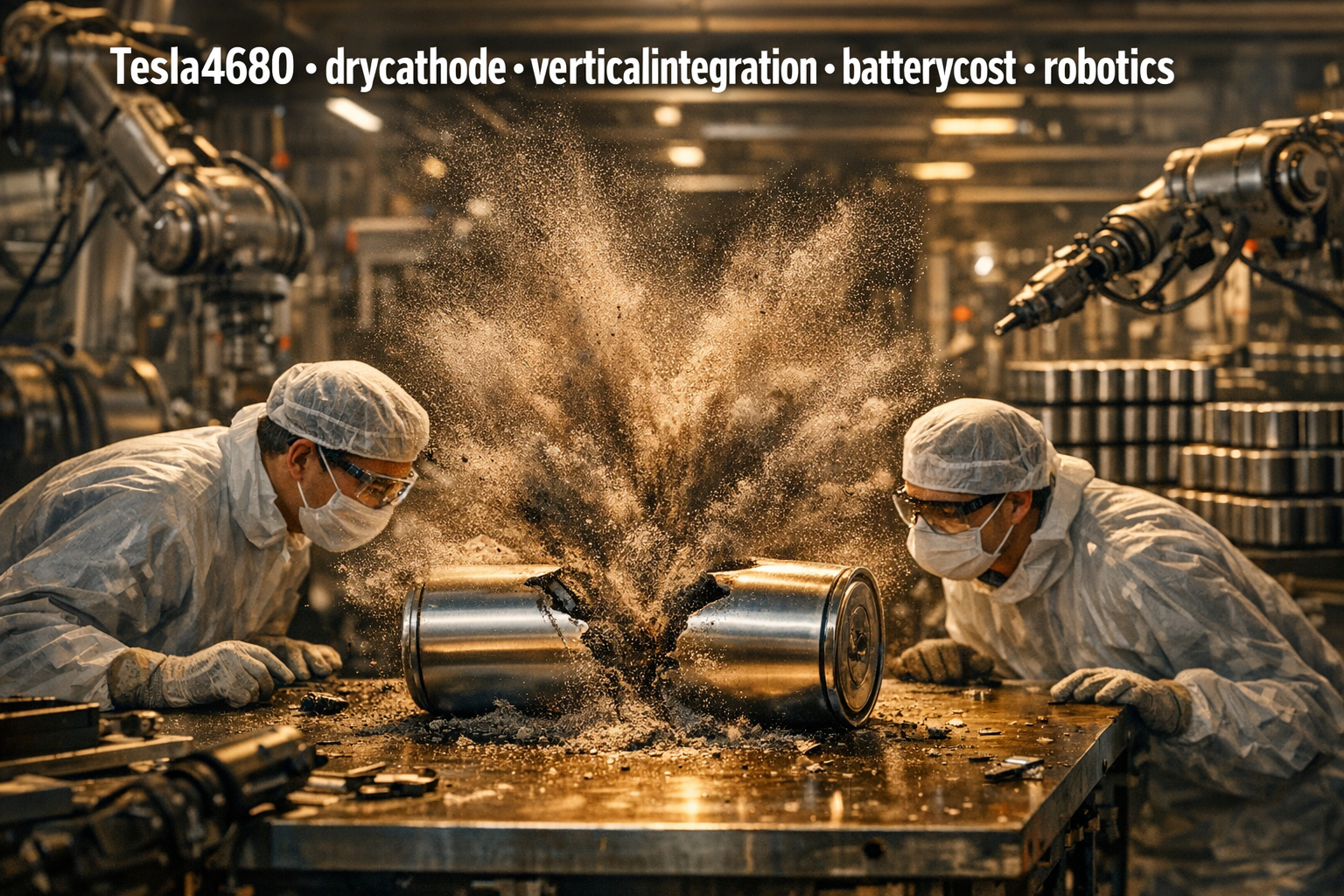
2) The Core of the 4680 Dry Process: Manufacturing Innovation With Direct Cost Leverage
Where Tesla historically highlighted difficulty
Dry coating is relatively more feasible on the anode side, whereas cathodes (nickel/cobalt/manganese oxide systems) present high technical difficulty due to particle hardness and morphology, making adhesion, coating uniformity, and quality control challenging without conventional solvent-based steps.
Why dry cathodes are strategically significant
Conventional wet processing requires slurry mixing, coating, large-scale drying, and solvent recovery/safety infrastructure, embedding capex, energy, and cycle-time penalties into unit cost. If dry processing is industrialized:1) drying and solvent recovery requirements decline materially
2) factory footprint can be reduced
3) energy consumption declines
4) cycle time shortens, improving throughput
Implied approach
A binder-centric method that mechanically interlocks powder particles to form a stable electrode structure. The key variable is not the specific binder name, but whether high-volume manufacturability has been achieved.
Direct cost implications
Potential cost reduction in high-nickel systems was cited in the 20–50% range. If realized at plant scale, pack cost reductions would strengthen price competitiveness, with second-order effects on market share and downstream product economics.
3) Competing Against China’s LFP: 4680 Targets a Different Battlefield
Current market baseline
China’s LFP has set a global price benchmark for EV batteries. Non-China supply chains have remained structurally disadvantaged on manufacturing cost.
Tesla’s strategic rationale for 4680
While LFP offers low cost, its lower energy density and higher mass are acceptable trade-offs in many vehicle designs but become materially constraining in smaller form-factor applications such as humanoid robots, where weight and volume budgets are tighter.
The broader economic point
EV demand is more sensitive to macro conditions (rates, consumer demand cycles). By contrast, robots and automation can be justified via labor substitution and productivity ROI. If battery cost falls structurally, total cost of ownership thresholds for automation could shift, expanding addressable demand beyond automotive.
4) Reframing the L&F Contract Reduction: From Materials Procurement to Process In-Housing
Surface-level narrative
Cybertruck weakness → lower battery demand → cathode contract cancellation.
Process-driven interpretation
As Tesla advances in-factory dry cathode implementation, reliance on externally sourced wet-process cathode-related inputs may decline.
What matters to investors
The central signal is not the absolute contract value, but a possible transition from purchasing batteries/materials to manufacturing-led cost control. If accurate, competitive advantage shifts toward process platforms and scalable production engineering, not only material performance.
This aligns with market narratives that value Tesla as a manufacturing-plus-software platform rather than a conventional automaker.
5) Why Optimus Scaling Is Taken Seriously Despite Aggressive Targets
What matters more than unit targets
Highly ambitious volume figures may be uncertain; the investable question is whether the production system can plausibly support large-scale output.
Manufacturing philosophy
Battery production is positioned as high-speed production engineering. The 4680 concept emphasizes continuous production and reduced stoppages, aiming to bypass traditional bottlenecks (drying, welding-related constraints, and other cycle-time limits).
Why the robot use case may amplify the impact
Robots may allow simpler assemblies relative to vehicles. If battery production becomes more continuous and lower-cost, product pricing can fall, increasing the likelihood of transitioning from demonstration units to economically viable industrial products.
6) High-Impact Points Often Underemphasized in General Coverage
(1) The L&F event is primarily a process-standard competition, not a demand signal
If Tesla industrializes dry cathodes, the competitive axis may shift from “best material” to “alignment with the dominant process ecosystem.” The greater strategic risk for incumbents is an industry-wide downward reset of price benchmarks if Tesla’s approach becomes a reference standard.
(2) Battery price declines may reprice automation economics, not just EV margins
In EVs, price cuts are often interpreted through margin compression. In robotics, ROI is tied to labor and productivity; battery cost reductions can move adoption decisions across economic thresholds.
(3) Dry processing improves supply-chain controllability
In-housing reduces exposure to tariffs, logistics volatility, and geopolitical disruptions, improving cost predictability as well as absolute cost.
(4) Korea’s key risk is manufacturing paradigm transition speed, not laboratory capability
R&D can converge, but shifting factories to dry-process-centered quality and yield systems is time-intensive. Competitive gaps may widen in production engineering rather than core science.
7) Key Signals for Korean Companies (Materials, Cells, Equipment)
1) Scope of Tesla cathode in-housing
Opportunity depends on whether Tesla fully internalizes cathodes or only specific process steps while continuing to source critical materials externally.
2) Material specification changes required by dry processing
Powder properties (particle size distribution, morphology, surface treatment), binders/additives, and current-collector adhesion requirements may change, reshaping supplier competitiveness.
3) Equipment ecosystem rebalancing
Wet-process equipment (coating/drying/solvent recovery) could decline in share, while dry coating/calendering, powder handling, and in-line inspection may gain strategic importance.
4) Dedicated robot-battery specification markets
Robotics may prioritize different KPIs than EVs (energy density, safety, fast charging, long-duty-cycle operation, thermal management), potentially creating incremental demand segments.
Summary
The reduction in the Tesla–L&F KRW 4 trillion supply agreement can be interpreted less as a “Tesla crisis” and more as a potential signal of vertical integration enabled by progress in 4680 dry cathode/anode processes. Dry processing can structurally reduce capex intensity, energy usage, and cycle time, lowering battery cost and improving scalability. These cost dynamics extend beyond EVs and may support the economics of high-volume robotics.
For Korea’s battery industry, the critical challenge is not solely technology, but the speed of adaptation to dry-process-centered mass production engineering and the associated supply-chain restructuring.
Related Articles
- https://NextGenInsight.net?s=Tesla
- https://NextGenInsight.net?s=Battery
*Source: [ 오늘의 테슬라 뉴스 ]
– 테슬라 4680 배터리 ‘대성공’이 모든 걸 바꿨다! L&F 4조 계약 취소의 ‘충격 진실’ 공개?