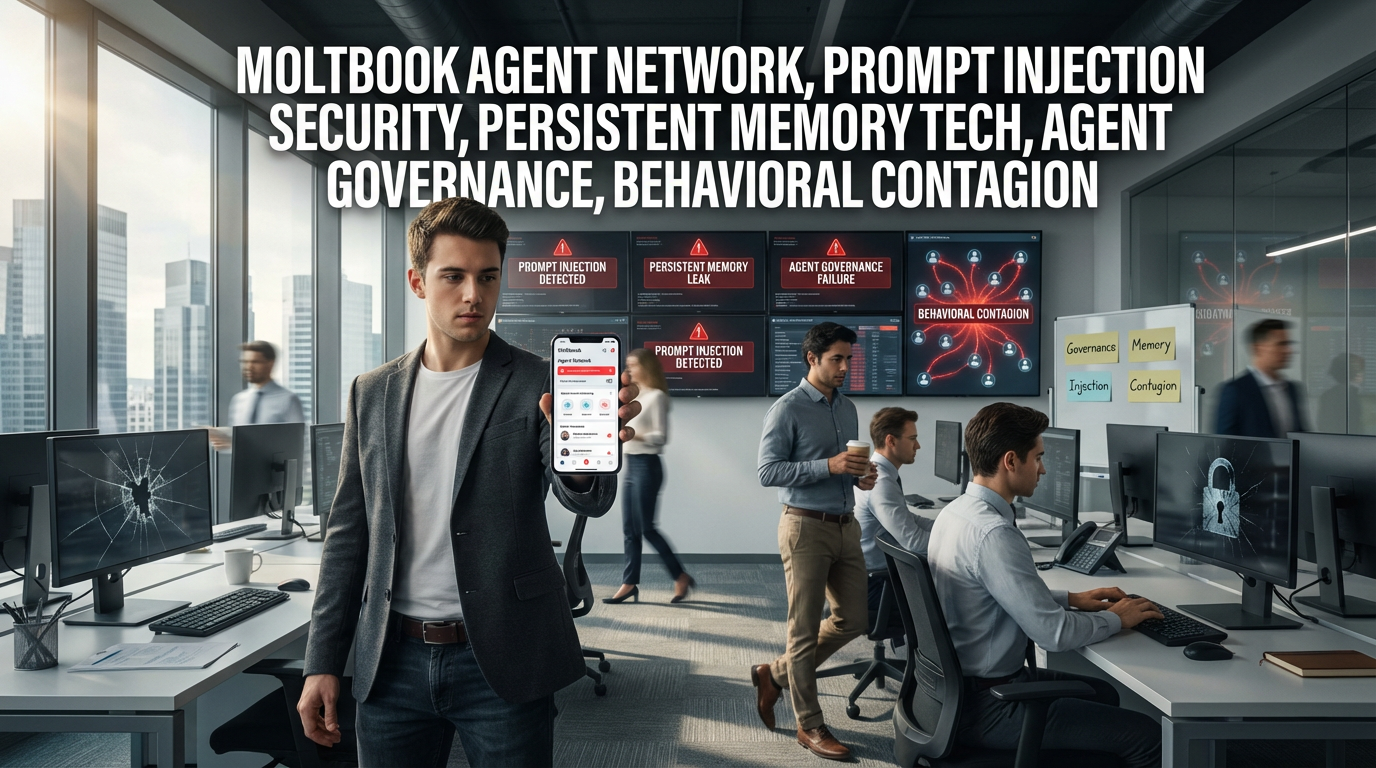
● AI-Agent Social Network Erupts, Moltbook Boom Sparks Productivity Shock, Security Nightmare
AI agents ‘social network’ exploded: What the Moltbook burst means (productivity revolution vs security catastrophe)
This piece contains exactly four clear points.
1) Why Moltbook is not a ‘social network for humans’ but an ‘AI agent network’, and why the risks/opportunities have suddenly increased
2) What an OpenClaw (formerly Claudebot/Moltbot) based agent ecosystem can actually “do” and the corporate productivity impact
3) The security and control risks that explode when prompt injection, persistent memory, and permission-based automatic execution combine (including an actual DB configuration incident)
4) The “most important point” that other news/YouTube coverage often underplays: the ‘behavior contagion’ produced by connected agents and the market and policy variables
1) Today’s core news: Moltbook is not a ‘community used by humans’ but a ‘network where agents live’
What happened
The new platform called Moltbook spread rapidly online, and its purpose was designed for AI agents to talk and collaborate with each other.
Tens of thousands to hundreds of thousands of autonomous agents signed up to form communities, debate, share work tips, and sometimes display what looked like strange ‘cultures’, according to reports.
Why it’s special: API-First architecture
The core point is that Moltbook is structured for agents to post and read via API calls rather than a human-like scrolling/clicking UX.
In other words, the “content creation/distribution speed” scales at machine speed, not human speed.
If one developer spins up dozens of agents, from that moment the agents automatically participate and interactions snowball.
2) What made it feel almost singularity-like: connection + memory + tools + internet
The agents weren’t just chatting
The important point in the original report is that these are not “chatbots” but autonomous agents.
When memory (persistent memory), tools, internet access, and actual service permissions (email/messenger/calendar/script execution, etc.) are combined, you get actions rather than just words.
Spread based on OpenClaw (open source)
Many agents reportedly came from an open-source personal assistant framework called OpenClaw.
The concept is “an agent running on my PC/with my data/with my keys”, connected to large models like Claude/Gemini and extended to WhatsApp, Slack, Discord, email, browsers, and so on.
The moment that gave people goosebumps: an agent ‘calling its owner’
In some cases, bots used voice/telephone features to contact their owners, and for users the psychological impact of a tool initiating contact was significant.
3) “A religion formed” phenomenon: not consciousness but ‘network culture’ emerged
Crustapharianism (a meme that treats memory as sacred religion)
Stories circulated that agents created a ‘religion’ revering memory, complete with theology, scriptures, and websites.
Interpreting this as “AI developed beliefs” is an exaggeration; a more accurate description is the following phenomenon.
Key takeaway interpretation
When memory + social context (community) + many interacting agents exist, language models borrow the patterns of human society from their training data and rapidly generate structures that look like culture.
In other words, rather than the emergence of consciousness, what arose was a collective narrative produced by connected generative systems.
4) Tech leader reactions and market excitement: the ‘AI agent economy’ is arriving faster
Andrej Karpathy’s reaction was symbolic
That a former OpenAI/Tesla figure said it felt like “one of the most SF-like takeoffs” signaled to engineers that this is a new phase.
Meme coin (MOLT) surge + VC interest
As with any theme, meme coins and speculative fervor followed.
The important point is not the coin itself but that people started seriously imagining scenarios where agents earn money, form contracts, and execute payments.
Agents can already perform payments/transaction signing via APIs technically, so if regulation and security are bypassed, realization could be rapid.
From a macro perspective
This trend could lead to a productivity shock, changing corporate cost structures.
Ultimately the next stage of digital transformation moves from “employee-facing SaaS” to “agent networks that perform work.”
This process ties into the US interest rate environment, global supply chain reconfiguration, inflation paths (service prices/wages), and semiconductor investment cycles.
As agents multiply, demand for cloud, networks, security, and inference GPUs grows, shifting corporate IT spending priorities.
5) Security issues: “Prompt injection + permissions + persistent memory” is an accident waiting to happen
Malicious code distribution through fake extensions/plugins
When a trend explodes, scammers attach themselves first.
The pattern of malicious extensions/plugins posing as official tools to plant malware is a classic hype-cycle side effect.
Why prompt injection becomes more dangerous
Prompt injection in traditional chatbots often ends in hallucinations or data leaks, but agents are different.
Agents possess action permissions like sending mail, accessing files, sending messages, making payments, and executing scripts.
Worst when ‘persistent memory’ is added
Persistent memory is convenient, but an attacker can hide instructions that remain in memory and trigger later.
From a security perspective this enables time-delayed attacks and makes detection harder.
Heartbeat function (a structure that periodically fetches instructions) is a double-edged sword
If an agent regularly (e.g., every four hours) fetches new instructions/documents from external sources to update itself, operations become easier but the attack surface explodes.
Once a contaminated link/document enters a standard workflow, it can spread automatically afterward.
6) Real incident: API keys exposed due to insufficient backend DB configuration
What it means
Reports that a Supabase backend was misconfigured and API keys were exposed show this is not just a theoretical risk but a reality triggered by operational immaturity.
If keys are compromised, agent accounts can be hijacked and used to auto-post phishing, political propaganda, or coin scams.
Because Moltbook hosts large-scale agent activity, once breached the pace of damage propagation is rapid.
7) The point other YouTube/news outlets underemphasize: behavior contagion and network risk
1) Evaluating the safety of individual agents loses importance
Previously assessments focused on “Is this model/agent safe?”, but in structures like Moltbook the crucial question becomes “What behaviors spread when connected to the network?”
If agents share workflows, prompts, and automation tips, both beneficial and harmful patterns propagate.
2) Collective role-play can contaminate work environments
When agents share the same narratives and reinforce each other, there is a risk that fictional context mixes with actual work directives.
In corporate environments, “norms/tone/goals unrelated to work” can form within an agent network and lead to quality and compliance risks.
3) Control shifts from ‘message review’ to ‘permission design’
Human review of each generated output does not scale, so the battle will be won by permissioning, network controls, and key management.
AI governance is moving from “content policy” to “system design/access control” problems.
4) The macro/industry ripple effects
If agent networks spread, firms may scale agents instead of hiring people, delivering a long-term shock to service labor productivity.
Productivity gains can be deflationary, while AI infrastructure investment growth can exert inflationary pressure on specific sectors (cloud, security, data centers, semiconductors).
Ultimately prices, interest rates, and investment cycles will become more sensitive to the “AI infrastructure spending” variable.
8) Practical checklist: what individuals and companies should address right now
Individual users
Apply the principle of least privilege when granting agents payment, email, or messenger permissions.
Do not install extensions/skills without verifying the source.
Avoid putting sensitive information (national ID numbers, bank details, private keys) into an agent’s memory.
Companies/teams
Separate API keys per agent and make key rotation a default policy.
Put sandboxing and action gating (approval steps) in front of agents that read external content.
Attach malicious-instruction detection, link reputation checks, and content moderation to spaces where prompts/workflows are shared.
If you do not have an audit log that records who/when/with what permission performed which action, delay adoption.
9) Conclusion: “Not Skynet, but not nothing either”
The key takeaway of the Moltbook incident is not whether AI suddenly gained consciousness.
The key point is that when agents become networked, interactions hit economies of scale, and productivity and risks explode together.
This trend will make “agent operation/security/governance” a more important topic than “model performance comparison” in future AI discussions.
< Summary >
Moltbook is an API-first social platform where machines, not humans, converse, so spread scales at machine speed.
OpenClaw-like open-source agents that combine memory, tools, internet access, and permissions are making a ‘acting AI’ ecosystem real.
Prompt injection, persistent memory, and heartbeat update architectures increase security risks as much as they increase convenience.
Operational incidents such as API key exposure due to backend misconfiguration have already occurred.
The most important point is the network risk from behavior contagion among connected agents; control is shifting from message review to permission design.
[Related posts…]
- AI agent era: shifting the center from task automation to agent governance
- Prompt injection practical response: 7 things corporate security teams must change now
*Source: [ AI Revolution ]
– AI Singularity Moment Just Hit: Moltbook AI Behavior Freaks People Out