● Teslas FSD Revenue Pivot Shock
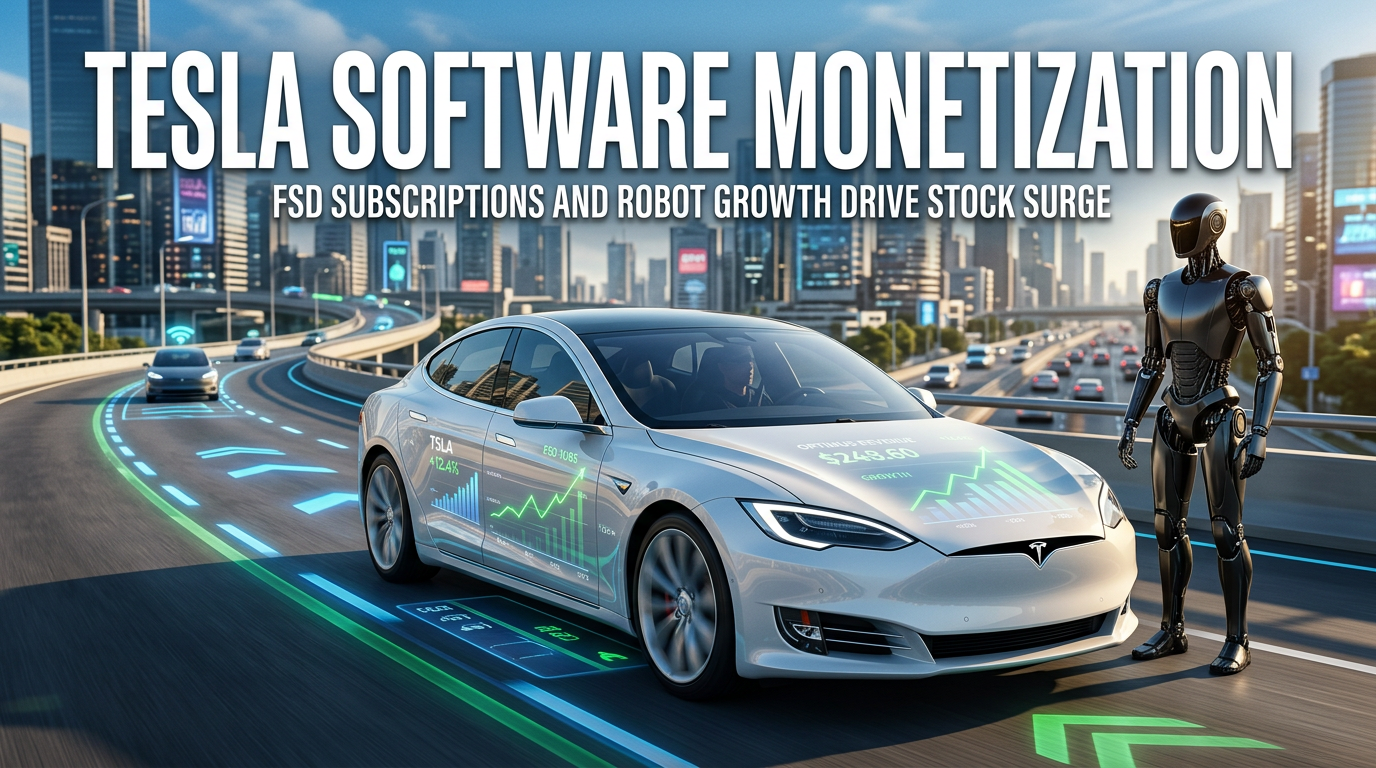
Tesla, “It could be faster than you think” why: FSD · robots · software monetization explain the stock price
Today’s post’s key takeaway is exactly 3 things.
1) Why the Tesla target stock price was lowered (the reason the stock price is wobbling)
2) But why Tesla’s “core value” can be realized sooner through autonomous driving (FSD) and subscriptions, and also through robots (Optimus)
3) What is the “biggest risk” investors should actually check
Based on the original article’s content, I’ll summarize the flow like news: most of Tesla’s investment value hinges on FSD (and is connected to robots), and depending on the regulatory environment / scalability / competitive landscape, the speed of earnings conversion can vary.
1) JP Morgan target stock price cut by 60%: “It’s true Tesla is weak right now”
1-1. Meaning of a large cut to the target stock price
Recently, JP Morgan reported that it lowered Tesla’s target stock price by 60%.
At the time, the assumption was set at around a $100 target price, so the fact that it was cut significantly is read as a sign that the market has started to view “earnings / guidance / growth pace” more conservatively.
1-2. Why does “everything goes up but Tesla just stays sideways…” show up?
As pointed out in the original article, when the overall market is rising, Tesla is showing relatively weak performance.
This is usually a mix of the factors below.
- When it seems like the timeline for autonomous driving (FSD) to move toward “full autonomy” is long
- When it’s judged that subscription / regulation / the pace of adoption by country is slower than expected
- When more investors come to see competition (especially China) and the pace of technological catch-up as risks
Main content to convey
The wobble in Tesla’s stock price can be interpreted not as a “bad company,” but as a sign that the market has begun to reassess—more conservatively—the timing of FSD monetization.
2) The reality of Tesla autonomous driving: level 2, yet “most of the value” is in FSD
2-1. Tesla is autonomous driving level 2
This is the point summarized in the original article.
In general, autonomous driving is divided up to level 5, and Tesla is considered level 2.
In other words, it’s not “fully automatic driving,” but a stage that assists the driver.
2-2. Even so, why Tesla’s FSD is important
A perspective appears that most of the investment value depends on the success or failure of FSD (full self-driving).
The core logic is this.
- The technology is focused not on “functions limited to certain areas,” but on extensibility
- Software monetization is possible in a subscription format
- As performance accumulates, a virtuous cycle can be created where data and models get even better
Main content to convey
Being level 2 doesn’t mean the technology value is low; the market ultimately values the company based on FSD’s commercialization / scalability and software monetization.
3) “Why wasn’t the adoption faster?”: Institutional, regulatory, and subscription accessibility
3-1. Why the FSD subscription rate is still low
According to the original article, Tesla has around 10 million vehicles, and among them, the number of vehicles subscribing to FSD is mentioned as about 1.3 million—around 13%.
What’s important here is that the question “If FSD can be used, why isn’t it being used?” comes up, and the answer is mostly about institutions/accessibility.
3-2. Korea’s reality: a setup where “even if you want to use it, you can’t”
The original article carries an implication that autonomous driving is restricted in Korea depending on certain models and environments.
In addition, the original article also mentions controversy about illegal workarounds (hacking / activating features).
The gist is simple.
From the user’s standpoint, FSD subscription use is limited due to risk and legal exposure, so penetration may not turn out as high as expected.
3-3. European (Netherlands) approval: “The next could be more”
The most eye-catching point is the news that FSD has been approved in the Netherlands.
There’s a view that Europe could expand on a per-interval or per-unit-of-road basis, and that the approval signal could ripple quickly.
Main content to convey
The bottleneck in FSD diffusion is not the technology itself, but “country-by-country regulation / approval / whether it’s usable.”
4) Software monetization scenario: “If penetration reaches 70–80%, operating profit changes”
4-1. Subscription price ($99/month) and perceived utility
The original article mentions the FSD subscription fee as $99 per month.
And it explains the value in terms of the time users save (assuming about 1 hour per day) versus the cost.
4-2. Assuming penetration of 70–80%
The original article forecasts that if FSD penetration rises to 70–80%, the number of FSD subscribers could reach around 10 million within 3 years.
This part is aggressive, but from an investment perspective, it’s meaningful because it’s a way of asking “how far could it go, if it can.”
4-3. The single most important line: operating profit could be bigger than vehicle sales
What the original article emphasizes is this.
A section could arrive where Tesla begins to look less like a “car company” and more like a “autonomous driving / software company.”
Main content to convey
The message is that what justifies Tesla’s multiple (valuation) is ultimately a software revenue model—like FSD subscriptions—not the vehicles themselves.
5) The biggest risk investors must see: China’s rapid catch-up
5-1. Why China does EVs “well”: data, support, and corporate ecosystem
The original article views China as the biggest competitive risk for Tesla.
The reasons given are as follows.
- A mood where personal data and learning environments are relatively less restricted within China
- Government support pushing EVs and autonomous driving at the level of industries and cities
- Various companies such as Xiaomi, Weilai, Nio, and Huawei aggressively entering the market
5-2. Spread of the Nvidia platform: “a catch-up leap in 2–3 years”
The original article says that a significant portion of China’s EVs are equipped with Nvidia chips, and that based on this, it quickly built its software stack.
In short, it’s an interpretation that “it brought a platform and accelerated learning/development speed.”
5-3. Still, there’s a counterargument that Tesla could be strong in North America
There’s also a viewpoint that due to US-China conflict, Chinese technology won’t easily transfer directly to North America.
In other words, while the risk grows across the “global whole,” in the short term Tesla could be defended by differences in North America and regulatory frameworks.
Main content to convey
Tesla’s biggest risk is not a “fundamental technological disadvantage.” Instead, it’s that as China rapidly moves to fully kick off autonomous driving competition, it can change market expectations.
6) AI experiences like SDV (SW-defined vehicles) and Grok: “not driving, but living space”
6-1. From SD to SDB: the vehicle moves from “a car” to a “software experience”
In the original article, the trend of Hyundai Motor is explained as expanding from SD (software-defined vehicle) to something like SDB (interpreted in context as SD by Ambient).
The key is a forecast that the vehicle becomes not just a means of transport, but a moving space (movies, music, games, meetings, etc.).
6-2. Lock-in effect created by conversational control (ecosystem)
The original article says Tesla can strengthen the experience by going beyond simple directions, requesting and responding like a conversation.
This direction is not competition based on simple features—it’s competition based on a “user ecosystem.”
Main content to convey
If Tesla locks in the ecosystem not just with autonomous driving but with “conversational AI + communications + subscriptions,” then even if competitors end up being similar, it becomes harder for users to churn—that’s the viewpoint.
7) Unmanned taxis (robotaxis): legal and rollout speed may be slow, but FSD is the priority
7-1. Core conclusion: taxi drivers are likely to eventually disappear
The original article discusses this direction: “taxi drivers must go away.”
However, it mentions that expansion is underway in limited areas like California/Texas for now.
7-2. When will it expand? “First, FSD needs to spread—then it’s the right order of urgency”
Because of legal issues, expansion may be slower than you’d think, but the frame is that as more countries/regions where FSD is approved and spreads increase, robotaxis could also accelerate.
7-3. Virtuous cycle: data → model performance → accelerated expansion
From Tesla’s perspective, this structure is strong.
- Accumulating driving data with more vehicles and wider regions of operation
- Improving model performance
- Rising likelihood of approvals / expansion
Main content to convey
Robotaxis get faster when “technology + regulation + data” come together. That’s why the logic is that Tesla wants FSD to spread first. That’s the core.
8) The robot (Optimus) business: claims that it isn’t yet sufficiently reflected in the stock price
8-1. Physical AI theme: robots become the main focus starting this year
The original article sees the recent trend of “physical AI” coming into full swing and believes robots have entered the diffusion stage like consumer electronics industries.
8-2. Optimus pricing and profitability logic
The original article references Elon Musk’s comments, saying the Optimus price is around $30,000. It also leaves open the possibility that it could get lower with production cost reduction and mass production scenarios, but in reality it may be $30,000 or more, according to the analysis.
8-3. Core claim: humanoid value isn’t yet in Tesla’s stock price
The original article makes a somewhat strong conclusion.
If Optimus is actually commercialized and starts being sold at the scale of several million units, the company’s valuation could become far larger than it is today. That’s the logic.
8-4. Why “hands” are the key
The difficulty of humanoids ultimately comes down to manipulation precision (fingers/hand functions).
The original article says Tesla has brought precision close to the level of human hands, and above all, it cites as a competitive advantage that “it can be mass-produced cheaply.”
Main content to convey
Optimus shouldn’t become profitable by being a “robot display,” but by going into a value chain that replaces labor costs in manufacturing and service industries. The claim is that Tesla can fit that path best.
9) Tesla’s technological moat: FSD · robots · energy · data centers connected “in one direction”
9-1. Everything connects: autonomous driving + robots + energy
The most striking conclusion in the original article is that “the businesses aren’t running separately, but create synergy.”
- Accumulating FSD data
- Robots’ physical work capabilities (physical AI)
- Expansion of the energy business
9-2. Real-world data + computing power + capital + manufacturing know-how
And the following items are mentioned as Tesla’s advantages.
- The scale of real-world data
- Computing infrastructure for training and inference
- Capital and manpower
- Manufacturing know-how (mass production)
Main content to convey
The moat is not a single technology, but a structure in which “data–computing–manufacturing–products” are connected. That’s the core perspective.
10) Conclusion: “It’s a good company, but the conversion to actual results hasn’t happened enough yet”
10-1. Difference in valuation: potential vs actual results
The original article summarizes the market reaction like this.
That Tesla is good is acknowledged, but
it takes time for potential to convert into real earnings, so the stock price can’t jump immediately—this is the flow.
10-2. Checkpoints investors should look at next (summary)
- FSD approval / expansion by country (the speed in Europe and China)
- The pace of subscription penetration growth (whether the $99/month subscription will go “mainstream”)
- Regulatory progress that connects to robotaxis
- Signals of Optimus’s real mass production / cost decline
Main content to convey
The deciding factor in Tesla’s investment case is the speed of FSD subscription spread and the timing of revenue conversion that follows with robotaxis / robots.
The “single most important line,” organized separately in the blog post (the core more than anywhere else)
The direction of Tesla’s stock price is likely to depend less on whether the technology is right or wrong, and more on the speed of the “regulation–expansion–data virtuous cycle” that leads from FSD approval → subscription penetration → software profitization.
If this speeds up (especially with spread in Europe / China / North America), the market may revalue Tesla more strongly as a software / AI company rather than as an automobile company.
< Summary >
• JP Morgan’s 60% cut to Tesla’s target stock price is read as a sign that the market is viewing the timing of FSD monetization more conservatively.
• Tesla is autonomous driving level 2, but the view is that most of the value depends on the success of FSD and software monetization through subscriptions.
• The reason FSD spread is slow is that issues are more about country-by-country regulation / approvals / usability (including in Korea) than about the technology.
• Events like Europe (Netherlands) approval could become triggers for accelerated future spread.
• If scenarios such as penetration reaching 70–80% become reality, Tesla’s operating profit structure may shift from being centered on “vehicle sales” to being centered on “software / subscriptions.”
• The biggest risk is China’s rapid catch-up (data environment, government support, and spread of an Nvidia-based stack).
• A perspective is presented that Tesla could have a “moat” where FSD, Optimus robots, energy, and large-scale computing / data infrastructure are connected.
• In conclusion, because the stock price conversion from potential to actual results is still underway, adjustments/delays can occur; the checkpoints are signals on approval, penetration, robotaxis expansion, and Optimus mass production.
SEO keywords (confirm natural insertion)
Tesla FSD, robotaxis, humanoid robot, electric vehicle market, software subscriptions
[Related posts…]
- FSD diffusion and the key to changes in Tesla’s valuation
- The impact of Optimus mass production on the stock price and key checkpoints
*Source: [ 월텍남 – 월스트리트 테크남 ]
– 테슬라, 생각보다 더 빠를지도 모르겠습니다…ㄷㄷ