● AI agent labor market shakeup
‘Hiring an Agent Instead of Taking Vacation’ Becomes Real… How the Agent Trading Market Changes the Labor Market and Organizational Structure
The key takeaway is threefold: It’s not about individual efficiency—here’s why ‘organizational performance’ doesn’t rise
These days, companies aren’t just using AI as a simple research tool—they’re pushing it everywhere, from recruitment, HR, product development, and marketing. And now there’s an even bigger development. Specifically, a market for trading agents (in a sense, hiring agents like freelancers or labor) is emerging, and soon, a time is coming when, if an employee takes a vacation, you attach an agent short-term instead of hiring a contractor.
This article includes points like these in particular. ① To see results, you need to move from bolt-on (using it like a tool) to integration (changing the flow of work itself), ② The core problem is a “disconnected” segment where individual time decreases but organizational performance doesn’t, ③ AI and agents can understand and execute work only when tasks are broken down into ‘tasks’ (rather than ‘jobs/roles’), ④ Agents simulate recruitment/HR/market research and run experiments, ⑤ The agent trading market makes the labor market more flexible (and reshapes middle-management systems).
If you get just this flow down, you’ll be able to see at a glance why careers, organizations, and workforce management are changing so fast these days. Below, I’ll summarize it like news—by category, clearly and neatly.
1) Corporate AI use: From report automation to ‘end-to-end execution’ across hiring/HR/product/marketing
The starting point for this content is “how far AI has already entered.” It doesn’t end at the stage of simply searching and summarizing into a report—it’s expanding into actual decision-making and execution workflows.
News-style summary
- Product development: You ask AI about ingredients/formulations and marketing strategy, and sometimes AI agents discuss with each other and create an execution path
- Marketing: There are mentions of cases where AI took over purchase-behavior prediction and produced results at a level similar to real people
- HR system design: For areas where it was difficult to test sensitive changes to systems like performance pay, agents/simulations are used to check in advance
Key takeaway (don’t miss this)
What’s important here isn’t that “AI is smart.” Instead, AI has begun to enter the ‘workflow/process’ of work and take responsibility all the way down to execution units. This is the starting point that affects both organizational structure and the labor market.
2) Bolt-on vs integration: Even if you adopt it, why doesn’t organizational performance improve?
This section is basically “the most important explanation.” It looks at why organizational productivity doesn’t meet expectations—even when many companies already use AI.
News-style summary
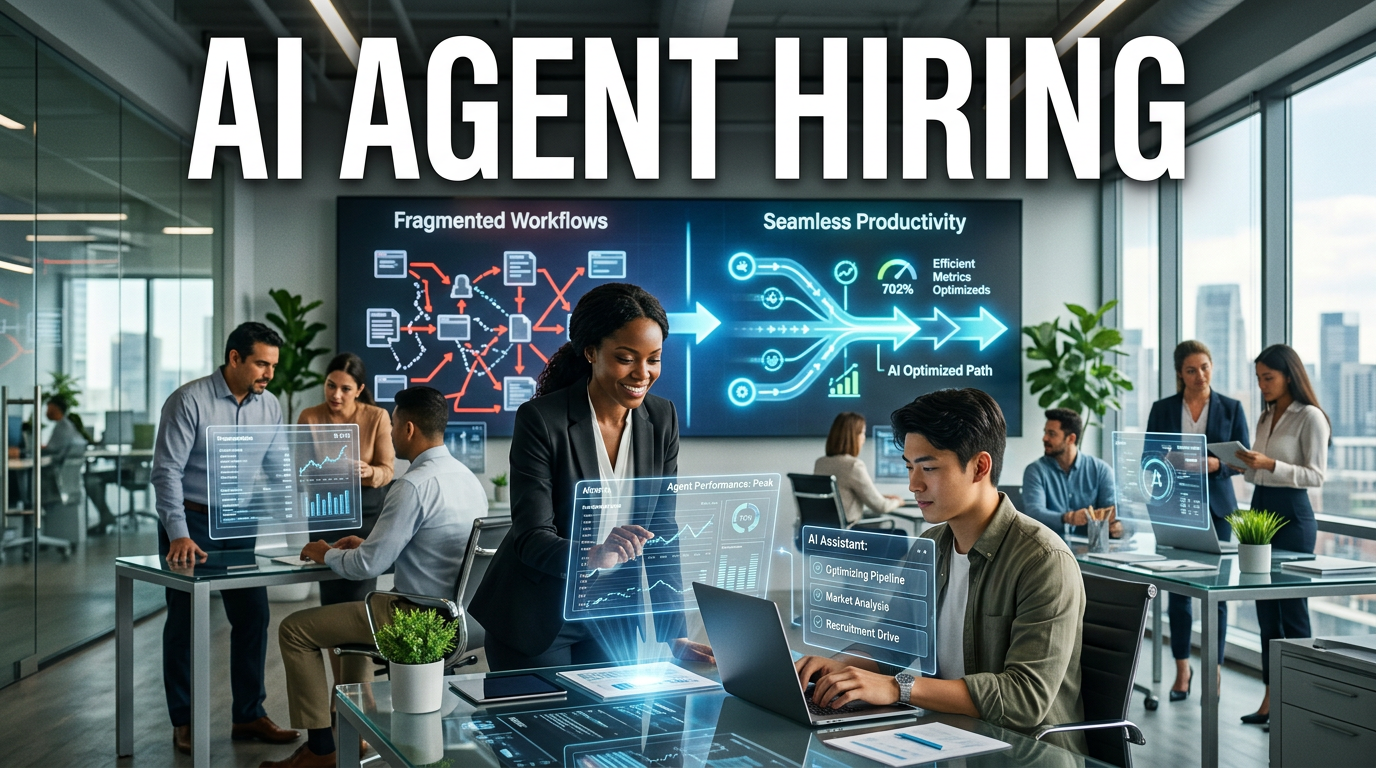
- Bolt-on (attach it like a tool): People use GPT-like tools only via prompting while still doing their existing work
- Integration (change the flow of work itself): You have to redesign workflows/work design so AI and agents become part of the process
- Moderna-like case: At first, there wasn’t much change in organizational productivity even though people were told to use GPT, and later they shifted by changing the process—making how people work different
The core issue: ‘individual efficiency’ and ‘organizational performance’ are disconnected
A clue that comes up often in research and experiments is this. Individuals save time with AI (efficiency↑) but there’s a segment where that time doesn’t “connect” to organizational performance.
- Individual efficiency: Mentions results like saving the equivalent of one day’s worth (about 8 hours) per week (in average studies, 4–5 hours are also mentioned)
- Organizational performance: But there are responses indicating organizational productivity/performance doesn’t rise as expected
- Conclusion: It’s not enough to just spend time faster; you need to redesign workflows, organizational structures, and HR/people strategy together for it to translate into performance
Main content to convey (summary)
The next step after adopting AI isn’t “use more,” but re-designing work so it fits a structure where AI has a place to operate.
3) Boundaries disappear: You have to break work down from job-centered to task-centered for AI to understand
Here, you’re given the “language of organizational change.” If previously work was viewed in terms of jobs/occupations, now the emphasis is on breaking it into smaller units so AI can understand it.
News-style summary
- Shift in the work-centered axis: Moving from job (position) centric to specific task-execution units
- Decomposition: AI/robotics splits work into smaller business units so it can understand it
- Defining tasks: Like a “verb + noun” form, it must be possible to specify goals and sequence
- Redefining collaboration boundaries: You must be able to clearly separate what humans do, what AI does, and what needs to be collaborated on
Why task decomposition connects to ‘organizational performance’
If AI receives a large job without context, it’s only natural that results drop. So you have to decompose work into units AI can perform, and specifying context—purpose, order, and goals—makes “execution” possible.
In the end, this also points in the direction of solving the cause of AI adoption failure (using it only as a tool).
4) Hiring/marketing/HR: Agents ‘run experiments instead of people’ and even make predictions
From here on, it shows concrete examples of “where it’s actually used.”
News-style summary
- Hiring (interviews): Mentions AI entering as an assistant to interviewers and warning against prohibited questions (those that could involve bias/discrimination)
- Interviewer training: Previously it was complicated to source people, but now there’s a flow where AI runs “interview simulations” to train interviewers
- Market research / purchase-behavior prediction: Mentions that if AI predicts whether someone will buy products like shampoo or cosmetics, the results come out similar to humans (mentions purchase-behavior prediction around 90%)
- Agent-based simulation: Implement the organization itself as agents and “run it like an experiment” to see what the response would be if this HR system were introduced
- Psychological logs: Instead of just simple scores (e.g., a 5-point scale), the agent’s psychological reaction logs are visualized to help decision-making
Digital twin-like ‘test environments’ move faster
In the past, simulations were done based on data, but now, with generative models like LLMs combined, interactive experiments (agents talking/responding) become possible.
So with the old approach, by the time surveys are collected and compiled, the trend may already be over. There’s a view that agent simulations are closer to keeping up with the speed of decision-making.
5) The agent trading market: In vacation season, “replacement labor” shifts from contractors to agents
Now we get into the real “labor market change.” The key is that agents themselves become something to hire/trade.
News-style summary
- Agent marketplaces: Sites that create agents and use them by time unit are spreading rapidly in the U.S.
- Skills trading market: Not only trading “agents” themselves, but also flows emerging where you trade the skills/components that agents use
- Short-term replacement: When an employee takes a vacation, instead of using contractors, you can short-term procure parts of the required work via external agents
Why this shakes the labor market structure
- More flexibility: Instead of “always-on employment,” you can attach agents “as needed, in the amount needed”
- Reconfiguring the role of middle management: Explained like the “great platterning” phenomenon, where leaders manage a larger scope
- Changing how meetings/information sharing works: Previously, people shared via meetings; now agents share/organize information and leaders move toward decision-making and planning
Main content to convey (one-line conclusion for this section)
Once the agent trading market opens up, as the unit of labor moves from ‘people (ongoing employment)’ to ‘work (short-term execution)’, the way organizations operate changes.
The single most important “extra beat” you should only summarize in this article
Everyone talks about AI in other places too, but what’s especially important in this content is the single line below.
“The success or failure of AI adoption isn’t about model performance—it’s about whether workflows, organizational structure, and HR/people management connect through ‘integration.’”
- The reason why saving personal time (efficiency↑) doesn’t translate into organizational performance (performance↑) is a “disconnected” segment
- The key to fixing that disconnect is “decomposition from job-centered to task-centered”
- And as the entities executing the decomposed tasks expand to AI/agents, the agent trading market shakes the labor market too
SEO keyword check (insert naturally)
In the end, this content connects with AI transformation, AI agents, organizational productivity, workflow redesign, and labor market change. Since it explains “how” to attach these things to an organization—not just “what”—it’s useful from an execution perspective.
< Summary >
- Companies are expanding AI beyond report tools into execution areas like hiring, HR, product development, and marketing
- Organizational performance doesn’t improve well with bolt-on (using it like a tool) alone; integration that changes workflows is needed
- The core problem is the “disconnected” segment where gains in individual efficiency don’t translate into organizational performance
- For AI to understand work, you must decompose work into task units rather than job/role units and specify context (goals/sequence)
- Hiring/market research/HR systems are becoming able to run pre-experiments and make predictions via agent simulations
- As the agent trading market grows, in vacation seasons you can replace short-term work gaps with agents instead of contractors, leading to more flexible reorganization of the labor market and how organizations operate
[Related articles…]
- 5 practical scenarios where agents change organizational productivity
- The agent trading era: why the hiring, HR, and middle-management structure changes
*Source: [ 티타임즈TV ]
– “휴가간 직원 대신할 에이전트 채용합니다” 에이전트 거래시장이 가져올 노동시장 변화 (이중학 동국대 교수)