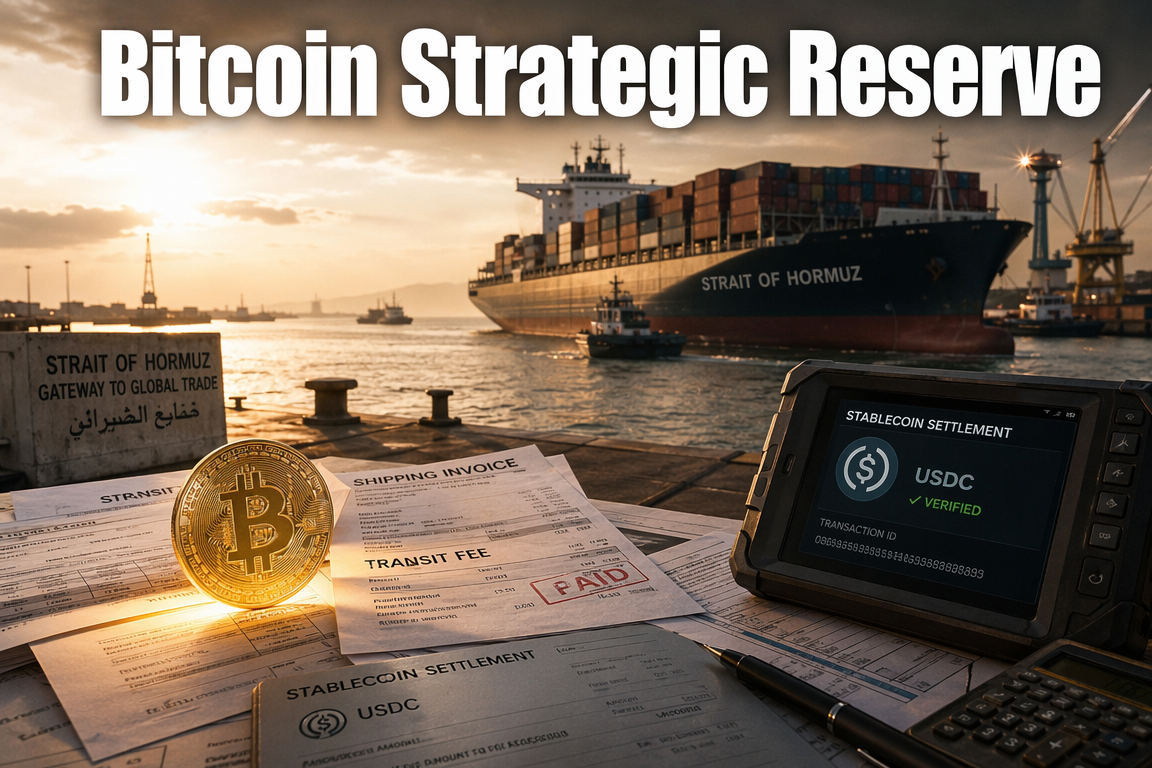
● HORMUZ TOLL SHOCK, STABLECOIN POWER, BITCOIN SURGE
A Larger Game After the War: Hormuz Transit Fees, Stablecoins, Bitcoin, and the Reordering of Energy Power
After a Middle East conflict ends, markets will not only price an relief rally. A central post-war question is who defines the rules governing the Strait of Hormuz.
This topic extends beyond geopolitics. It links crude oil pricing, inflation, dollar dominance, US Treasury demand, stablecoin expansion, Bitcoin’s potential strategic role, and the broader architecture of energy and payments.
This report summarizes, in a news-style format:
- The plausibility of imposing transit fees in the Strait of Hormuz
- Why the United States and Iran may accept such a framework
- Why the payment rail could tilt toward stablecoins or Bitcoin rather than the renminbi
- The potential signals for global macro conditions and portfolio strategy
It also highlights less-discussed angles:
- Post-war compensation via institutional design rather than direct cash transfers
- Stablecoins as a de facto mechanism that channels demand into US Treasuries
- Bitcoin as a potential instrument for geopolitical revenue allocation
1. Key Points at a Glance
A core claim is that, after hostilities subside, transit fees in the Strait of Hormuz could be introduced.
The significance is not limited to higher shipping costs. Hormuz is a critical corridor for global oil flows; a fee regime would transmit through crude benchmarks, logistics costs, inflation expectations, risk premia, and dollar liquidity.
The payment instrument is a second-order but potentially decisive variable. Whether fees are settled in renminbi, USD-linked stablecoins, or Bitcoin could shape the trajectory of digital monetary influence.
2. Why the Probability of Hormuz Transit Fees Appears Elevated
2-1. Post-war reconstruction funding becomes the primary constraint
Once war ends, reconstruction financing becomes immediate. Iran could attempt to seek direct compensation from the US, but explicit cash transfers are politically difficult for Washington, particularly in an election cycle.
A more feasible approach is to enable a revenue-generating structure rather than direct payments. A transit-fee mechanism is often cited as the most scalable option.
2-2. The US has limited incentive to oppose outright
Publicly, the US has emphasized freedom of navigation. Operationally, however, maritime security imposes substantial costs, including carrier strike group deployments.
If a fee structure recovers part of these costs, it can be framed domestically as monetizing security provision rather than subsidizing it.
2-3. A joint-administration model is more executable
A unilateral Iranian fee regime would face broad resistance. A jointly managed framework involving the US (or US-backed administration) is more likely to be accepted internationally.
Such a model can be positioned as:
- Security provision
- Order and enforcement
- A predictable funding channel for post-war reconstruction
2-4. Order-of-magnitude economics
Using commonly cited figures, Hormuz throughput is approximately 20 million barrels per day. A USD 1 per barrel fee implies:
- USD 20 million per day
- Approximately USD 7 billion per year
At this scale, the revenue could be argued to offset portions of sustained maritime-security costs.
3. Payment Rails: Renminbi, Stablecoins, or Bitcoin
3-1. Why the renminbi case may be constrained
The renminbi is a plausible candidate in operational terms: China is the largest oil importer and a major buyer of Iranian crude, and renminbi settlement has been used under sanctions conditions.
The limiting factor is geopolitical signaling. A visible renminbi-based Hormuz fee regime could be interpreted as formal alignment with China’s monetary order, raising the political cost for multiple stakeholders, including China itself.
3-2. Why stablecoins appear most implementable
Stablecoins are operationally suited to recurring trade settlement due to:
- Lower price volatility than most cryptoassets
- Faster cross-border settlement
- Straightforward integration into commodity invoicing
USD-linked stablecoins also carry a strategic implication for the US: issuers typically hold reserves heavily weighted toward US Treasuries, particularly short-dated T-bills. In effect, stablecoin-based fee settlement can translate into incremental Treasury demand.
This is less a payment innovation than a digital extension of dollar-based financial plumbing.
3-3. Iran’s constraints: sanctions and asset-freeze risk
Stablecoins are exposed to issuer and regulatory control, often within US jurisdictional reach. For a sanctions-exposed country, the primary concern is the risk of issuance restrictions or asset freezes.
Adoption would likely require some form of enforceable assurance regarding convertibility and non-interference, though the credibility and legal durability of such assurances are uncertain.
3-4. The Bitcoin alternative
Bitcoin has different properties:
- No central issuer that can halt issuance
- Reduced susceptibility to administrative freezes relative to centrally issued instruments
- Borderless custody and transfer
For actors with high sanctions risk, Bitcoin may be viewed as a more robust store-of-value and settlement asset than issuer-controlled stablecoins.
If a recurring revenue stream (such as transit fees) accumulates in Bitcoin, it may evolve into a component of sovereign balance-sheet strategy rather than a purely speculative holding.
4. Why Bitcoin Matters: Beyond Payments Toward a Strategic Reserve Asset
4-1. Potential US incentive to receive Bitcoin
Bitcoin-based fee settlement is not solely aligned with Iran’s incentives. Under a joint-administration model, the US could receive a defined share of revenues in Bitcoin.
Politically, this matters: accumulating Bitcoin via externally generated security-related revenue differs from purchasing Bitcoin with taxpayer funds.
4-2. The emergence of state-linked demand
If fees are collected routinely in Bitcoin, demand could expand beyond retail, ETFs, and institutions into state or quasi-state channels.
This could reinforce Bitcoin’s dual positioning as both a risk asset and a geopolitical hedge, depending on macro conditions and adoption pathways.
4-3. Supply-side implications
Bitcoin’s supply is structurally capped. Persistent, non-discretionary demand linked to commodity transit could reduce liquid float over time, with potential implications for long-run price dynamics.
More importantly, it would represent deeper integration of Bitcoin into trade and geopolitical cash-flow systems.
5. Implications for the Global Macro Environment
5-1. Crude oil pricing
A formalized Hormuz fee regime could impose structural upward pressure on oil prices. Even a USD 1 per barrel charge would be passed through by refiners, shippers, and importers.
If combined with risk premia linked to transit enforcement, the price impact could exceed the nominal fee.
5-2. Inflation re-acceleration risk
Energy costs transmit broadly into CPI via transportation, manufacturing inputs, power pricing, and petrochemical feedstocks.
Central banks would need to assess whether the shock is transient or institutionalized. If institutionalized, it becomes a persistent inflation variable rather than a one-off event.
5-3. US Treasuries and dollar liquidity
Greater stablecoin usage in trade settlement can increase indirect demand for US Treasuries through reserve management by issuers.
This links energy settlement, digital-dollar distribution, and the Treasury market into a single reinforcing ecosystem.
5-4. Risk assets and digital assets
In the near term, elevated Middle East risk can pressure risk assets. Post-conflict, once a rule-based framework becomes clearer, markets typically reprice toward beneficiaries of the new structure.
Potential beneficiaries include:
- Bitcoin
- Stablecoin-related infrastructure
- Cross-border settlement networks
- Energy logistics and shipping ecosystem participants
6. Investor Checklist: What Markets Should Monitor
6-1. Policy
- The design of Iran’s reconstruction funding mechanism in post-war negotiations
- Whether the US advances a joint-administration or enforcement mandate for Hormuz as a negotiating position
- The direction of stablecoin regulatory frameworks (e.g., allocation of oversight across agencies and the resulting compliance perimeter)
6-2. Energy
- Whether oil prices reflect a temporary conflict premium or a priced-in fee regime
- Changes in Hormuz throughput, marine insurance costs, and the speed of freight pass-through
6-3. Digital assets
- The pace of stablecoin institutionalization as a trade-settlement rail
- Increased official or quasi-official references to Bitcoin as a receivable or reserve asset
- Adoption signals and real-world usage metrics, not only price action
7. Undercovered Core Themes
7-1. Reconstruction compensation via fee architecture rather than cash transfers
Public discourse often focuses on explicit reparations. In practice, durable revenue structures can be more politically feasible than direct payments.
A Hormuz fee regime would function as a post-war order mechanism, not merely a tariff.
7-2. Stablecoins as a Treasury-demand channel, not only a payments tool
Many analyses emphasize remittance efficiency. The more material point is the reserve structure.
As stablecoin circulation expands, demand for short-dated US Treasuries can rise, reinforcing dollar-system stability.
7-3. Bitcoin’s shift from investment product to geopolitical asset
If Bitcoin becomes embedded in resource-linked revenue sharing (such as transit fees), it shifts from a financial product toward an instrument within geopolitical cash-flow allocation.
This would represent a higher-order form of institutional integration.
7-4. The US system may be viewed as strategically preferable to deep renminbi dependence
Even for states positioned against US policy, deeper financial dependence on China may be judged as more constraining over the long term.
China remains a critical energy trade partner, but limitations in global security projection, financial openness, and reinvestment flexibility may keep incentives tilted toward selective accommodation with US-linked rails.
8. Conclusion (Reframed)
The end of war may mark the start of a new monetization regime. Hormuz transit fees should be analyzed as an institutional redesign point linking energy control, reconstruction financing, domestic US political constraints, dollar architecture, stablecoin expansion, and Bitcoin’s potential strategic role.
The choice of settlement instrument functions as a leading indicator for the next decade of monetary and payments infrastructure.
Near-term implementability favors stablecoins due to trade suitability and clear US incentives. However, sanction risk and administrative control concerns keep Bitcoin relevant as a non-sovereign alternative that can become salient during politically sensitive phases.
Investors should monitor not only whether hostilities end, but whether a rule-based fee system emerges, which entity collects it, what instrument settles it, and how proceeds are reinvested. These variables may jointly influence oil prices, inflation persistence, US Treasury demand, and digital-asset positioning.
< Summary >
Hormuz transit fees could become a primary post-war macro variable.
Iran may seek reconstruction funding; the US may prefer institutional mechanisms over direct cash compensation for domestic political reasons.
Settlement rails may draw more attention toward stablecoins and Bitcoin than toward the renminbi.
USD-linked stablecoins can expand indirect demand for US Treasuries as a digital-dollar infrastructure, while Bitcoin offers sanction-resilient characteristics and may evolve into a strategic reserve asset for one or more stakeholders.
This is a cross-asset variable linking crude oil, inflation, dollar influence, US Treasuries, and Bitcoin adoption.
[Related Articles…]
- https://NextGenInsight.net?s=Bitcoin
- https://NextGenInsight.net?s=Stablecoin
*Source: [ 경제 읽어주는 남자(김광석TV) ]
– 전쟁 끝나면 시작된다… 호르무즈 통행료와 비트코인 부상 | 경읽남과 토론합시다 | 김동환 대표 [2편]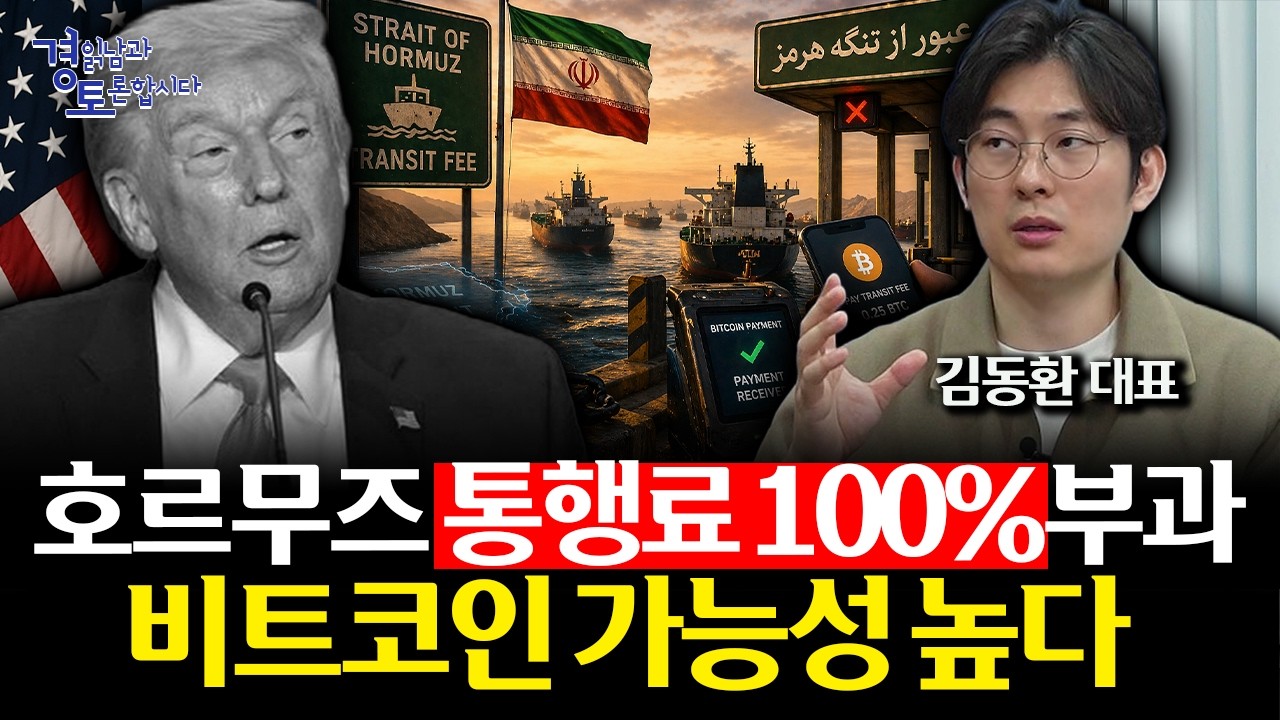
● App Tech to 800K, Smart Cashflow Hack
Realistic Path to KRW 800,000 per Year via App-Based Micro-Saving: Building a “Cash-Flow System,” Not Just Collecting Points
This report consolidates how app-based micro-saving functions as an entry point for early-career personal finance, why savings-only approaches compound slowly, how to link deposits, high-yield liquidity accounts, CMA, and ETFs, and how to optimize everyday cash flow through year-end tax settlement, cash-receipt tracking, and local currency programs.
A key takeaway often omitted in mainstream media is that the core of app-based micro-saving is not “earning a few hundred won,” but converting fragmented household spending into an asset-building system.
The content is reconstructed in a news-report format based on the practical experience of author Yonina, designed to be applicable for both salaried employees and freelancers.
1. Key News Points
Three core observations:
- First, wealth-building starts with goal definition and account separation rather than income growth.
- Second, app-based micro-saving is not a side job; it is a lifestyle-based approach that reduces leakage and improves cash flow.
- Third, repeating installment savings alone leads to slow asset growth; deposits, liquidity management, and investment linkage are required.
Overall, this case illustrates a post-high-rate personal finance structure focused on system design rather than isolated tactics.
2. Starting Point: Spending Control Requires Clear Objectives
Financial constraints as the trigger for disciplined money management
Yonina cites a formative experience at age 20: being unable to afford KRW 30,000 for a group outing, which catalyzed structured money management.
The broader implication is that personal finance typically begins with lived constraints rather than return optimization.
Initial strategy: KRW 10,000 per day budget and KRW 50,000 pre-savings
With a monthly allowance of KRW 350,000, she set a daily spending cap of KRW 10,000 and separated KRW 50,000 upfront as pre-savings.
The central mechanism is not the amount but the “separate first” habit:
- Income received
- Savings automatically segregated
- Remaining funds used for living expenses
This structure enables spending control and supports longer-term asset allocation under inflation and cyclical volatility.
3. Why Savings-Only Approaches Accumulate Slowly: Convert Maturities into Time Deposits
A common early-career blind spot
Many beginners save consistently but rely primarily on installment savings.
While effective for habit formation, installment savings often compound more slowly because principal is contributed incrementally rather than deployed from day one.
Operational solution: roll savings maturities into time deposits
Yonina emphasizes avoiding consumption after maturity and reallocating proceeds into time deposits to extend compounding.
- Installment savings: strong for accumulation discipline
- Time deposits: effective for locking in accumulated principal with relatively stable yield
- High-yield demand accounts and CMA: suitable for idle cash management
Recommended capital pathway:
Installment savings → Time deposits → High-yield demand/CMA → Investment
4. Core Function of App-Based Micro-Saving: Automated Capture of “Incidental Cash”
Using many apps reflects time-fragmented execution, not continuous labor
Yonina reports using 48 micro-saving apps, executed in short intervals rather than concentrated sessions:
- Commuting time
- Waiting periods (e.g., elevators)
- Brief idle moments
The purpose is not income replacement but recovery of money that would otherwise dissipate through routine behavior.
Example: step-based rewards in the Toss Bank benefits menu
A common mechanism is step-count rewards:
- Steps tracked automatically by the phone
- Users tap to claim points
- Points can be redeemed for gift items or converted into cash-equivalent value
This is positioned as monetizing existing daily activity rather than adding incremental work.
“Portal routing” rewards: increasing return on identical consumption
For purchases that would occur regardless, using routing channels (e.g., Payco, OK Cashbag, Toss) instead of direct brand checkout can yield incremental points or discounts.
This improves effective purchase price and functions as household expense reduction.
5. Why KRW 800,000 per Year Is Achievable: Do Not Spend Points; Segregate Them
The operational core: a dedicated “incidental cash account”
Income sources such as micro-saving points, resale proceeds, small refunds, and minor side income should not be mixed with daily spending; they must be segregated into a separate account.
Typical components:
- Micro-saving rewards
- Secondhand sales proceeds
- Unexpected refunds
- Trial/review program proceeds and other ancillary income
These funds are characterized by being non-essential to baseline living; if mixed into spending accounts, they are quickly consumed. Segregation converts them into investable or savings principal.
Why the impact is larger than perceived
KRW 800,000 per year may appear immaterial, but it functions similarly to incremental after-tax income due to minimal marginal taxation and high retention (i.e., it is “net savings” rather than gross earnings).
When combined with deposit interest, high-yield liquidity rates, and eventual ETF allocation, the perceived impact increases.
6. Local Currency and Onnuri Gift Certificates: Practical, High-Impact Savings Tools
Local currency as an ongoing expense-reduction instrument
Local currency programs are often treated as one-off subsidy vehicles, but ongoing top-ups for everyday spending can yield:
- Typically 5–10% effective discount
- Potential year-end tax settlement benefits
- Immediate reduction in recurring living costs
This approach is positioned as a practical hedge during sustained cost-of-living pressure.
Onnuri gift certificates for traditional markets
Onnuri gift certificates can provide meaningful discounts (often 10%, occasionally up to 20%) at eligible merchants such as traditional markets.
During periods of rising food and dining costs, these policy-linked instruments can materially reduce household outlays.
7. Account Segmentation: Different Structures for Salaried Employees vs. Freelancers
Salaried employee account structure
With stable payroll inflows, a simplified segmentation model is feasible:
- Payroll account
- Fixed-expense account
- Living-expense account
- Emergency fund account
- Savings account
- Investment account
This clarifies purpose and reduces cross-contamination between consumption and accumulation.
Freelancer/self-employed account structure
With higher income volatility, maintaining dedicated fixed-expense and tax buffers is critical, as fixed obligations are less flexible than revenue.
- Income-receipt (“payroll”) account
- Fixed-expense account
- Living-expense account
- Emergency fund account
- Tax-reserve account
- Savings/investment account
This supports cash-flow stability under income gaps or downturns.
8. High-Yield Demand Accounts and CMA: Avoid Idle Cash in Low-Rate Accounts
Keeping cash in standard payroll accounts is yield-destructive
Payroll accounts typically offer low rates; leaving balances idle effectively forfeits available yield.
Short-term idle funds are more efficiently held in high-yield demand accounts or CMA.
Product distinction
- High-yield demand accounts: bank-centric, flexible withdrawals, lower onboarding friction
- CMA: brokerage-based, often competitive yield for short-duration cash management
Examples referenced include Mirae Asset Naver Pay CMA and K-Bank Plus Box; terms change frequently and require verification at purchase.
The principle: emergency and waiting funds should not remain in persistently low-yield accounts.
9. Household Ledger: A Consumption Analytics Tool, Not a Self-Discipline Journal
Primary objective: pattern detection rather than reconciliation
Ledger use is framed as identifying repeated triggers and categories rather than achieving perfect balance matching.
Core value: understanding when, why, and how consumption repeats (including emotional drivers).
Categorization improves decision quality
Rather than aggregating “food,” segmentation can isolate actionable drivers:
- Survival food: groceries and basic meals
- Emotional food: stress-driven delivery or impulse cafe spending
- Social food: gatherings with friends or colleagues
This enables prioritization between costs to reduce and spending with retained utility.
10. Cash Receipts: Small Habits with Year-End Tax Settlement Impact
Cash-receipt capture is frequently neglected, but habitual tracking can create material differences over time.
If not registered at the point of sale, self-registration is possible via the tax authority using:
- Approval number
- Amount
- Date
Year-end tax settlement outcomes are driven by cumulative small records rather than one-time events.
11. From KRW 100 Million in Savings to ETFs: A Conservative Transition Path
Limits of savings-only strategies
Yonina reports building to KRW 100 million primarily through saving, then expanding into investment due to lower-rate environments and slower asset-growth momentum.
This remains relevant amid inflation persistence and real purchasing-power preservation requirements.
Why ETFs are structurally accessible for beginners
Compared with single-stock selection, ETFs reduce concentration risk and lower analysis burden through diversification and index/sector exposure.
They can provide comparatively straightforward access to asset classes such as:
- Nasdaq and broader U.S. equities
- Dividend strategies
- Bonds
- Gold
Loss risk remains, but the framework positions lifestyle savings and micro-saving surplus as funding sources for long-horizon, diversified allocation.
12. Key Points Often Underemphasized in Media
Core point 1: the function is leakage control, not income generation
App-based micro-saving is characterized as a spending-defense system that recaptures value from routine consumption and behavioral data rather than a second wage stream.
Core point 2: cashing out points and spending them eliminates the benefit
The critical step is the destination of funds. If mixed into the consumption account, the effect is largely nullified. Segregation is required for asset conversion.
Core point 3: structure precedes product selection
Common questions focus on “best” savings products or rates; the framework argues that account architecture, spending structure, and goal definition must be established first.
Products are tools; performance differences are frequently driven by system design.
Core point 4: repeatable habits matter more than high-return narratives for beginners
Macro variables (rates, FX, U.S. policy, index movements) matter, but in early asset formation, repeatable small habits typically dominate outcomes.
A combined toolkit—micro-saving, local currency, cash receipts, ledgers, and an incidental-cash account—forms a durable financial base.
13. Action Checklist (Immediately Implementable)
- Start with one automated micro-saving tool (e.g., step-based rewards).
- Open an incidental-cash account for points, resale proceeds, and refunds.
- Roll installment-savings maturities into time deposits rather than consuming them.
- Move emergency funds from payroll accounts to high-yield demand accounts or CMA.
- Verify local currency and Onnuri gift certificate eligibility within daily living areas.
- Use a ledger to analyze patterns rather than focusing on exact reconciliation.
- Register missed cash receipts through self-issuance using receipt details.
- Allocate lifestyle-savings surplus over time into diversified ETFs and similar vehicles.
14. Closing View: Micro-Saving as Entry-Level Training for Asset Discipline
App-based micro-saving is positioned as a mechanism to change financial behavior, control cash flow, and convert small, fragmented resources into investable capital.
In environments with simultaneous uncertainty across rates, FX, inflation, and growth, lifestyle-based cash-flow management can provide a resilient foundation.
Asset accumulation can be achieved not only through large income gains but also by systematically preventing small leakages and compounding retained value.
< Summary >
App-based micro-saving is a system for converting household spending into assets, not a point-collection tactic.
The central mechanism is segregating points and incidental income into a dedicated account.
Repeating installment savings alone slows asset growth; linkage to time deposits, high-yield liquidity accounts, CMA, and ETFs improves capital efficiency.
Local currency programs, Onnuri gift certificates, cash receipts, and ledgers are core tools for practical expense reduction.
Outcome dispersion is driven more by structural design and repeatable habits than by selecting “best” products.
[Related Articles…]
- App-based micro-saving: current strategies for reducing household expenses
https://NextGenInsight.net?s=AppTech - How to use high-yield liquidity accounts and manage short-term funds
https://NextGenInsight.net?s=ParkingAccount
*Source: [ Jun’s economy lab ]
– 앱테크로 연 80만 원 모으는 법(ft.요니나 작가 1부)