● Tesla Shock, Musk Selloff, Capex Surge, Robotaxi Delay
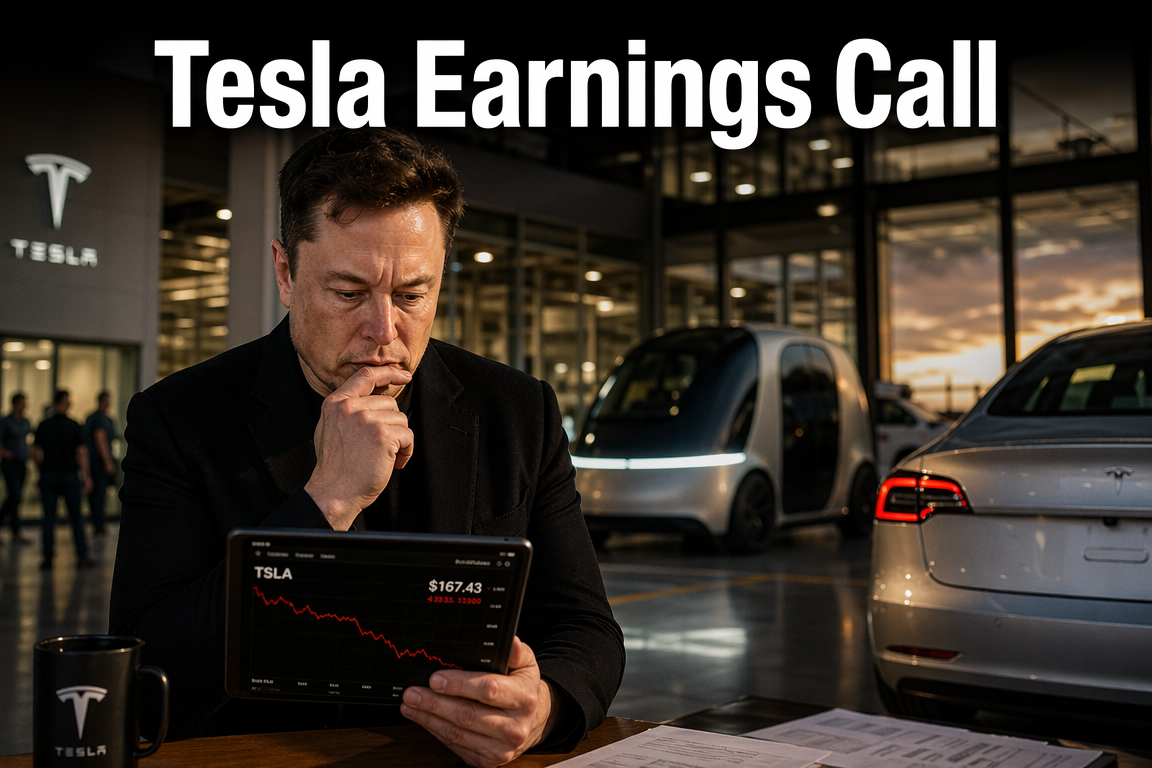
Tesla Earnings Call Disappointment: The Real Issues Behind the Reaction — Musk’s $0 Disposal Filing, Capex Upshift, Robotaxi Timeline, and Investor Decision Framework
This event should not be reduced to “results were fine, so why did the stock fall.” The key drivers were (i) the substance of Elon Musk’s $0 share disposal filing, (ii) the earnings-call wording that shifted market sentiment from relief to disappointment, (iii) the implications of higher capex as a near-term headwind and potential long-term option, and (iv) how FSD subscription momentum and the robotaxi schedule influence valuation.
A central point often underemphasized is that “rising uncertainty” and “structural changes in cash-generation” are occurring simultaneously. The following is a consolidated, investor-oriented recap.
1. Key News Briefing
The issue set can be organized into three items:
1) Elon Musk’s Tesla share disposal filing.
2) Why initial post-release optimism reversed after the earnings call.
3) How investors should interpret the current price action.
The release was not materially worse than expectations; cash flow and several business lines were more resilient than feared. The earnings call, however, introduced a more aggressive capex trajectory and greater uncertainty around the robotaxi timeline, prompting the market to apply a higher risk premium. The reaction reflected “future funding burden and timing risk” more than “current-quarter performance.”
2. Elon Musk’s $0 Disposal Filing: What It Actually Indicates
The most notable element was the disposal of approximately 96 million shares at $0. On its face, this can appear alarming; however, it should not be interpreted as a cash sale into the market.
2-1. Why a $0 Disposal Appeared
The context is the Delaware court decision and the CEO compensation package dispute. A prior compensation framework granted substantial option-based awards contingent on market-cap and operating milestones. A Delaware court invalidated the package as excessive; although a subsequent shareholder vote re-approved it, legal uncertainty has not been fully eliminated.
2-2. Tesla’s “Double-Compensation Prevention” Structure
Tesla structured the arrangement so that if the original package is ultimately reinstated via legal outcomes, separately granted shares would be forfeited to avoid duplication. The ~96 million share disposal is therefore closer to a rights forfeiture mechanism than an economic sale, explaining the $0 reporting.
2-3. Practical Interpretation for Investors
Interpreting this filing as “Musk is exiting Tesla” is not supported by the mechanics. While it may weigh on sentiment, it is more accurately framed as a legal/compensation normalization step than a signal of deteriorating conviction.
3. Why the Market Initially Responded Positively
Based on the prepared results materials, the initial response was driven by relief that near-term capex and cash flow were not as weak as feared.
3-1. Why Capex Concern Appeared to Ease
Markets had already expected significant investment across AI, autonomy, robotics, data-center compute, and manufacturing infrastructure. The uncertainty centered on magnitude and timing. The quarter’s capex and free cash flow appeared less adverse than some expectations, and operating cash flow held up.
3-2. Why That Matters
Equities often discount “large investment cycles” due to near-term cash consumption and elevated uncertainty. The release allowed a short-lived “less bad than feared” interpretation.
4. Why Sentiment Reversed During the Earnings Call
During the call, management commentary implied a more aggressive capex path, potentially around $25 billion annually, alongside the possibility of negative free cash flow in the second half.
4-1. The Phrase the Market Penalized Most
“Cash outflows could increase in the second half.”
This implies investment may outpace internal cash generation, requiring a higher risk premium while returns remain unproven.
4-2. What Happens When the Discount Rate Rises
Long-duration growth equities are priced on expected future cash flows. When uncertainty increases, those cash flows are discounted more heavily. The long-term narrative can remain intact while near-term valuation compresses.
4-3. Is the Selloff Rational?
In the near term, yes. Higher capex increases execution risk. Upside can be significant if successful, but downside expands if returns disappoint. Absent near-term proof of efficiency, conservative pricing is typical.
5. Why Higher Capex Is Not Necessarily Purely Negative
The interpretation depends on time horizon. Near-term optics are unfavorable, but the strategic context is AI-enabled automation, autonomy, and robotics.
5-1. Capex as Potential “Future Productivity Preemption”
The AI cycle is capital-intensive: compute, power, data, models, and automation systems. Tesla positions itself as an AI-enabled physical-world automation company, implying that capex expansion is consistent with strategy.
5-2. What Ultimately Changes Valuation
The core variable is not capex size but realized return on invested capital. If investments translate into defensible economics in robotaxi, autonomy software, energy storage, and manufacturing automation, today’s valuation discount could later convert into a premium.
5-3. The Core Question
The issue is not “spending more.” The issue is whether Tesla can establish a durable, high-return cash-generation structure in an AI-driven industrial transition.
6. FSD Subscription Growth: An Underweighted Signal
A key datapoint is the increase of roughly 180,000 monthly FSD subscribers during the quarter. This is more significant than it appears.
6-1. Why It Matters
FSD is not merely a one-time software add-on; it indicates movement toward a recurring-revenue platform model. Growing subscription penetration implies compounding cash flows beyond initial vehicle sales.
6-2. Financial Implication
Incremental subscribers add meaningful monthly revenue. If churn remains controlled, contribution to quarterly profitability and cash generation can grow over time. Expanding the subscriber base can improve operating cash flow resilience.
6-3. Common Misread
Free cash flow can weaken due to investment while the underlying operating engine strengthens. “Cash used for capex” and “deteriorating core competitiveness” are not equivalent and should be analyzed separately.
7. Robotaxi: Why the Market Was Disappointed, and What Still Matters
One of the largest disappointments was guidance implying that broad robotaxi scaling could be oriented around 2027, tied to “Version 15” readiness.
7-1. Why It Was Treated as Negative
A material portion of Tesla’s valuation is tied to future optionality, with robotaxi as a major premium component. Longer timelines increase discounting and reduce near-term visibility.
7-2. The Key Variable: Reason for Delay
Not all delays are equivalent. A delay due to insufficient capability differs from a delay driven by raising safety and deployment standards. The messaging aligns more with the latter.
7-3. Evidence of Unsupervised Operating Experience
Even if limited, references to unsupervised operational experience and stable safety outcomes suggest progression beyond “no demonstrated capability,” shifting the discussion to scaling criteria.
7-4. Why Wait for Version 15
In autonomy, early incident history and regulatory confidence are critical. Delaying broader rollout for a meaningfully safer, more robust release may improve long-term adoption and enterprise value, despite near-term disappointment.
8. Musk’s Earnings-Call Demeanor: Not Purely Negative
Some investors perceived a less optimistic tone and greater emphasis on constraints.
8-1. Interpretation
Earlier stages required more vision-led communication. Today, autonomy, energy storage, robotics, and AI infrastructure are closer to operational reality, making manufacturing scale, regulation, safety, deployment logistics, and cost structure more relevant discussion points.
8-2. Why Markets Reacted Poorly
Equity markets reward narratives but also demand speed. Emphasizing constraints implies longer timelines, which pressures near-term valuation.
9. Energy Segment Margin Near 40%: Positive, With Adjustments
Reported energy margins approached ~40%, a strong headline metric.
9-1. Separate One-Off Effects
Part of the margin uplift reflected a tariff-related refund from a prior period. Treating 40% as a new structural margin level without normalization would be inappropriate.
9-2. Why It Still Matters
Even after adjusting for one-offs, the profitability trend appears favorable. With grid constraints, storage demand, and data-center power requirements rising, the energy segment could become a more stable growth driver relative to autos.
10. Macro and AI-Trend Context
This quarter also reflects broader market framing.
10-1. Capital Is Moving Toward AI Infrastructure
The dominant global theme is large-scale investment in AI-linked capacity: semiconductors, power, data centers, automation, networks, and robotics. Tesla should be assessed within this capex-driven transition.
10-2. Why Rates Matter
In higher-rate environments, markets prioritize current cash flow over distant earnings. Consequently, rising capex and weaker free cash flow guidance pressure growth-equity valuations.
10-3. If Rates Stabilize
If inflation eases and policy rates stabilize, markets can re-rate long-duration growth. In that scenario, investment expansion may be reframed from “burden” to “strategic preemption,” contingent on execution.
11. Investor Decision Framework
The key decision is not the narrative itself but fit with investor time horizon and risk tolerance.
11-1. Confirm Time Horizon
For long-horizon investors, volatility may be part of the process. For 6–12 month horizons, the path dependence and valuation sensitivity can be difficult.
11-2. If Conviction Exists but Volatility Is Unmanageable
Reduce position sizing. A common source of poor outcomes is not the asset quality but excessive allocation that forces emotional decision-making.
11-3. If Opportunity Cost Pressure Is Rising
If other AI-linked equities outperform while Tesla lags, concentration risk increases. A diversified approach across AI infrastructure bottlenecks (compute, power, automation) may improve risk-adjusted experience.
11-4. Practical Checklist
- Do you agree with Tesla’s long-term value creation path?
- Can you hold through multi-year uncertainty?
- Is your portfolio sized so that drawdowns do not impair decision quality?
12. Most Misunderstood Points
12-1. The $0 Disposal Is Primarily Legal/Compensation Normalization
Treating it as a conventional insider sale can lead to incorrect conclusions.
12-2. The Market Reacted to Discount-Rate/Uncertainty, Not the Quarter Alone
The drawdown reflects a higher uncertainty premium.
12-3. Free Cash Flow vs. Operating Cash Flow
Capex-driven free cash flow pressure is distinct from operating deterioration.
12-4. Robotaxi Timing May Reflect Higher Commercialization Standards
The valuation recovery path depends on whether delays are capability-driven or standards-driven.
12-5. FSD Subscriptions Represent a Transition Toward Recurring Revenue
This is a platform monetization signal, not a simple option-sales metric.
13. Consolidated View
From a short-term perspective, the earnings call was a negative: capex may rise, second-half free cash flow may weaken, and broad robotaxi scaling appears later than prior expectations. From a longer-term perspective, Tesla is deploying capital into AI, autonomy, energy, and robotics while expanding recurring software monetization and strengthening non-auto cash drivers.
The primary investor decision is whether near-term volatility is acceptable in exchange for potential multi-year changes in Tesla’s cash-generation model. If aligned, position sizing and diversification are the practical tools; if not aligned, forcing a long-term stance can be counterproductive.
< Summary >
- The stock decline was driven more by higher capex and increased free cash flow uncertainty than by headline results.
- Musk’s $0 share disposal is better characterized as legal/compensation cleanup to prevent double counting, not a cash exit.
- FSD subscriber growth is a meaningful recurring-revenue indicator.
- Robotaxi timeline disappointment increases discounting, but delay rationale may reflect higher safety/commercialization standards rather than lack of capability.
- Long-term value depends on execution across AI, autonomy, and energy; investors should align allocation with time horizon and risk capacity.
[Related Articles…]
-
Tesla Robotaxi and FSD: Key Checkpoints Investors Should Track
https://NextGenInsight.net?s=Tesla -
AI Infrastructure Capex Expansion: Beneficiaries Across Semiconductors, Power, and Automation
https://NextGenInsight.net?s=AI
*Source: [ 허니잼의 테슬라와 일론 ]
– [테슬라] 대실망을 가져온 어닝콜, 투자자로서 올바른 판단은? / 중복 보상 방지 조항에 따른 일론 머스크 테슬라 매도