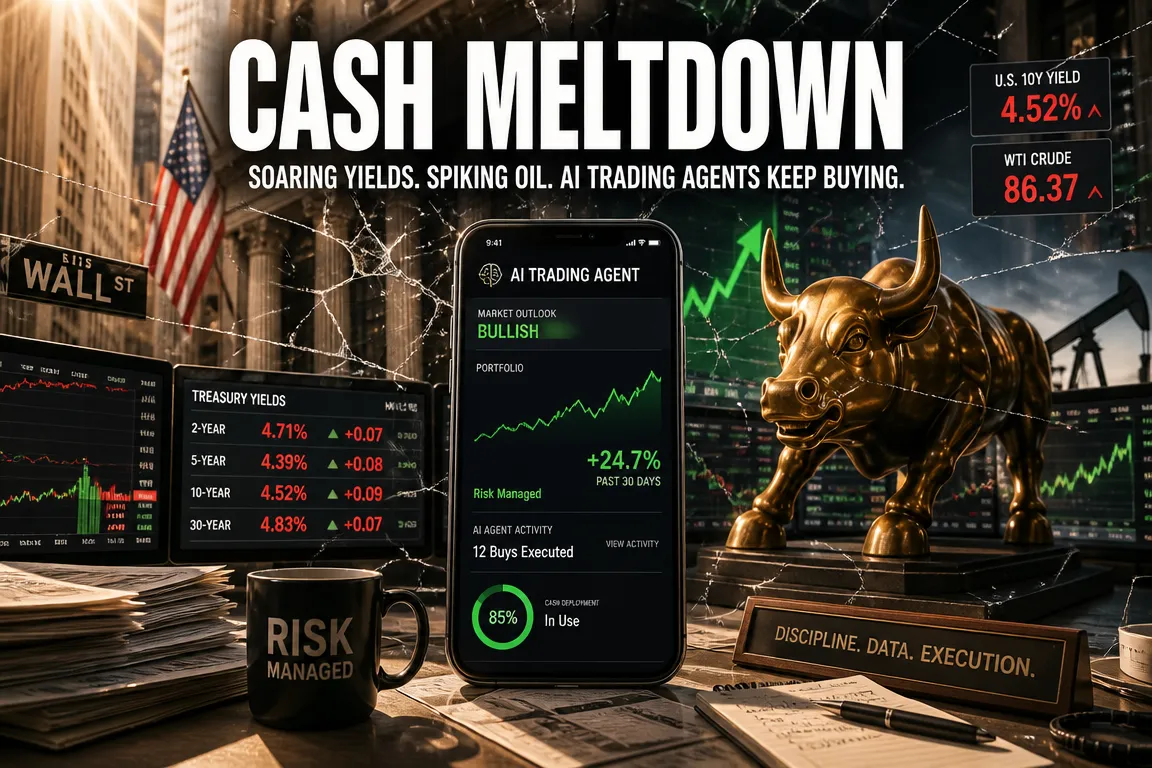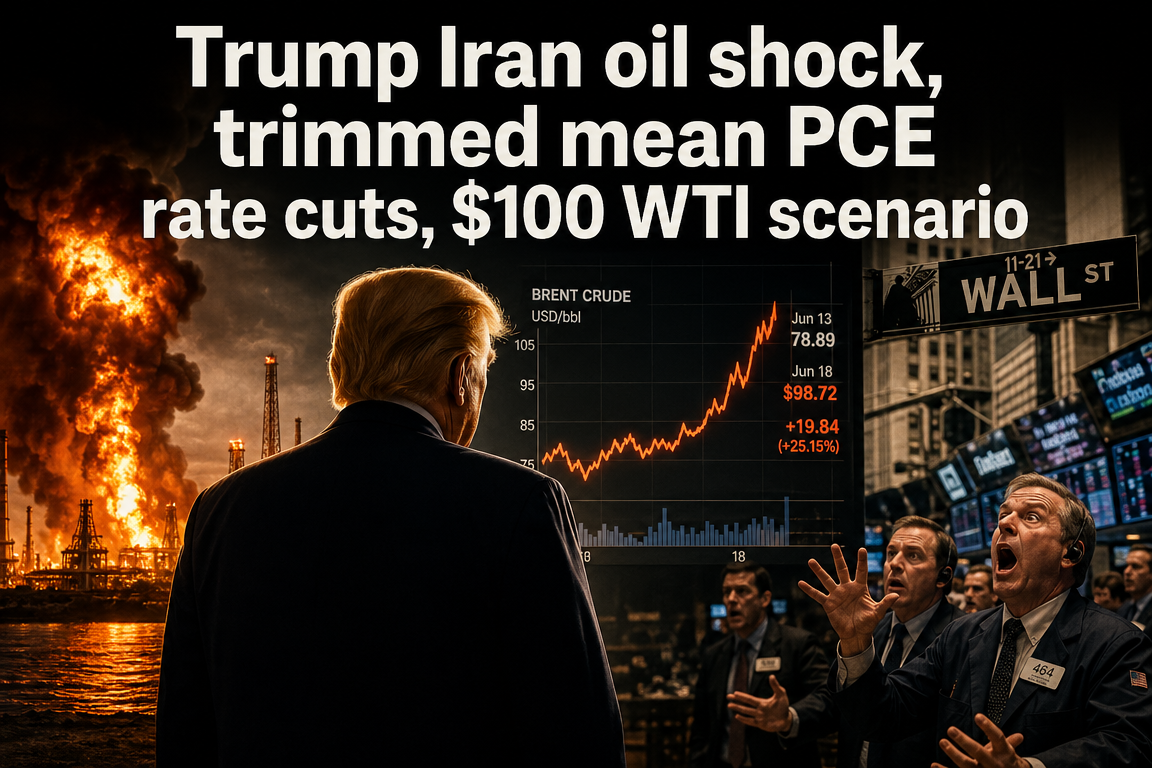
● Trump-Iran Shock, Oil Spike, Rate Cut Gamble
Trump–Iran Tensions, the Possibility of $100 Oil, and Rate-Cut Scenarios: An Integrated Brief
This is not a standalone Middle East headline. It links potential crude oil upside, the logic for U.S. policy-rate cuts, shifts in inflation interpretation, possible changes in Federal Reserve leadership, and direction across global risk assets. While many reports stop at “Iran’s hardline stance” and “high-oil-price risks,” the market’s core focus is increasingly different: policy outcomes can change materially depending on how inflation is measured. This report centers on that point—why a rate-cut narrative can persist even under high oil prices—and what investors should monitor.
1. What Has Changed: Why Trump–Iran Negotiation Expectations Are Deteriorating
The first key development is that expectations for a second round of U.S.–Iran negotiations have weakened. Messaging associated with the Trump camp has been notably hardline: a planned meeting schedule with the Iranian delegation was canceled, and Iran’s internal power structure was publicly described as unstable.
For markets, this is less about diplomatic rhetoric and more a signal that a near-term deal is less likely. Prediction-market pricing has also implied declining odds of an early agreement.
Separately, potential engagement tied to movements by Iran’s foreign minister—reportedly linked to Pakistan—ended without a clear breakthrough, further reducing near-term de-escalation expectations. Overall, markets have begun to assign higher probability to a prolonged period of tension rather than a rapid diplomatic resolution.
2. Why Oil Has Re-Emerged as the Primary Variable: The Return of the $100 Scenario
Iran-related developments matter primarily through supply-risk transmission to crude oil. The core concern is not conflict headlines per se, but increased risk around energy transport chokepoints such as the Strait of Hormuz.
Current market framing appears to focus less on extreme outcomes far above $105 and more on the practical probability of a $100–$105 range. This level is material: it can feed through to consumer prices, corporate input costs, logistics expenses, and multiple sectors including airlines, chemicals, refining, and transportation.
Under conventional assumptions, such a backdrop constrains the Federal Reserve’s ability to cut rates, because higher oil is a classic source of cost-push inflation. However, the rationale for advocating rate cuts even under high oil hinges on the inflation metric emphasized, addressed below.
3. Core Issue: How a Rate-Cut Case Can Be Built Despite High Oil
The critical variable is not inflation in the abstract, but which inflation gauge is prioritized. A key concept is the Trimmed Mean PCE.
This measure ranks price changes across components, removes a defined portion of the most extreme increases and decreases, and computes an average. The objective is to filter out temporary or idiosyncratic shocks and infer underlying inflation pressure.
In periods of sharp energy price moves, this approach can reduce the pass-through of oil-driven volatility into the headline signal, potentially producing a “lower and steadier” inflation narrative than broader measures.
4. Why Warsh Emphasizes This Measure: Shifting the Interpretive Framework
A notable point is that Kevin Warsh, discussed as a potential future Fed Chair candidate, referenced this metric during the hearing process. This may be more than a technical aside, particularly because the Trimmed Mean PCE has recently tended to print lower than other inflation indicators.
As a result, the same macro environment can support divergent conclusions—“inflation remains high” versus “inflation is stabilizing”—depending on the measure used, with direct implications for U.S. rate policy and broader financial conditions.
Warsh’s implied framework can be summarized as follows: the Fed should avoid overreacting to small, short-term inflation deviations and instead focus on the broader trajectory. Under this view, even without a precise return to 2.0%, rate cuts could be considered if the overall trend is improving and productivity gains support disinflation.
This aligns with policy preferences often associated with the Trump camp, which tends to favor earlier monetary easing to support growth, equity markets, and employment.
5. News-Style Summary: Key Messages Being Priced
First. Reduced expectations for U.S.–Iran negotiations are pushing de-escalation scenarios to the background.
Second. The probability of oil trading around $100 has re-emerged as a realistic baseline scenario.
Third. In standard models, higher oil raises inflation pressure and makes rate cuts harder to justify.
Fourth. Emphasizing measures such as the Trimmed Mean PCE can support a “more stable inflation” interpretation by dampening the apparent impact of oil shocks.
Fifth. If Fed leadership or policy emphasis shifts, this framework could become a central justification for U.S. policy-rate cuts.
6. The Macro Point Investors Should Prioritize: The Policy Reaction Function Matters More Than Oil
Many reports conclude with “higher oil pressures equities.” The more important issue is how the Fed interprets oil-driven inflation, i.e., the policy reaction function.
Historically, oil spikes often translated directly into tighter-policy risk. The current environment is more conditional: if policymakers characterize energy-driven inflation as temporary while core momentum moderates, markets can sustain rate-cut expectations despite higher oil.
Accordingly, investors should prioritize the inflation-measure debate and shifts in Fed language over the oil print itself.
7. The Under-Discussed Core: Inflation Is Also a Definition Choice
The central question is not simply “can the Fed cut with high oil?” but whether the choice of inflation definition changes the perceived reality.
Policy appears data-driven, but the selection of which data to privilege effectively sets the direction of policy debate. Emphasizing Trimmed Mean PCE is therefore not merely a methodological preference; it is a framing choice.
This also connects to economic policy in an AI-driven era. As the volume of data expands, decisions about which variables to exclude and which to treat as core become more consequential. As AI-based macro analysis scales, the model’s weighting scheme may increasingly shape policy signaling.
In practical terms, “which model-produced inflation measure” may become as important as “the inflation rate” itself.
8. Investor Checklist: U.S. Equities, Bonds, Commodities, and AI-Linked Stocks
8-1. U.S. Equities
U.S. equities may face two opposing forces: Middle East risk and higher oil as a headwind, versus expectations for U.S. rate cuts as a tailwind.
If markets conclude “oil is a risk but the Fed will remain accommodative,” growth stocks—particularly Nasdaq and AI-linked equities—could retain relative strength. If oil rises rapidly and remains elevated, valuation pressure may increase.
8-2. Bond Market
The bond market is likely the primary transmission channel. Rising inflation concerns can push long-end yields higher, while growth deceleration and easing expectations can pull yields lower. U.S. Treasury yields may become more sensitive to Fed communication than to oil levels.
8-3. Commodities and Energy
Energy may experience elevated volatility. After sharp rallies, prices can reverse on incremental negotiation headlines; momentum-driven entries warrant caution. This is a typical regime where geopolitics and monetary policy interact to amplify commodity volatility.
8-4. AI and Fourth Industrial Revolution-Linked Equities
Although the headline is geopolitical and rates, the AI sector is directly exposed through discount-rate sensitivity. If rate-cut expectations persist, conditions may become more supportive for high-multiple growth. Semiconductors, cloud platforms, data centers, power infrastructure, and AI software may benefit from improved liquidity expectations.
Energy input costs remain relevant: data centers are power-intensive, so oil and broader energy pricing can indirectly affect cost structures. AI-linked investing increasingly requires integrating energy and macro variables alongside technology fundamentals.
9. Key Upcoming Catalysts and Variables
Fed personnel shifts
Monitor public remarks and hearing signals from potential Fed Chair candidates. Preference for specific inflation measures can serve as a policy indicator.
U.S. inflation releases
Track CPI, PCE, Core PCE, and market attention to supplementary measures such as Trimmed Mean PCE.
Middle East diplomatic calendar
Watch for unofficial U.S.–Iran contacts, third-party mediation signals (including Pakistan), and rhetoric related to the Strait of Hormuz.
Oil price path
Beyond direction, focus on where WTI and Brent stabilize. Sustained trading near $100 can materially affect sentiment.
U.S. growth and productivity
A Warsh-style framework relies on productivity-led disinflation. Track productivity data, capex trends, and whether AI investment is translating into measurable growth support.
10. One-Line Conclusion
Markets are tracking the familiar chain “Middle East tension → higher oil → inflation risk,” but a parallel and potentially larger shift is underway: “changes in inflation measurement emphasis → justification for rate cuts → recovery in liquidity expectations.”
The core issue is less the oil price itself than who defines inflation, how it is defined, and which policy path that definition enables. This framing can affect financial markets broadly, including global risk assets and AI-centered growth equities.
< Summary >
As expectations for a Trump–Iran agreement weaken, the $100 oil scenario has re-entered market focus. While high oil typically elevates inflation and constrains U.S. rate cuts, emphasizing inflation measures that trim extremes—such as the Trimmed Mean PCE—can support a lower-inflation interpretation and help justify easing. This framework could become more influential if Fed leadership or policy emphasis shifts. The key issue is therefore not oil alone, but the inflation-definition framework and the resulting policy response. U.S. equities, bonds, commodities, and AI-linked stocks may all be affected through this channel.
[Related Articles…]
Key Takeaways: U.S. Rate Outlook and Asset-Market Regime Shifts
AI Investment Trends and Global Big Tech Strategy Analysis
*Source: [ Maeil Business Newspaper ]
– [홍장원의 불앤베어] 트럼프 믿는 구석 있나? 고유가에 금리인하 주장할 수 있는 이유