● Powell, Slams, Rate-Cut, Hopes
Key Takeaways from the April 2026 FOMC Statement: Powell’s Message Beyond the Rate Hold, and the US Outlook Investors Should Not Miss
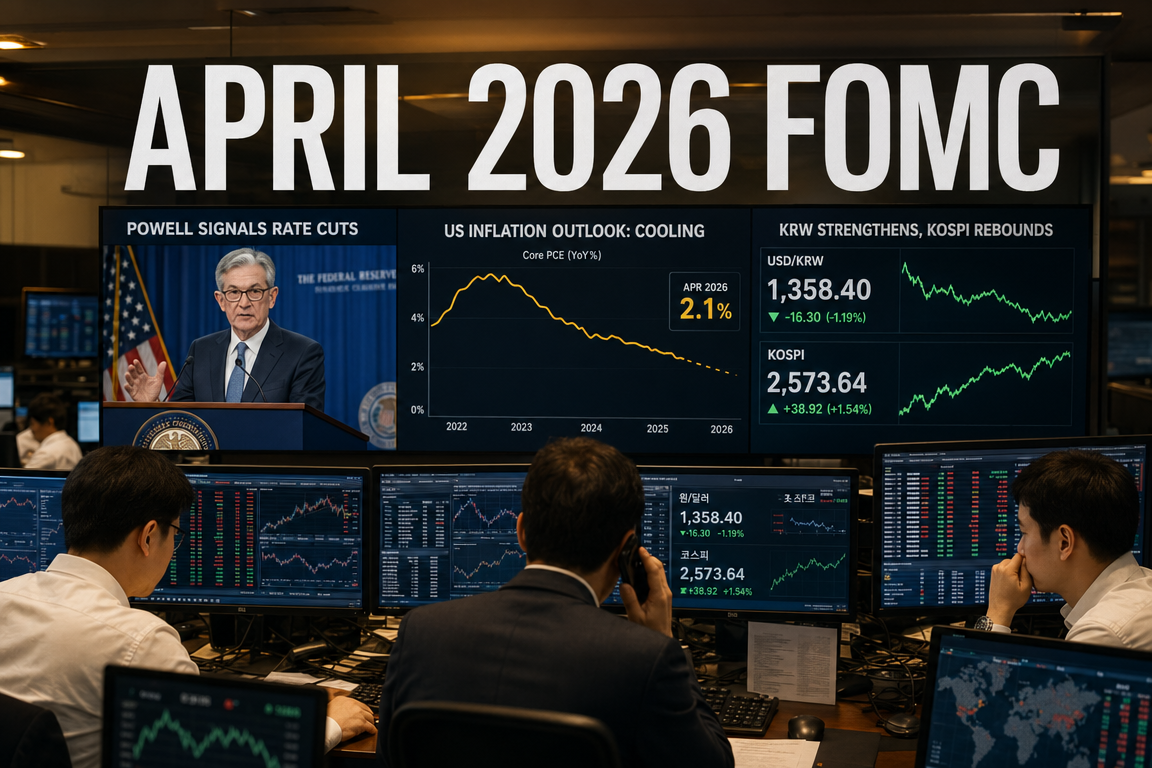
This April 2026 FOMC was not a routine event defined solely by whether the policy rate moved up or down. The key signal was policy optionality: no immediate action, and no commitment to a near-term pivot. Markets looked for clearer easing guidance, but the Fed emphasized that incoming data will determine timing, reflecting continued concern over inflation persistence alongside a still-resilient labor market.
1. April 2026 FOMC at a Glance
The core message can be summarized as: “No immediate move, and no easy promises.”
- Maintain a cautious stance on the policy-rate path
- View that disinflation progress is not yet sufficiently confirmed
- Highlight concurrent labor-market strength and inflation pressure
- Wording that can be interpreted as more hawkish than market expectations
- Keep the possibility of H2 rate cuts open, while avoiding definitive signals
In effect, the Fed sought to prevent premature market easing. If rate-cut expectations loosen financial conditions too quickly, inflation risks can re-accelerate.
2. Key Phrases Investors Should Extract from the Statement
FOMC statements are brief, but small wording shifts can drive market direction.
2-1. The Fed’s Inflation Framework
The central point was the lack of sufficient confidence that inflation is converging to target in a stable manner. The Fed acknowledged progress from prior peaks but continued to flag sticky components such as services inflation, wage pressure, and persistence in select core categories.
Implication: price stability remains the primary constraint, and earlier-than-expected rate cuts may be delayed.
2-2. Labor Market Assessment
Employment remains a key support for the US economy. However, sustained labor strength can slow disinflation. The statement and press conference suggested the Fed does not view labor conditions as deteriorating rapidly.
Implication: there is limited urgency to cut rates purely to pre-empt recession risk.
2-3. Growth and Activity
While signs of moderation exist, the economy appears to be holding up better than expected. If consumption and business activity do not materially weaken, the rationale for rapid easing diminishes.
Overall, this meeting leaned slightly more toward inflation control than growth protection.
3. The Most Material Signals from Powell’s Press Conference
Powell’s tone and emphasis were more influential than the statement text. He reaffirmed “data dependence,” which in practice was interpreted as a message not to front-run rate cuts.
3-1. Signals to Markets
- Rate cuts are discussable, but not at a conviction stage
- Inflation re-acceleration risk is not fully discounted
- A small number of favorable inflation prints is insufficient for a policy pivot
- A material weakening in labor conditions would create policy flexibility
- Greater caution toward inflation re-heating than toward over-tightening
The communication function appeared oriented toward restraining excessive optimism rather than validating it.
3-2. Why the Press Conference Mattered More
This press conference functioned as a reset mechanism for near-term rate expectations. Equity, rates, and FX markets focus on the Fed’s reaction function; the meeting reinforced that the reaction function remains conservative.
4. Market Transmission: US Equities, Treasury Yields, the Dollar, and FX
Initial reactions often differ from deeper interpretation. The same framework applies here.
4-1. US Equities
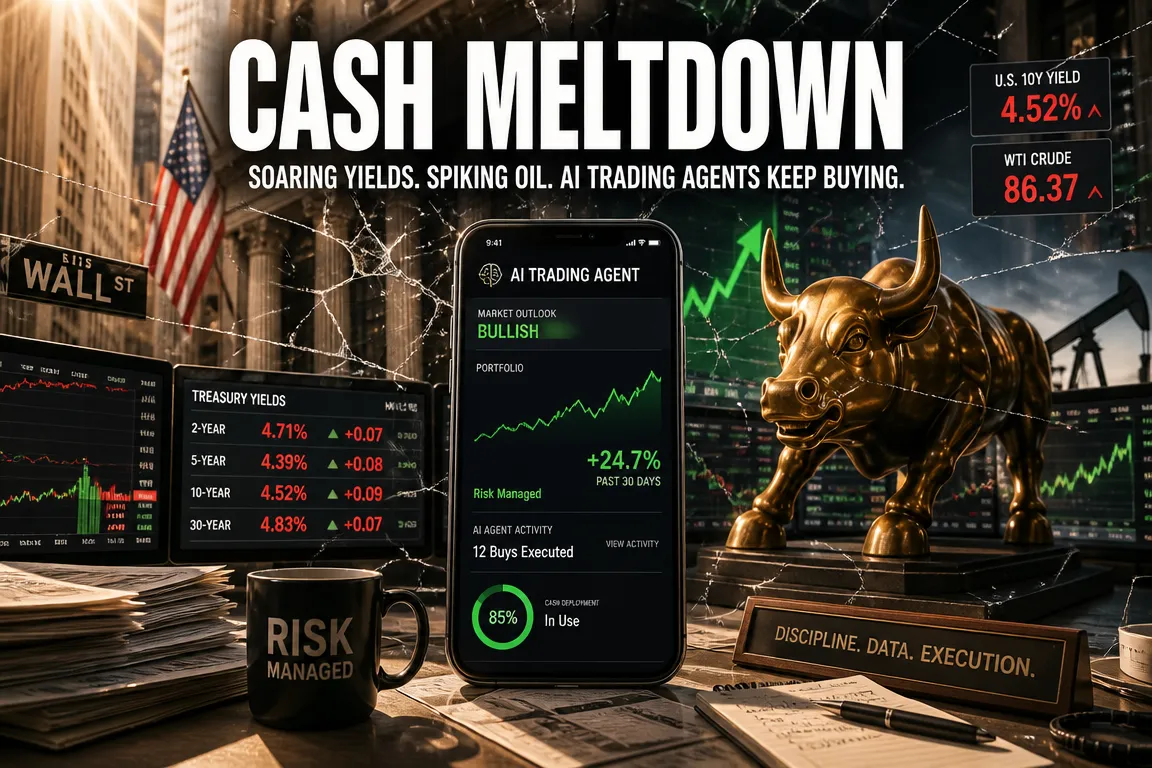
Equities generally respond positively when easing expectations rise; a hawkish read can increase volatility, especially in rate-sensitive growth segments. Large-cap technology and AI-related names remain particularly sensitive to changes in discount rates. Even with strong AI fundamentals, higher rates can pressure valuations.
4-2. US Treasury Yields
Rates markets are likely to reflect the most direct read-through. If the Fed is perceived as delaying cuts, front-end yields may remain elevated. Long-end yields may fluctuate based on the balance between growth and inflation expectations. The relative moves in the 2-year versus 10-year segment remain a key signal.
4-3. The Dollar and FX
The dollar tends to strengthen when the Fed is expected to keep rates higher for longer than peer central banks. This can pressure USD/KRW. For Korea-based investors, the policy rate itself is less important than the resulting dollar strength and its impact on cross-border flows.
5. Implications for Korea: KOSPI, KRW, and Exporters
The meeting has direct channels into Korean assets through FX, foreign flows, and sector rotation.
5-1. KOSPI and Foreign Flows
If US easing expectations are pushed out, foreign allocations to emerging markets may become more selective. KOSPI performance may therefore become more dispersed, favoring sectors with clear earnings support.
5-2. Semiconductors and AI Infrastructure Beneficiaries
Semiconductors remain the central pillar of the Korean equity market. AI servers, high-bandwidth memory, and data-center capex are structurally supportive over the medium term. Near term, however, US rate and FX dynamics can increase volatility.
The regime is characterized by simultaneous macro headwinds and strong AI-driven growth, requiring integrated positioning rather than single-factor views.
5-3. KRW Weakness and Exporters
KRW depreciation can benefit exporters, but may also coincide with weaker foreign risk appetite and capital outflow concerns. FX should be treated as a proxy for liquidity and risk sentiment, not only a level.
6. The Most Important Points Often Underappreciated
Headline coverage tends to focus on “hold vs cut” and isolated Powell quotes. The more relevant signals are structural.
6-1. The Fed Is Managing Market Conditions
The Fed is not only responding to inflation data; it is also countering markets that price in easier conditions too early. Rising equities, tightening credit spreads, and looser financial conditions can dilute restrictive policy.
Powell’s caution therefore functions as policy communication designed to prevent premature celebration.
6-2. The Inflation Challenge Is the Final Mile
The key risk is not the initial decline from peak inflation, but the final move from approximately 3% toward 2%. This phase can take longer due to sticky services, wages, and housing-related components.
This “last mile” risk is frequently underweighted in market pricing.
6-3. AI Capex Can Influence the Rate Path
AI investment expansion can sustain capex and data-center buildouts among large technology firms, partially offsetting cyclical slowing. If productivity expectations and capex keep growth more resilient than forecast, the case for earlier Fed cuts weakens.
AI is therefore increasingly relevant not only as an equity theme but as a macro variable affecting growth and policy.
6-4. Liquidity Direction Matters More Than the Policy Rate
Asset prices often respond more to liquidity conditions than to the policy-rate level alone. Fed communication, Treasury issuance, cash management, bank lending posture, and corporate financing conditions jointly define the market environment.
A practical framework is to focus less on predicting the number of cuts and more on whether liquidity conditions are tightening or easing.
7. Key Data to Monitor Going Forward
Post-meeting, markets are likely to become more data-sensitive. Key releases include:
- US CPI
- US PCE inflation
- Nonfarm payrolls
- Unemployment rate and wage growth
- Retail sales and manufacturing indicators
- Housing-related inflation and services inflation subcomponents
If these indicators do not align, volatility may persist.
8. Investor Action Points
A balanced approach is required; both unconditional optimism and blanket recession positioning carry risk. Integrate Fed policy, earnings quality, AI growth, and FX.
8-1. US Equity Investors
Large-cap technology and AI-linked equities retain strong medium-term fundamentals. However, given rate sensitivity, short-term drawdowns are plausible. Prefer companies with durable earnings and strong free-cash-flow profiles.
8-2. Korean Equity Investors
Within KOSPI, dispersion may continue between semiconductors, export-oriented large caps, FX-beneficiaries, and domestic-demand cyclicals. During foreign-flow volatility, sector selection may matter more than index direction.
8-3. USD and Fixed-Income Investors
If the Fed holds restrictive policy longer than markets expect, dollar strength and rate volatility may persist. In fixed income, avoid over-reliance on rate-cut timing; prioritize confirmation that disinflation is durable.
9. News-Style Summary
Fed maintains a cautious stance at the April 2026 FOMC.
Clear near-term rate-cut guidance was avoided.
Powell emphasizes insufficient confidence in inflation stabilization.
Disinflation is progressing, but not at a level that warrants a decisive pivot.
Resilient labor market limits the case for early easing.
Policy is not positioned to shift rapidly absent clearer weakening.
US equities and rates may reprice the path of policy.
AI-linked megacaps and curve dynamics remain key variables.
Korean assets are within the transmission channel.
KOSPI, USD/KRW, foreign flows, and semiconductors may be affected in sequence.
10. Conclusion: Focus Less on “When Cuts Start” and More on “Why Cuts Are Hard”
This FOMC appeared orderly on the surface but carried meaningful implications. The Fed recognizes slowing risks, yet views the final phase of disinflation as difficult and therefore avoids committing to a quick shift. Combined with AI-driven capex support, US economic resilience, potential dollar strength, and shifting global flows, H2 market conditions may not be explained by rate-cut expectations alone.
The central message: rate cuts remain possible, but may not arrive as quickly or as smoothly as markets anticipate.
< Summary >
The key takeaway from the April 2026 FOMC was the Fed’s cautious posture rather than the policy-rate decision itself. Powell indicated that confidence in inflation’s return to target remains insufficient, and with labor markets not weakening sharply, the case for early cuts is limited. As a result, US equities, Treasury yields, the dollar, FX, and KOSPI may be influenced by renewed repricing of the expected path. A notable additional variable is that expanding AI investment can affect US growth resilience and, by extension, the Fed’s policy trajectory. The appropriate lens is less “when rates will be cut” and more “why the Fed cannot cut easily yet.”
[Related Articles…]
- FOMC-Driven US Equity Volatility: What to Monitor Now (https://NextGenInsight.net?s=FOMC)
- AI Investment Cycle and the Semiconductor Supercycle: Korea Market Beneficiaries (https://NextGenInsight.net?s=AI)
*Source: [ Maeil Business Newspaper ]
– [LIVE] 4월 FOMC 성명서 해설 l 파월 마지막 기자회견