● Fed-Locked, Oil-Shock, Middle-East-Crisis
The Federal Reserve’s Core Constraint on Further Rate Hikes: Middle East Conflict, Crude Oil, and U.S. Treasuries in One Framework
This issue should not be reduced to “oil rose because of the Middle East conflict.” The market-relevant points are:
1) Whether higher crude prices are inflationary enough to warrant additional Fed tightening.
2) Why the market initially pushed the U.S. 10-year yield higher on fear, then retraced.
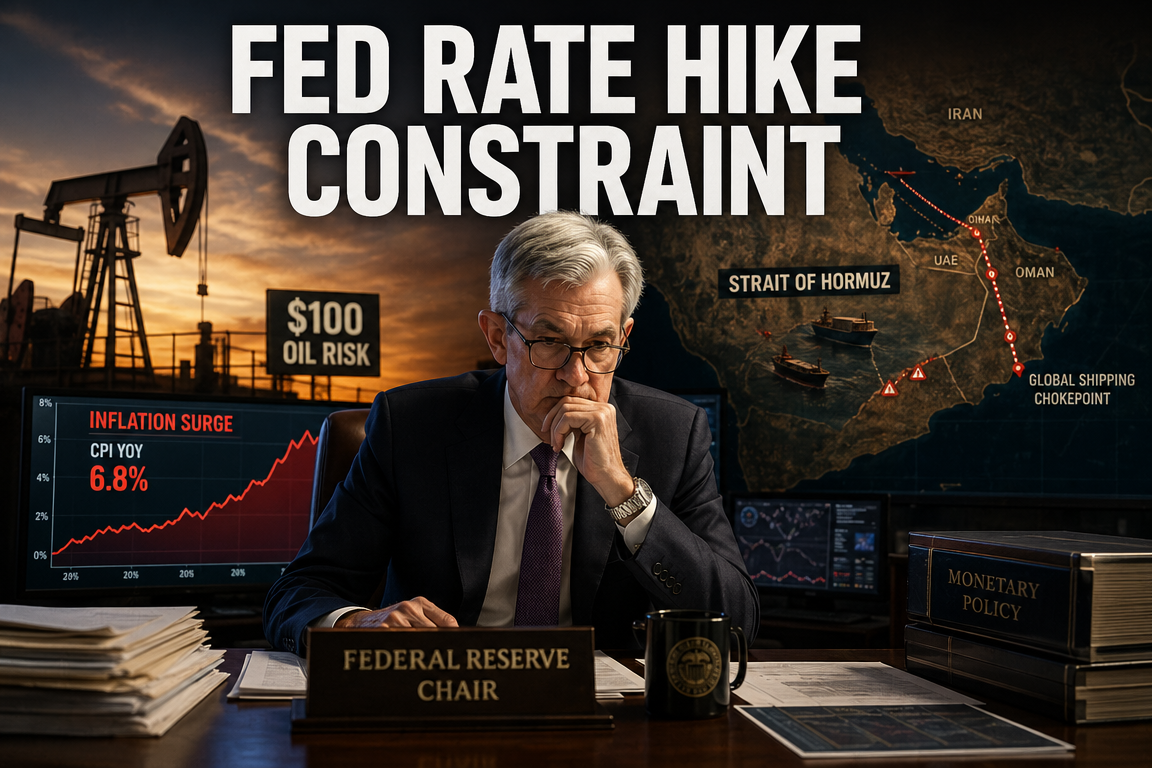
3) If the Strait of Hormuz risk persists, downside growth and global financial-market stress may outweigh inflation concerns.
This note outlines why the Fed is constrained from hiking aggressively, the distinction between headline inflation and long-term inflation expectations, interpretation of the Treasury market, and the key risk the market may be underweighting.
1. Key question: Does rising oil trigger an immediate Fed rate hike?
Conclusion: A crude-oil spike alone is unlikely to prompt an immediate Fed rate hike.
Escalation can raise crude prices, lifting gasoline, transport, and input costs and pressuring CPI. However, the Fed is not primarily reacting to a one-month headline surge. The policy focus is long-term inflation expectations: whether the shock is temporary (supply-driven) or becomes embedded through expectations and behavior.
2. Core distinction: Short-term inflation vs. long-term inflation expectations
Oil typically raises near-term inflation via broad pass-through (refining, airlines, chemicals, plastics, coatings, logistics). Central banks then assess whether the increase is transitory or persistent.
Current market framing is broadly:
- Headline inflation can rise in the near term.
- Long-term inflation expectations remain relatively anchored.
- Immediate incremental tightening may not be required.
The present move appears closer to a supply shock than demand-led overheating. Supply shocks are often difficult to offset with policy rates; further hikes can depress demand and accelerate labor-market and cyclical cooling.
3. The Fed’s practical constraint: Policy is already restrictive
U.S. policy rates are already at restrictive levels, implying meaningful cumulative tightening. Additional hikes in response to a temporary oil-driven inflation impulse carry material downside risk.
The trade-off is not inflation alone; labor-market and growth risks matter. While equity performance can obscure conditions, parts of the real economy have been gradually cooling under sustained high rates. The cycle is increasingly characterized as late-cycle rather than early expansion.
If oil rises, it can lift prices while simultaneously tightening financial conditions for consumers and firms, increasing recession risk. This shifts the Fed’s primary concern toward avoiding over-tightening.
4. Market sequence observed after the conflict: A news-style timeline
4-1. Phase 1: War-risk premium lifts crude and Treasury yields
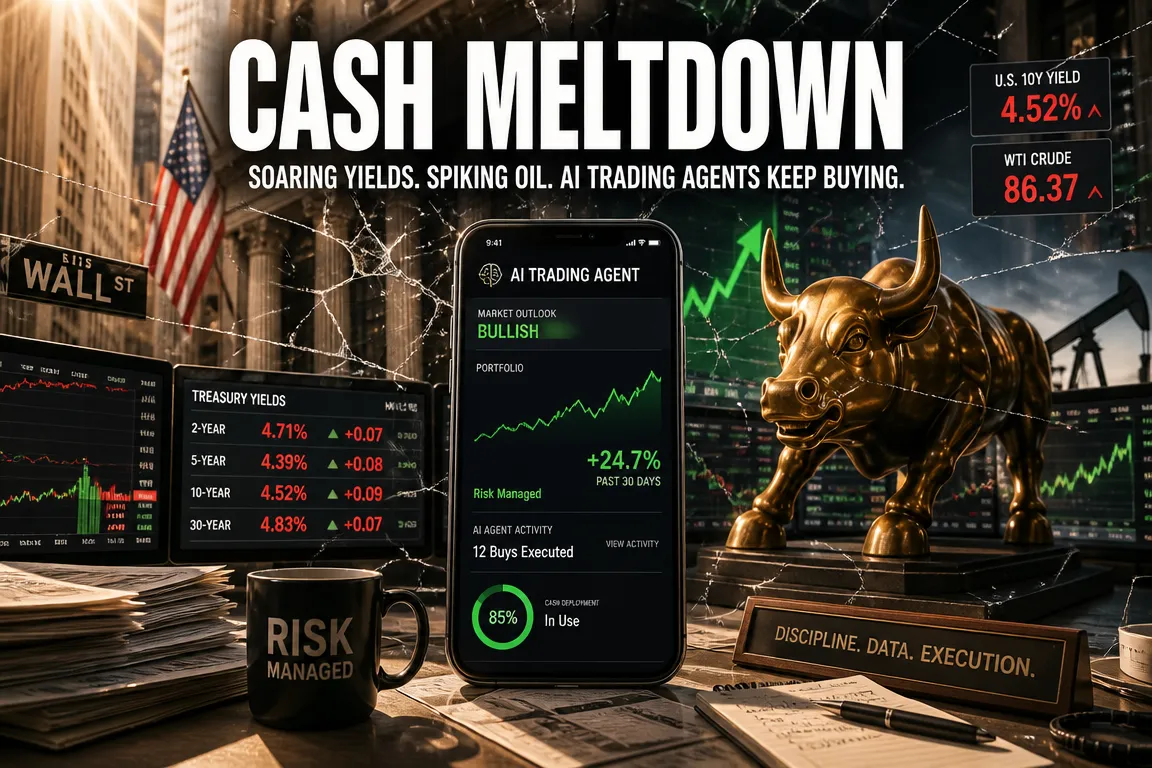
At the onset, markets price worst-case scenarios: potential Strait of Hormuz disruption, crude spikes, renewed inflation pressure, and reduced probability of rate cuts. The U.S. 10-year yield can rise quickly as investors price fewer cuts or, in extreme interpretations, potential additional hikes.
4-2. Phase 2: After peak fear, yields retrace
As fear peaks, expectations begin shifting toward de-escalation, reduced disruption risk, or normalization of supply. Crude stabilizes and Treasury yields come off highs.
The initial yield spike is better explained as a rapid repricing of “fewer/ later cuts” rather than confirmed structural inflation.
4-3. Phase 3: Market shifts from “hikes” to “higher-for-longer”
Current pricing appears to emphasize prolonged policy restrictiveness (rate cuts delayed) rather than imminent hikes. This distinction matters because a more hawkish path has already been partially priced.
5. Why stagflation risk may be overstated
Stagflation combines slowing growth with elevated inflation. Geopolitical oil shocks can raise that risk, but duration is decisive.
Key points:
- Oil-driven inflation is plausible in the near term.
- If long-term expectations remain anchored, policy implications are limited.
- If disruption persists, recession pressure may become the dominant risk.
Over time, the narrative can shift from “oil spike implies more tightening” to “oil spike implies demand destruction, corporate margin pressure, and higher recession probability.”
6. The Strait of Hormuz as the primary variable: Potential recession trigger
The critical sensitivity is the duration of any disruption. Short-lived shocks can be absorbed. A multi-month constraint can strain inventories, logistics, and industrial costs, transmitting more directly into real activity.
Beyond a threshold, markets may pivot from inflation concerns to global recession risk. Under that regime, the Fed may ultimately need to consider stabilization rather than incremental tightening.
7. Treasury-market interpretation clarifies the regime
The U.S. 10-year yield reflects expected policy-rate paths and growth/inflation risk premia. The post-conflict yield rise was consistent with repricing fewer cuts. Subsequent stabilization suggests the market is reassessing the shock as potentially non-structural with expectations still anchored.
For fixed-income positioning, headline inflation should be assessed alongside long-term expectations, real yields, and growth deceleration signals.
8. Why non-U.S. central banks may react differently
Policy responses will diverge across countries. Economies that have already cut substantially, or maintain lower rate levels, may be more sensitive to renewed inflation prints. The U.S. has more restrictive-policy “buffer,” while lower-rate jurisdictions may face greater constraint even at moderate inflation.
A uniform global shift back to hiking is not assured; domestic policy starting points will matter more.
9. The most frequently missed points in mainstream coverage
Typical coverage stops at:
- Middle East conflict raises crude
- Crude raises inflation risk
- Inflation risk implies potential Fed hikes
Key additions:
9-1. The Fed prioritizes expectations over monthly prints
Short-term CPI/PCE volatility is less decisive than whether households, firms, and markets re-anchor to higher future inflation.
9-2. The longer oil stays high, the more the logic shifts toward recession
Persistent high energy prices can depress demand and activity, weakening the case for additional hikes.
9-3. Markets price inflection points faster than events
Asset prices often reflect the peak of fear and the transition in expectations rather than the event itself. Peaks in crude and yields and troughs in equities can cluster temporally.
9-4. The Fed is managing policy-error risk
Overreacting to a supply shock risks unnecessary damage to an already cooling labor market and real economy. The Fed must balance the risk of acting too late with the risk of overtightening.
10. Practical monitoring checklist
10-1. Inflation trajectory
Track the magnitude of energy pass-through in upcoming releases, alongside core inflation, services inflation, and inflation-expectations measures.
10-2. Labor-market cooling
Employment data are central to assessing how constrained the Fed is. A weakening labor market narrows tightening capacity.
10-3. Duration of Strait of Hormuz and geopolitical risk
Duration, not headlines, determines whether the shock remains transitory or becomes a recessionary impulse.
10-4. Direction and drivers of the U.S. 10-year yield
Focus not only on level changes but also on whether moves are driven by policy-path repricing, inflation risk premia, or growth concerns.
10-5. Equity–commodity co-movement
If equities remain resilient despite higher oil, markets may view the shock as temporary. Broad risk-asset drawdowns alongside rising oil would indicate a shift toward growth-shock interpretation.
11. One-sentence summary
The Fed is constrained from hiking because the oil-driven shock is more consistent with a temporary supply impulse than an unanchoring of long-term inflation expectations, and because policy is already restrictive in a late-cycle environment where additional tightening could amplify labor-market and growth damage.
< Summary >
Geopolitical risk and potential Strait of Hormuz disruption can lift crude and near-term inflation. The Fed focuses more on long-term inflation expectations than short-term headline prints. With the shock appearing supply-driven and expectations still relatively anchored, immediate additional hikes are less likely. If elevated oil prices persist, recession risk may dominate inflation risk. Markets currently price “higher-for-longer” more than renewed hikes, and the Treasury market reflects that transition.
[Related]
- Key summary of Fed rate expectations and U.S. Treasury dynamics: https://NextGenInsight.net?s=Fed
- Global economic outlook and industry restructuring in the AI era: https://NextGenInsight.net?s=AI
*Source: [ 경제 읽어주는 남자(김광석TV) ]
– 연준이 지금 금리를 못 올리는 진짜 이유 | 경읽남과 토론합시다 | 마경환 대표 [1편]
● Oil-Shock-Recession-Risk
Why Sustained $100 Oil for Even a Few Months Is Risky: The Real Driver That Can Disrupt the 2026 Global Economy and Equity Markets
Markets appear resilient on the surface. Equities are holding up, and large-cap AI-related stocks remain strong. However, a more consequential risk is building beneath the headline performance: the potential for crude oil to break above $100 and remain elevated.
This report explains, beyond the simplified “higher oil raises inflation” narrative, how sustained high oil prices can transmit through inflation, interest rates, FX, global supply chains, and equities in a reinforcing sequence. It also addresses commonly underexplained issues: why oil prices may not normalize quickly even if hostilities de-escalate, why oil production cannot be restarted like turning on a tap, and why Asia may absorb the shock earlier and more materially.
If oil holds near or above $100 for multiple months, it becomes a macro regime variable that could force revisions to global growth and policy assumptions into 2H26. In such a regime, investors should assess the interaction between the AI rally, cyclicals, consumer sectors, energy/refining, commodities, rates, and USD strength.
1. Why $100 Oil Is an Uncomfortable Threshold for Markets
A move above $100 is not treated as a routine price increase. Over the past two decades, sustained periods above $100 have been infrequent and often associated with materially higher equity volatility.
Episodes such as 2008, 2011, and 2022 illustrate that sharp oil increases can impose significant stress on both financial markets and the real economy, frequently followed by meaningful equity drawdowns.
$100 oil does not mechanically imply an equity collapse. Certain segments (e.g., AI, semiconductors, defense, and parts of energy) can show relative strength. However, at the broad market level, sustained high oil has generally been a negative signal.
2. Why High Oil Is Systemically Risky: Broad and Deep Inflation Transmission
Oil is not limited to retail gasoline. It is a core input across the economy and can raise the cost base simultaneously across many sectors.
2-1. Energy Prices Are an Input Cost Across Most Industries
Oil links to transportation and logistics costs, heating, petrochemical feedstocks, plastics, packaging, jet fuel, shipping rates, and manufacturing input costs. A sustained rise therefore pressures economy-wide costs rather than isolated categories.
Food prices are also tightly linked through fertilizer, agricultural fuel, transportation, cold-chain distribution, and packaging. High oil can therefore propagate into food inflation.
2-2. Persistent CPI Pressure Forces Central Banks to React via Rates
Even when inflation originates from a supply shock, persistent CPI acceleration reduces central banks’ ability to characterize inflation as transitory. This can delay rate cuts and, in more adverse cases, reintroduce the possibility of additional tightening.
For markets, the key mechanism is discount-rate sensitivity. Even if AI growth remains strong, higher yields can compress valuations. A rebound in long-end rates can cap multiple expansion in technology and other long-duration assets.
3. The Critical Structural Point: Oilfields Cannot Be Stopped and Restarted Seamlessly
A frequent market assumption is that production will rapidly normalize once geopolitical events fade. Operationally, oil production is not easily reversible.
3-1. Reservoir Pressure Maintenance Is Central to Stable Production
Some major fields require continuous pressure support (e.g., gas injection) to sustain output. If production is interrupted by conflict, strikes, export blockages, or storage constraints, pressure-management systems can be disrupted and the reservoir can be impaired.
3-2. Water Influx and Water Coning Can Be Difficult to Reverse
Pressure imbalance during prolonged shutdowns can increase the risk of water intrusion. Once water coning occurs, recoverable barrels may decline economically even if hydrocarbons remain in place. This can reduce long-term productive capacity, extending supply tightness beyond the immediate event.
3-3. Paraffin Wax and Asphaltene Deposition Can Block Production Tubing
Extended shut-ins can lead to deposition and blockages in wellbore tubing and flowlines. Restart costs rise, restoration takes longer, and output efficiency can decline. Producing the same volumes may require materially higher time and capital.
3-4. Storage Saturation Can Force Production Curtailments
Continuing production is not feasible when storage is constrained. Crude cannot be disposed of without significant environmental, regulatory, and cost implications. Storage limitations can therefore force shutdowns, increasing the probability of operational damage and slow recovery.
4. Why Supply May Not Recover Quickly Even After De-escalation
Oil prices can react immediately to headlines, but physical supply recovery is slower and subject to infrastructure and reservoir constraints.
4-1. Damage to Gas/Oil Facilities Can Disrupt Wider Pressure Systems
A strike on a single facility can affect surrounding wells and shared pressure-management infrastructure, creating broader-than-expected production impacts. Even if a restart is announced, restoring prior capacity can take substantial time.
4-2. Industry Research Suggests Even Brief Interruptions Can Cause Large Losses
Published industry findings indicate that interruptions lasting days to weeks can reduce output by approximately 20–30%. If interruptions extend for months, markets may price not only temporary curtailments but also partial, longer-lived capacity impairment. This dynamic raises the effective price floor.
4-3. Ceasefire and Price Normalization Are Not Equivalent
A ceasefire can trigger a relief rally in risk assets, but physical supply may already be compromised. Oil may fall from a spike yet remain structurally elevated, potentially sustaining an $80–$100 range rather than reverting quickly to $50–$60.
5. How Large a Shortfall Matters: Why Markets React Disproportionately
The oil market is highly sensitive to marginal imbalances. Historically, disruptions of roughly 1 million barrels per day have moved prices materially.
Under scenarios involving reservoir damage, chokepoint disruptions, or regional blockades, the potential loss could be materially larger (e.g., 4–6 million barrels per day in severe cases). If such magnitudes emerge, the shock moves beyond a short-term spike and toward a structural rebalancing of the global energy system.
6. Why Asia May Absorb the Shock First and Most Severely
From a regional perspective, Asia is a primary risk zone, particularly economies with high import dependence.
6-1. Asia Has High Dependence on Middle Eastern Crude
If Middle East supply is disrupted, Asia typically enters replacement procurement competition sooner than the US or Europe. Strategic reserves can buffer initially, but spot and term markets can tighten rapidly thereafter.
6-2. Asian Refiners Pulling Barrels from Europe/North America Can Lift Global Prices
If Asia begins sourcing incremental volumes from Europe and North America, a regional shortfall can become a global bidding dynamic. The result can be higher regional premiums that transmit into benchmark prices.
In tighter conditions, procurement can resemble “price-insensitive” buying to maintain refinery utilization, reinforcing upward price pressure.
6-3. Why This Is Particularly Material for South Korea
South Korea’s high energy import reliance and industry mix (manufacturing, petrochemicals, refining, shipping, aviation, autos) increase sensitivity to oil shocks.
Sustained high oil can pressure margins, worsen trade balances, weaken consumption, and contribute to currency depreciation and imported inflation.
FX interaction is critical. If USD strength coincides with higher oil, the local-currency cost of imports rises further for oil-importing economies.
7. Macro Scenario Pathways Under an Oil Shock
Assuming prolonged conflict and persistent supply disruption, a four-stage framework is useful.
7-1. Stage 1: Markets Hold Until Inventories Decline
Strategic and commercial inventories absorb the initial shock. Equities may appear resilient, supported by AI capex, large-cap earnings, and liquidity expectations.
7-2. Stage 2: Inventory Drawdown and Spot Procurement Competition
As inventories fall, refiners and traders bid up replacement cargoes. Asian spot premiums rise. Regions with strong crack spreads may sustain operations, while those facing feedstock constraints may see utilization pressure.
7-3. Stage 3: High Prices Begin to Destroy Demand
Sustained high prices can reduce driving and air travel demand, weaken petrochemical demand, and compress consumption. Firms with limited pricing power and intermediaries tend to weaken first. The terminal outcome of persistent oil inflation is typically growth deceleration.
7-4. Stage 4: Oil Peaks as Recession Risk Becomes Visible
Oil often peaks when demand destruction becomes pronounced. However, by that point, macro activity and earnings may already be materially impaired. For allocation, the key question is not whether oil eventually falls, but which assets break first under tightening financial conditions.
8. Equity Market Implications
8-1. Broad Market Headwind, Greater Sector Dispersion
High oil typically pressures equities via higher inflation expectations, delayed rate cuts, weaker consumption, and margin compression. Sector outcomes diverge materially.
- Potential relative beneficiaries: energy, select refiners, select shipping phases, defense, alternative energy, power infrastructure
- Potential underperformers: airlines, transport, chemicals, consumer, parts of autos, domestic sectors with limited pass-through
- Mixed impact: semiconductors, AI infrastructure, big tech may hold if earnings remain strong, but valuation sensitivity increases
8-2. AI Strength and High Oil Can Coexist
High oil does not necessarily trigger immediate broad selloffs. In prior energy shock periods, certain technology segments held up. Currently, AI infrastructure, data centers, semiconductors, grid equipment, and automation may retain structural demand.
However, if $100 oil persists, higher electricity, logistics, construction, and capital costs can eventually pressure the AI value chain.
8-3. The Key Risk Is a Halt in Multiple Expansion
Even with strong earnings, higher yields can constrain equity upside. Nasdaq and other growth segments remain highly sensitive to liquidity and long-end rates.
In a high-oil regime, entry price and valuation discipline become more important than thematic exposure. Differentiation increases between overcrowded, high-multiple names and segments with stronger earnings visibility (infrastructure, power, software).
9. Structural Shifts to Monitor Through the Lens of AI and Industrial Transformation
9-1. High Oil Can Re-accelerate EV Transition Narratives
If oil tightness persists structurally, EVs, batteries, and charging infrastructure can regain support. However, EV adoption also depends on rates, subsidies, and consumer confidence.
9-2. Tailwinds for Solar/Wind/Nuclear/Grid Investment
Energy security can shift policy from pure decarbonization toward supply resilience. This can support multi-year capex in renewables, nuclear, storage, and transmission/distribution.
This is not solely a thematic trade; it can redirect industrial policy and capital allocation over several years.
9-3. AI and Energy Are Now Interdependent
AI compute demand translates directly into power demand. Rising power costs can affect data center economics and investment prioritization.
AI analysis should incorporate power procurement, efficiency, cooling technology, and grid buildout alongside chip performance.
10. Key Points Often Underemphasized in Mainstream Coverage
10-1. The Core Issue Is Not Headlines, but Potential Permanent Capacity Impairment
Markets focus on ceasefires and retaliatory actions. The more durable risk is physical: pressure-system failures, reservoir damage, flowline blockages, and storage constraints. If realized, supply does not normalize quickly even after geopolitical de-escalation.
10-2. The Main Market Risk Is Not Inflation Itself, but the Collapse of Rate-Cut Expectations
Equities react more to the rate path than to inflation prints in isolation. Persistent high oil can delay easing, lift long-end yields, and pressure risk assets broadly.
10-3. Asia Likely Feels the Shock Early
High Middle East dependence, import-heavy structures, and manufacturing-centric economies can translate supply disruption into rapid inventory drawdowns and aggressive spot procurement. For South Korea, this directly affects earnings, FX, imported inflation, and competitiveness.
10-4. An AI Bull Market Does Not Eliminate Macro Constraints
AI leadership can dominate market narratives, but sustained high oil influences the AI ecosystem through power costs, capital costs, inflation expectations, and long-end rates. A balanced framework is required.
11. Practical Monitoring Framework for Individual Investors
11-1. Focus on Duration, Not the Initial Break Above $100
A brief spike can be event-driven. Sustained levels over weeks to months are more consistent with structural stress.
11-2. Indicators to Track Alongside Oil
- US CPI and inflation expectations
- US 10-year Treasury yield
- DXY and USD/KRW
- Refining margins and freight rates
- Asian crude inventories and strategic reserve policies
- Export and shipment data rather than headline geopolitical news
11-3. Portfolio Construction: Diversification Over Single-Theme Concentration
In this regime, concentrated exposure to AI growth increases sensitivity to rates and volatility. Balanced exposure across energy, power infrastructure, cash-flow-stable sectors, select commodities, and defensives can improve robustness.
As volatility rises, position survivability becomes as important as asset quality.
12. Core Question for Markets
The key question is whether the oil shock is a short-lived headline event or the start of structural supply impairment.
If it is temporary, risk assets can extend relief rallies, and AI/semiconductor/mega-cap leadership can persist. If structural impairment emerges, 2026 macro assumptions may shift toward re-accelerating inflation, sticky policy rates, Asia-led supply stress, weaker consumption, and sharply polarized sector performance.
Oil should be treated as a macro thermometer and an implicit risk premium for equities. For South Korea-focused investors, oil, USD, rates, AI, and the export cycle should be analyzed as a single integrated system.
< Summary >
Sustained $100 oil is not merely an energy price issue. It can propagate into inflation re-acceleration, delayed rate cuts, FX pressure, Asia-centric supply stress, and higher equity volatility.
The central risk is not the geopolitical event itself, but physical impairment: reservoir pressure disruption, storage constraints, and capacity loss. Under such conditions, oil may not normalize quickly even after de-escalation.
Asia, including South Korea, is more exposed due to import dependence and industrial structure. Equities face a broad headwind, but dispersion increases; AI, energy, and power infrastructure can differentiate.
A 2026 investment framework should integrate oil, rates, FX, and supply chains alongside AI rather than treating AI as a standalone driver.
[Related Articles…]
- https://NextGenInsight.net?s=oil
- https://NextGenInsight.net?s=AI
*Source: [ Jun’s economy lab ]
– 수개월 이상 유가 100달러 넘기면 안 되는 이유