● Tesla-Robotaxi-Boost,Hw3-Revolt,400-Setup
Tesla Robotaxi Night Operations and HW3 Backlash: The Market’s Core Focus Is Elsewhere
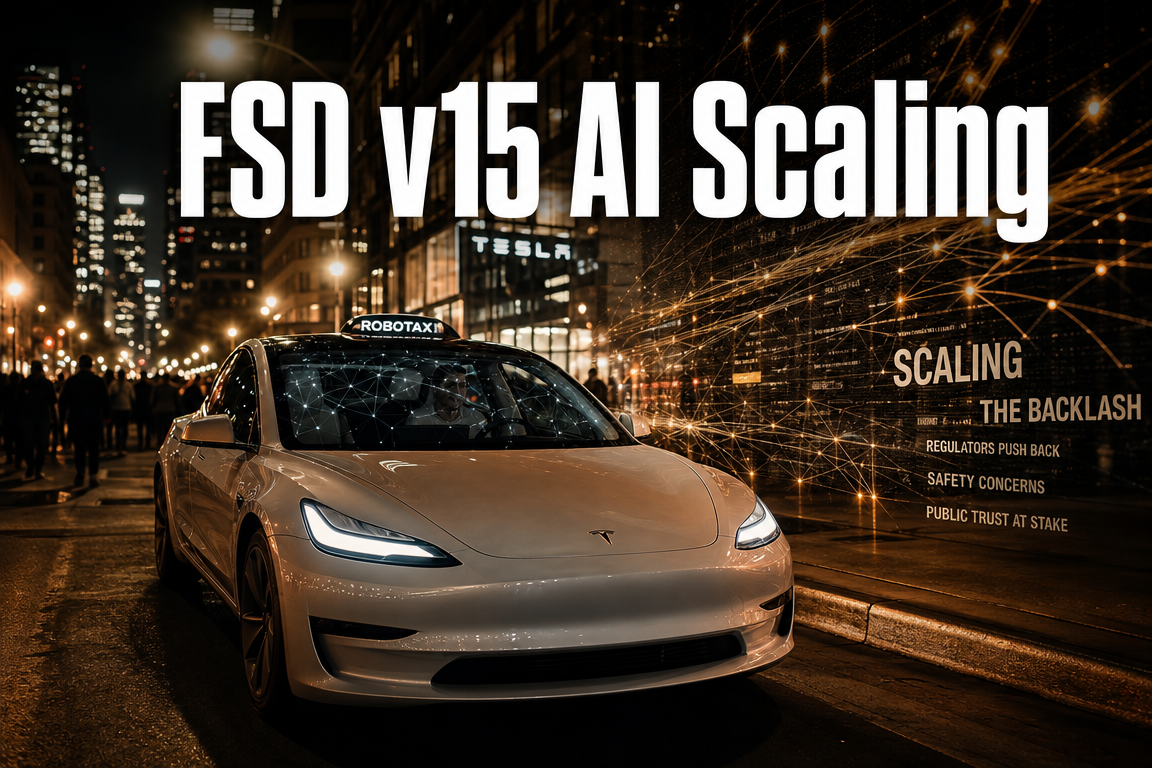
Two same-day developments materially affected investor sentiment toward Tesla and the broader autonomous driving landscape: (1) the launch of nighttime robotaxi operations in Austin, and (2) a collective backlash by 5,700 HW3 owners in Europe.
While the headlines appear offsetting, together they signal a potential inflection point for Tesla’s business trajectory, AI strategy, legal exposure, and equity narrative. The key question is whether Tesla breached prior commitments or shifted its technical strategy toward AI-driven scaling, and how the company will manage the resulting trust and liability considerations.
1. The Two Most Market-Relevant Developments
1-1. Tesla robotaxis begin nighttime operations in Austin
Tesla has expanded unsupervised robotaxi operations from daytime into nighttime conditions.
Night driving materially increases autonomy difficulty due to low illumination, headlight glare, shadow distortion, pedestrian detection complexity, traffic-signal recognition stability, and lane-marking ambiguity.
Given Tesla’s camera-first approach (rather than LiDAR-centric sensing), the move implies internal confidence that vision-based neural network performance has reached a threshold deemed operationally acceptable under reduced-light conditions.
1-2. Collective backlash by 5,700 HW3 owners in Europe
Approximately 5,700 HW3 vehicle owners in Europe are organizing collective action.
The dispute centers on Tesla’s 2019 positioning that HW3 vehicles contained the necessary hardware for full self-driving capability, which influenced FSD purchases. Subsequent signaling that unsupervised full autonomy may not be feasible on HW3 has raised questions over product representation, consumer expectations, and potential legal exposure.
This is not limited to routine customer complaints; it may affect regulatory scrutiny and long-term customer trust in autonomy-related offerings.
2. News Brief: Key Points at a Glance
- Tesla shares closed at $392.51, increasing near-term focus on a potential $400 level
- Austin robotaxi operations expanded from daytime to nighttime
- Unsupervised fleet across Austin, Dallas, and Houston: approximately 36 vehicles
- More than 5,700 HW3 owners in Europe are pursuing collective response measures
- Core dispute: FSD commitment breach vs technical strategy evolution
- Some reduction in legal overhang related to SEC and Elon Musk
- Technical positioning suggests potential golden cross, supporting short-term momentum sentiment
3. Why Nighttime Robotaxi Operations Matter
3-1. Night conditions function as an operational stress test
Daytime driving generally offers higher-quality sensor inputs and easier object recognition. Night operations expose failure modes more quickly.
Expansion into nighttime operation indicates an effort to broaden real-world operating conditions, suggesting movement from demonstration toward early operational scaling.
3-2. Camera-first vs LiDAR-first approaches return to focus
Waymo is widely associated with a LiDAR-first stack, which generally supports strong depth estimation in low light and robust 3D perception. Trade-offs include higher sensor cost and scaling constraints, and often higher HD-map dependence, which can slow geographic expansion.
Tesla’s approach relies primarily on cameras and neural networks. If successful, this architecture can provide cost advantages and faster global scaling. Night operations directly address a key critique of camera-first systems: reduced robustness in low-light environments.
3-3. Fleet growth rate may be more important than absolute count
The fleet size remains small, but the expansion across multiple cities and the extension into nighttime operations is directionally significant.
The relevant indicator is the slope of deployment: adding cities and extending operating hours simultaneously implies increasing operational confidence. This underpins expectations that deployments could expand meaningfully if the pace is sustained.
4. Why FSD Version 15 Is a Key Variable
4-1. Current deployment may prioritize data accumulation over revenue
Limited deployment can be interpreted as a learning phase rather than full commercialization. References to improved software in the pipeline have led markets to treat FSD v15 as a potential enabling release for broader scaling.
This phase likely emphasizes accumulating edge-case data across city-specific scenarios, nighttime conditions, and irregular traffic patterns to support the next performance step.
4-2. Investors should prioritize operating conditions over vehicle count
The critical metric is not only how many vehicles operate, but under what conditions:
- Daytime only vs nighttime capability
- Fair weather only vs adverse-weather robustness
- Single-city vs multi-city operation
- Map-dependent operation vs generalization across new areas
Under this framework, the move into nighttime operations is a material milestone.
5. Why the HW3 Backlash May Be More Material Than It Appears
5-1. This is a trust and contract-equivalent issue
Tesla’s autonomy strategy depends heavily on customer trust. Early HW3 buyers represent a high-conviction cohort that purchased FSD based on stated assumptions.
If this group perceives inadequate remediation, the impact may extend beyond refunds or upgrades into a persistent trust discount affecting future software and service monetization.
5-2. The issue resembles a paradigm shift more than a simple dispute
From a technical standpoint, HW3 may have been viewed as sufficient under earlier assumptions. As Tesla shifted toward larger-scale, learning-driven architectures, compute and memory requirements likely increased.
Both statements can be simultaneously true:
- Consumers may view this as a material change in promised capability
- Technically, it can be framed as realism imposed by an evolving autonomy stack
The market impact depends on Tesla’s remediation strategy and external interpretation by regulators and courts.
5-3. Potential response paths
Three broad approaches are plausible:
- Provide a lightweight FSD variant for HW3
- Offer HW4 retrofit support
- Provide price compensation and/or subscription concessions
A near-term response could be a constrained HW3 FSD experience. However, it may not satisfy customers who expected full parity. Hardware retrofits are operationally and financially complex, making partial compensation packages (credits, discounted upgrades, subscription adjustments) a likely component of any settlement approach.
6. SEC Context: Why It Matters
6-1. Partial reduction in Musk-related legal overhang
Reports indicate SEC-related issues involving Elon Musk were resolved at a relatively limited penalty level. Markets typically treat reductions in CEO-linked legal uncertainty as supportive, given Tesla’s valuation sensitivity to leadership and execution narratives.
6-2. Regulatory environment remains a gating factor
Commercial autonomy depends on more than technical progress: approvals, liability standards, state-by-state operating permissions, insurance structures, and potential federal frameworks.
Investors should monitor regulatory developments alongside earnings releases.
7. Equity Implications: Prospects Around the $400 Level
7-1. Technical setup is constructive
Markets are monitoring a potential crossover of shorter and longer moving averages (a “golden cross”), which can reinforce momentum positioning.
After moving through prior trading ranges, the stock is now near a psychologically significant resistance area. A $400 test may itself become a catalyst for short-term trading flows.
7-2. Fundamentals dominate beyond short-term price action
Chart momentum reflects expectations; sustained valuation requires operational proof.
Two variables are likely to matter most:
- Robotaxi scaling speed
- Whether HW3 legal risk expands beyond Europe
If the HW3 dispute broadens across regions, valuation multiples could face sustained pressure. Conversely, credible progress on operational scaling can support the AI-platform narrative.
8. The Underemphasized Core Point
8-1. The underlying issue is AI compute strategy, not vehicle hardware alone
The HW3 dispute illustrates a broader pattern: AI model evolution can outpace embedded hardware lifecycle assumptions. This dynamic is likely to recur across AI-enabled products beyond automotive.
8-2. Market perception will hinge on remediation
Tesla may be framed either as a company that failed to honor commitments or as one that successfully transitioned to a stronger AI-first architecture. The determining factor is whether customers and regulators view the response as responsible and proportional.
8-3. The two headlines reflect the same structural message
Night robotaxi operations represent accelerating capability; HW3 backlash represents the cost of accelerated capability when legacy commitments cannot be met.
Investors should evaluate not only whether autonomy improves, but whether Tesla can manage the economic, legal, and reputational costs of rapid AI-driven iteration.
9. Forward Monitoring Checklist
9-1. Near-term
- Expansion beyond Austin to additional cities
- Extension beyond nighttime into adverse weather and more complex urban domains
- Timing and scope of FSD v15
- Announcement of HW3 remediation terms
- Disclosure of robotaxi operating metrics before the July earnings period
9-2. Medium-term
- Whether the European collective action becomes formal litigation and expands
- Emergence of similar claims in the United States
- Pace of autonomy regulation changes and standard-setting
- Clarification of robotaxi monetization model
- Degree to which Tesla is re-rated as an AI platform company
10. Conclusion: Commitment Breach vs Strategic Shift
A balanced interpretation is that both elements may apply: consumers face a material change in expectations, while Tesla may have undergone a genuine technical transition that invalidated prior hardware assumptions.
The central issue is how a company allocates responsibility when innovation outpaces earlier product commitments. Near-term attention may focus on $400, but the more durable drivers are robotaxi scalability and the handling of HW3 trust and liability exposure.
< Summary >
Tesla faced simultaneous positive and negative catalysts: nighttime robotaxi operations and organized HW3 owner backlash. Night operations signal progress for vision-based autonomy; HW3 disputes highlight trust risk when AI capability requirements outgrow legacy hardware assumptions. Near-term price momentum is constructive, but medium-term valuation sensitivity will likely depend on robotaxi scaling and the scope and resolution of HW3 remediation.
[Related…]
- Tesla robotaxi scaling and autonomy monetization re-rating framework (https://NextGenInsight.net?s=Tesla)
- How AI infrastructure investment affects global equities and growth stocks (https://NextGenInsight.net?s=AI)
*Source: [ 오늘의 테슬라 뉴스 ]
– 야간 로보택시 시작된 날, 초기 구매자 5,700명이 들고 일어섰다 — 테슬라가 약속을 어긴 건가, 방향을 바꾼 건가 ?
● AI, Tesla, Energy, Boom
AI Investment Returns Surge, but a More Material Issue Is Emerging
This report focuses on points more material than a simple performance disclosure:
1) Why an investor shifted a portfolio from a 100% Tesla concentration toward AI-related equities
2) Why higher returns coincided with a more cautious risk posture
3) Where AI industry bottlenecks may persist through 2026–2027
4) Why global macro conditions and energy supply constraints may become the next investable axis
5) Why the tension between a YouTube channel’s stated philosophy and actual investment behavior offers relevant implications for retail investors
This is not a summary of “which stocks went up.” It frames how equity market expectations and fundamentals are aligning in the AI transition, and how rates, semiconductors, energy, and productivity may link into a coherent narrative.
1. Core Message: Not Performance Disclosure, but a Revision of Investment Framework
The primary message is not that “AI investments produced strong returns,” but that the investor publicly re-aligned investment principles, channel purpose, and forward portfolio intentions.
- The YouTube channel is positioned as a tool to organize investment judgments rather than a monetization vehicle
- Historically, Tesla-centric content followed from an extended period of near-100% Tesla exposure
- After rebalancing, AI exposure increased materially; future content is expected to shift toward AI companies and industry structure
- Options were used, but specific tactics will not be disclosed due to responsibility and suitability concerns
For retail investors, the relevant signal is the explicit acknowledgment of the gap that can arise between public narrative and private positioning.
2. News-Style Summary: What Changed in the Portfolio
2-1. Shift from ~100% Tesla to a 70/30 Mix with AI
The investor maintained a long-duration Tesla-concentrated strategy, then restructured the portfolio to reflect perceived AI structural opportunity and optionality around a potential SpaceX listing.
- Before: ~100% Tesla
- After: 70% Tesla, 30% non-Tesla AI-related equities
- Additional buying during a March drawdown; options used in parallel
- AI-related holdings appreciated rapidly, resulting in Tesla and non-Tesla positions becoming roughly similar in size
Implication: without aggressively selling Tesla, relative performance increased AI weight through appreciation.
2-2. Primary Exposure Targets
The stated AI exposure was organized across the value chain rather than via a single flagship name:
- Micron: beneficiary of AI memory bottlenecks
- TSMC: central node in AI chip supply chains
- Google: exposure via Anthropic ownership and broader AI ecosystem optionality
- Lemonade: expectation of AI-driven insurance automation, including potential Tesla FSD insurance linkage
- Tesla: retained as a core long-term holding framed through FSD, robotics, and AI infrastructure
Key point: the approach decomposes AI into memory, foundry capacity, model ecosystems, autonomy data, and workflow automation.
2-3. Rationale for Options Use
Options activity was described with explicit caution:
- The drawdown was viewed as an unusually favorable entry opportunity
- Options were used selectively to increase convexity in some accounts
- Tax considerations in a Canadian TFSA were cited as a factor supporting more aggressive implementation
- Options were not recommended to a broad audience due to the possibility of total loss
Investor-facing implication: high reported returns may be partially driven by leverage and payoff asymmetry not suitable for replication.
3. Why AI Exposure Increased: Assessment that Fundamentals Are Stronger Than Expected
3-1. AI as a Rare Source of Observable Productivity Gains
AI was framed as already improving knowledge-work productivity rather than remaining a distant promise:
- Automated data collection
- Automated summarization of high-signal posts on X
- Automated earnings call analysis
- Automated database construction
- Automated tracking of company statements versus execution
Macro relevance: sustained productivity improvements can influence growth expectations and the valuation regime for US equities, particularly technology.
3-2. Bottleneck Identification: Memory Demand Expansion
A central industry claim was that major hyperscalers and TSMC view memory as a binding constraint.
- Larger models increase high-bandwidth memory demand
- Data center build-outs structurally raise memory consumption
- GPU performance is necessary but insufficient; memory supply is an equivalent constraint
- Bottlenecks may persist through 2027
Market implication: focusing only on a single GPU leader risks missing bottleneck-driven profit pools across memory, foundry, networking, power, and cooling.
4. The Next Axis: Why Energy Becomes Investable
The most material forward-looking point is the designation of energy as a potential next bottleneck.
AI expansion requires data center growth, which is directly constrained by power availability and grid capacity.
4-1. Post-AI Software: Power and Physical Infrastructure
- AI servers have materially higher power draw than conventional IT loads
- Large-scale data center expansion increases stress on generation and transmission
- Demand may rise for power generation, transmission/distribution, cooling, and energy storage
- The theme extends from software into physical infrastructure capex
This is also relevant to global macro outlook: as AI capex compounds, energy and grid constraints may increasingly shape the pace of deployment.
4-2. Holding Energy ETFs Instead of Cash
The investor indicated holding energy-related ETFs as a substitute for cash.
- This is positioned not purely as defense, but as exposure to a later-stage beneficiary of the same AI-driven capex cycle
- Conceptual mapping:
- First-order: AI models, cloud, semiconductors, memory
- Second-order: data center infrastructure, power, cooling, energy
- Third-order: companies that absorb productivity improvements into earnings
5. Overheating vs. Justified Re-Rating
The investor identified the core valuation question: whether AI price action reflects justified fundamentals or excess enthusiasm.
5-1. Elements Supporting Overheating Risk
- Many AI-linked equities have risen sharply in a short period
- Expectations may be discounting future outcomes faster than near-term earnings delivery
- Options and leveraged flows can amplify volatility
- Rate-path uncertainty can pressure high-multiple growth equities
5-2. Elements Supporting Fundamental Strength
- Observable productivity adoption
- Rising hyperscaler capex
- Memory constraints reflected in operating data and pricing dynamics
- Potential multi-year infrastructure tightness through 2027
- The theme resembles industrial reconfiguration more than a transient narrative
Conclusion: fundamentals may be strong while select segments exhibit near-term over-discounting; a binary “bubble vs. not” framing is not analytically sufficient.
6. Forward Positioning: Tesla as Core, AI Expanded, Rebalance if Overextended
6-1. Tesla Long-Term Conviction Maintained
- Tesla remains the highest expected long-term return candidate in the investor’s framework
- The stated objective is to maintain Tesla share count after rebalancing
- Option gains may be used to add Tesla equity exposure
This indicates expansion into AI rather than replacement of Tesla.
6-2. AI Holdings to Be Adjusted Based on Valuation
- Recognition of potential overheating in parts of AI
- If price appreciation outpaces fundamentals, partial trimming is considered
- Proceeds could rotate toward Tesla or energy exposure
7. Content Strategy: From Single-Name Tesla to Broader AI and Industry Coverage
The investor indicated an expected shift toward broader AI and industrial coverage:
- Prior period: Tesla-centric coverage over multiple years
- Current portfolio: AI exposure has become too material to exclude from content
- Mismatch between holdings and content is viewed as reducing transparency
- Future emphasis: AI industry analysis, infrastructure, and adjacent sectors
8. Under-Discussed Points with High Relevance
8-1. Conviction Driven by Direct AI Workflow Adoption
The conviction base is framed as hands-on productivity impact rather than price targets or chart narratives.
8-2. Bottlenecks Extend Beyond GPUs: Memory, Then Power
Supply-chain constraints may redirect excess returns toward less crowded segments (memory and energy/power infrastructure).
8-3. Emphasis on Non-Prescriptive Communication Around Options
Despite positive outcomes, the investor avoided publishing actionable options tactics, citing suitability and responsibility.
8-4. Tesla Reframed Within an AI System
The framework positions Tesla within an AI stack via autonomy, robotics, insurance, and data rather than as a separate thematic category.
8-5. Structural Change Is in Information Processing
Automating earnings calls, social data, historical statements, and execution tracking suggests a shift in the investor edge from information access to information structuring.
9. Key Takeaways for Retail Investors
9-1. Prioritize Process Over Reported Returns
Focus on decision logic, portfolio construction, and risk management rather than outcome narratives.
9-2. Treat Options Performance as Non-Transferable
Options carry asymmetric outcomes and can result in total loss; replication risk is high.
9-3. Evaluate the Full AI Supply Chain
Assess models, chips, memory, foundry capacity, power, data centers, and cooling as an integrated system.
9-4. Monitor Rates and Valuation Continuously
A strong secular theme does not imply that current prices are always justified; rate sensitivity remains a key risk factor.
10. Consolidated Outlook: How the 2026–2027 Landscape May Evolve
A consolidated scenario set consistent with the stated framework:
- Continued intensification of AI software/model competition
- Hyperscaler capex sustained or expanding
- Recurrent semiconductor and memory supply tightness
- As AI infrastructure scales, grid and energy constraints become more prominent
- Periodic drawdowns remain possible in overextended AI equities
- Over the longer horizon, primary beneficiaries may be firms that translate productivity gains into durable earnings
The investable question shifts from “is AI finished or beginning” to “where excess returns migrate across the value chain.”
11. One-Line Conclusion
This is best read as a signal that a Tesla-centric investor is reweighting toward AI based on observed productivity impact, multi-year memory bottlenecks, and rising power/energy constraints, with corresponding implications for equity cycles and sector rotation.
< Summary >
The substance is a re-articulation of investment principles and portfolio direction rather than performance disclosure. The portfolio added AI-related equities, benefited from drawdown buying and options convexity, and experienced AI-driven appreciation that increased AI weight. The stated rationale emphasizes observable productivity gains, memory bottlenecks, and a possibility that infrastructure tightness persists through 2027. The investor also highlighted energy and power infrastructure as a potential next investment axis. Overall, the framework supports multi-sector analysis spanning Tesla, AI software, semiconductors, memory, and energy.
[Related Links…]
- https://NextGenInsight.net?s=AI
- https://NextGenInsight.net?s=energy
*Source: [ 허니잼의 테슬라와 일론 ]
– 솔직히 공개합니다. AI 투자 진행 상황 및 향후 유튜브 및 투자 계획