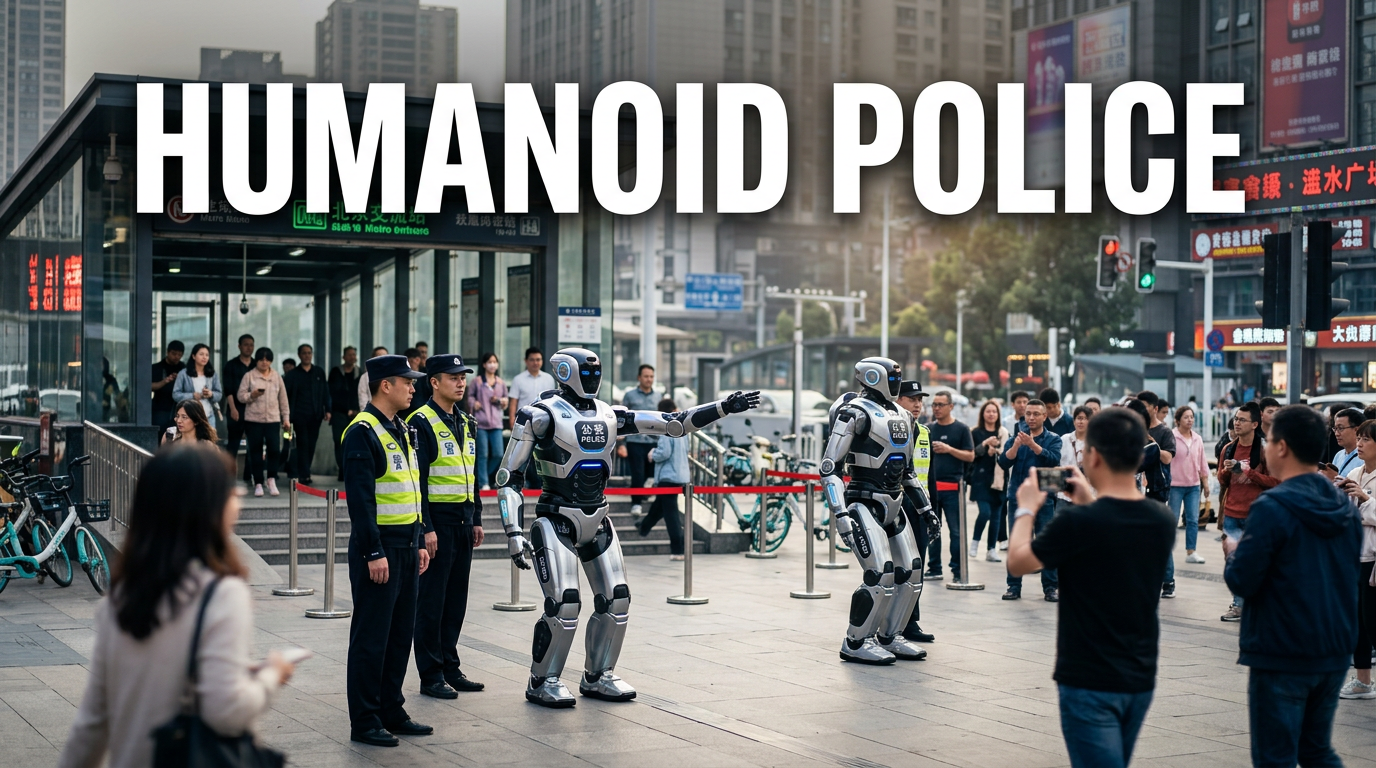
● Humanoid Police Deployment Accelerates
AI humanoid robots enter “SWAT/law enforcement” scenes…running in front of citizens and even with a mount (core points only)
The biggest point in today’s news is just one thing.
It’s that humanoid robots have moved beyond lab demos and are already being deployed in “public domains” like real urban public safety, traffic, and public-facing guidance.
And the core points that this article specifically includes are the following four:
① China (Shenzhen, Guangzhou, Hangzhou) tests humanoids “on the street” together with police
② The goal isn’t simple patrol, but public communication up to “traffic control + anti-fraud messaging”
③ Industrialization speeds up due to price declines (around the $4,000 range) and improvements in precision
④ The U.S. and big tech (Meta) are also investing in robot AI stacks…making public safety a “real-world link” in AGI discussions
1) China: street testing humanoids with a “police-grade visual” (Shenzhen)
Full-size humanoid standing next to SWAT in Shenzhen
- At a level of walking beside people: The video released in Shenzhen wasn’t just an information-guidance robot; it was reported as a scene where an adult-sized humanoid, wearing police equipment, patrolled on foot alongside SWAT officers.
- Movements feel “much more aggressive”: Compared to typical serving/guidance robots, it drew attention for actually running and including stronger motions such as rotational actions (e.g., kick-type movements).
- Key message: Even if it isn’t yet a stage where law enforcement is performed independently, it’s interpreted as a test to create a “visual presence of public safety”.
Why is “SWAT accompaniment” important?
- Human psychology/response changes: Even with the same technology, the signal strength sent to citizens differs between general patrol and SWAT accompaniment.
- Trust in the technology starts with “impression”: How robots earn trust in public safety areas depends not only on “functions,” but also on the “context of their appearance.”
2) Guangzhou: “layered smart patrol” with humanoid + drones + electric scooters
Guangzhou unveiled a multi-layered system over 5 days (May Day holiday)
- Humanoid: In public-facing spaces like a park (Ersa Island), its role in interacting with citizens and delivering anti-fraud messages was emphasized.
- Drone: Described as a structure that monitors crowd flow and traffic conditions in real time from the air and coordinates with ground personnel.
- Gyro/electric scooter: Used to increase patrol efficiency by moving quickly in areas where vehicle access is restricted (mentioned at up to roughly 20 km/h).
The core is “decomposing the public safety mission”
- Humanoids tend to be designed as a ‘visual attention device’ to draw public focus + a public communication tool
- Drones cover the view above (situation awareness), scooters cover mobility, and humanoids handle conversation/guidance—splitting responsibilities
- If this combination holds, operational efficiency is much better than a single robot
3) Hangzhou: a humanoid that guides with its “arm raised” in traffic management (large-scale deployment)
- During May Day: It was reported that 15 humanoids were deployed at major intersections.
- Role: Scenes were introduced of it assisting traffic police—guiding vehicles and pedestrians—and sending signals with hand gestures.
- Meaning of adopting the technology: Since Hangzhou is frequently discussed as an AI/tech city, the emphasis is on expansion into everyday public services rather than one-off performances.
4) Why is it becoming real so fast “now” like this: price drop + precision + platformization
Unitree: lowering the “market entry barrier” for a humanoid around the $4,000 range
- Price disruption: The message is that humanoid robots are being discussed at around the $4,000 range, making entry costs dramatically lower than in the past.
- Specs aren’t just for demos: It includes elements like a dual-CPU configuration, multi-microphones, visual perception, real-time perception capability, and a modular design (you can operate with a fixed base or a wheel chassis).
- Developer ecosystem strategy: If you open interfaces and let parts be swapped out, it becomes a “platform” so that researchers/startups can apply it quickly.
KAI (115 degrees of freedom): targeting advanced work with “precision control + haptics”
- Degrees of freedom: A structure where many degrees of freedom are concentrated in the hands (mentioned as around 115-degree-of-freedom level).
- Haptics (18,000 sensing points): Very fine force detection (e.g., around 0.1N) makes safety in tasks around humans or handling fragile objects a highlighted core strength.
- World model: An approach that doesn’t react blindly, but reduces risk by simulating the outcome of actions.
- Learning method: You can see the direction of connecting wearable-based data (gesture/timing information of what people do) to robot learning.
- Target market: Focused on “real-world use,” like retail, concierge services, and home assistance.
1X (U.S.): converting a home humanoid into “factory production”
- NEO: Production began in California, and a plan was presented to quickly scale annual production volume.
- Proof of early demand: There’s mention that the first year’s production was quickly sold out.
- On-device inference: The direction is to reduce latency with local AI processing like Nvidia Jetson Thor and lower dependence on the cloud.
- Change in pricing model: A design that strengthens a “service” character rather than “ownership,” such as one-time purchase (around $20,000 mentioned) plus subscription options (monthly subscription fee mentioned).
5) Meta (big tech): quietly joining the ‘model layer’ of humanoid robot AI
- Meta’s acquisition of robot startups: News about acquisitions related to Assured Robot Intelligence (ARI) is mentioned.
- Core direction: A flow to strengthen capabilities on the model side—making robots understand, predict, and adapt to human behavior.
- Connected to AGI logic: It aligns with the view many researchers have that AGI can’t be achieved by learning only from simple internet data, and that real-world interaction is necessary.
6) From the public safety industry perspective: “the U.S. police personnel shortage” is a real driving force behind humanoid adoption
- Labor shortage: Explanations point to rising recruitment difficulty, increased retirements/quitting, and that around 87% of agencies are not fully staffed.
- Chain effect: Delayed dispatch → burnout → lower morale → reduced service.
- So robots from “simple tasks” onward: It’s realistic to reduce the burden on human police in areas like report intake/reporting, traffic assistance, translation, and public guidance.
Examples already underway
- China: A trend where humanoid deployment is attempted for patrol and information services
- Dubai: Robot police help with tourist guidance and complaint intake, and future plans to switch a certain percentage of schedules to robots are mentioned
- Private sector: In shopping malls/campuses, robots for boundary patrol and monitoring have already become common
7) But there are clearly risks that still need to be addressed (public safety has high “error costs”)
Technology/ethics/law/security issues
- Limitations in emotional intelligence and cultural understanding: If judgment about emotions and cultural context is lacking, misunderstandings can occur on-site.
- Malfunctions going viral: A single mistake can destroy trust in an instant.
- Responsibility: If a robot causes an accident, legal clarification is needed about who is responsible—police stations, manufacturers, or operators.
- Bias, transparency, and accountability: If AI is used for public safety, sensitivity increases around bias and explainability.
- Cybersecurity: If it’s based on network connectivity, there are risks of attacks (hijacking/malfunctions). Encryption, monitoring, and human override are essential.
- Maintenance costs: Costs don’t stop at initial purchase—charging, updates, repairs, and infrastructure also add expense.
So the approach is solidifying into a “support role + phased introduction” model
- Start with guidance (assistance) rather than enforcement (coercion)
- Operate paired with humans while collecting feedback
- Accumulate trust to expand further
[Not commonly covered well elsewhere] The truly important 3 things in this news
- 1) “Public safety = punishment” is not the only definition; public safety = attention/communication, redefining the robot’s role
If robots specialize in anti-fraud messaging like in the Guangzhou case, the barrier to adopting the technology becomes much lower. - 2) SWAT accompaniment may be a test designed more around a “social signal (psychological effect)” than around “functionality”
In public safety, the “way of appearing” determines trust just as much as performance does. - 3) The timeline gets pulled forward as hardware price drops + on-device AI + platformization come together
Once this combination forms, the speed of moving from demos to services increases. (Here, the practically important keywords come up: ***, ***, ***, ***, ***.)
Outlook: the next 6 to 18 months are the period for “standardizing street tests”
- Expansion from public domains: There’s a strong chance that standards will be created first in areas where error costs can be managed relatively well—like traffic, complaint handling, and guidance.
- Competition isn’t just “multi-functional robots,” but “multi-layered systems”: It seems likely that structures where drones, mobility tools, and control/monitoring systems move together will strengthen—rather than humanoids alone.
- Big enterprise model competition: Big tech is likely to try to hold on to model layers like “behavior prediction/human understanding,” and that could determine the likelihood of humanoid adoption.
Main content to convey (one-line summary)
Humanoid robots are now moving from “technology that shows” to “operating public services,” and China’s street deployments look like a signal that makes this real.
< Summary >
- In Shenzhen, SWAT-accompanying humanoids are unveiled, and they’re being tested even down to the visual presence of public safety.
- In Guangzhou, multi-layer smart patrol is run using humanoids (public messaging) + drones (overhead awareness) + scooters (mobility).
- In Hangzhou, humanoids are placed at intersections to support vehicle/pedestrian guidance.
- Industrialization accelerates with price declines (around the $4,000 range mentioned) and precision manipulation and model-based inference (WORLD MODEL, haptics, etc.).
- The U.S. shifts home/service humanoids to factory production (on-device AI, subscription-style models).
- Meta invests in robot AI model layers to strengthen the “real-world connection” in humanoid and AGI discussions.
- Labor shortages are a driving force behind adopting public safety robots, and at the same time, legal/ethical/security/maintenance cost risks are key concerns.
[Related posts…]
- Latest articles on humanoid robots: accelerating street deployment
- Public safety AI/robot operation trends: combining labor shortages and automation
*Source: [ AI Revolution ]
– AI Robots Join Armed SWAT Police And Shock The Public Worldwide