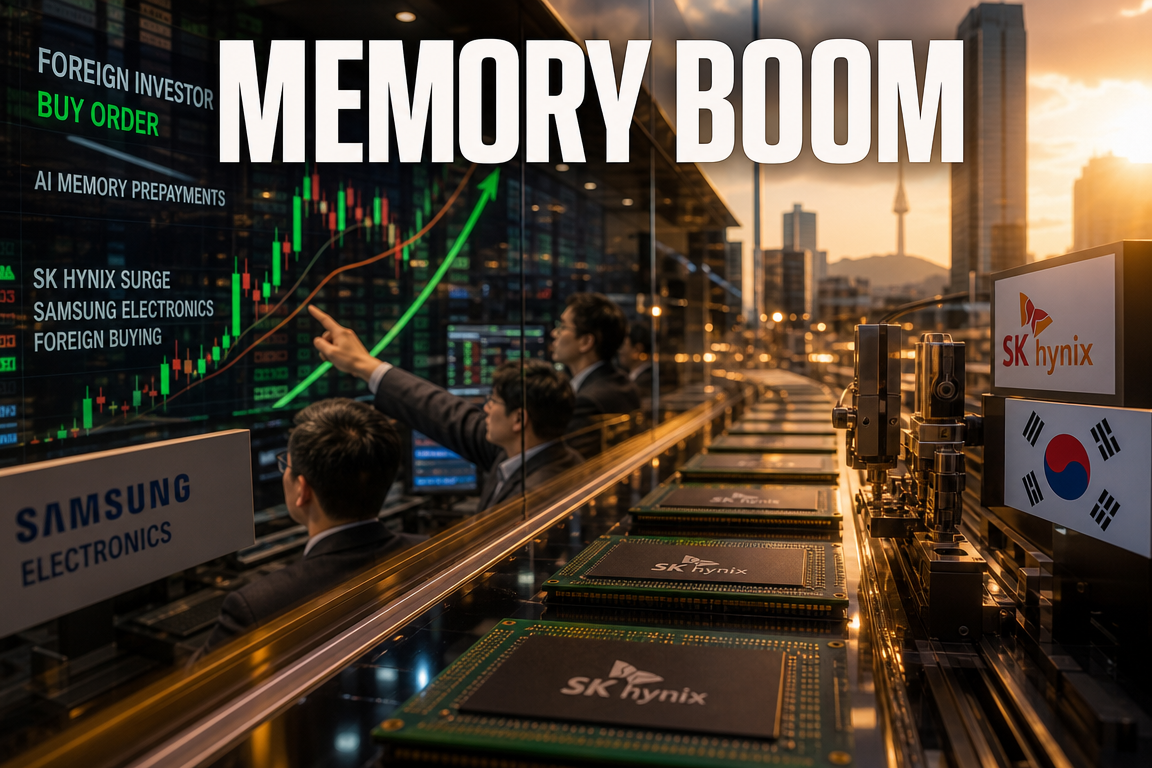
● Samsung-Hynix Surge, AI Memory Boom, Foreign Buying Spree
Reasons Samsung Electronics and SK Hynix Could Open Strong on Monday: A Coordinated Move Across U.S. Equities, Memory Fundamentals, and Foreign Flows
This is not limited to “U.S. stocks were up.” The setup suggests potential strength in Samsung Electronics and SK Hynix on Monday, with possible spillover into the KOSPI. This note also distinguishes between a short-term rebound and a move that could extend alongside semiconductor investment and AI semiconductor demand.
Key variables include: (i) short-term overheating risk driven by call-option activity, (ii) signals of hyperscaler prepayments and CAPEX support for memory supply, and (iii) the impact of European GDR performance on investor sentiment toward Korean semiconductor large caps.
1. Primary driver: U.S. equities ended the week exceptionally strong
The most immediate catalyst is Friday’s U.S. market performance. The rally continued to be led by AI infrastructure-related segments:
- servers and data centers
- memory
- power and networking
- the broader GPU ecosystem
In Korea, this typically translates first into large-cap semiconductors, particularly Samsung Electronics and SK Hynix, as the market’s fastest transmission channel for U.S. AI-infrastructure risk-on moves. Strong U.S. memory sentiment often carries into Monday gap-up expectations for Korean memory leaders.
2. Key sentiment trigger: Micron’s surge may lift Korean memory valuation expectations
A sharp rally in Micron (approximately mid-teens percent) can function as a cross-market repricing signal for memory. Market interpretation tends to follow relative comparison:
- memory-cycle expectations may be improving
- HBM (high-bandwidth memory) demand may be strengthening further
- Korean memory leaders may face upward valuation re-assessment
Within the AI semiconductor era, memory is increasingly treated as core infrastructure rather than a secondary component—an important distinction versus prior semiconductor cycles.
3. Why the KOSPI may also benefit: index concentration in the two names is high
Strength in Samsung Electronics and SK Hynix often extends beyond the semiconductor sub-sector due to their outsized index weight and sensitivity to foreign positioning. A strong open can reinforce:
- early index upside
- expectations for foreign buying in futures and cash equities
- strength in equipment and materials/supply-chain names
- broader risk appetite across the KOSPI
When large caps lead, the market frequently emphasizes directional flow over isolated idiosyncratic negatives, enabling a more pronounced “semiconductor-led” tape.
4. Risk consideration: the U.S. move also reflects call-option-driven positioning
The character of the U.S. rally matters. Recent upside has been supported by elevated call-option demand, reportedly at historically large levels. This implies that part of the move may be momentum-amplified rather than solely driven by long-only accumulation.
Accordingly, even if Korea opens strong on Monday, elevated intraday or near-term volatility risk should be assumed.
5. Why call-option leadership matters: upside can accelerate, but reversals can be abrupt
Call buying can compress the repricing window and intensify trend-following. However, if expectations soften, profit-taking can emerge quickly. Korea often reacts with a lag to U.S. moves; therefore, a strong open alone is not sufficient evidence of a durable uptrend.
Key monitoring items:
- whether foreign buying persists beyond the open
- whether Samsung Electronics and SK Hynix hold gap gains with sustained turnover
- whether the KOSPI advance broadens beyond semiconductors
- whether futures/program flows continue to support the index
“Strong start” and “trend continuation” should be analyzed separately.
6. Potentially stronger catalyst for SK Hynix: hyperscaler prepayments and CAPEX support signals
A central point is reporting that hyperscalers may be proposing prepayments and/or CAPEX support to SK Hynix to secure stable memory supply. This is a stronger signal than simple demand growth:
- customers move from intent (“willing to buy”) to supply security actions (“lock in capacity”)
7. Strategic implication: potential for shortage premium and improved producer bargaining power
Historically, memory has been treated as a cyclical industry. In contrast, AI-server-era high-performance memory—particularly HBM—has a more constrained, complex supply function involving:
- customer-specific qualification
- packaging integration
- yield and capacity constraints
- equipment investment and timelines
If hyperscalers are willing to fund prepayments or capacity, markets may infer:
- HBM tightness could persist longer than expected
- SK Hynix bargaining power may strengthen
- upside may include margin expansion, not only volume growth
- pricing dynamics could partially shift in favor of producers
This is not merely a near-term headline; it indicates a possible structural change in how high-performance memory is contracted and priced.
8. Why this can also be supportive for Samsung Electronics
While the catalyst appears more direct for SK Hynix, markets typically extrapolate to the sector. If supply is tight and hyperscalers compete for memory allocation, Samsung Electronics can be repriced as part of the broader memory value chain.
Samsung exposure can include a combination of:
- HBM competitiveness trajectory
- foundry and advanced packaging linkage
- recovery expectations in conventional memory
A plausible tape is SK Hynix leading with higher beta, with Samsung Electronics following via sector re-rating and catch-up positioning.
9. European GDR strength: an indirect read-through on global investor positioning
European-listed GDR performance can serve as a weekend proxy for offshore sentiment toward Korean blue chips when the local cash market is closed. A strong GDR tape can indicate:
- constructive foreign risk appetite toward Korean semiconductor large caps
- potential reinforcement of Monday’s domestic open via sentiment and positioning
Given the importance of foreign flows in Korea, such proxy signals can be non-trivial.
10. Headline summary: four drivers supporting Monday’s upside bias
-
U.S. equities strong
AI infrastructure led; risk appetite improved. -
Micron surge
U.S. memory strength may catalyze re-rating expectations for Korean memory leaders. -
Hyperscaler supply-security actions
Prepayment/CAPEX support discussions suggest persistent tight supply and stronger pricing power for suppliers, particularly SK Hynix. -
European GDR gains
Offshore sentiment may transmit into Monday’s domestic session.
11. Core takeaway often underemphasized in general coverage
The central issue is not “U.S. up, Korea up,” but a potential shift in the market framework for memory:
- memory increasingly treated as AI infrastructure rather than a purely cyclical segment
- customer funding and prepayment behavior can shift supply-chain leverage toward producers
- the rally may be strong but includes short-term call-option-driven heat, requiring volatility discipline
Upside catalysts and risk signals are present simultaneously.
12. Monday checklist for investors
- post-open volume and follow-through in Samsung Electronics
- whether SK Hynix can hold early highs
- confirmation of foreign net buying in both cash equities and futures
- rotation into equipment and supply-chain names
- whether KOSPI strength broadens beyond semiconductors
If leadership remains confined to the two large caps with rapid fade, conditions are consistent with short-term trading. If breadth improves and flows persist, the move may have higher durability.
13. One-line view: focus less on the gap-up and more on flow persistence
There is a clear basis for a strong Monday open: U.S. equity momentum, Micron strength, AI-memory supply security headlines, and supportive GDR signaling. However, the presence of call-option-driven acceleration increases the probability of volatility.
The primary differentiator is not whether prices can rise, but whether the move is sustained—best assessed through foreign flows, turnover, and sector breadth.
< Summary >
U.S. equity strength and Micron’s rally support upside expectations for Monday in Samsung Electronics, SK Hynix, and the KOSPI. Hyperscaler discussions around memory prepayments and CAPEX support represent a materially stronger signal, implying tighter supply and improved supplier bargaining power, particularly for SK Hynix. European GDR gains add a supportive offshore sentiment indicator. Nonetheless, elevated call-option activity in the U.S. suggests heightened volatility risk. Sustainability should be evaluated via foreign flows, trading volume, and breadth beyond semiconductors.
[Related Posts…]
- Semiconductor investment trends and KOSPI direction at a glance: https://NextGenInsight.net?s=semiconductor
- Impact of AI infrastructure expansion on the Korean equity market: https://NextGenInsight.net?s=AI
*Source: [ 내일은 투자왕 – 김단테 ]
– 월요일에 삼전 하이닉스 떡상하는 이유 (5월 9일)
● Fed,Oil,Shock,Stablecoin,Bond,Storm
Why the Fed Cannot Easily Hike Rates Now: Key Investment Takeaways Covering Stablecoins, Korean Treasuries, and Brazilian Bonds
After the Middle East conflict, investors are reassessing whether inflation could re-accelerate, whether the Federal Reserve could consider another rate hike, and where opportunities may emerge across sovereign bond markets.
This report focuses on the following under-discussed drivers:
- Long-term inflation expectations (rather than headline monthly inflation prints)
- Stablecoin-driven demand for U.S. Treasury bills (T-bills)
- Post-WGBI inclusion changes in Korea’s long-duration government bond demand
1. The Core Macro Question: Could the Middle East Conflict Trigger a Fed Rate Hike?
Key points
Headline logic suggests higher oil prices lift inflation and push central banks toward tighter policy. Market pricing, however, depends more on whether long-term inflation expectations become unanchored.
Why the Fed is constrained
- The current oil shock is assessed largely as a supply-side shock rather than demand overheating.
- Additional tightening into a supply shock risks weakening growth and employment faster than it reduces inflation.
- Policy is already restrictive; inflation fluctuating in the 3%–4% range alone is not sufficient to justify an immediate additional hike without evidence of re-anchoring risk.
Long-term inflation expectations remain relatively stable
Market stability reflects the view that long-term inflation expectations have not materially deteriorated. A sustained rise in long-term expectations would likely force a policy response, but signals remain limited to date.
2. Why Higher Oil Prices Do Not Automatically Imply Immediate Stagflation
Short-term inflation versus medium-term demand destruction
A prolonged oil spike can compress real demand, potentially increasing recession risk. Markets are therefore pricing both:
- near-term inflation pressure, and
- rising medium-term growth downside if high energy costs persist.
The Strait of Hormuz as the critical variable
Duration matters:
- A short disruption suggests contained supply effects.
- A multi-month disruption would directly pressure inventories, logistics, and growth, potentially shifting market focus from inflation to recession risk.
3. Why Treasury Yields Peaked Alongside Peak War Anxiety
Interpreting the price action
During the initial escalation, U.S. 10-year yields rose sharply before retracing. This reflected repricing of the expected policy path rather than a pure flight-to-safety.
Transmission mechanism
- Geopolitical escalation
- Oil price spike
- Inflation concerns
- Reduced expectations for rate cuts
- Higher long-term yieldsSubsequent de-escalation expectations reversed part of the move, supporting both lower yields and risk asset rebounds.
4. Who Absorbs U.S. Treasury Supply: Stablecoins as a Non-Obvious Variable
Core market issue
Beyond fiscal deficits and increased issuance, the key question is marginal demand for the growing stock of short-dated U.S. government paper.
Stablecoins as a structural T-bill demand channel
- Stablecoin issuers typically hold high-quality liquid reserve assets.
- T-bills are a primary reserve instrument.
- Stablecoin market growth can therefore translate into incremental, structural demand for U.S. T-bills.
Link to long-term rate stability
If issuance is absorbed more heavily through bills, long-duration supply pressure may be reduced, moderating upside risk in long-term yields. This has implications for:
- mortgage rates,
- corporate funding costs, and
- equity valuation discount rates.
5. Stablecoins as a Digital Extension of Dollar Hegemony
Stablecoins may function not only as payment infrastructure but also as a mechanism that increases global reliance on USD-linked instruments and U.S. short-term government securities. This can be interpreted as a digital reinforcement of the dollar system rather than erosion.
Potential linkage to strategic payment corridors
If stablecoin usage becomes institutionalized in specific cross-border payment contexts, associated reserve growth could further stimulate T-bill demand. This remains scenario-based rather than confirmed, but policy direction and adoption trajectories can influence bond market expectations.
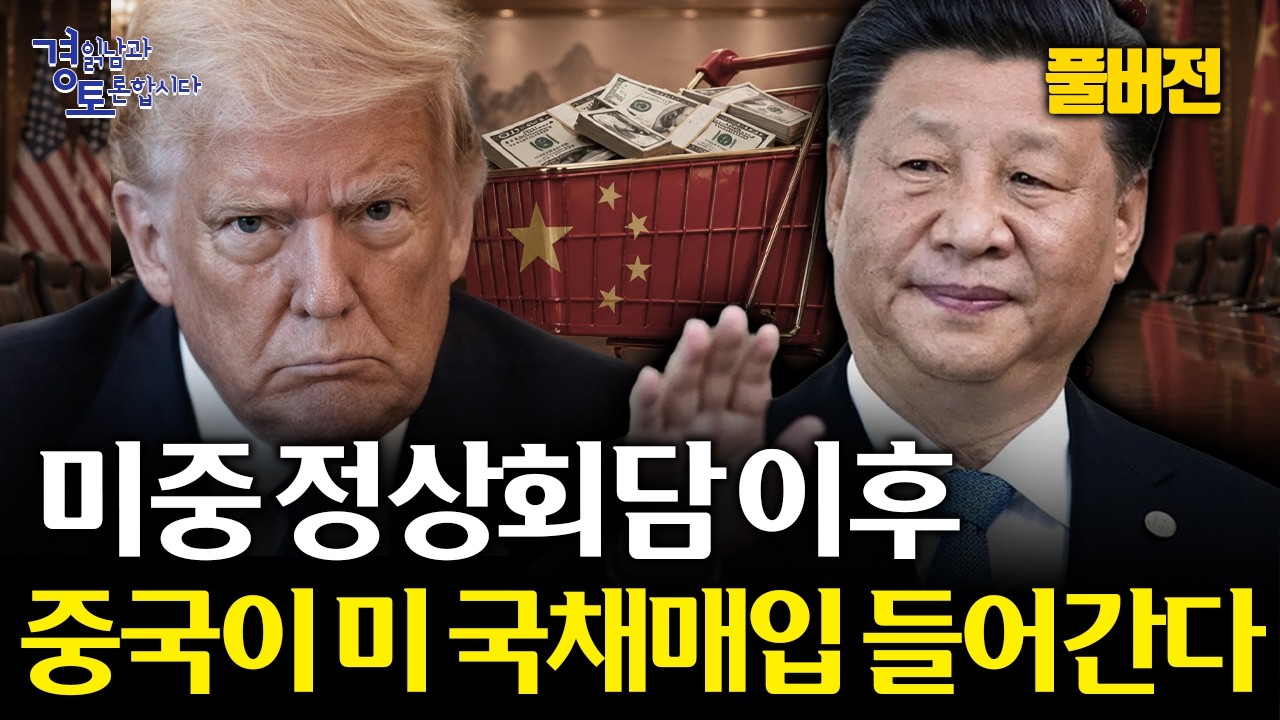
6. Why a U.S.-China Leaders’ Meeting Could Lower Treasury Yields
The relevant channels extend beyond tariffs
A credible thaw could influence markets via:
1) Increased inflow of lower-priced consumer goods
Lower tariffs or improved trade flow could reduce consumer price pressures, especially in year-over-year comparisons.
2) Potential stabilization in China’s U.S. Treasury demand
China’s Treasury holdings can function as both portfolio allocation and negotiation leverage. Improved bilateral management could reduce supply-demand uncertainty, potentially supporting lower long-term yields.
7. U.S. Treasury Selling Is Not Necessarily Ideological
Liquidity-driven behavior in wartime
In conflict conditions, entities often liquidate the most liquid assets to raise cash quickly. Gold and U.S. Treasuries are primary liquidity sources. Sales should not be automatically interpreted as a regime shift away from the dollar system.
8. Why Brazilian Bonds Are Returning to Focus
The prior performance drivers
Brazilian bond outperformance has historically reflected three concurrent sources:
- high coupon carry,
- price gains from rate declines, and
- FX appreciation in BRL.
Current positioning requires differentiation
Replicating prior returns may be difficult:
- Inflation may not fall quickly.
- Political and fiscal concerns can lift long-term inflation expectations.
A more risk-controlled approach is to diversify between:
- shorter-maturity local-currency bonds, and
- USD-denominated Brazilian sovereign or quasi-sovereign exposure.
Why Brazil can screen positively during energy shocks
Brazil is a commodity and energy exporter, while Korea is more energy-import dependent. During oil-driven risk regimes, currency and terms-of-trade dynamics can diverge, supporting Brazil as a diversification sleeve for KRW-based investors.
9. Why Korean Government Bonds Merit Reassessment
WGBI inclusion is structural, not a one-off catalyst
Benchmark-driven and liability-matching flows can increase persistent foreign demand for Korean government bonds, including ultra-long tenors (e.g., 30-year).
Policy actions matter
Debt buybacks, supply management, and accessibility improvements indicate a policy preference to contain volatility and funding costs, reinforcing market stability.
Where the investment case is derived
- Market yields are materially above the policy rate, implying partial pricing of additional tightening risk.
- Under a medium-term backdrop consistent with lower trend growth, subdued inflation, and aging demographics, duration exposure may regain attractiveness.
- Current yield levels may support phased accumulation under a risk-managed framework.
10. Key Risk for Individual Investors in Korean Bonds
Overconcentration in low-coupon ultra-long duration
Treating bonds primarily as a price-timing trade can increase volatility, particularly when concentrated in low-coupon, ultra-long maturities. A more balanced framework emphasizes:
- carry income, and
- portfolio hedging properties alongside potential price appreciation.
11. News-Style Summary
Macro
- The Middle East conflict has increased oil and inflation risk, but immediate Fed hikes remain unlikely.
- The inflation impulse appears more supply-driven than demand-driven; long-term inflation expectations remain relatively contained.
- A prolonged disruption in the Strait of Hormuz would likely raise global recession risk more than it entrenches long-run inflation.
Rates and bonds
- Yields can peak during peak conflict anxiety when markets reprice the policy path.
- Reduced rate-cut expectations can dominate safe-haven demand in the near term.
- Stablecoin institutionalization is a relevant variable for U.S. T-bill demand and, indirectly, long-end stability.
Investment implications
- Korean government bond demand dynamics have improved structurally post-WGBI inclusion.
- Brazilian bonds remain relevant, but require a more segmented approach across currency and tenor.
- Bond allocations are better framed around carry and defensive portfolio function than short-term mark-to-market gains.
12. Under-Discussed Points
1) The Fed prioritizes long-term inflation expectations over single-month CPI outcomes.
If expectations remain anchored, oil shocks may not force immediate hikes.
2) Stablecoins are not only a crypto topic; they are a potential expansion mechanism for U.S. T-bill demand.
Digital dollar instruments can influence fiscal financing channels.
3) A prolonged Strait of Hormuz disruption could be more recessionary than inflationary.
Demand destruction can become the dominant macro effect.
4) Korea’s bond investment case is increasingly about improved demand structure, not only yield levels.
Benchmark inclusion and policy stabilization can support valuation floors.
5) Bonds should be evaluated primarily for carry and hedging value.
In volatile equity regimes, duration can regain portfolio utility.
13. Practical Portfolio Framing
Conservative investors
Consider phased allocation to Korean government bonds while avoiding excessive concentration in the longest maturities; balance carry versus duration volatility.
Neutral investors
Monitor long-term inflation expectations, oil dynamics, and stablecoin regulatory progress alongside Fed communication.
Aggressive investors
Consider selective exposure to Brazil with explicit monitoring of inflation, fiscal credibility, and political timelines; diversify between local-currency and USD-denominated instruments.
14. Conclusion
Current market pricing reflects an interconnected set of drivers: geopolitics, oil, inflation expectations, the Fed reaction function, U.S.-China diplomacy, stablecoin-driven Treasury demand, and structural shifts in Korean bond flows post-WGBI inclusion.
Simplified interpretations (e.g., oil up implies immediate hikes) risk missing the dominant mechanism: the behavior of long-term inflation expectations and the evolving structure of sovereign bond demand.
< Summary >
- Oil-driven inflation pressure has risen, but immediate Fed hikes remain difficult to justify without a clear shift in long-term inflation expectations.
- Stablecoins may expand structural demand for U.S. T-bills, with implications for broader Treasury market stability.
- A U.S.-China diplomatic thaw could support lower inflation and improve Treasury demand conditions.
- Korean government bond demand has become more structurally supported post-WGBI inclusion; phased entry may be warranted under disciplined duration management.
- Brazilian bonds remain attractive but require segmentation across local-currency and USD exposure.
[Related Articles…]
- https://NextGenInsight.net?s=Federal%20Reserve
- https://NextGenInsight.net?s=Stablecoin
*Source: [ 경제 읽어주는 남자(김광석TV) ]
– [풀버전] 연준은 왜 금리를 못 올리나? 스테이블코인과 한국 국채에 숨은 투자 기회 | 경읽남과 토론합시다 | 마경환 대표