● Crisis,Power,Control,AI,Lines
If Subsea Cables Are Weaponized: US-China Hegemonic Competition, AI Infrastructure, and Shifting Investment Landscapes
This issue extends beyond a single remark about “collecting subsea cable fees.” It reflects (i) why Iran’s statement may function as a negotiation signal, (ii) how US-China rivalry is expanding from semiconductors to communications infrastructure and data sovereignty, (iii) why subsea cables are becoming strategic assets in the AI era, and (iv) potential implications for the global economy, supply chains, interest-rate conditions, equity markets, and long-horizon investment themes.
A central framing is that subsea cables are not merely telecom infrastructure; they increasingly function as the “borderlines” of the AI era.
1. Core of the News: Why Iran’s “Subsea Cable Usage Fee” Remark Matters
On the surface, Iran referenced imposing fees on subsea cables transiting the Strait of Hormuz. The significance is not limited to escalation risk; the wording also signals economic pressure and the potential use of infrastructure as an adjustable bargaining lever.
1-1. Why “Fee” Instead of “Blockade”
Hardline posture typically uses terms such as “block” or “cut off.” The explicit use of “fees” and “collection” suggests a preference for monetizable, negotiable pressure rather than outright disruption.
1-2. A Signal Not Only to the US but Potentially to China
Some cables passing Hormuz connect to China-linked telecom consortia. Accordingly, the remark may be intended as leverage toward multiple stakeholders, including China, particularly amid overlapping variables such as US-China diplomacy, Middle East negotiations, and sanctions-relief pathways.
1-3. What Markets May Focus On: “Negotiation Premium” vs. “Escalation”
Markets do not price only worst-case conflict scenarios. Such statements can also be interpreted as evidence that transactional options remain active (payments, sanctions flexibility, indirect trade, diplomatic compromise). Monitoring should include crude oil, FX, USD trends, and safe-haven positioning.
2. Why Subsea Cables Have Become Strategic Instruments
Subsea cables function as the global economy’s digital backbone. International voice, financial transactions, cloud services, AI data movement, enterprise connectivity, and defense communications are heavily dependent on these links.
2-1. Most Global Data Transits Undersea
Despite satellite advances, high-volume intercontinental data transfer remains primarily cable-based due to latency, cost, and capacity advantages.
2-2. Risk Is Not Limited to Physical Cuts
Key threat vectors include route exposure, interception, traffic-pattern analysis, network disruption, and delayed repair/maintenance. Subsea cables are both physical infrastructure and cyber-security assets.
2-3. Post Russia-Ukraine: Critical Infrastructure as “Gray-Zone” Targets
After the Russia-Ukraine war, Europe’s risk framework expanded from pipelines and power grids to subsea communications. Disruption can occur without direct kinetic conflict, affecting economic and communications stability.
3. US vs. China: Subsea Cables as a New Front in Hegemonic Competition
Strategic competition is expanding beyond semiconductors and batteries into communications infrastructure control. Subsea cables are a less visible but high-leverage domain.
3-1. Why the US Leans on Private Big Tech
The US model often relies on large technology firms (e.g., Google, Meta, Microsoft, Amazon) to finance and operate cable systems. This can appear market-driven while reinforcing data sovereignty and technology advantage.
3-2. Why China’s Telecom Participation Is Closer to State Strategy
China typically participates via state-linked or state-influenced operators. As a result, cable ownership and operations are commonly interpreted through an integrated national security and foreign policy lens.
3-3. The Key Metric Shifts from “Scale” to “Trust”
Going forward, the count of cables may matter less than perceived security and trust in equipment and operators. Infrastructure decisions may increasingly prioritize security over efficiency.
4. What Hormuz Risk Implies: A Data Chokepoint, Not Only an Energy Chokepoint
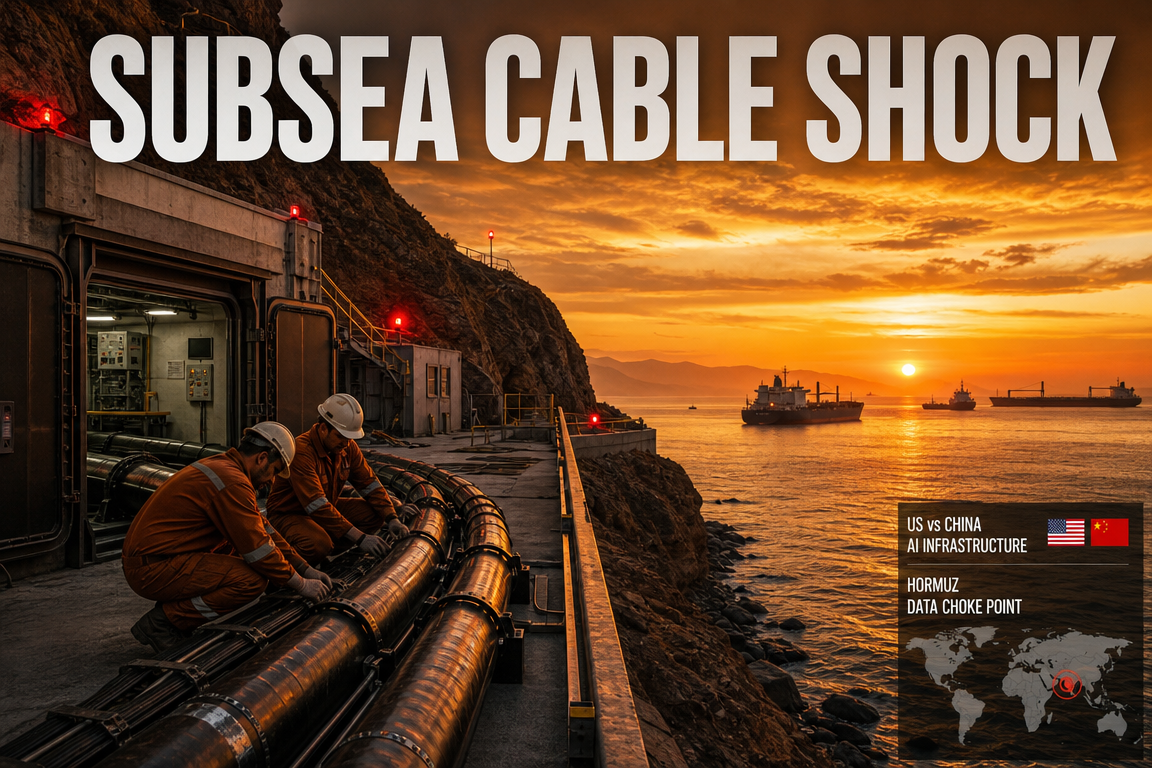
Hormuz is widely recognized for oil flows; it should also be viewed as a potential bottleneck for data transit. Regional instability can affect cloud/AI traffic resilience and portions of financial-network connectivity, not only energy pricing.
4-1. Implications for Gulf States
The event reinforces the risk of concentrated dependence on specific corridors. Strategic responses may include diversified routes: alternative subsea paths, expanded terrestrial links, and multi-route redundancy.
4-2. Route Diversification as an Investment Theme
New or reinforced routes via Oman, Saudi Arabia, the Red Sea, and India could gain priority. This may represent a structural reconfiguration analogous to supply-chain diversification, applied to digital connectivity.
5. Why Subsea Cable Demand Can Accelerate in the AI Era
Subsea cables are evolving from legacy telecom infrastructure into enabling infrastructure for AI deployment at scale.
5-1. Traffic Growth: Text to Images to Video to AI Agents
The internet shifted from text to images to high-resolution video and real-time streaming. Generative AI, cloud AI, AI agents, and real-time inference add a new layer of bandwidth intensity.
5-2. AI Is Not Only a Data-Center-Internal Issue
AI increases cross-border data movement: training datasets, inference requests, replication, backups, distributed processing, and multi-region cloud operations.
5-3. Why Big Tech Builds Cables Directly
For major traffic generators, owning connectivity can reduce unit costs and improve quality control. This reflects a shift of subsea cable economics from traditional telecom operators toward hyperscale capital.
6. Market and Investment Implications of the Subsea Cable Theme
Equity markets typically discount follow-on capital expenditure more than the triggering headline. Subsea cables may be re-rated as national-security and AI-enabling assets rather than standard communications equipment.
6-1. Beneficiary Segments Are Broader Than Commonly Assumed
1) Subsea cable manufacturers: fiber, insulation, and transmission-grade cable production.
2) Installation and maintenance providers: specialized vessels and engineering capability.
3) Optical networking equipment: terminal equipment, repeaters/amplifiers, transmission systems, transceivers.
4) Data-center and cloud connectivity infrastructure: downstream drivers of traffic growth.
6-2. Why Many Related Equities Have Already Repriced
Korean wire/cable names, US optical equipment providers, and select Japanese manufacturers have often seen substantial appreciation. A thematic approach requires discrimination rather than blanket exposure.
6-3. Primary Investment Filter: Revenue Exposure “Purity”
Markets tend to assign higher multiples to companies with high direct revenue contribution from the theme. Conglomerate exposure may receive less incremental premium than pure-play exposure.
7. Where Opportunities May Emerge by Region
7-1. United States
The core driver is hyperscaler-led expansion. Directly investable pure-play cable-laying exposure may be limited; attention may focus on optical networking, network equipment, and data-center interconnect solutions. Valuation risk is elevated where AI infrastructure expectations are already priced in.
7-2. Japan
Japan retains strong technical capability in communications equipment and cable manufacturing. Investment relevance depends on (i) subsea-related revenue share and (ii) the degree of direct linkage to AI infrastructure spending.
7-3. Korea
Korea has visible capacity in wire/cable manufacturing and segments of subsea capability. The theme often clusters with power infrastructure, offshore wind, and transmission upgrades. While many equities have moved materially, the underlying structural demand drivers may remain intact.
8. Why This Matters for the Global Macro Outlook
This is not only a geopolitical headline; it signals where global capital expenditures may be directed.
8-1. Indirect Effects on Inflation and Rates
If economies pursue overlapping investments in energy security, power grids, data networks, and semiconductor production, aggregate costs may rise. This is consistent with a shift from low-cost globalization to bloc-based redundancy, with potential implications for medium- to long-term inflation and rates.
8-2. The Next Phase of Supply-Chain Reconfiguration: The Digital Supply Chain
Reconfiguration is extending from semiconductors and materials to data routing and infrastructure. The jurisdictions of servers, the cables used for transit, and the equipment embedded in networks become components of economic security.
8-3. “Invisible Infrastructure” as a Persistent Equity Theme
Investor attention often concentrates on AI applications, but durable returns may accrue to enabling infrastructure (wire, cooling, transformers, optical networking, subsea systems) that underpins deployment.
9. Key Takeaways (News-Format)
- Iran’s subsea cable fee remark may be interpreted as negotiable economic leverage rather than a pure disruption threat.
- The Strait of Hormuz should be evaluated as a data chokepoint as well as an energy chokepoint.
- US-China competition is expanding from semiconductors into subsea communications infrastructure.
- AI-driven global traffic growth supports a structural increase in subsea capacity demand.
- Beneficiaries span cable manufacturing, installation/maintenance, optical equipment, and data-center connectivity.
- Given prior price appreciation across many names, selection should be based on revenue exposure and valuation discipline.
10. Under-Discussed Core Point
Subsea cables are increasingly not just communications infrastructure but geopolitical boundary lines for the AI era.
Power in the AI era is not determined solely by model quality or chip manufacturing capacity. It also depends on the ability to route data securely, build redundancy, and maintain control over critical connectivity at scale. Subsea infrastructure therefore becomes a key indicator for future economic order, digital security, data sovereignty, and capital expenditure direction.
11. Monitoring Checklist
- Whether post–US-China leadership engagements produce signals on telecom/semiconductor policy posture
- Whether Middle East states commit capital to Hormuz-bypass digital connectivity routes
- Whether US hyperscalers announce additional subsea cable projects
- Whether Korean and Japanese firms secure incremental awards across manufacturing, installation, or equipment
- Whether data-center expansion plans and international backbone expansion progress in parallel
12. Conclusion
This is not a single-region event. It highlights an ongoing transition from an era defined by oil chokepoints to one increasingly defined by data chokepoints and subsea connectivity. US-China rivalry, AI infrastructure buildout, and global economic reconfiguration intersect in this domain.
In practical terms, subsea cables may be treated as “invisible semiconductors”: difficult to observe in daily life, but essential for system-level functionality. The relevance is therefore better framed as a long-duration trend than a short-term headline.
The subsea cable issue is a convergence point for US-China strategic competition, AI infrastructure expansion, and data sovereignty. Iran’s statement is more consistent with negotiable pressure than immediate disruption. Markets may increasingly focus on bypass routes, network diversification, and expanded subsea investment. Over the long term, key beneficiary areas may include cable manufacturing, installation/maintenance, optical networking equipment, and data-center connectivity infrastructure.
[Related Articles…]
- Overview of AI infrastructure investment expansion and data-center beneficiaries (NextGenInsight.net?s=AI)
- Key points on US-China strategic competition and global supply-chain reconfiguration (NextGenInsight.net?s=US-China)
*Source: [ Jun’s economy lab ]
– 해저케이블이 무기화 되면 벌어질 일(ft.중국, 미국)