
● AI Agent Phone Revolution
OpenAI shakes up the smartphone landscape with an app-free “AI phone”… Why the mobile ecosystem centered on Samsung and Apple could change
OpenAI is increasingly likely to usher in the era of the AI agent phone in earnest.
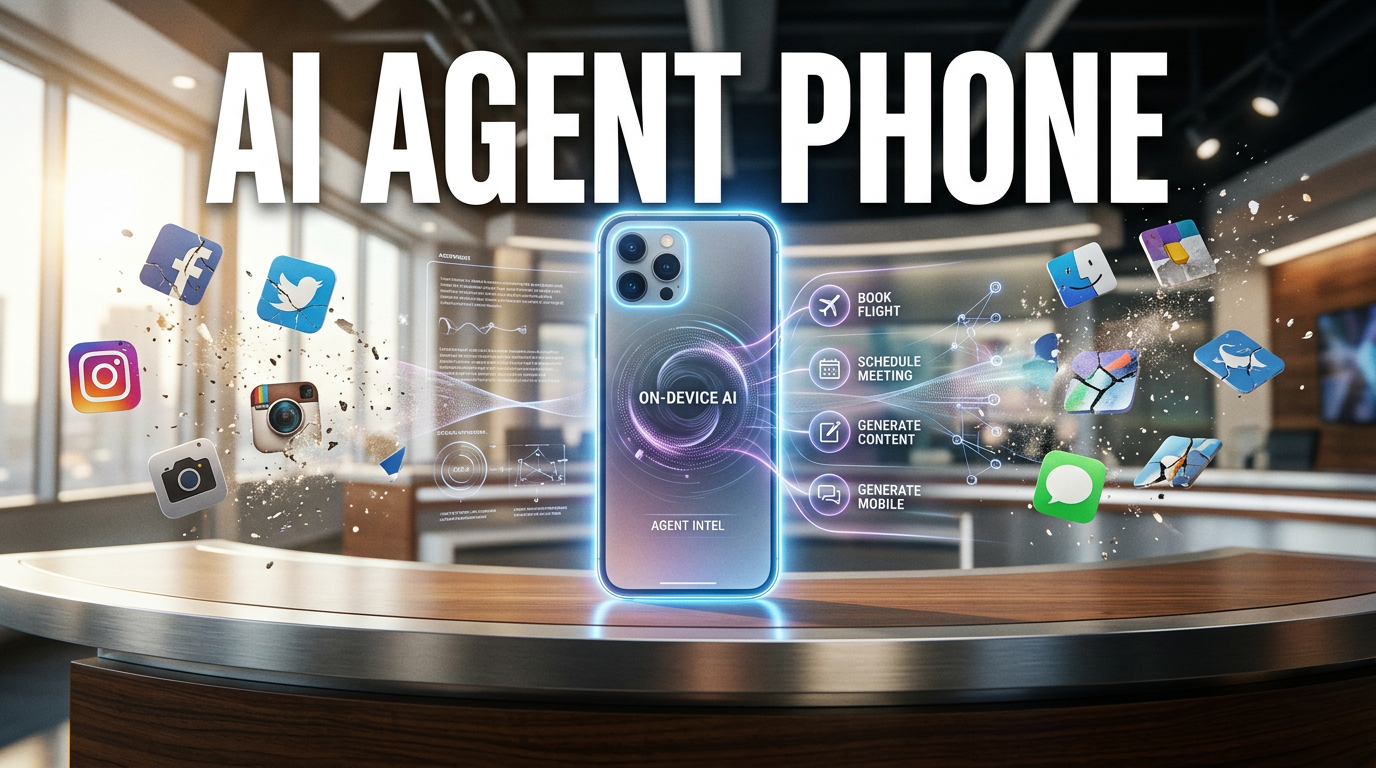
The key point is not a smartphone that you tap through apps, but a smartphone where AI does the work on its own.
If this change becomes reality, it could shake up the smartphone market, the mobile app ecosystem, search advertising, platform revenue structures, and even the competition in semiconductors and AI chips all at once.
Today, we’ll organize this news in article format and also highlight the real key takeaway that is not well covered elsewhere.
What OpenAI is targeting is not a “smartphone” but the “center of user behavior”
OpenAI appears to be trying to take over not just another device, but the entry point of users’ daily lives entirely.
Today’s smartphone requires you to tap app icons, swipe through screens, and move back and forth between multiple apps.
But OpenAI’s direction is different.
If a user says, “Summarize my meeting,” “Call me a taxi,” or “Book dinner to fit my schedule tomorrow,” AI will connect multiple apps and execute the task automatically, then show only the result.
In other words, the system moves from an app-centered UI to an AI-centered interface.
This shift is not just a convenience upgrade; it is a change that redefines the very meaning of a smartphone.
Why the market is reacting strongly to a 2028 mass-production target
According to reports, OpenAI is developing an AI smartphone with its own chip and operating system, aiming for mass production in 2028.
Here, the important issue is not “when it launches,” but “who controls the hardware and OS.”
Until now, power in the mobile market has been concentrated in Apple’s iOS, Google’s Android, and Samsung Electronics’ hardware competitiveness.
But OpenAI’s move to combine its own chip, OS, and device experience is an attempt that directly challenges the existing big tech order.
If this succeeds, smartphones could evolve from simple devices into a personal AI platform that acts like the user’s digital twin.
Why is OpenAI trying to control hardware directly?
OpenAI’s thinking seems fairly clear.
It believes that if AI is to act more intelligently on behalf of users, software alone is not enough.
Real-time data such as the user’s location, voice, schedule, spending habits, and movement patterns accumulates most heavily on the smartphone.
To properly use this data, AI must not sit on top of apps; it must control the device as a whole in an integrated way.
In the end, OpenAI seems to be moving toward the idea that “if AI is to become the center of the world, it must directly control the hardware and OS.”
Jony Ive, MediaTek, Qualcomm, and Luxshare… the supply chain is already moving
This plan is not just an idea; it is already extending into real industrial partnerships.
OpenAI recently reportedly acquired IO, the startup founded by iPhone designer Jony Ive, for about $6.5 billion.
This is not simply hiring a designer; it is being interpreted as a move to absorb the “emotional hardware experience” that Apple has built.
It is also reportedly working with MediaTek and Qualcomm on AI-specific chip development.
In other words, the company is trying to connect everything at once: chips that can run AI functions well, the design that shapes the user experience, and manufacturing partners that will produce the device.
Manufacturing is also said to potentially go to China’s Luxshare, which produces the Apple Watch.
This means that the AI phone is not a mere experiment, but a full-scale project mobilizing the global supply chain.
Why Samsung Electronics and Apple have no choice but to be nervous
The reason this change is so alarming is that it affects more than just smartphone sales.
The biggest potential damage is to the mobile app ecosystem.
Until now, payments, advertising, subscriptions, and fee structures have all revolved around app stores.
But if AI handles all tasks in the middle, users will have less reason to open apps directly.
Then app installs, time spent, ad exposure, and fee revenue could all be shaken.
This is not just Apple’s and Google’s problem.
Even hardware-strong companies like Samsung Electronics may struggle to differentiate themselves with products that are simply prettier or faster.
Ultimately, smartphone competition will shift from “who has the better device?” to “who has the stronger AI agent?”
Declining mobile app usage, and the market’s sensitive point of focus
Market research institutions predict that mobile app usage could decline significantly by 2027 due to the spread of AI.
This forecast matters not just as a numerical estimate, but because it signals a change in consumer behavior.
If people move from directly searching, comparing, booking, and paying to having AI make decisions and carry them out, the reason apps exist may weaken.
In particular, the faster AI can replace tasks like shopping, search, reservations, schedule management, travel, and finance, the quicker the transition could be.
In that case, search advertising and platform revenue models are also likely to be reorganized.
The most important point that other reports don’t emphasize enough: competition shifts from “apps” to “intent”
Here is the core point that other news articles and YouTube videos tend to cover less:
This competition is not about smartphone hardware; it is a battle over who understands and executes user intent first.
Until now, users went directly into apps, but in the future, AI is likely to read the user’s purpose and automatically connect multiple services.
In other words, control over services moves from apps to AI.
This also means that the companies making money in the future may not be the ones with the most apps, but the ones that best complete the user’s actions on their behalf.
The scary part of this change is that it disrupts the revenue structures of existing big tech while also opening entirely new opportunities for startups.
Industry-by-industry winners and risks in the AI phone era
1. Semiconductor industry
For AI agents to run in real time on-device, high-performance AI chips are essential.
Memory, APs, power efficiency, and NPU performance become the core competitiveness factors.
2. Smartphone manufacturers
Beyond manufacturing, how naturally they implement the AI experience becomes critical.
Both Samsung Electronics and Apple may face pressure to redesign their UI/UX.
3. App developers
If direct user touchpoints are lost, traffic may decline.
Services will need to be designed for a structure where AI executes tasks on the user’s behalf.
4. Advertising and search platforms
Search volume and click-through rates may decline, shaking up the existing advertising model.
A new advertising model based on AI recommendations and automated execution may become necessary.
5. Payments and fintech
If AI handles automatic payments and reservations, the actor making decisions may shift from the human to AI.
This means security, authentication, and responsibility must all be redesigned.
Key checkpoints for investors and readers going forward
First, whether OpenAI’s AI phone truly progresses to 2028 mass production needs to be watched closely.
The hard part is not technology itself, but the supply chain, manufacturing, OS optimization, battery life, and heat management.
Second, how Samsung Electronics and Apple respond will be important.
The key is whether they strengthen their own AI features or integrate more deeply with external AI.
Third, the pace of decline in mobile app usage must be monitored.
If it falls faster than expected, the impact on advertising and platform stocks could be significant.
Fourth, the earnings of companies tied to AI chips and on-device AI should be checked.
This is because the era is moving beyond cloud-only AI toward greater processing inside the device itself.
Conclusion: The smartphone market is now entering an “AI assistant war”
OpenAI’s AI phone effort is not just a new product launch story.
This is an attempt to rewrite the rules across smartphones, apps, advertising, search, payments, and the chip industry.
Going forward, the competition may no longer be about who makes the thinnest phone, but about who can run the user’s life most intelligently on their behalf.
Ultimately, the mobile industry is shifting from a “device competition” to an “AI agent competition.”
If this change takes hold, it could become the biggest turning point since the debut of the iPhone.
< Summary >
As OpenAI prepares an app-free AI phone, the center of the smartphone market may shift from apps to AI agents.
This change could shake Samsung Electronics, Apple, search advertising, mobile apps, and the payments ecosystem.
The key takeaway is not device performance, but how naturally AI can carry out a user’s intent on their behalf.
From here on, the real competition may be not smartphone competition, but AI assistant competition.
[Related Articles…]
Rising semiconductor demand driven by the AI phone era: key points investors should watch
How the spread of AI agents is changing search advertising and platform revenue structures
*Source: 서울경제TV