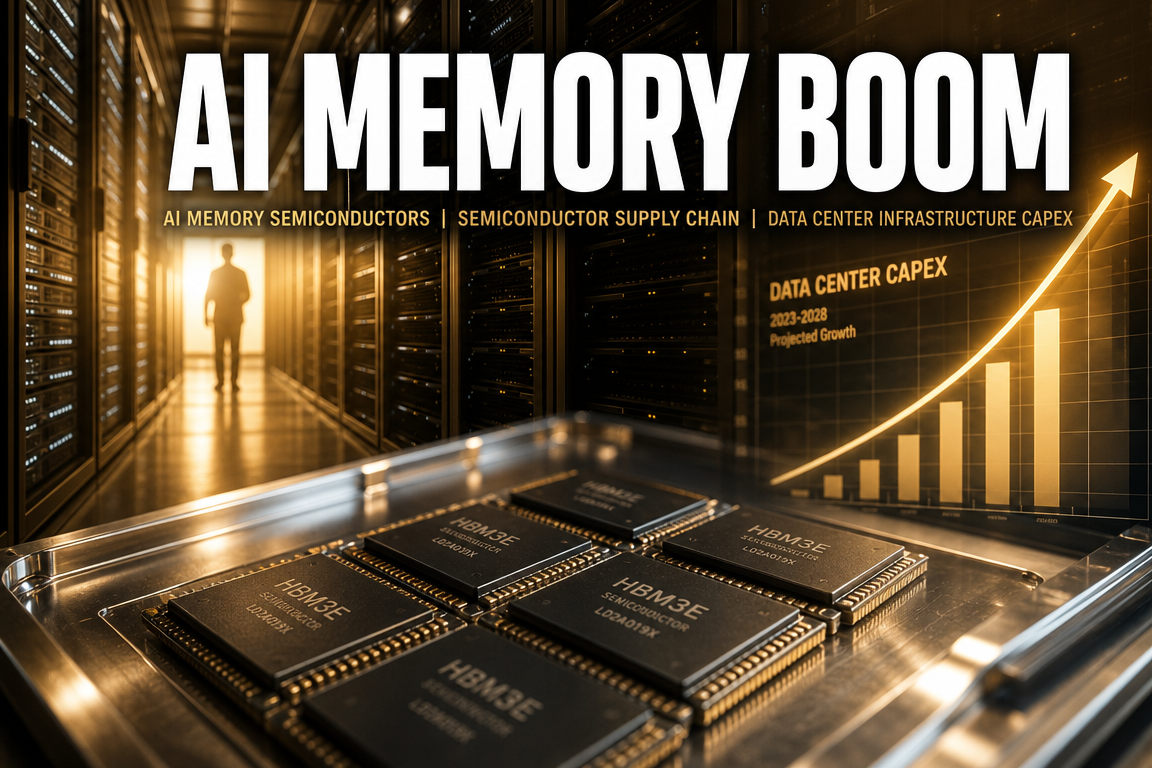
● AI Supply Chain Boom
The Global Rally in Memory Semiconductors: The Core Theme Is the AI Infrastructure Supply Chain
Equity markets are not merely pricing a semiconductor upswing. Memory semiconductors, AI infrastructure, data centers, optical networking, and power equipment are moving as a single, integrated theme.
Three points are central to the current cycle:
1) Memory semiconductors are being re-rated from a cyclical segment to a strategic asset.
2) Big Tech is prioritizing volume security over price.
3) The U.S. government and global capital are simultaneously positioning for memory and AI infrastructure supply-chain security.
This report summarizes recent market and sector moves (Nasdaq, semiconductor ETFs, AI-related equities) and highlights key drivers that are often underappreciated.
1. One-line Market Summary: An “AI Infrastructure Concentration” Regime
U.S. and global equity indices are increasingly driven by AI infrastructure-linked equities. While the Nasdaq and S&P 500 have reached record highs, leadership is concentrated in memory semiconductors and data center-related names.
Capital is rotating into AI infrastructure, while many other sectors lag, producing a polarized market structure.
The core complex includes memory, CPUs, foundry, semiconductor equipment, optical networking, and power infrastructure. The relevant frame is not simply “semiconductors are up,” but a synchronized build-out across AI training/inference, data center expansion, network upgrades, and power capacity additions—driving a broad supply-chain re-rating.
2. Why Memory Semiconductors Are Leading
2-1. Big Tech Procurement Behavior Has Shifted
A key catalyst has been reporting that Big Tech offered unusually aggressive terms—effectively prepayments—to memory suppliers.
The implication is straightforward: “Pay upfront to secure priority allocation.”
Such terms are common in leading-edge foundry or high-end tool contracts, but are notable when applied to memory. This suggests memory is transitioning from a commodity component to a binding constraint for AI server deployment.
High-bandwidth memory and high-performance server memory are increasingly required to translate GPU availability into usable data center capacity.
2-2. Negotiating Power Has Moved to Suppliers
Historically, Big Tech held procurement leverage. The current environment indicates a supplier-advantaged market in which memory producers control scarce supply and customers compete for allocation.
This is more than demand growth; it signals structural tightness. Markets are therefore reassessing medium-term margin durability for memory suppliers relative to prior cycles.
2-3. Memory Is Being Reframed from “Cycle” to “Strategic Asset”
Memory has traditionally been among the most cyclical segments, sensitive to PC, smartphone, and server replacement cycles, with pronounced boom-bust dynamics.
The market’s framework is shifting: memory is increasingly treated as a scarce, strategic input to AI infrastructure. From an investment perspective, this can alter valuation anchors—moving from peak-cycle debate toward supply-chain positioning and structural growth premia.
3. U.S. Policy Attention to Memory Is a Material Signal
The cycle is supported not only by private demand but also by national-level policy focus. Reports that U.S. officials are explicitly prioritizing memory scarcity in supply-chain discussions are notable.
This suggests potential follow-through via subsidies, industrial policy coordination, allied capacity build-outs, equipment investment support, minerals/refining initiatives, and supply-chain reconfiguration—more specifically oriented toward memory.
Given Korea’s role in global memory supply, spillovers may extend to domestic equities, exports, FX dynamics, and trade structure.
4. What ETF Flows Indicate: Global Capital Is Rotating Toward Memory
ETF inflows provide a direct read on positioning. Significant near-term inflows into memory-focused ETFs—despite early-stage fund histories—signal that institutions and global allocators are treating memory scarcity, AI server demand, and data center capex as a structural theme.
ETF flows typically reflect broader, sector-level conviction rather than single-name speculation, and therefore matter for assessing rally breadth and persistence.
5. The Move Extends Beyond Memory: The Full AI Infrastructure Stack Re-rates
5-1. CPUs and Foundry Are Moving in Parallel
AI servers require integrated stacks: memory, CPUs/GPUs, networking silicon, and power management. As memory demand rises, adjacent compute and manufacturing capacity often tightens.
Recent reassessments of AMD and Intel reflect this linkage. Intel’s domestic manufacturing footprint and foundry ambitions gain relevance as customers consider diversification beyond a single dominant foundry.
5-2. Momentum Is Reaching Secondary Foundry Players
A late-cycle breadth signal is when gains expand beyond the top-ranked players to smaller competitors. With leading capacity increasingly constrained, incremental demand can migrate to alternative manufacturers—consistent with a supply-constrained expansion phase rather than a short-lived rebound.
5-3. Semiconductor Equipment Remains Supported
Sustained AI infrastructure build-outs translate into incremental tool orders and fab capex. Strength in ASML, Lam Research, and Applied Materials aligns with this dynamic.
Equipment demand functions less as a lagging indicator and more as a forward read on capacity expansion intentions.
6. Optical Networking: Less Visible, Operationally Critical
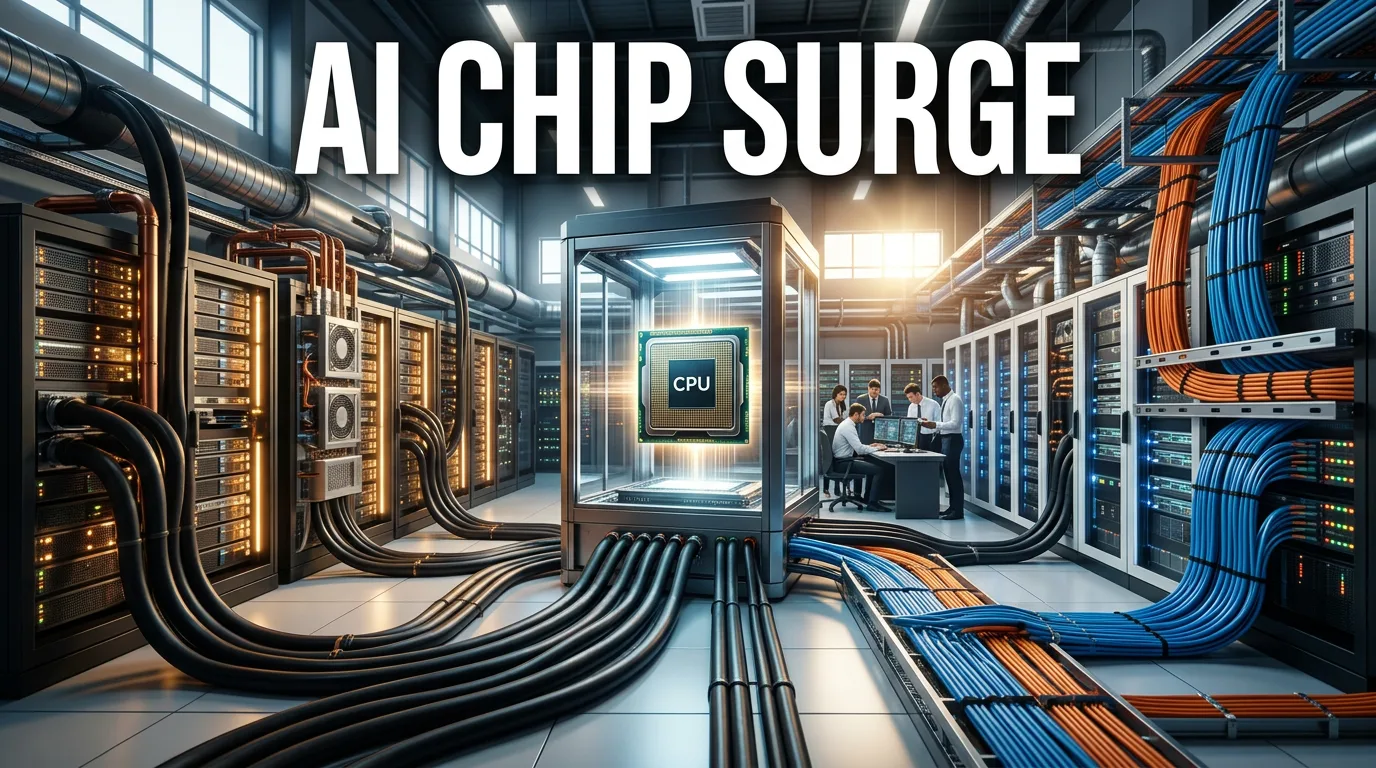
Optical networking is a key enabling layer for AI data centers. As server counts rise, interconnect traffic grows materially, and copper cabling faces bandwidth and power-efficiency constraints. This accelerates migration toward optical links.
NVIDIA’s increased investment and contracting activity in optical-related areas reinforces the view that interconnect is a binding constraint. If memory represents a storage/processing bottleneck, optical networking addresses transmission bottlenecks.
7. NVIDIA’s Strategic Shift: From GPU Vendor to Ecosystem Capital Allocator
Viewing NVIDIA solely as a GPU supplier understates its current role. The company is increasingly deploying capital across the AI infrastructure ecosystem—optical networking, custom silicon, networking, server interconnect, and production partnerships.
Such capital allocation can function as a market signal: areas receiving strategic investment are more likely to become required infrastructure within AI data centers. NVIDIA is evolving toward a platform-style influence across the broader supply chain.
8. Current Leadership Segments
Leadership is concentrated in four linked pillars:
- Memory semiconductors
- CPUs and foundry
- Optical networking
- Power and cooling infrastructure
These are not separate themes; they form an integrated bill of materials. Adding AI server capacity requires simultaneous scaling across compute, memory, interconnect, and facility-level power/thermal systems. The market is effectively pricing an “AI infrastructure capex” cycle distributed across multiple industries.
9. Key Risks Investors Should Monitor
9-1. Overheating Risk
Price momentum is strong, but entry timing remains non-trivial. The slope of gains in some memory ETFs and semiconductor names implies elevated risk of sharp profit-taking even on positive news.
9-2. Expectations May Lead Fundamentals
Current pricing reflects not only near-term earnings improvement but also scarcity premia, policy support expectations, and structural growth narratives. Any signal of shipment delays, slower capacity expansion, or customer capex moderation could increase volatility.
9-3. Geopolitical and Policy Sensitivity
Semiconductors and AI-related equities are highly policy-exposed. Export controls, tariffs, technology-transfer constraints, and bilateral negotiations can materially shift sentiment and valuations, particularly for companies with meaningful China exposure.
10. Near-term Calendar and Monitoring Points
Near-term focus includes U.S.–China leader-level engagement. A constructive tone could support semiconductors, Big Tech, and AI-related equities with China sensitivity; disappointment could trigger outsized de-risking in recent winners.
Additional variables include inflation data, options expiration, crypto-related legislation review, and earnings releases among smaller-cap technology names. In strong momentum regimes, rotation can also broaden into adjacent themes such as newly listed AI semiconductor firms, robotics, and aerospace.
11. News-style Key Takeaways
- Memory semiconductors are increasingly viewed as a primary bottleneck resource in the AI era, attracting concentrated global capital.
- Big Tech is competing for memory allocation, reportedly offering prepayment-like terms to secure supply.
- U.S. policymakers are elevating memory scarcity within supply-chain strategy discussions.
- Markets are re-rating memory from a cyclical segment to a strategic scarce asset.
- Memory strength is propagating across CPUs, foundry, semiconductor equipment, optical networking, and power infrastructure.
- NVIDIA is expanding influence beyond chips into broader AI infrastructure ecosystem positioning.
- Near-term overheating, policy uncertainty, and U.S.–China risk remain critical constraints.
12. Underappreciated Core Point
The key issue is not simply “memory is rising.” The core is that AI-era bottlenecks extend beyond GPUs into memory, optical networking, power, cooling, and foundry simultaneously.
Companies that relieve these constraints may be positioned not only for earnings recovery but also for multi-year benefits from supply-chain reconfiguration. This framework links ETF inflows into memory, NVIDIA’s optical investments, and U.S. policy focus on memory into a coherent narrative: the market is assigning a premium to solutions that unlock AI infrastructure scaling.
13. Conclusion (Investor Report)
Global equities are currently more sensitive to the AI infrastructure investment cycle than to rates, consumption, or conventional macro signals.
Memory sits at the center, with CPUs, foundry, optical networking, and power/cooling as adjacent beneficiaries. For monitoring Nasdaq performance, U.S. equities, semiconductor ETFs, and AI-linked names, analysis should extend from individual companies to system-level bottlenecks across the supply chain.
Given elevated momentum, a balanced approach is warranted: avoid indiscriminate extrapolation, while maintaining a structured view of which infrastructure layer is likely to become the next constraint.
< Summary >
Memory semiconductors are being re-rated from a cyclical segment to a strategic asset in the AI era. Big Tech is prioritizing supply security, including prepayment-like terms, and U.S. policy attention is increasingly focused on memory supply chains. Current market leadership spans memory, CPUs/foundry, optical networking, and power/cooling infrastructure. NVIDIA is expanding from a GPU vendor toward an AI infrastructure ecosystem investor. Overheating risk, U.S.–China dynamics, and policy volatility remain key risk factors.
[Related Articles…]
AI Semiconductor Supply-Chain Reconfiguration and Korea Export Outlook
https://NextGenInsight.net?s=semiconductors
Post-NVIDIA: Key AI Infrastructure Investment Factors
https://NextGenInsight.net?s=nvidia
*Source: [ 소수몽키 ]
– 전세계가 메모리 반도체에 열광? AI 시대 재평가 받는 주식들
● AI-Revolution, Semiconductor-Surge, Liquidity-Shift
Mixed Circle Results but a Higher Stock Price; HSBC Raises S&P 500 Target to 7,650; JPMorgan Floats a KOSPI 10,000 Scenario: The Current Market Core Is Semiconductors, Liquidity, and AI Infrastructure
Today’s market appeared muted in headline index moves. Under the surface, several structural shifts are progressing simultaneously.
This report focuses on: (i) why semiconductors continue to lead, (ii) why US equities remain resilient despite rate pressure, (iii) why Korean equities are re-entering the center of global capital allocation, and (iv) why Circle and stablecoins are increasingly interpreted as payments infrastructure for an AI-driven economy.
Many commentaries reduce the narrative to “semiconductors are strong,” “Bitcoin is up,” or “targets were raised.” The more relevant issue is the underlying transmission mechanism. This report links US equities, KOSPI, semiconductors, inflation, and AI industrial dynamics.
1. US Equities Snapshot: Indexes Flat, Market Internals Not Flat
US equities were broadly range-bound: the S&P 500 slightly higher; the Nasdaq and Dow modestly lower; the Russell 2000 slightly higher.
- S&P 500: marginally higher
- Nasdaq: marginally lower
- Dow: marginally lower
- Russell 2000: slightly higher
The key point is that subdued index performance does not imply reduced market risk appetite. Capital is becoming more concentrated in semiconductors and AI-linked equities.
2. Semiconductors Remained the Lead Theme
Memory and legacy semiconductor names (including Micron, Intel, and SanDisk) maintained relative strength.
This is no longer a “single-name” phenomenon. Demand visibility is broadening beyond GPUs to CPUs, memory, storage, power infrastructure, and the full data-center stack. This suggests the AI investment cycle is moving from a narrow theme to broader industrial expansion.
2-1. What Intel’s Rise Signals: A Change in Market Interpretation
Intel had recently been viewed as structurally challenged, particularly relative to Nvidia in AI and high-performance compute.
Recent strength is better explained by a shift in market framing: AI deployment at scale increases demand not only for GPUs, but also for the operating backbone of compute (CPUs), as well as memory and storage. Intel’s move is therefore increasingly treated as evidence of a widening AI capex beneficiary set rather than a purely technical rebound.
2-2. Why Micron Strength Matters: Direct Read-Through to Korean Semiconductors
Micron functions as a market proxy for the memory cycle. Sustained strength tends to lift expectations for Samsung Electronics and SK hynix via improved pricing and earnings expectations in memory.
As the market prices a stronger memory recovery, the probability of valuation re-rating for Korean memory leaders increases, with direct implications for KOSPI performance.
2-3. How US-Listed ETF Inflows Can Lift Korean Semiconductor Large Caps
When flows enter US-listed semiconductor or DRAM-related ETFs, those vehicles cannot typically purchase Samsung Electronics or SK hynix spot shares directly in the US market. However, exposure can be created via swaps and derivative structures.
In practice, global dealers and Korea-focused desks that intermediate these exposures may need to buy Korean cash equities in subsequent sessions as hedges. As a result, US equity flows into semiconductor products can indirectly translate into systematic buying of Korean semiconductor mega-caps.
If persistent, this dynamic can increase semiconductor index weight within KOSPI during rallies. Recent KOSPI upside has been disproportionately driven by Samsung Electronics and SK hynix, consistent with this mechanism.
3. Why “Short Semiconductors” Is Repeatedly Flagged as Risky
Wall Street commentary has increasingly characterized short positioning in semiconductors as structurally difficult, beyond simple concerns about overextension.
3-1. Reason 1: Demand Is Expanding Across the Stack
AI beneficiaries have broadened from a GPU-centric narrative to include CPUs, memory, networking, storage, and power equipment, driven by agentic AI, real-time automation, and enterprise AI scaling.
This frames the semiconductor rally as a supply-chain-wide revenue expansion rather than a single-stock momentum trade.
3-2. Reason 2: Earnings Momentum Offsets Valuation Concerns
Comparisons to the 2000 bubble are often based on price charts. A key distinction is earnings delivery.
For certain semiconductor companies, forward 12-month P/E multiples remain near or below market averages despite large price appreciation, reflecting profit growth outpacing share-price gains.
3-3. Reason 3: Supply Tightness Reflects Structural Bottlenecks
Leading-edge capacity is largely pre-booked, while AI server and data-center demand continues to rise. Supply constraints appear difficult to resolve quickly, supporting pricing power and margins for key suppliers.
4. The Primary Fuel: Liquidity Is Not Gone; It Is Reallocated
Market participants often question why US equities remain firm despite sticky inflation and reduced expectations for near-term rate cuts. The relevant point is that liquidity has not disappeared; it has shifted toward segments with the clearest growth and earnings visibility.
4-1. Effects of a Late-Cycle Tightening Regime
If the Fed further reduces the intensity of balance-sheet runoff or moves toward a less restrictive stance, cash previously parked in short-duration instruments can rotate back into risk assets.
The first destinations are typically sectors with dominant competitive positioning, high earnings visibility, and strong secular narratives, notably semiconductors and AI megacaps.
4-2. Fiscal Outlays Function as Incremental Liquidity
Even when monetary conditions appear restrictive, ongoing fiscal programs continue to channel funds into the economy. Semiconductor support, AI-related tax incentives, defense AI budgets, and cloud/data-center investment support can translate into corporate capex, equipment orders, and backlog growth.
4-3. Megacaps Create Their Own Liquidity
Large technology companies generate substantial free cash flow and recycle it through buybacks, dividends, and investment. In such a regime, equity performance becomes less mechanically linked to short-term rate expectations.
5. Why HSBC Can Raise the S&P 500 Target to 7,650
HSBC’s higher target is consistent with:
- continuation of an AI-driven earnings cycle
- upward revisions to semiconductor and megacap profit forecasts
- concentration of flows into growth sectors despite rate pressure
- a market where the destination of liquidity matters more than aggregate liquidity
This does not imply broad-based participation. The rally remains narrow, led by a small set of large-cap winners, which is also a key risk.
6. JPMorgan’s KOSPI 10,000 Scenario: Not Purely Hypothetical
The level appears aggressive but not categorically impossible under a global semiconductor upcycle. KOSPI is not solely a domestic-demand equity market; it is increasingly treated as a major beneficiary of the global AI semiconductor supply chain.
6-1. Re-Rating Potential for Samsung Electronics and SK hynix
These firms are central to AI memory (including high-bandwidth memory), server semiconductors, and advanced packaging demand. As US and Taiwan semiconductor strength persists, Korean leaders are structurally positioned to remain in focus.
6-2. Foreign Inflows: A Changing Composition
Historically, foreign flows were the dominant driver and retail investors often followed. More recently, retail participation reflects stronger long-horizon conviction in semiconductor fundamentals, which can extend trend persistence while increasing volatility.
6-3. US ETF and Global Allocation Effects
Global AI/semiconductor allocations and US-listed ETF flows can transmit into Korean semiconductor exposure via the mechanisms described above. If sustained, index upside may exceed prior consensus ranges.
7. CPI, Oil, and Middle East Risks: Why Headline Risks Have Not Broken the Market
US CPI remains a near-term catalyst. Elevated energy and gasoline prices can lift headline inflation prints.
Market sensitivity has shifted from the data point itself to whether it disrupts AI capex plans and the earnings trajectory of key semiconductor and megacap firms. To date, those investment and profit streams have not shown clear impairment.
7-1. Higher Oil: Real-Economy Headwind, Limited Equity Index Impact So Far
WTI and Brent remain elevated. US consumers face meaningful gasoline-driven cost pressure. However, markets have largely priced geopolitical risk as persistent but contained, absent a direct supply shock.
7-2. US-China Leader-Level Meeting: Key Watch Items
The meeting is relevant to AI semiconductors, supply chains, tariffs, and Middle East considerations. The presence of major corporate leaders would signal that industrial and technology policy topics may be central.
Key items to monitor:
- AI semiconductor export controls and supply-chain adjustments
- potential use of Chinese influence on Iran-related dynamics
- tariff policy and strategic industry coordination
- direction of global manufacturing and data-center investment
8. Circle: Mixed Results, Stock Up
Circle reported revenue growth alongside lower net income, a mixed profile, yet the market reaction was positive.
The primary driver appears to be a reframing of Circle from a stablecoin issuer to a foundational infrastructure provider for AI-era payments and settlement.
8-1. Circle Metrics (High Level)
- revenue: increased year over year
- USDC on-chain volume: materially higher
- net income: declined
Net income weakness is partly consistent with IPO-related compensation, forward investment, and infrastructure expansion costs, which markets may be treating as growth expenditures.
8-2. The Core Angle: Payments Infrastructure for AI Agents
The investment thesis increasingly centers on a programmable digital-dollar rail that can support machine-to-machine transactions. In an environment where AI agents autonomously execute spending, subscription payments, and settlements, stablecoins such as USDC can function as a native settlement layer.
This supports an interpretation of Circle as AI-native financial infrastructure rather than a pure crypto beta asset.
8-3. Why Institutional Capital Is Engaging
Participation by large traditional financial institutions in financing and ecosystem development indicates continued integration of stablecoins into regulated capital markets and payments infrastructure.
9. Current Market Interpretation: Leader Concentration and Structural Positioning
The market is not rewarding all names within a theme. Capital is concentrating in category leaders with demonstrable earnings leverage and secured demand.
This environment reduces the effectiveness of mean-reversion strategies based solely on drawdowns. Flow analysis and earnings durability are increasingly decisive.
10. Core Points Often Underemphasized in Media Coverage
10-1. The Semiconductor Rally Reflects Cash-Flow Industrialization
AI is translating into capex, orders, and installed capacity, indicating a shift from narrative-driven enthusiasm to investment-led industrial scaling.
10-2. Liquidity Is Concentrating
Even with constrained system-wide liquidity, capital can remain abundant in high-conviction areas such as semiconductors and AI.
10-3. Korea Is Not Simply a US Equity Proxy
KOSPI is increasingly valued as a strategic node in the global AI semiconductor supply chain, with Samsung Electronics and SK hynix treated as core global assets.
10-4. Stablecoins as AI Financial Infrastructure
Stablecoins are increasingly framed as programmable settlement rails for automated economic activity, not merely a speculative crypto theme.
10-5. The Real Economy vs. Equity Market Gap Can Persist
Household cost pressure and energy-driven inflation may remain elevated, while equity indexes are supported by the earnings and cash-flow dominance of a narrow group of large-cap firms.
11. Key Forward Variables to Monitor
- US CPI outcomes and the degree of energy pass-through
- messaging on semiconductors, tariffs, and Middle East issues from US-China engagements
- persistence of semiconductor supply bottlenecks
- trajectory of megacap capex
- pace of stablecoin and digital-asset institutional integration
- degree of semiconductor concentration within KOSPI
12. One-Line Conclusion
This is not a “strong economy” rally; it is a regime where liquidity concentrates in AI, semiconductors, and infrastructure assets with superior earnings delivery. Apparent index-level stability can mask ongoing reallocation into the next phase of AI infrastructure buildout.
< Summary >
US equities were near flat at the index level, but market leadership remained concentrated in semiconductors and AI.
The semiconductor cycle is broadening beyond GPUs to CPUs, memory, power, and the broader data-center stack, supported by earnings and order visibility.
HSBC’s S&P 500 7,650 target and JPMorgan’s KOSPI 10,000 scenario are consistent with a market shaped by AI-driven earnings revisions and concentrated liquidity allocation.
Despite mixed reported results, Circle is increasingly valued as AI-era financial infrastructure rather than a pure stablecoin issuer.
The dominant market drivers are earnings durability over rates, liquidity destination over aggregate liquidity, and structural AI/semiconductor expansion over index-level moves.
[Related Links…]
- https://NextGenInsight.net?s=semiconductor
- https://NextGenInsight.net?s=stablecoin
*Source: [ Maeil Business Newspaper ]
– 서클 실적 혼조, 주가는 상승ㅣHSBC, S&P500 연간목표가 7,650으로 상향ㅣJP모건, 코스피 상승 시나리오 목표가 10,000ㅣ홍키자의 매일뉴욕