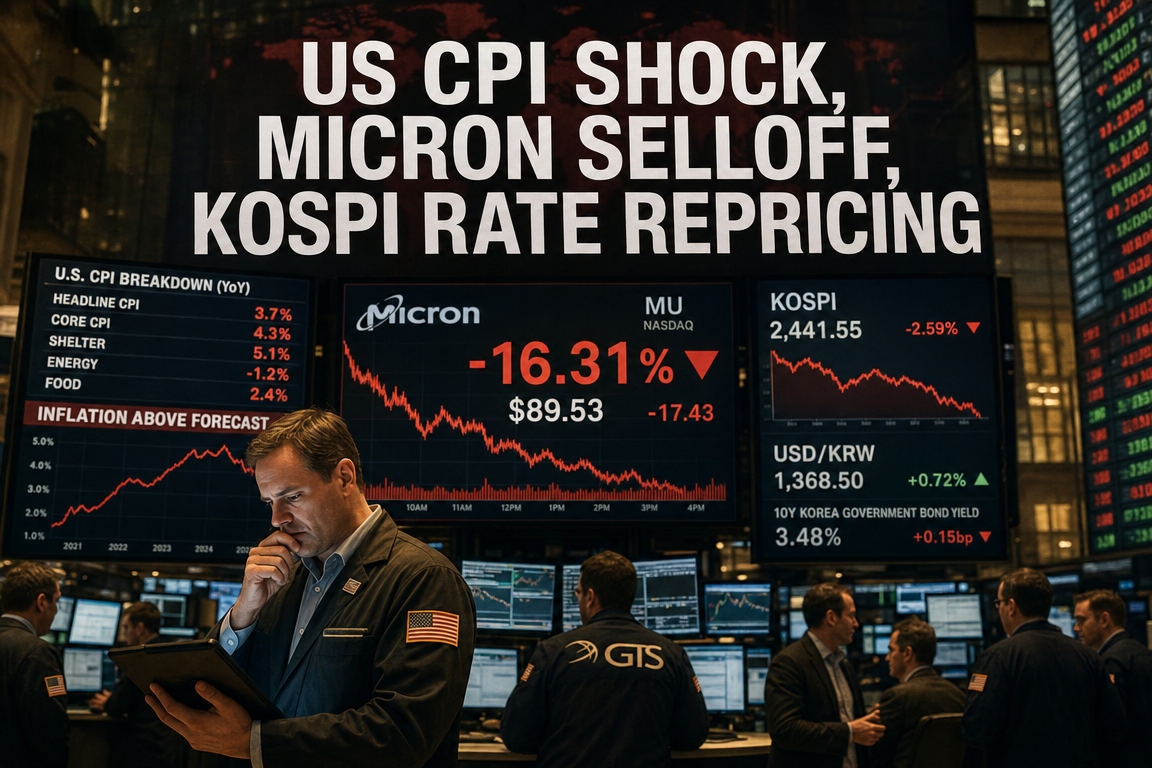
● Inflation Shock, Micron Plunge, Samsung and SK Hynix Hit, KOSPI Sinks
US Inflation Shock, Micron Sell-Off, and the Underlying Drivers Moving Samsung Electronics, SK Hynix, and the KOSPI
This is not merely a “US CPI came in hot” headline. The current move reflects a combined repricing across US inflation, rate-path expectations, semiconductor valuation sensitivity, softening confidence in the memory upcycle, and foreign flow dynamics. The key is the market’s transmission mechanism.
1. Immediate catalyst: US inflation printed above expectations
A higher-than-expected US inflation reading reduces the likelihood of near-term Fed easing. Markets tend to reprice toward higher-for-longer or renewed tightening risk.
This matters because:
- Higher rates increase discount rates applied to future cash flows
- Growth/technology segments typically absorb the first-order impact
- Semiconductors, where expectations are heavily embedded in prices, often exhibit amplified drawdowns
Recent risk assets had partially priced in a potential easing trajectory. When that expectation weakens, volatility increases.
2. Why Samsung Electronics and SK Hynix are more rate- and US-tech-sensitive
These names are not only single-stock exposures; they are structural drivers of the KOSPI and therefore closely linked to US rates, US tech sentiment, and semiconductor-cycle narratives. Key pressure points:
2-1. Higher rates raise the valuation hurdle for semiconductors
Semiconductor equities are priced on both current earnings and expected cycle recovery. As discount rates rise, the present value of future improvement declines, tightening valuation support even if earnings forecasts are unchanged.
2-2. Concerns that memory-cycle expectations may weaken
Both companies have substantial memory exposure. Recent optimism was supported by AI-driven demand, HBM growth, and ongoing data center capex. A hotter inflation backdrop can tighten financial conditions and challenge growth assumptions, raising concerns that:
- IT demand normalization may slow
- Data center capex sentiment could become more conservative
- Memory pricing momentum may be less durable than expected
2-3. Micron’s sharp decline acts as a global sector reference point
A large move in Micron is not treated as idiosyncratic. Global investors often trade semiconductors as a correlated basket. A US memory leader selling off can rapidly translate into risk reduction across Korean memory leaders, including through flow-driven, fundamentals-agnostic de-risking.
2-4. Foreign flows can transmit the shock to the entire KOSPI
Foreign ownership is meaningful in large-cap Korea, and foreign flows frequently concentrate in Samsung Electronics and SK Hynix. If US rate expectations shift higher, USD strength can re-emerge, reducing EM risk appetite. Potential knock-on effects include:
- KRW depreciation pressure
- Higher probability of foreign outflows
- Concentrated selling in liquid index heavyweights
This is not only a single-stock issue; weakness in these two names can mechanically weigh on the index.
3. Market recap (news-style)
US inflation data
Inflation exceeded consensus, weakening expectations for imminent policy easing. Markets repriced the timing and magnitude of potential cuts, and risk appetite deteriorated, led by technology and semiconductors.
US semiconductor performance
Micron’s significant decline increased perceived downside risk for Korean memory leaders. Given global sector correlation and basket trading behavior, US semiconductor weakness can transmit directly to Korea.
KOSPI implications
Samsung Electronics and SK Hynix are top index constituents. A drawdown in these names can pressure the KOSPI, particularly when foreign flows are sensitive to rate and FX moves.
4. Why comparisons to 2022 are resurfacing
The 2022 episode featured inflation-driven rapid tightening and material drawdowns in growth and semiconductors. That memory increases market sensitivity to inflation surprises.
However, the current regime differs:
- 2022: initiation of aggressive tightening
- Now: re-affirmation risk of a prolonged restrictive stance
This implies less shock novelty but potentially greater fatigue from extended tight conditions.
5. Key monitoring points for Samsung Electronics and SK Hynix
5-1. Distinguish between an event-driven pullback and a trend shift
Not every decline implies structural deterioration. Key indicators:
- Whether the US 10-year yield continues to rise materially
- Whether Micron remains weak for multiple sessions
- Whether foreign investors sustain net selling in Samsung Electronics and SK Hynix
- Whether USD/KRW accelerates higher
Deterioration across several factors simultaneously increases the probability that the move is not purely transitory.
5-2. AI demand does not fully offset macro repricing risk
AI-linked semiconductor demand can remain strong, but equity prices can still correct if:
- Discount rates rise
- Valuations appear extended
- Profit-taking intensifies
These equities remain highly exposed to macro variables in the short run.
5-3. The KOSPI is more vulnerable due to semiconductor concentration
Korea’s index structure is more concentrated than US benchmarks. As a result, semiconductor drawdowns can translate into index-level weakness more directly, reducing overall shock absorption capacity.
6. Core point often underemphasized: the market is repricing a broken narrative, not just a CPI print
6-1. Markets react more to scenario disruption than to the absolute number
Markets price forward scenarios. A prevailing framework had been:
- Disinflation would continue
- The Fed would eventually ease
- Semiconductors would improve supported by AI demand
- Earnings for Samsung Electronics and SK Hynix would recover
An upside inflation surprise undermines the initial premise, weakening the broader risk-on narrative supporting semiconductors.
6-2. Semiconductors can fall more due to positioning than fundamentals
If many investors are already overweight the sector, even modest negative macro surprises can trigger outsized selling through position reduction. This is consistent with a crowded-trade unwind dynamic.
6-3. The primary near-term risk for the KOSPI is FX and foreign flows, not earnings headlines
Short-term index direction is often driven more by USD/KRW and foreign investor flows than by incremental earnings news. In risk-off regimes, large, liquid names can become the first source of funding and risk reduction.
7. Key upcoming variables to monitor
- Additional US inflation and labor market releases
- Shifts in Fed communications
- Trend in the US 10-year yield
- Direction of the USD index and USD/KRW
- Rebound or continued weakness in US semiconductor equities, including Micron
- Persistence of foreign net buying/selling in Samsung Electronics and SK Hynix
- Evidence-based demand data for HBM, server memory, and AI infrastructure capex
If these stabilize, the shock may remain contained. If multiple indicators deteriorate concurrently, KOSPI volatility may increase further.
8. One-sentence summary
The risk is that a higher US inflation print simultaneously pressures rates, FX, foreign flows, and semiconductor cycle expectations, and Micron’s sell-off reinforces the negative sector signal for Korean memory leaders.
< Summary >
A higher-than-expected US inflation print weakened easing expectations and pressured technology and semiconductor risk appetite. Micron’s sharp decline increased perceived downside risk for Samsung Electronics and SK Hynix, potentially amplifying KOSPI volatility via sector correlation and foreign flow sensitivity. The key issue is not the inflation datapoint alone, but the disruption of the liquidity and cycle-recovery narrative. Going forward, rates, FX, foreign flows, and US semiconductor performance should be monitored jointly.
[Related Articles…]
- Semiconductor cycle inflection signals: key indicators to monitor now (NextGenInsight.net?s=semiconductor)
- Why foreign flows and FX matter in rising KOSPI volatility (NextGenInsight.net?s=KOSPI)
*Source: [ 내일은 투자왕 – 김단테 ]
– 하이닉스, 삼성전자, 코스피 큰일 난 이유 (5월 13일)
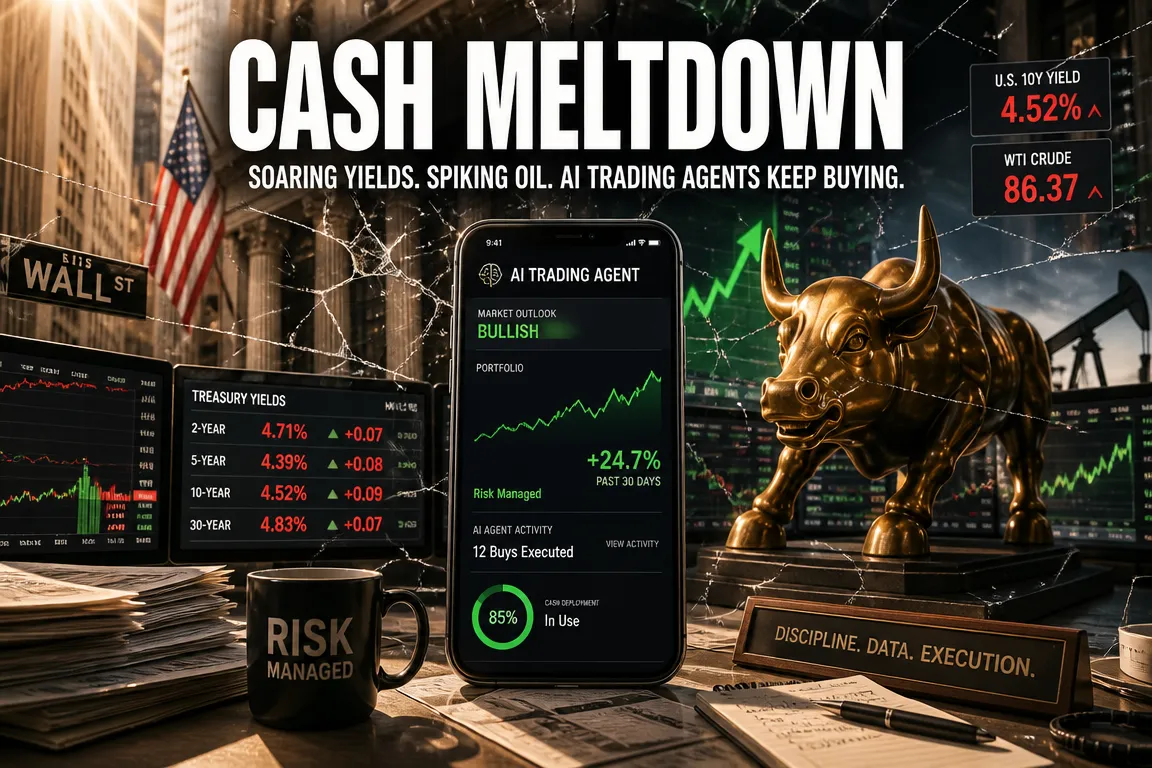
● US-China, CPI Shock, Rate Reprice
US-China Summit and the US CPI Shock: The Market’s Real Inflection Points
This is not a standalone story about the US-China summit or a single US CPI print. The market-relevant pivot is the interaction of three factors:
1) US-China relations are re-entering a bargaining phase in which tariffs, semiconductors, and energy supply are being negotiated as a linked package.
2) US inflation has re-emerged as a primary market driver after a stronger-than-expected CPI release.
3) The combination can simultaneously influence US Treasury yields, policy-rate expectations, and equity-market direction.
1. Why the US-China Summit Matters Now
The summit functions less as a ceremonial diplomatic event and more as a negotiation over a rebalancing of economic and security arrangements. Extended engagement time suggests deeper agenda-setting and practical coordination.
From a market perspective, the key point is that current US-China frictions extend beyond trade into semiconductors and supply chains, energy security, tariffs, technology competition, and Middle East geopolitics.
1-1. Practical agenda beyond the headline items
Core negotiating positions can be summarized as follows:
- China’s priorities: relief from elevated tariffs; easing of semiconductor-related restrictions
- US priorities: narrowing the bilateral trade deficit; increased Chinese purchases of US energy
- Shared priorities: managing Middle East risk; stabilizing supply chains; reducing market volatility
The US position remains anchored to the view that China should increase purchases of US goods commensurate with its exports to the US. The practical focus has shifted from incremental agricultural purchases toward energy exports as a strategic lever.
1-2. Why the US is emphasizing energy
The US is no longer primarily an energy-importing economy. In oil and natural gas, the US has increasingly operated as a net exporter, with structurally rising crude and LNG exports over recent years.
Accordingly, potential US pressure on China to expand imports of US LNG and crude should be treated as an actionable trade-and-industry objective rather than diplomatic rhetoric. This aligns with a policy bias toward expanding domestic energy production and leveraging energy exports in broader trade negotiations.
1-3. Energy imports: security over cost optimization
The operating framework has shifted from lowest-cost energy procurement toward supply security and geopolitical resilience. Europe’s post-war reduction in Russian energy dependence illustrates willingness to accept higher costs to reduce strategic vulnerability.
This logic also applies to import-dependent economies: increasing the share of US LNG or crude can be framed as a supply-chain and security hedge rather than a pure cost-minimization decision.
2. Potential Market Implications of the Summit
If interpreted positively, the summit can support risk appetite, particularly through expectations of partial relaxation in semiconductor constraints, tariff adjustments, and incremental energy cooperation. This may improve sentiment toward Asian equities and manufacturing-linked sectors.
However, the summit should be viewed as a bargaining process rather than a broad reconciliation. Partial measures are plausible; comprehensive resolution remains uncertain, increasing the probability of disappointment if expectations become excessive.
2-1. What corporate participation implies
References to major corporates (e.g., Musk-linked initiatives and large US industrial, technology, and pharmaceutical firms) signal the potential for sector-level working discussions after the summit. Market impact is more likely to emerge through subsequent regulatory adjustments and transaction resumptions than through summit communiques.
3. Why This CPI Print Was Interpreted as a Shock
The key issue was not only a higher CPI level, but a stronger-than-expected outcome versus consensus and signs that energy-driven inflation may be spreading into other components.
The market message was not “one-off inflation,” but “potential re-acceleration.”
3-1. Headline and core were both firm
Headline CPI exceeded expectations, and core CPI was also stronger than forecast. This suggests inflation pressures are not confined to volatile components. For the Federal Reserve, persistence in core services and housing-related inflation is more policy-relevant than isolated energy fluctuations.
3-2. Primary risk: energy transmission into services and housing
The critical mechanism is pass-through:
- higher global oil prices
- higher domestic energy costs
- later effects on transportation, utilities, dining-out, and broader services
- eventual pressure on housing-related costs
If inflation becomes embedded in services and housing, the probability of policy restraint increases.
3-3. Why a housing-cost rebound matters
Housing has a large weight in US inflation measures. A renewed rise in housing costs undermines expectations of a sustained deceleration in services inflation and weakens the narrative of imminent policy easing.
4. The Fed and Policy-Rate Expectations: What Changes
The immediate impact of the CPI surprise was further erosion in rate-cut expectations. While the market had already reduced anticipated easing, the upside surprise reinforces the risk of higher-for-longer policy rates.
Two points are central:
- near-term rate cuts appear less likely
- markets cannot fully dismiss the tail risk of renewed tightening, even if not the base case
The more plausible scenario is extended policy restrictiveness rather than an imminent rate hike, given the current policy-rate level and the Fed’s sensitivity to inflation re-acceleration.
4-1. Why “higher for longer” can be more restrictive than a single hike
Persistent high rates raise corporate financing costs, prolong household borrowing burdens, and pressure equity valuations through a higher discount rate. Growth and technology segments are particularly sensitive, implying greater dispersion even if AI-linked themes remain structurally supported.
5. Treasury Yields and Equities: Why the Market Did Not Collapse
Despite the CPI surprise, downside in risk assets may be limited if positioning and flows had already reflected caution. Evidence of pre-event defensive rotation and conservative foreign flows implies partial pre-pricing of the risk.
5-1. Treasury yields remain the primary sensitivity channel
Inflation surprises raise expected inflation and push out the timing of easing, creating upward pressure across the yield curve. Dollar strength can accompany this adjustment. Equity markets may initially appear resilient, but sustained yield pressure can later transmit into valuation compression.
6. The Critical Forward Checkpoints
A single CPI print is not determinative. The key variables to monitor are:
- whether next month’s CPI accelerates further
- whether PCE inflation follows the same direction
- whether global oil prices stabilize or Middle East risks re-intensify
- whether post-summit signaling points to energy cooperation or tariff relief
- the extent to which higher Treasury yields pressure equity valuations
The current regime requires tracking the interaction among inflation, diplomacy, energy, and rates rather than reacting to isolated data points.
7. AI Trends and the Fourth Industrial Transformation: Market-Relevant Shifts
This macro setup has direct implications for AI and advanced-industry positioning because higher rates and supply-chain realignment can reshape investment pace and industry cost structures.
7-1. The geopoliticization of semiconductors and AI infrastructure
Semiconductors are treated as strategic assets. AI servers, data centers, high-performance computing, autonomous systems, and robotics depend on semiconductor supply chains. Therefore, any change in US-China restrictions influences AI infrastructure deployment and large-cap technology earnings dynamics.
7-2. Energy and AI are structurally linked
AI scale-out increases power demand through data centers, semiconductor fabrication, cloud infrastructure, and grid investment. Volatility in oil and natural gas can affect operating costs and capex assumptions across the AI ecosystem.
Competitive advantage may increasingly favor countries and firms with coordinated access to chips, power, networks, and data.
8. News-Style Key Takeaways
The US-China summit has evolved into a strategic negotiation that includes energy supply realignment alongside tariffs and semiconductors.
The US is likely to encourage China to expand purchases of US LNG and crude, reflecting the US structural shift toward energy exports and its objective of reducing the bilateral trade deficit.
The US CPI exceeded expectations, increasing concerns about inflation persistence. The critical issue is potential transmission from energy into core services and housing.
Rate-cut expectations weakened. The primary risk is higher-for-longer policy and upward pressure on Treasury yields rather than an immediate return to hiking.
Equities may have partially pre-priced the risk, but additional volatility is likely if PCE and subsequent CPI prints re-accelerate.
9. Underemphasized Market-Critical Points
- The summit’s implicit center of gravity may be energy trade renegotiation; LNG and crude purchases can become core bargaining chips alongside semiconductors.
- The principal inflation risk is pass-through effects; if energy feeds into services and housing, the Fed’s reaction function can become more restrictive.
- Markets may have partially pre-priced the shock; post-release equity stability should be cross-checked against bond-market repricing and upcoming inflation data.
The current environment is consistent with a structural transition in which energy leverage, supply-chain security, higher-for-longer rates, and AI infrastructure competition interact.
10. Interpretation for Investors and Practitioners
This phase favors scenario-based positioning over single-direction conviction:
- Near term: CPI-driven pressure persists, but some risk has been priced in
- Medium term: the next CPI and PCE prints are more decisive for policy expectations
- Structural: energy and supply-chain realignment are durable constraints
- Sector: semiconductors, AI, power infrastructure, and resources remain core axes
Market focus is shifting from the timing of the first cut to the duration of restrictive policy and the relative winners under that regime.
< Summary >
The US-China summit is a material inflection point, extending beyond tariffs and semiconductors to include energy-related bargaining.
The US may press China to increase imports of US LNG and crude, consistent with energy-export capacity and trade-deficit objectives.
US CPI surprised to the upside, raising concerns about renewed inflation momentum, especially through energy-driven transmission into services and housing.
Rate-cut expectations weakened; higher-for-longer policy and upward pressure on Treasury yields represent the more realistic risk than an immediate return to rate hikes.
Effective market interpretation requires integrating summit outcomes, oil-price dynamics, inflation releases, and AI/semiconductor supply-chain restructuring.
[Related Articles…]
- AI infrastructure expansion and the emerging variable of data-center power demand (https://NextGenInsight.net?s=AI)
- Post-realignment semiconductor supply chains: checkpoints for Korea’s exports and equity markets (https://NextGenInsight.net?s=반도체)
*Source: [ 경제 읽어주는 남자(김광석TV) ]
– [LIVE] (1)미중 정상회담 ‘분기점’ 될까? (2)미국 CPI 물가 심층분석 : ‘인플레 쇼크’ 오는가? [즉시분석]