● US-China Showdown, Semiconductors, Tariffs, LNG, Taiwan, Rare Earths
Immediate Readout of the US-China Summit: Key Implications for Capital Flows Across Semiconductors, Energy, Tariffs, and Taiwan
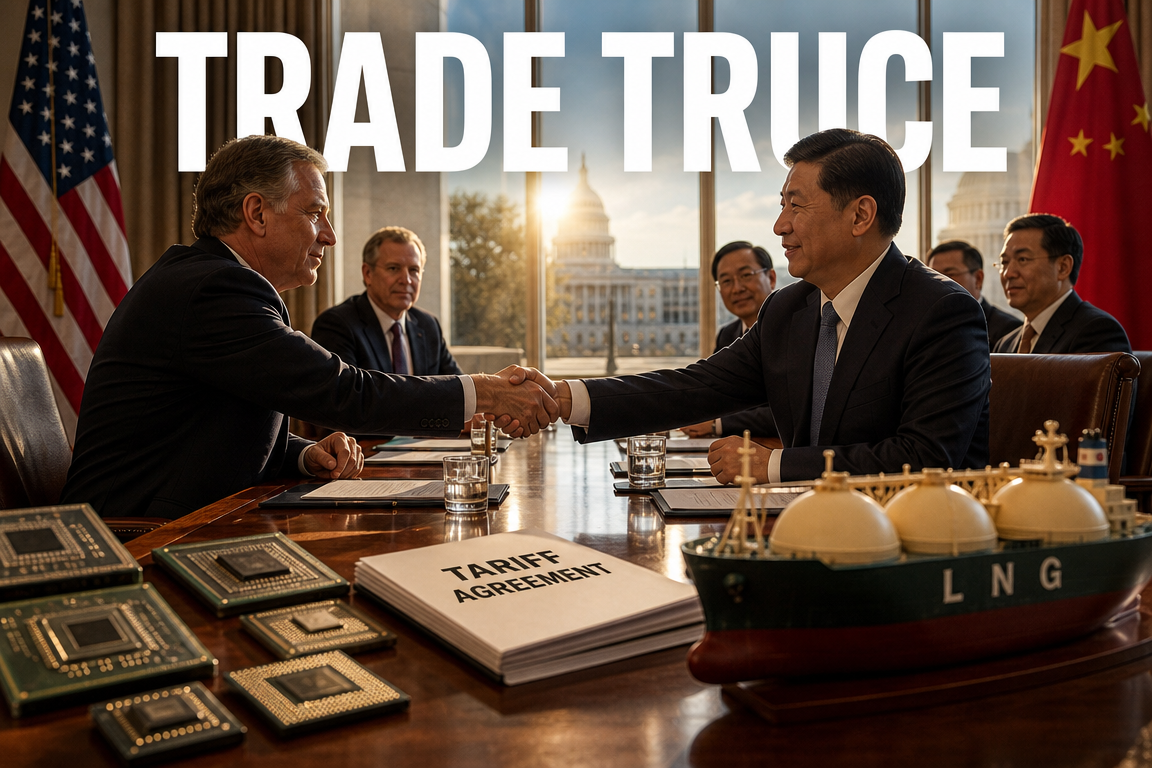
This summit is a market-relevant policy event. The key market-sensitive items are tariff adjustments, semiconductor export controls, LNG and energy supply chains, rare-earth negotiations, Taiwan risk, and Middle East geopolitics. The core issue is not “who demanded what,” but why urgency is asymmetric, which assets and industries may reprice first, and what it implies for Korean equities and exporters.
The underlying dynamic is a confrontation between US near-term political timing and China’s long-horizon strategy, with direct implications for the real economy, capital markets, technology leadership, and supply-chain reconfiguration.
1. One-line framing of the summit
The summit can be viewed as a transactional negotiation where both sides exchange near-term deliverables for strategic concessions.
- The US prioritizes quickly measurable outcomes.
- China prioritizes structural shifts in technology, security, and diplomatic positioning.
2. What the US is primarily seeking
US objectives are largely aligned with deliverables that can be communicated domestically in the near term.
2-1. Agricultural exports: beef and soybeans as political instruments
Expanded or resumed Chinese imports of US beef and soybeans would function as a highly visible trade outcome with direct linkage to US agricultural constituencies. This item is therefore a high-probability inclusion in any package of deliverables.
2-2. Expanded LNG exports: energy security and the trade balance
Increased Chinese purchases of US LNG is a practical negotiating item.
- For China: diversification away from Middle East supply concentration.
- For the US: trade-balance support and reinforcement of energy-export leverage.
Higher visibility of this topic can affect investor sentiment toward energy infrastructure, LNG shipping, and related logistics.
2-3. Improved market access for US firms in China
Beyond goods trade, the US may seek more predictable operating conditions for US companies in China, including investment protection and regulatory clarity. While less headline-driven, this can influence long-term valuation assumptions for US multinationals.
3. What China is primarily seeking
China’s agenda is more strategic, emphasizing technology constraints and geopolitical risk management over one-off contract volumes.
3-1. Easing semiconductor export controls: the most sensitive topic
China is likely to press for easing restrictions on advanced semiconductors, including AI accelerators (GPUs), advanced memory, and server infrastructure.
Market relevance extends beyond US-China trade: any change affecting leading AI compute supply can transmit to the broader AI infrastructure stack, including HBM, advanced packaging, semiconductor equipment, and data-center supply chains.
Key linkage for markets: GPU availability and HBM demand are tightly coupled. Increased AI infrastructure spending typically propagates across memory, packaging, power equipment, and thermal management.
3-2. Tariff relief: reducing the intensity of the trade conflict
China is expected to seek partial tariff reductions.
- Tariff relief may reduce pressure on global supply-chain reconfiguration pace.
- It may contribute to price stabilization for manufacturers and consumer goods.
- From a US perspective, it can be framed as supportive for inflation management.
3-3. Taiwan: China’s core red line
Taiwan is not treated by China as a purely territorial issue; it is also central to technology leadership and domestic political legitimacy, with advanced manufacturing capacity as a critical factor.
Even absent explicit agreements, moderated language or de-escalation signaling could be interpreted by markets as risk containment.
4. Core underlying trade-off: semiconductors versus rare earths
A practical “grand bargain” candidate is a partial exchange between semiconductor constraints and rare-earth supply flexibility.
4-1. Why rare earths matter
Rare earths underpin strategic industries spanning EVs, defense systems, wind power, smartphones, semiconductor equipment, and data-center power systems. Alternative supply chains require time to scale, making near-term supply stability a binding constraint.
4-2. Why China needs semiconductor access
China’s AI ecosystem, cloud infrastructure, autonomous systems, military applications, and advanced manufacturing all depend on access to high-performance compute and memory. Restrictions on advanced GPUs and high-end memory can impose structural limits on AI competitiveness.
4-3. Implications for Korea
Korea is a central node in memory and advanced components.
- Any adjustment in controls affecting China can shift earnings expectations and export outlook for Korean semiconductor and related supply-chain firms.
- If restrictions remain unchanged or tighten, supply-chain uncertainty is likely to persist.
5. Geopolitical agenda: Iran, Middle East conflict, and the Korean Peninsula
The summit also functions as a coordination point for global risk management.
5-1. Iran and Middle East de-escalation: testing China’s mediator role
Middle East risk can affect oil prices, shipping routes, inflation, and rate expectations.
- De-escalation could contribute to oil-price stabilization and ease inflation pressure.
- China may seek to strengthen its role as a diplomatic problem-solver, with longer-term implications for international positioning.
5-2. The Korean Peninsula: secondary but relevant as a background risk factor
North Korea’s nuclear issue and DPRK-Russia alignment remain material security concerns, but are unlikely to be the central negotiation track. For markets, the primary effect is through regional risk premia rather than direct summit deliverables.
6. Why the US is time-constrained and China appears less so
The negotiation is shaped by asymmetric time horizons.
6-1. The US needs near-term outcomes
Key pressures include inflation sensitivity, rate uncertainty, electoral timing, and manufacturing policy objectives. Tariff adjustments and lower-cost imports can be framed as supportive for price stability and economic messaging.
6-2. China is optimizing for long-term position
China’s priorities include easing technology pressure, managing Taiwan-related risk, reinforcing a mediator narrative, and maintaining leverage in supply-chain negotiations.
7. Where capital may move: immediate market checkpoints
7-1. Semiconductors and AI infrastructure
If expectations rise for easing semiconductor controls, initial market reactions could concentrate in semiconductors and AI infrastructure: accelerators, HBM, servers, power infrastructure, data-center cooling, and advanced packaging.
7-2. Energy and LNG
If LNG cooperation becomes more credible alongside Middle East risk moderation, energy-market effects may diverge:
- LNG transport and gas infrastructure may benefit.
- Upward oil-price positioning may weaken if de-escalation signals dominate.
7-3. Agriculture and transportation
Resumed agricultural purchasing can support expectations for grains, logistics, shipping, and port activity, contingent on contract size and durability.
7-4. FX and safe havens
A constructive tone may support risk appetite and reduce near-term USD strength. Conversely, hawkish messaging on Taiwan or semiconductors may revive safe-haven demand and volatility.
8. Key points in a news-style summary
8-1. Economy and trade
- The US seeks resumed purchases of US aircraft, expanded imports of beef and soybeans, increased LNG purchases, and improved market access.
- China seeks tariff reductions and normalization of trade conditions.
- Tariff easing could also support US inflation management.
8-2. Technology and security
- China is likely to prioritize easing semiconductor export controls and AI-related technology restrictions.
- The US seeks stable rare-earth supply and resilience in strategic supply chains.
- A semiconductors-versus-rare-earths exchange is a plausible core bargaining channel.
8-3. Geopolitics
- Iran and broader Middle East dynamics are direct inputs into oil and rates.
- China may pursue a mediator role.
- Taiwan remains the most sensitive red-line topic regardless of public communiqué language.
9. Under-covered but material considerations
9-1. The key question is urgency, not “who won”
Near-term political and economic messaging needs make the US more time-sensitive, which can increase China’s bargaining leverage.
9-2. The semiconductor issue is broader than chips; it is the AI infrastructure stack
Market repricing is not confined to leading GPU vendors. It can propagate to HBM, packaging, power equipment, cooling, data-center buildout, networks, and upstream materials.
9-3. Taiwan is a supply-chain issue as much as a geopolitical one
Taiwan anchors the most advanced foundry capacity. Rhetorical intensity on Taiwan can change discount rates for global tech risk assets.
9-4. China’s objective extends beyond sanctions relief to status redefinition
China may aim to position itself as a stabilizing actor relative to US-driven volatility. If reinforced, this can affect long-term sentiment on dollar dominance, bloc formation in trade, and supply-chain restructuring.
10. Points Korea should monitor
Korea is not a direct party but is highly exposed via trade and supply chains.
10-1. Semiconductor export outlook
Any shift in China-related controls can affect Korean memory producers and equipment/material suppliers.
10-2. Energy import burden
Middle East stabilization is positive for Korea’s energy import costs and domestic price stability.
10-3. FX and foreign flows
Reduced US-China tension can be supportive for KRW and foreign inflows, while renewed tech-security confrontation can raise volatility.
11. Conclusion: the summit as a signal for capital reallocation
This summit links six market-critical axes: tariffs, semiconductors, rare earths, LNG, Taiwan, and Middle East risk. The market focus is likely to be less on headline outcomes and more on changes in tone, attendee composition, and which issues are deprioritized.
Capital tends to reallocate toward predictability rather than toward formal declarations of rapprochement. Even limited de-escalation and clearer red-line management can prompt earlier market reactions.
< Summary >
- Core topics: tariffs, semiconductors, rare earths, LNG, Taiwan, and Middle East geopolitics.
- The US prioritizes near-term trade and energy deliverables ahead of domestic political timelines.
- China prioritizes easing technology constraints, managing Taiwan risk, and strengthening international positioning.
- A semiconductors-versus-rare-earths exchange is a key implicit bargaining channel.
- Korea’s key sensitivities: semiconductor exports, FX and foreign flows, and energy import costs.
- This is not primarily a diplomatic event; it is a potential inflection point for global growth narratives, AI infrastructure exposure, and capital-market positioning.
[Related Articles…]
- https://NextGenInsight.net?s=Semiconductors
- https://NextGenInsight.net?s=LNG
*Source: [ 경제 읽어주는 남자(김광석TV) ]
– [속보] 미중 정상회담 세기의 담판 : 돈이 이동한다 [즉시분석]
● AI Frenzy, Inflation Shock, Leveraged ETF Surge
Surge in Flows to U.S. Leveraged Equity ETFs: What the AI-Led Rally Signals Despite Inflation Shocks
This market move cannot be explained solely by broad U.S. equity strength. The key points are:
First, the Nasdaq advanced despite a PPI shock that was stronger than CPI.
Second, gains were concentrated in mega-cap AI and semiconductor names such as NVIDIA, Micron, and Google rather than the broader market.
Third, record-scale inflows into leveraged ETFs are amplifying near-term overheating risk.
This report summarizes re-accelerating inflation, the rate path, a narrow mega-cap-led rally, the semiconductor cycle, and the core drivers of AI investment.
1. Market Snapshot: Mega-Cap Buying Overpowered the Inflation Print
U.S. Producer Price Index (PPI) data came in significantly above expectations:
+1.4% m/m vs. +0.5% consensus.
+6.0% y/y, with core PPI at +5.2%.
Under typical conditions, such a print would push yields higher and pressure growth stocks. Market action diverged:
The Dow closed modestly lower, while the Nasdaq finished up more than 1%.
This indicates that technology leadership absorbed the inflation shock.
Key outperformers included Micron, Google, Apple, Amazon, Tesla, Meta, and NVIDIA.
Price action suggests the market is currently more sensitive to “who captures AI demand” than to macro data.
2. Why Did the Nasdaq Rise Despite Elevated Inflation Data?
Higher inflation typically delays Federal Reserve cuts and can reopen discussions of additional tightening, pressuring growth valuations.
This time, the pressure was visible in parts of the market but did not materially impact a small set of leaders.
Two primary drivers:
2-1. A “Narrow Rally” Rather Than Broad-Based Strength
The current U.S. equity advance is not broad.
A limited group of mega-cap technology and AI/semiconductor companies is lifting the indices.
Headline index strength may diverge from average-stock performance.
In narrow leadership regimes, market direction depends less on “the whole market” and more on whether the dominant leaders remain resilient.
2-2. Earnings Growth Expectations Are Outweighing Multiple Compression
Equity prices reflect earnings and valuation multiples.
Higher inflation and rates typically compress multiples.
However, leading AI and semiconductor names are supported by expectations of rapid forward earnings expansion, partially offsetting valuation pressure.
A notable factor is that, on forward estimates, some semiconductor valuations are viewed as within a justifiable range.
In effect, earnings revisions have moved higher alongside prices, limiting perceived valuation risk.
3. NVIDIA and the China Variable: A Supply-Chain Demand Signal
NVIDIA’s move stood out.
Market participants appeared to price in potential shifts in China-related export restrictions or broader bilateral semiconductor sentiment, linked to CEO travel and related headlines.
The stock reached new intraday highs alongside renewed market-cap milestone narratives.
This is not being treated as a purely event-driven move.
NVIDIA is positioned as a top-of-stack beneficiary of AI infrastructure.
Any incremental improvement in China-related access could support not only near-term revenue but also expectations for medium-term global demand normalization.
NVIDIA’s leadership is a proxy for the market’s conviction in the AI hardware investment cycle.
4. Why the Fed Remains Cautionary: Inflation Re-Entering the Center of Risk
Federal Reserve commentary remained relatively hawkish.
The core message: inflation is proving more persistent than expected.
Several officials indicated that additional tightening is not fully off the table.
This is a non-trivial risk signal for markets.
4-1. Why This Inflation Print Is More Problematic
The inflation impulse is not easily attributed to one-off factors such as energy or tariffs.
Elevated services inflation is a key concern.
Services inflation tends to be sticky, making it a focal point for policymakers.
Energy-driven inflation can fade with time, but services and wage-linked components can extend inflation persistence.
4-2. Geopolitical Risk Adds to Inflation Uncertainty
Iran-related geopolitical risk and crude oil dynamics can lift inflation expectations.
Oil affects transport costs, input costs, and broader inflation psychology.
Market sensitivity remains particularly high around why services inflation is not moderating.
5. Why Some on Wall Street Remain Relatively Calm: Focus on PCE
Despite strong CPI and PPI, some institutions remain comparatively measured because the Fed prioritizes the Personal Consumption Expenditures (PCE) price index.
Some expect core PCE to be less alarming than CPI/PPI.
A key reason is differing housing cost treatment:
Housing has a larger weight in CPI than in PCE.
Accordingly, CPI-driven concern may not translate one-for-one into PCE, supporting market stability despite inflation surprises.
6. The Core Question: Semiconductor Growth Deceleration vs. Interest Rates
While macro narratives emphasize inflation and rates, the market’s operative question is:
“When does AI infrastructure investment and semiconductor demand growth begin to decelerate?”
Leader valuations already embed significant forward growth expectations.
As a result, a key catalyst for volatility may be less the rate level itself and more:
the trajectory of hyperscaler CAPEX,
and the timing and magnitude of any CAPEX growth-rate slowdown.
6-1. Why Hyperscaler CAPEX Matters
Microsoft, Amazon, Google, and Meta are central to the AI data-center buildout.
Their spending on servers, GPUs, memory, power infrastructure, and networking flows directly into revenue for semiconductor and equipment vendors.
Markets are therefore highly sensitive to any sign of reduced investment intent.
If CAPEX growth slows, the AI/semiconductor-concentrated rally may be repriced quickly.
6-2. What Micron’s Strength Signals
Micron’s performance reflects broader demand expectations for HBM, server DRAM, and AI-server memory.
The market is pricing not only GPUs but the full AI infrastructure bill of materials.
This supports the interpretation that the rally is broader than a single-stock dynamic, extending across the AI server supply chain.
7. Leveraged ETF Inflows: Potentially the Most Material Near-Term Risk Signal
A critical development is the surge in leveraged ETF inflows.
Record-scale inflows imply aggressive trend-following by retail and short-term capital.
While leverage can magnify gains in rising markets, it can also amplify drawdowns when volatility increases.
7-1. Why Leveraged ETF Inflows Often Lag as an Overheating Indicator
Investors tend to allocate heavily to leveraged products after large moves, when confidence peaks.
Concentrated inflows can therefore indicate excessively optimistic positioning.
This risk increases when index gains are driven by a small number of stocks.
7-2. Why Risk Is Elevated Now: Concentration Matters More Than the Headline Gain
Headline index returns can obscure concentration risk.
If a small set of leaders drives performance and leveraged exposure builds on top of that,
even modest negative catalysts can trigger disproportionate volatility.
The market appears strong but structurally thin, with risk concentrated in a few large constituents.
8. Key Points: What to Monitor
8-1. Inflation Data
PPI materially exceeded expectations, reinforcing inflation concerns.
Core inflation remained elevated, sustaining tightening risk.
8-2. Equity Market Reaction
Dow weaker; Nasdaq stronger.
Strength remained selective, concentrated in mega-cap tech and AI-linked equities.
8-3. Leadership
NVIDIA, Micron, and Google led the market.
NVIDIA benefited from China-related expectations and continued AI infrastructure demand pricing.
8-4. Fed Stance
Officials maintained a hawkish tone and kept the door open to additional tightening.
Sticky services inflation remains a central concern.
8-5. Wall Street Interpretation
Some expect PCE to be less severe than CPI/PPI due to differences in housing cost weights.
This may reduce the policy signal implied by CPI/PPI prints.
8-6. Positioning and Sentiment
Large leveraged ETF inflows strengthened near-term overheating signals.
Even if the uptrend persists, the probability of volatility expansion has increased.
9. Under-Discussed Key Issue: Growth-Rate Deceleration Risk
Many narratives focus on the outcome (“Nasdaq rose despite inflation”).
The more important point is that the market appears to be more sensitive to the timing of growth deceleration than to rates alone.
In practical terms, investor focus is increasingly on hyperscaler CAPEX plans rather than solely on the Fed.
As long as the AI investment cycle remains intact, inflation shocks may be partially absorbed.
This implies a regime shift versus prior cycles, when high CPI typically triggered immediate growth-stock weakness.
Currently, expected AI-driven earnings growth is offsetting macro headwinds.
However, the downside trigger set may be straightforward:
AI investment growth-rate slowing,
GPU supply normalization,
slower memory price momentum,
more conservative hyperscaler guidance.
10. Practical Investor Checklist
10-1. PCE as the Next Directional Catalyst
PCE is more directly aligned with the Fed’s reaction function than CPI/PPI.
Inflation interpretation should be updated after PCE confirmation.
10-2. Guidance Matters More Than Reported Results
Strong results may be largely priced in.
Forward guidance and incremental improvement are likely to drive repricing.
10-3. ETF Flow Monitoring for Overheating Signals
Track whether leveraged ETF inflows persist or reverse into profit-taking.
Flows may explain near-term volatility better than index levels.
10-4. Increasing Differentiation Within AI Beneficiaries
The market may move beyond a phase where “AI” branding alone lifts all exposures.
Differentiation across the value chain (GPU, memory, power, cooling, networking, cloud software) is likely to increase.
10-5. For Korea-Based Investors: Monitor the U.S. and Korean Semiconductor Value Chains Together
Strength in Micron and NVIDIA can directly influence domestic semiconductor sentiment.
Memory-cycle conditions and AI server investment are key valuation variables for Korean semiconductor equities.
11. Conclusion: A Strong Market, but Not Broadly Healthy
U.S. equities remain strong.
However, the strength is driven less by broad participation and more by concentration in mega-cap AI and semiconductor leaders.
Resilience amid high inflation reflects the market’s current preference for AI growth expectations over rate sensitivity.
Near-term risk indicators include leveraged ETF overheating, narrow leadership, sticky services inflation, and hawkish Fed signaling.
The environment is best characterized as simultaneous AI-led momentum and macro uncertainty, requiring disciplined risk management.
In summary:
The market is hot, but not broad.
Such regimes can advance quickly, but can reprice quickly as well.
< Summary >
The Nasdaq rose despite a PPI surge due to a narrow rally led by mega-cap AI and semiconductor equities.
The market’s focal point is increasingly AI investment durability and semiconductor demand momentum rather than rates alone.
NVIDIA and Micron strength reflects AI infrastructure demand expectations.
The Fed is focused on sticky services inflation and renewed inflation risk.
PCE may print less aggressively than CPI/PPI due to housing-weight differences.
The primary near-term risk is concentration plus leveraged ETF inflows, increasing overheating and volatility risk.
[Related Articles…]
Key variables for the AI semiconductor market after NVIDIA’s rally
Rates vs. U.S. equities: core points for 2H investment strategy
*Source: [ Maeil Business Newspaper ]
– [홍장원의 불앤베어] 미 증시 레버리지 ETF, 사상최대 자금 빨아들였다