● Tesla, China, FSD, Shock, 443, Boeing, Deal
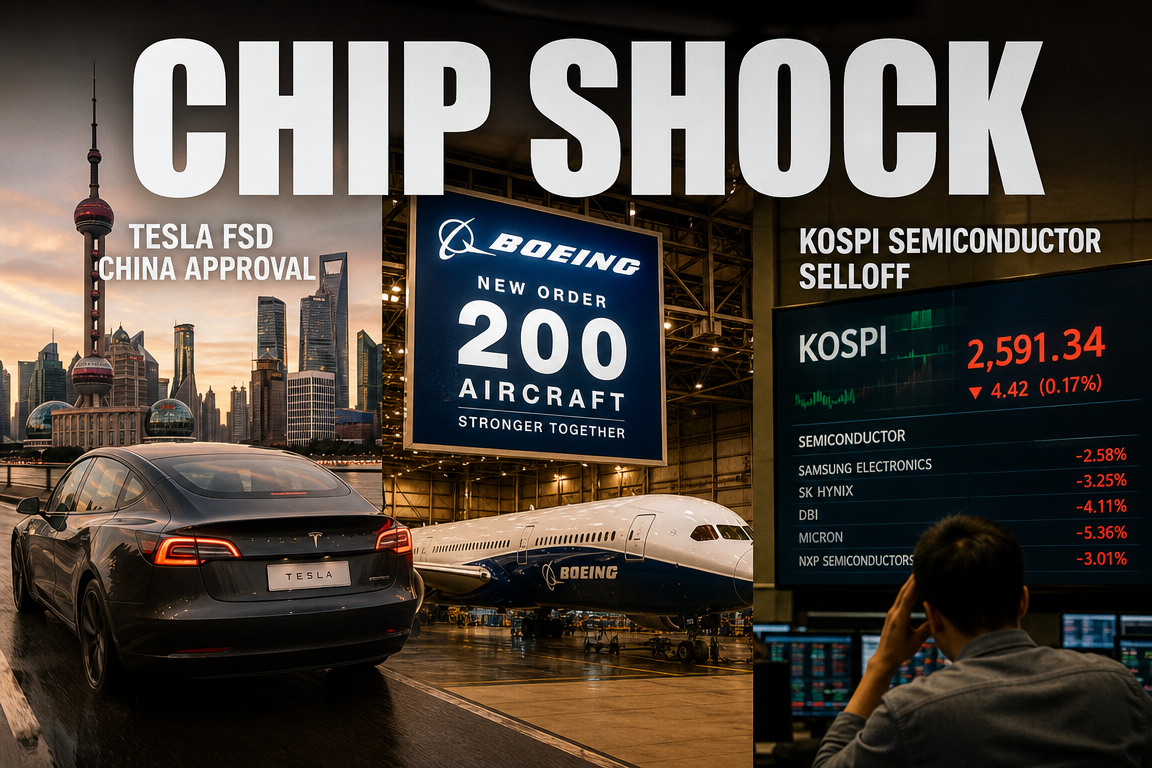
Boeing Secures 200 Aircraft Orders: Why Tesla Stayed Quiet, and the Real Variable Behind China FSD Approval and Tesla at $443
This development should not be viewed as a single-company headline.
This report consolidates the practical implications of the US-China summit, the signaling value of Boeing’s 200-aircraft order, the timing considerations around broad approval of Tesla’s FSD in China, why the market paused near the $443 level, and additional variables often underweighted in mainstream coverage.
Rather than assuming “approval equals upside,” this analysis addresses why no announcement has been made, why China views Elon Musk as both a partner and a risk, and how these dynamics connect to global macro conditions, US equities, EVs, and AI.
1. Market in one line: Expectations were largely priced in; no confirmed announcement
Tesla closed at $443.3, down 0.44% on the day.
Given the recent run (5 up days out of the last 6 sessions; cumulative gain of more than 14%), the move appears consistent with consolidation rather than a directional reversal.
The core issue is that the market had already discounted a meaningful portion of the catalyst.
- US-China summit optimism priced in
- Expectations around Elon Musk’s Beijing visit priced in
- Partial pricing of China FSD approval probability
- Expectations of policy relaxation and renewed China growth priced in
The lack of upside is better explained by the absence of a definitive announcement than by the absence of catalysts.
2. What materially occurred in Beijing
The visit functioned less as a symbolic diplomatic event and more as an economic negotiation venue supported by business outcomes.
Beyond the optics of the Trump-Xi meeting, the participation of major US corporate leaders indicated an agenda spanning supply chains, investment, technology cooperation, and trade balance.
Reported attendees included Elon Musk, Nvidia CEO Jensen Huang, Apple CEO Tim Cook, Boeing, and BlackRock, among others, reinforcing the view that the discussions were commercially oriented.
Macro implications:
- While strategic rivalry persists, the tone signaled de-escalation
- Messaging suggested an intent to maintain a “strategic stability” framework over the medium term
- May provide a sentiment buffer for US equities with significant China exposure (technology and manufacturing)
- Could marginally reduce regulatory friction in strategic sectors such as AI, EVs, semiconductors, and autonomy
The dominant signal was pragmatic: reduce conflict intensity and prioritize commerce.
3. Why Boeing’s 200-aircraft order matters to Tesla investors
China’s agreement to purchase 200 Boeing 737 aircraft was the most visible deliverable.
The significance is structural rather than numerical: a large, tangible Boeing outcome increases market expectations that other US corporates may also secure practical concessions or business benefits.
However, key caveats remain:
- A Boeing order does not imply automatic approval of Tesla FSD
- Commercial aircraft purchases are traditional industrial transactions; FSD is intertwined with data governance, road safety, national security, and AI regulation
- Boeing sits in a lower-sensitivity category; Tesla autonomy is materially more sensitive
This sensitivity gap helps explain why Boeing generated a clear announcement while Tesla did not.
4. China FSD approval: current status
Tesla is not necessarily at “zero approval” in China for autonomy-related activity.
Limited pilot-style testing has reportedly occurred, including trials oriented around HW4 vehicles.
China’s tightening of connected-vehicle and software update regulation has increased complexity. In particular, requirements to submit detailed technical information prior to OTA updates appear to have strengthened, forcing renewed procedural alignment across both HW3 and HW4.
Current position:
- Broad commercial rollout to the general customer base has not occurred
- Internal testing appears to be materially advanced
- Conditions resemble a late-stage process, but a final approval gate remains
- Regulatory and political context outweigh pure technical readiness as the key variable
The situation is better characterized as “late-stage pending approval” than as a low-probability scenario.
5. Why approval has been delayed: political and security factors outweigh technology
While regulators cite autonomy validation, road data, update rules, and cybersecurity reviews, the dominant constraint appears linked to US-China relations and a national-security framing.
From China’s perspective, permitting large-scale deployment of a US company’s AI autonomy system is not equivalent to approving a consumer feature. It implicates data, mapping, traffic patterns, urban infrastructure, and real-time decision logic.
Accordingly, heightened geopolitical tension likely reduced China’s willingness to finalize approval.
6. China’s dual view of Elon Musk: partner and risk
China’s posture reflects a two-track assessment.
Positive framing:
- Symbol of EV innovation
- Perceived leadership in autonomy and AI
- High-profile figure in robotics and space
- Benchmark entrepreneur for domestic technology firms
Risk framing:
- Starlink raises military and communications-security concerns
- X may conflict with information-control priorities
- SpaceX’s strategic relevance extends beyond a standard commercial enterprise
This dual assessment likely influences the pace and conditions of autonomy-related approvals.
7. Quantifying potential impact: how China FSD approval could translate to fundamentals
FSD is software-led and therefore structurally higher margin than hardware-led growth, making China-scale approval economically meaningful.
- Potential margin expansion without proportional manufacturing growth
- Recurring subscription model could improve cash-flow stability
- May support partial re-rating toward software/AI platform valuation frameworks
Common market scenarios include:
- If ~25% of China Tesla owners adopt a monthly subscription, incremental annual revenue could be approximately $500 million
- Given software economics, incremental profit contribution could be significant
- Longer-dated scenarios (toward 2030) include multi-billion-dollar annual revenue potential, though outcomes remain uncertain
At the $443 level, the market appears to have priced “probability-weighted expectation” more than “post-approval financial revision.” A durable move would likely require estimate revisions and valuation reset following confirmed commercialization details.
8. Why the stock did not rise today despite positive backdrop
- Recent gains already reflected improved sentiment
- No concrete, official FSD announcement
- China approval is a binary step where “possible” and “confirmed” differ materially
- Broad tech-sector profit-taking contributed
Sentiment catalysts can lift price temporarily; the next leg typically requires disclosures and execution details such as approval language, launch timelines, pricing, and compliance framework.
9. Underweighted variables that may drive the outcome
9-1. FSD approval is less about “option sales” and more about Tesla’s identity shift
A China-scale FSD commercialization could be interpreted as evidence of Tesla operating as an AI platform with real-world deployment at scale, potentially changing the valuation narrative.
9-2. Even with approval, adoption may ramp more slowly than expected
China’s EV market is highly competitive, and local OEMs often bundle ADAS features at low or near-zero incremental cost. Adoption will likely depend on perceived performance, safety, trust, and city-by-city availability, not only price.
9-3. China’s objective includes economic balance, not only technology oversight
Reported discussions around Tesla pursuing procurement of Chinese solar equipment suggest a broader “balance of benefits” logic. Approval may be influenced by trade balance, local investment, and tangible economic reciprocity.
9-4. The final determinant may be political timing rather than engineering readiness
If technical readiness is largely in place, the remaining gating factor may be the timing of public communication. Monitoring should include diplomatic calendars, regulator messaging, and tone shifts in state media in addition to product-level signals.
10. Key indicators and checkpoints
- Changes in official language from Chinese regulators regarding FSD and OTA updates
- Adjustments to Tesla China website product structure for FSD
- Signals of expanded internal testing and geographic coverage
- Follow-on announcements tied to US-China economic cooperation frameworks
- Changes in data localization and cross-border transfer requirements
- Additional Musk visits or local partnership announcements
Such developments often emerge through incremental signals before a definitive “approval completed” headline, prompting stepwise market repricing.
11. Consolidated view
The central question is not only “why approval has not been announced,” but “why sentiment and negotiation tone improved materially at this juncture.”
Boeing’s order functioned as an early visible deliverable. Musk’s presence served as symbolic capital. FSD represents a more sensitive and higher-stakes negotiating item.
While the $443 level likely reflects meaningful expectation, it may not fully reflect a confirmed approval pathway and post-launch financial impact.
Risks remain material: policy discretion, security framing, intense pricing competition, and domestic competitive pressure in China.
The key question is whether approval translates into measurable adoption, margin impact, and multiple expansion rather than a one-time headline effect.
12. News-style key takeaways
- Tesla closed at $443.3, slightly down; price action is consistent with consolidation after a strong multi-day rally
- The US-China summit appeared more focused on commercial outcomes than diplomatic signaling
- China’s 200-aircraft Boeing purchase signals willingness to deliver tangible benefits to select US corporates
- Tesla FSD in China appears closer to a late-stage approval process than a preliminary stage
- Approval timing is likely more constrained by politics and security framing than by technology alone
- China views Musk positively in EV/AI but as a risk in satellite communications and information networks
- Broad China approval could enable high-margin software revenue expansion for Tesla
- Adoption and earnings impact may ramp gradually rather than immediately
- The primary inflection is official approval and commercialization details, not sentiment
13. Most important point
China FSD approval is not merely an incremental feature authorization; it is a potential catalyst for Tesla’s reclassification toward an AI operations/platform narrative. The conditions for approval likely include geopolitical context, security interpretation, economic reciprocity, and local industrial considerations.
This is better analyzed as a nexus of autonomy, AI, macroeconomics, and geopolitics than as a standalone automotive item.
< Summary >
Tesla is consolidating near $443 amid expectations for broad China FSD approval.
Boeing’s 200-aircraft order indicates the summit produced tangible commercial outcomes.
China FSD appears to be in a late-stage process, but final authorization remains pending.
The delay is likely driven more by politics and security framing, including China’s dual assessment of Musk as both partner and risk.
Approval could expand high-margin software revenue, but adoption and market repricing may occur in stages.
The core issue is not incremental vehicle sales, but whether Tesla is re-rated as an AI platform business.
[Related Articles…]
- Tesla China FSD Approval Issue and Restructuring Points in China’s Autonomous Driving Market
- Boeing Orders, US-China Negotiations, and Implications for Global Supply Chains
*Source: [ 오늘의 테슬라 뉴스 ]
– 보잉은 200대 받아간 날, 머스크는 왜 조용했나 — FSD 전체 승인 나면 주가에 생기는 일, $443 주주는?
● Stocks-Rout, Samsung, Hynix, Kospi-Sink
Comprehensive Summary of the Sell-Off in Samsung Electronics, SK hynix, and the KOSPI: May 15 Decline and the Core Drivers
The domestic equity market on May 15 saw concurrent weakness in Samsung Electronics, SK hynix, and the broader KOSPI. The move was not solely a “semiconductor-led decline,” but a multi-factor risk-off adjustment driven by the combination of: (i) labor-related uncertainty at Samsung Electronics, (ii) disappointment versus expectations around U.S.-China engagement, (iii) technical and valuation pressure at key index levels, (iv) Middle East geopolitical risk, (v) KRW depreciation, and (vi) a sharp rise in bond yields. Market interpretation requires linking global macro conditions, semiconductor sentiment, foreign investor flows, inflation expectations, and AI-related semiconductor positioning.
Market Snapshot: Why Multiple Segments Sold Off Simultaneously
On May 15, losses were concentrated in large-cap stocks. Weakness in top index constituents, particularly Samsung Electronics and SK hynix, mechanically amplified downside pressure on the KOSPI.
While multiple headlines appeared independent, the session was characterized by (i) catalysts failing to exceed elevated expectations and (ii) accumulated risk factors being repriced simultaneously, triggering profit-taking.
1. Samsung Electronics: Why Labor-Union Risk Weighed on the Stock
Market Focus Shifted to a More Confrontational Signal
Samsung Electronics faced renewed pressure on labor-union strike risk. Although management signaled openness to dialogue, market participants interpreted the union’s stance as implying prolonged conflict. Equity markets tend to discount uncertainty around timing and resolution more aggressively than the existence of conflict itself.
For a market bellwether such as Samsung Electronics, perceived operational instability can trigger risk premia compression even without confirmed production disruption.
Why Sensitivity Was Higher Than Usual
Samsung Electronics is a primary directional driver of the KOSPI and is widely used by foreign and institutional investors as a proxy for Korea’s equity risk sentiment. As a result, labor-related headlines can affect valuation through confidence and governance/operational risk channels, independent of near-term earnings.
With semiconductor recovery and AI-linked upside already partly reflected in pricing, incremental negative developments were met with amplified sensitivity.
Key Point
The decline reflected the repricing of uncertainty around the duration and trajectory of labor negotiations. Sentiment and risk premia outweighed near-term fundamentals.
2. SK hynix: Sector-Wide Expectation Reset More Than Company-Specific Deterioration
U.S.-China Meeting: Expectations Exceeded Realized Outcomes
A key driver was disappointment relative to market expectations for broader de-escalation signals across semiconductors, technology, and trade. Outcomes were perceived as limited versus prior positioning, prompting a rotation away from crowded, higher-valuation growth exposures.
Why SK hynix Declined in Tandem
SK hynix had been a primary beneficiary of HBM and AI memory expectations, supported by concentrated foreign inflows. In such positioning-heavy names, the absence of fresh upside catalysts can trigger profit-taking even without new fundamental negatives.
The session’s price action was consistent with short-term overheating concerns and an expectations-driven valuation adjustment rather than a deterioration in core fundamentals.
Key Point
The move was driven by elevated expectations and valuation sensitivity, not by a weakening earnings outlook.
3. KOSPI: Index-Level Overhang and Profit-Taking
Failed Breakout at Key Levels Triggered Supply
The KOSPI’s inability to hold above an important psychological/technical threshold during the session contributed to an increase in selling pressure. Failed breakouts often accelerate de-risking by short-term participants.
Why Profit-Taking Was Larger
The recent rebound had been led by semiconductors and supported by foreign and tactical flows. Without incremental positive catalysts, capital typically reduces exposure to lock in gains.
Because Samsung Electronics and SK hynix carry significant index weight, concurrent declines in both names tend to produce outsized index-level downside.
Key Point
The decline reflected resistance near the upper bound of the recent range and active supply absorption. In the absence of stronger positive catalysts, downside volatility can increase.
4. External Macro Factors: Strait of Hormuz Risk, KRW Depreciation, and Rising Bond Yields
Middle East Risk Re-Introduced Energy and Inflation Concerns
Persistent Strait of Hormuz risk remained a market overhang. Given the region’s role in global crude flows, higher geopolitical tension increases perceived risk to oil prices and logistics costs, reinforcing inflation concerns and tempering rate-cut expectations. This dynamic is typically negative for equity valuations, particularly in growth segments.
KRW Depreciation Pressured Foreign Flows
KRW weakness is a key variable for Korea equities due to its direct effect on foreign investors’ currency-adjusted returns. A rising USD/KRW increases FX loss risk, often reducing incremental foreign buying and, in some cases, prompting position trimming. Stocks with high foreign ownership, including Samsung Electronics and SK hynix, tend to be more sensitive to this channel.
Higher Bond Yields Increased the Equity Discount Rate
Rising bond yields generally compress equity valuations by raising discount rates, with a stronger effect on long-duration growth exposures. Semiconductor and AI-linked stocks, which embed longer-horizon growth assumptions, are particularly yield-sensitive.
Key Point
Geopolitical risk, FX pressure, and higher yields aligned to reduce risk appetite and tighten valuation conditions simultaneously.
5. News-Style Summary of the Session
Closing Drivers
- Samsung Electronics and SK hynix led the KOSPI lower.
- Samsung Electronics: investor sentiment weakened due to heightened uncertainty around potential strike escalation.
- SK hynix: declined amid disappointment versus U.S.-China expectation-setting and semiconductor-sector profit-taking.
- KOSPI: selling accelerated after failing to sustain a move above a key level intraday.
- Additional headwinds: Strait of Hormuz-related geopolitical risk, KRW depreciation, and rising domestic/global bond yields, reinforcing risk-off positioning.
- Near-term stabilization likely requires improved visibility on foreign flows, FX conditions, and incremental semiconductor catalysts.
6. The Most Material Interpretation: Expectations, Not the Absolute Size of the Headlines
Core Driver: Elevated Expectations Were Already Priced In
The critical factor was not a single dominant negative headline, but the extent to which positive scenarios were already embedded in prices: semiconductor recovery, AI-driven demand expansion, U.S.-China easing expectations, and continued domestic equity rebound. With limited incremental confirmation, relatively modest negatives produced disproportionate price responses.
Concurrent Weakness in Samsung Electronics and SK hynix Signals a Sentiment Reset
Simultaneous declines in both leaders imply sector-level sentiment and positioning adjustment rather than idiosyncratic company issues. This can extend short-term consolidation; however, if fundamentals remain intact, reversals can occur quickly once macro variables stabilize.
Near-Term Focus: Flows and FX Over Headlines
In the current regime, foreign flows and FX direction may be more actionable than headline interpretation. If USD/KRW stabilizes and yields moderate, semiconductors are positioned to attract renewed allocation. Conversely, supportive headlines may have limited impact if KRW weakness and yield pressure persist.
7. Key Monitoring Items
1) Escalation vs. Resolution Path for Samsung Electronics Labor Negotiations
The market is primarily sensitive to uncertainty. Clear progress toward resolution can stabilize risk premia.
2) Additional Signals of U.S.-China Stabilization
Any incremental messaging on semiconductor and advanced technology policy could affect both earnings risk and valuation multiples.
3) Stabilization in FX and Bond Yields
USD/KRW and yield dynamics are central to foreign participation and index-level recovery conditions.
4) Reconfirmation of AI Semiconductor Momentum
The semiconductor thesis remains linked to AI servers, HBM demand, and data-center capex. If the structural AI narrative holds, price weakness may reflect pace normalization rather than trend reversal.
5) KOSPI Support Levels in the Coming Week
The speed and quality of any rebound will help differentiate a contained pullback from a higher-volatility range-bound phase.
8. Conclusion: A Repricing Event and a Risk Check, Not a Fundamental Breakdown
The May 15 decline in Samsung Electronics, SK hynix, and the KOSPI reflected a multi-factor adjustment: labor uncertainty, limited upside from U.S.-China engagement expectations, index-level resistance, KRW depreciation, rising yields, and Middle East geopolitical risk.
At this stage, the move is better characterized as an expectations and valuation reset than a deterioration in semiconductor fundamentals. Market direction is likely to depend on the stabilization of FX and rates, the return of foreign flows, progress on labor negotiations, and continued validation of AI-linked semiconductor demand.
< Summary >
The May 15 sell-off in Korea equities reflected simultaneous pressure from Samsung Electronics labor-strike uncertainty, disappointment versus U.S.-China expectation-setting, a failed KOSPI breakout, Strait of Hormuz geopolitical risk, KRW depreciation, and rising bond yields.
Samsung Electronics was impacted by labor-related uncertainty; SK hynix by sector-level expectation cooling and profit-taking; the KOSPI by technical resistance and large-cap weakness.
The key takeaway is that elevated prior expectations were repriced. A potential rebound depends on FX stabilization, recovery in foreign flows, and incremental confirmation of semiconductor/AI catalysts.
[Related Articles…]
-
Semiconductor recovery and AI memory beneficiaries: key points to reassess now
https://NextGenInsight.net?s=semiconductors -
How KRW depreciation affects the KOSPI and foreign investor flows
https://NextGenInsight.net?s=exchange%20rate
*Source: [ 내일은 투자왕 – 김단테 ]
– 삼성전자 하이닉스 코스피 떡락 이유 (5월 15일)