● Mecha Robots Become Products
“Manned (Riding-Type) Mecha” robots have become a “product”… Unitree GD01, a sign of China’s rush to commercialize robots
Reasons you absolutely need to see this now (starting with the conclusion)
The core of today’s news isn’t a single “viral video,” but the fact that the threshold for manned mecha robots to move from “experimental” to “commercialization” has actually opened. And the point is that this momentum is accelerating simultaneously in China’s supply-chain strengths, embodied AI (AI you do with your body), and autonomous humanoids.
In particular, these three items are the “truly important content” the article emphasizes separately.
1) Unitree GD01: Riding-capable two-armed/two-legged variants (2 legs → 4 legs) + wall-breaking unveiled as a “product form”
2) Figure AI: Two units reset a bedroom in 2 minutes without communicating with each other (including handling clothing/bedlinen “fabric”)
3) Physical Intelligence: A robot brain (general-purpose model) mentions the stage of “field-capable motion” around GPT-2 level possibility + says GPT-4 level still needs scaling
As these three streams move together, the humanoid robot market is rapidly shifting from “cool technology demos” to “products/systems that at least keep running.”
① Unitree GD01: The background for pushing a “riding-type mecha” like a real product
The way GD01 was revealed: not just a concept, but a “buyable product” tone
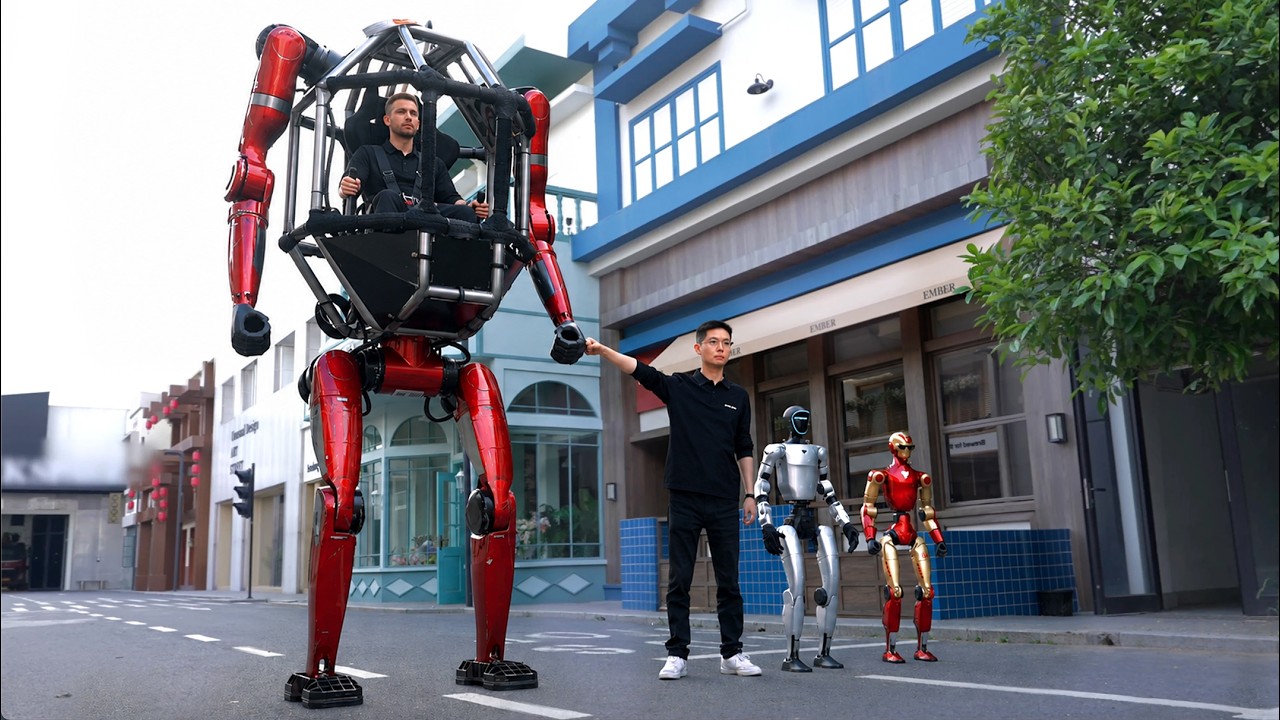
The GD01 that Unitree unveiled was introduced as a so-called “Production-ready manned mecha.” In other words, it reads like a presentation that weighs more on “a real thing you can actually buy,” not a prototype shown behind glass at an exhibition.
– Size/weight: about 2.7 m tall, about 500 kg
– Payload: an open cockpit structure where the pilot goes in near the chest
– Materials: high-strength alloy-based (a narrative focused on civilian transport/real-world use)
Key “evidence of technology” points shown in the video
GD01 connects walking → destruction → reconstruction (transformation) → driving/maneuvering all at once, beyond simply standing. The core is “maintaining leg postures” and “controlling the center axis during transformation.”
– Bipedal walking: a stable walking demo with minimal wobble
– High-output impact: power strong enough to push aside piles of blocks
– Breaking walls/bricks without a pilot: showing “destructive force” with autonomous actions
– Mode switching: compressing from biped (2 legs) to quadruped (4 legs) and then unfolding again, with reconstruction in seconds
– Sensors/posture: scenes emphasizing dynamic center-of-mass adjustment even during transformation
They also laid out realistic limitations at the same time (safety notice)
Unitree clearly stated in a safety notice that the technology is not yet a complete package from the perspective of individual use. So it’s appropriate to view it not as an absolutely “perfect all-purpose robot,” but as an early stage moving toward commercialization.
② Why this is “bigger news”: an engineering threshold for embodied AI
Robots are in the process of changing from “tools” to “mobility platforms”
The major logic in the China-side comments surrounding this GD01 is that it has moved “outside the research lab.” Once it gets a price tag, a roadmap, and links to actual shipping/production, the competitive landscape changes.
Another interesting claim: the final form of a humanoid doesn’t necessarily have to be human-like (humanoid). You can also expect a future perspective where various hybrid configurations blending humans and machines may appear.
To summarize: if robots become mobility platforms that carry people and perform work again, industries are likely to be reorganized not around labor replacement, but around “human capability expansion.”
③ Why China is moving fast: supply chain, manufacturing capability, and “scale”
The core is closer to “parts/production ecosystem” than to the technology itself
There are recurring statements about the background for robots like GD01 coming out quickly. That is: China has the key industrial categories domestically.
– High-performance motors/speed reducers/sensors
– Batteries/carbon-fiber materials
– The speed of precision manufacturing chains and parts procurement
With such a foundation, even humanoids with high engineering difficulty can be pushed not as “individual R&D,” but as a “product line.”
The message conveyed by shipping numbers
For humanoids, shipping volume directly leads to training data/field feedback/improvement speed. Unitree mentions shipping of more than 5,500 units last year. It was also discussed in the same framework that Tesla, Figure AI, Agility Robotics, etc. shipped only in the hundreds during the same period.
Also, as of 2025, analysis surfaced that Chinese companies account for a large share of global humanoid sales. In other words, it means market leadership is being taken first not by “technology showcases,” but by volume + supply chain.
Notable point: GD01 is evaluated as having a stronger “proof (publicity + destructive power)” character than “everyday utility”
There’s also a balanced point here. In outlets like Wired, they said GD01’s character is more about showing something like “it works” than providing highly skilled dexterity (precise hand work) that you could use right away in daily life.
That means the next step must move toward real-use task execution ability (manipulation, cognition, safety). From there, you’ll need simultaneous maturation of AI and robotics engineering.
④ Figure AI: An autonomous humanoid that reset a bedroom in 2 minutes—“without communicating with each other”
Core scene: even when two units collaborate, there is no “central planning unit”
The demo revealed by Figure AI works differently. Two humanoids enter a bedroom and autonomously handle tidying/resetting, but they don’t directly give information to each other.
– No shared planner (joint planning)
– No central controller
– No inter-device message communication
Instead, each robot moves based on onboard cameras and learned policies, and while handling difficult materials together like bedlinen (comforter), it continuously re-evaluates the situation.
The difficulty of bedlinen (fabric) is where “real technology” gets separated
Bedlinen is different from rigid objects. Its shape isn’t fixed; it folds and stretches, and its form changes depending on the location being pulled.
Based on Figure’s explanation, the robots had to do the following at the same time:
– Predict the other unit’s next move
– Adjust picking up/pose/action accordingly
– Reflect in real time the changes in the environment as the fabric keeps transforming
This is a task closer to a much higher difficulty level than “walking” (manipulation, prediction, and stability).
Single framework + simulation-based learning, and points to improve for sim2real (simulation-to-reality transfer)
Figure explains that it learns a vision-language-action framework end-to-end, builds policies using reinforcement learning and large-scale randomized simulations. And it presented the ability to transfer directly into real-world operation without additional calibration as evidence for closing the sim2real gap.
Helix02 upgrade: not only proprioception (joint sensing), but also “3D environment perception”
Previously, the focus was on understanding mainly the joint positions and movements of one’s own body. Now, they add a configuration that converts RGB into a 3D spatial map using stereo cameras, and they mention that this improved stability.
– Maintain balance on stairs/uneven terrain
– Improve stability even when lighting conditions change
⑤ Physical Intelligence: An approach to build a robot’s “one brain” (general-purpose model)
A roadmap to directly tackle Moravec’s paradox
Physical Intelligence aims not for a “robot made for a specific task,” but for a general-purpose robot brain (foundation model) that adapts across the whole hardware.
Their representative line of thinking is Moravec’s paradox.
– Things that are easy for humans (walking/folding clothes/grasping) are hard for computers
– Things that are hard for humans (math/chess) were comparatively easy for computers
So the underlying problem awareness is that the truly hard part for robots lies in “real-world physics” and “fine manipulation.”
Learning method: a structure that runs repeated loops with real household-environment data (household action demo)
The company collects demonstration data like coffee-making, laundry, and packaging in an office setting, and shows the process of repeating within the same robot workflow: research → data collection → model training → evaluation.
Version changes are also interesting.
– Pi Zero: “prove the capability works” (anchored tasks like folding clothes)
– Pi 0.5: generalization (after training in about 100 household environments, transferring to 100 environments it has never seen before)
– Current version: improved performance/reliability (centered on success rates for laundry/coffee/package assembly)
Message from a market perspective: a GPT-2 moment (possibility looks real, but scaling is still needed)
The most directly worded expression from an investor/leader perspective is “GPT-2 moment.” That is,
– “Field-level feasibility” starts to become visible close to real use, but
– general-purpose mass applicability like GPT-4/5 level still needs to be expanded (scaled).
There was also a 전망 that enterprise deployment at the company level could become possible within 1 to 3 years, followed by a wider consumer product wave afterward.
⑥ If you bundle the whole flow into one line: “humanoids = demos” to “humanoids = platforms/products”
These three announcements differ in direction, but they share a common denominator. That is that robots are entering the realm of repeatable tasks in real environments through embodied AI.
And the way the market moves is similar too.
– China is rapidly productizing with supply chain/manufacturing/shipping scale
– Figure is going head-on to overcome “field difficulty” in autonomous collaboration/manipulation (bedlinen/fabric)
– Physical Intelligence is aiming to increase the likelihood of real use with a robot brain (general-purpose model) strategy
Here, the keywords the reader should take away can be compressed to about five.
- Embodied AI (AI that learns/performs with the body)
- Autonomous collaborative humanoids
- sim2real transfer (sim-to-real gap)
- Robot supply chain and manufacturing scale
- General-purpose robot brain (foundation model)
🔥 The “really important points” that other news/YouTube talk about less, summarized separately
1) The deciding factor in this competition is not only “form factor (human-like),” but the learning/improvement speed created by shipping volume
2) Even demos like GD01 ultimately need to lead to “everyday manipulation,” and the next gate is dexterity (precise hand manipulation) + dynamic stability
3) Like Figure’s bedlinen handling, the “fabric manipulation” that people underestimate reveals real-use difficulty fastest
4) Physical Intelligence’s GPT-2 moment framing is both a cold reality diagnosis and a reference point for predicting future momentum (That is, a sign that they’ve entered the transition from the “possibility discovery” stage to the “large-scale application” stage)
5) In the end, robots have to pass through the world people live in as-is, so infrastructure (supply chain + data + field iteration) is what decides the winner more than technology demos
Future checklist (from an investment/business perspective)
If you look at the next issues, the flow will become even clearer.
- To what extent riding-type/mobility-platform robots are commercially operated “safely”
- How reliably humanoids improve success rates in repetitive tasks (including failure rates/maintenance)
- Generalization performance in highly deformable objects like fabric/clothing/bedlinen (not just demos, but continuity)
- How much the manufacturing/parts supply chain actually lowers prices (directly tied to market adoption speed)
- How far a general-purpose robot brain (foundation model) expands across hardware and tasks
< Summary >
Unitree GD01 is a rideable “production-ready” manned mecha that demonstrated bipedal walking, four-legged transformation, and wall breaking, suggesting the commercialization threshold for embodied AI. China is changing the competitive landscape by continuing large-volume shipments based on advantages in supply chain, components, and manufacturing scale. Figure AI had two units autonomously reset a bedroom within 2 minutes without communication, and especially emphasized sim2real transfer in high-difficulty manipulation like handling bedlinen (fabric). Physical Intelligence discussed real-world feasibility at the level of a GPT-2 moment through an approach using a robot brain (general-purpose foundation model), and suggested that enterprise deployments and consumer expansion could follow within 1 to 3 years. In conclusion, humanoids are moving from “demos” to “platforms/products,” and the deciding factor is likely to hinge less on the form factor than on shipping volume, data, field iteration, and stable success rates.
[Related articles…]
- Analysis of the riding mecha robot GD01: a signal for embodied AI commercialization
- Figure AI humanoid autonomous collaboration demo: what bedlinen manipulation implies
*Source: [ AI Revolution ]
– Unitree Just Dropped A Real Life MECHA AI Robot