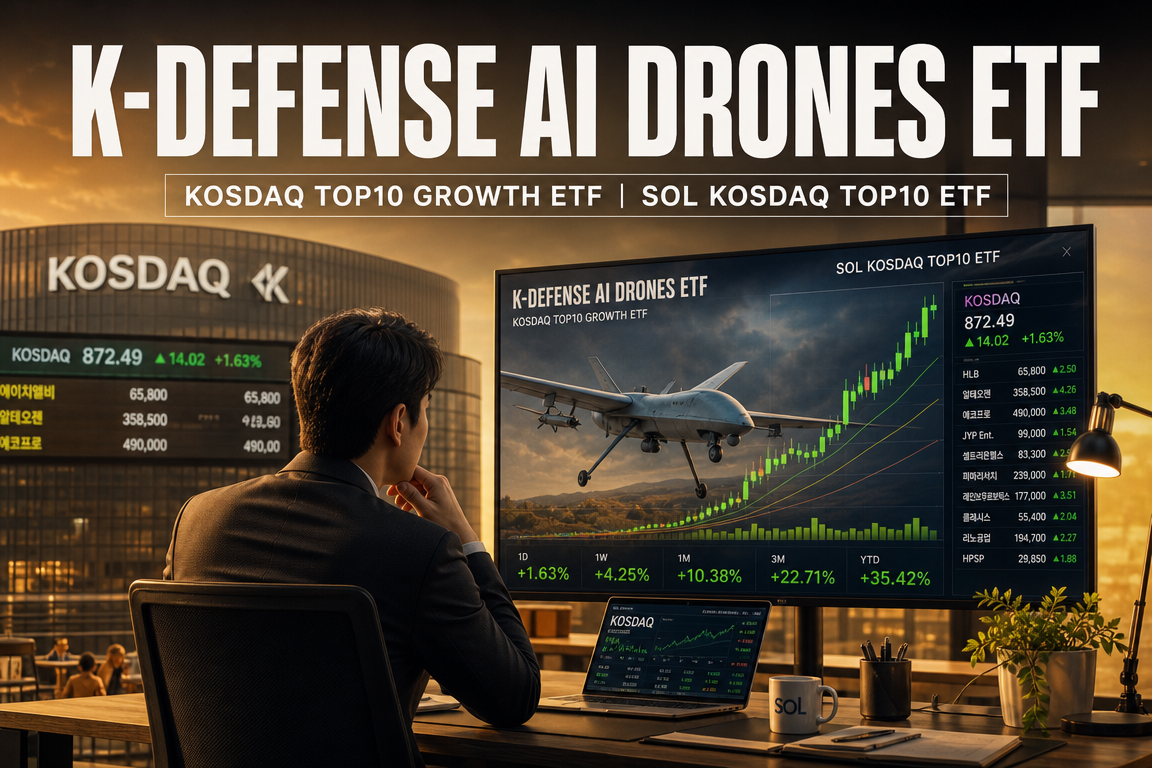
● Asymmetric-War, K-Defense, AI-Drone-Shift
Opening of the Asymmetric Warfare Era: Key Takeaways on How K-Defense, AI, and Drones Are Reshaping the Global Economic Landscape
This shift is not a standalone geopolitical event. It links defense budget expansion, restructuring of the defense industrial base, a transition toward drone- and AI-centric force structures, and implications for Korea’s equity market and export opportunities. This report summarizes why asymmetric warfare is influencing global macro and capital-market dynamics, why defense equities are increasingly treated as a structural industry rather than a short-term theme, and the most material angles often omitted in mainstream coverage.
1. Key Development: The Defense Industry’s Competitive Basis Is Shifting
Following conflicts in the Middle East and the Russia–Ukraine war, the global security environment has structurally changed. Warfare is increasingly characterized by asymmetric cost dynamics, where low-cost, high-effect systems pressure legacy high-cost platforms.
A representative example is the cost exchange between drones and interceptors: deploying a USD 4 million missile to neutralize a drone costing roughly USD 20,000 is operationally and fiscally difficult to sustain. This cost imbalance is a central driver of defense modernization.
Competition is shifting from fielding more expensive hardware toward rapidly deploying AI-enabled systems that are cheaper, scalable, faster to operate, and more precise.
2. Definition: What Asymmetric Warfare Means in Practice
Asymmetric warfare differs from conventional large-scale state-on-state conflict. A relatively weaker actor leverages low-cost tools and irregular capabilities—drones, sabotage, cyber operations, psychological operations—to impose outsized costs on a stronger opponent.
The core mechanism is cost asymmetry: low-cost offense versus high-cost defense, which alters procurement priorities. As a result, the strategic importance of the following increases simultaneously:
- Drones and loitering munitions
- Electronic warfare
- Unmanned surface and underwater systems
- Cybersecurity
- ISR (intelligence, surveillance, reconnaissance)
Military capability assessments are shifting from large platforms (fighter aircraft, tanks, naval vessels) toward networked unmanned systems integrated and operated through AI-enabled command architectures.
3. Why a Structural Defense Industry Transition Is Underway
3-1. Geoeconomic Fragmentation Is Intensifying
The global system is moving from deep globalization toward fragmentation. Industrial policy and security priorities increasingly shape trade, technology access, and supply-chain design.
Since 2022, conflict and great-power competition have reinforced the premise that security is an economic variable. Energy, semiconductors, batteries, food security, and defense are increasingly treated as strategic sectors.
In this environment, defense is being repriced as a national strategic industry rather than a cyclical manufacturing segment. For equity markets, this supports the interpretation of defense as policy- and security-driven with multi-year visibility.
3-2. “Unstable Peace” Is Becoming the Baseline
The prevailing condition is neither full peace nor full mobilization. A prolonged period of recurring friction is more likely, including terrorism, limited clashes, maritime disputes, cyberattacks, high-profile threat activity, and disruptions to critical events.
Defense demand tends not to normalize quickly after a ceasefire. Post-conflict requirements—stock replenishment, air and missile defense expansion, and ISR modernization—typically extend over multiple years, supporting sustained procurement.
4. Why Defense Budget Growth Is Likely to Persist
As security risk rises, governments face political constraints in cutting defense spending. Public support for defense strengthening often increases during periods of elevated risk, and legislatures can justify higher allocations.
NATO members have signaled intent to raise defense spending toward higher shares of GDP. Korea has also exhibited a pattern where defense budget growth exceeds GDP growth. This implies that even under low-growth conditions, defense outlays can retain strategic priority.
Incremental budgets typically flow into:
- Ammunition and munitions replenishment
- Integrated air and missile defense
- ISR systems
- Drones and counter-drone capabilities
- Satellite communications
- Electronic warfare
- Cybersecurity
- AI-enabled battlefield management platforms
5. The Center of Gravity Is Moving from Legacy Platforms to Advanced Convergence
Defense is evolving into a convergence industry integrating:
- AI and software
- Sensors
- Communications and satellite infrastructure
- Semiconductors
- Data analytics
- Autonomy and robotics
Recent conflict dynamics highlight that cost-effectiveness, scalable production, and real-time data integration can be as decisive as platform performance.
Future competitiveness can be summarized as:1) Low-cost, high-volume production capability
2) AI-enabled autonomy
3) Network-centric battlefield integration
6. Core Technologies to Monitor: Drones Are Not Limited to Air
A key inflection point is the expansion of unmanned systems across domains—air, land, surface, and subsurface—reshaping force structure and procurement priorities.
6-1. Aerial Drones
Used for ISR, target acquisition, loitering strike, and swarming. High operational utility at low unit cost supports partial substitution and broad supplementation of manned aviation.
6-2. Ground Drones
Applied to high-risk reconnaissance, explosive ordnance disposal, logistics, and urban operations, reducing personnel exposure while improving access and persistence.
6-3. Unmanned Surface Vehicles (USVs)
Optimized for maritime ISR, port and coastal defense, infiltration response, escort missions, and monitoring of key sea lanes, with potential to change naval cost structures.
6-4. Unmanned Underwater Vehicles (UUVs)
Increasingly important for mine countermeasures, submarine tracking, seabed infrastructure monitoring, and ASW support. UUVs are a representative asymmetric capability, enabling lower-cost counters to high-cost undersea platforms.
7. Why the Shift Creates a Material Opportunity for Korea
Korea has established a recognized defense export position through major firms including Hanwha Aerospace, LIG Nex1, Hyundai Rotem, and KAI, supported by competitive pricing, faster delivery timelines, and packaged export execution.
The next step is moving beyond legacy system exports toward advanced defense. Sustained competitiveness is more likely if incumbents expand technology portfolios via partnerships or M&A with AI, satellite communications, software, robotics, and sensor companies.
Successful execution could reposition Korea from an equipment exporter to a next-generation defense platform provider.
8. Investor Lens: What to Prioritize
Defense equities often trade with high sensitivity to headline risk. However, the medium-term drivers are more structural: rising defense budgets, multi-year procurement programs, maintenance and sustainment revenue, and modernization investment.
Key diligence questions include whether a company can expand across:
- Drones and counter-drone systems
- Precision strike and missile defense
- Radar and ISR
- Satellite communications
- AI-enabled C2 and battlefield platforms
- Cybersecurity
In Korea’s market, export growth combined with policy support can increase the probability of earnings-driven re-rating.
9. Policy Priorities with the Highest Leverage
Budget expansion alone is insufficient. Defense should be integrated with national growth strategy by aligning “defense + AI + ICT + space + communications” under a unified industrial policy framework.
Five priorities:1) Expand R&D for drones, underwater unmanned systems, and AI-enabled command-and-control
2) Build collaboration mechanisms between private-sector ICT and defense primes
3) Strengthen export finance and diplomatic support for defense sales
4) Develop an integrated security industry including cybersecurity and satellite communications
5) Enable small and mid-sized defense technology firms to enter prime contractor supply chains
This framework supports the potential for defense to become a major strategic growth sector.
10. Most Underemphasized Point in General Coverage
Common narratives focus on defense stocks, drones, and budget increases. The more material shift is a reconfiguration of national economic structures. Prolonged security competition increases fiscal spending justified by defense imperatives, and that spending catalyzes not only defense primes but also adjacent high-technology sectors: AI, semiconductors, communications, software, robotics, and space.
Therefore, the principal beneficiary is not “traditional defense” alone, but a broader defense-centered advanced technology complex.
A second critical factor is the economics of defense. Outcomes may increasingly favor actors that can sustain resilient defense networks with efficient cost structures, linking battlefield effectiveness to macro-fiscal capacity.
11. Ongoing Indicators to Track
1) Whether NATO and major economies’ defense budget commitments translate into executed spending
2) Whether orders scale for drones, counter-drone systems, and underwater unmanned capabilities
3) Whether Korean defense firms expand collaboration or M&A with AI, satellite, and software companies
4) Whether instability persists across the Middle East, Eastern Europe, and the Indo-Pacific
5) Whether exports evolve from one-off contracts into sustainment, training, and upgrade revenue streams
12. Conclusion: Asymmetric Warfare Represents a Macro-Economic Regime Shift
Asymmetric warfare is not only a change in tactics. It reflects a combined shift in geoeconomic fragmentation, persistent instability, sustained defense budget growth, modernization toward AI-enabled systems, and supply-chain restructuring.
Korea has credible upside optionality if it extends from legacy exports into drones, underwater unmanned systems, AI battlefield platforms, cybersecurity, and satellite communications.
Long-run advantage is likely to accrue to countries that integrate defense industry capability into an advanced-technology growth strategy. The transition is already underway.
< Summary >
The asymmetric warfare era is accelerating a shift in defense from legacy platforms to an advanced convergence model centered on drones, AI, satellite communications, and cybersecurity. Geoeconomic fragmentation and persistent instability increase the likelihood of structurally higher defense spending. Korea can leverage established export competitiveness but must expand into AI- and unmanned-system-centric capabilities and software-driven architectures. From an investment perspective, longer-duration modernization and export-support dynamics are more relevant than short-term conflict headlines.
[Related Articles…]
- K-Defense Export Expansion and the Restructuring of the Global Defense Industry: Key Analysis (https://NextGenInsight.net?s=defense)
- AI-Drone Warfare and the Outlook for Next-Generation Unmanned Systems (https://NextGenInsight.net?s=AI)
*Source: [ 경제 읽어주는 남자(김광석TV) ]
– 방위산업의 지형이 변화한다. ‘비대칭 전쟁’이 온다 [경읽남 245화]
● SOL KOSDAQTOP10 ETF, Growth, Boom, Rotation, Disruption
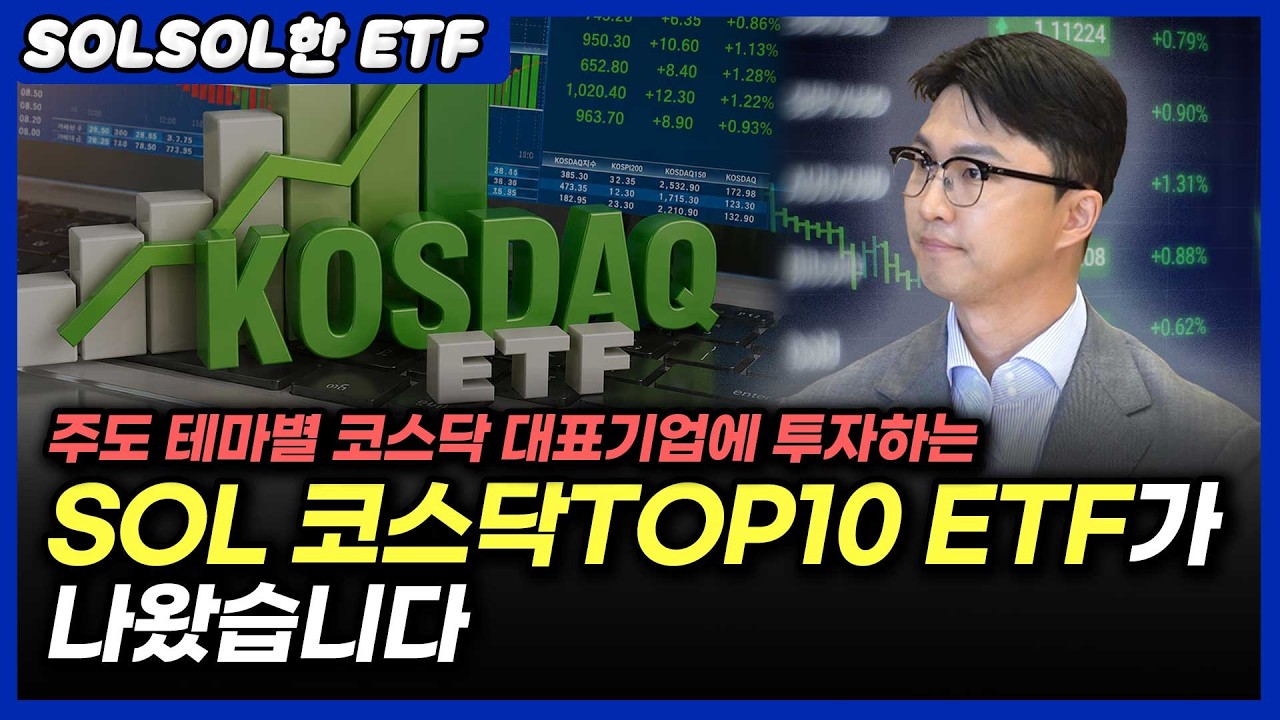
Launch of the SOL KOSDAQ TOP10 ETF: Why It Matters Now — A New ETF Approach Focused on Core KOSDAQ Growth Stocks While Reducing Sector Concentration
This report goes beyond a product launch summary. It explains why the current environment warrants renewed attention to KOSDAQ ETFs, how this approach differs from traditional KOSDAQ 150 exposure, and which industries are most likely to drive leadership within the Korean equity market.
Key topics include: the structural limitations of legacy KOSDAQ benchmarks that have been heavily tilted toward secondary batteries and biotechnology; how government-led KOSDAQ market initiatives may translate into investable opportunities; and how this ETF’s design seeks to reduce risk while maintaining exposure to growth equities.
It also addresses three under-discussed points: (1) why a new flagship KOSDAQ index-style ETF structure has become relevant, (2) how sector diversification can support downside resilience, and (3) why a single product designed to track semiconductors, robotics, biotech, secondary batteries, and AI supply-chain beneficiaries has become more strategically important.
1. Key Development: Rationale Behind the SOL KOSDAQ TOP10 ETF
Shinhan Asset Management has launched the SOL KOSDAQ TOP10 ETF, an instrument designed to invest in 10 representative growth stocks within the KOSDAQ market.
The defining feature is not simply holding the “top 10 by size,” but applying a sector diversification rule to reduce concentration in any single industry.
Many existing KOSDAQ ETFs—particularly KOSDAQ 150 trackers—appear diversified by name, but in practice often behave like thematic funds due to high weights in secondary batteries and pharmaceuticals/biotech.
This ETF addresses that issue by limiting the number of constituents from any single sector to a maximum of three.
The result is a concentrated portfolio of leading growth names with explicit constraints intended to mitigate the KOSDAQ index’s most persistent weakness: sector concentration risk.
2. Why KOSDAQ Now: Potential Rotation From Large-Caps to Small/Mid-Cap Growth
Recent performance has been led by large-cap equities—KOSPI constituents, semiconductors, and export-heavy names—while elevated interest rates have been a headwind for smaller, growth-oriented stocks.
Historically, market leadership has often broadened from large-caps into small/mid-caps after an initial rally phase.
KOSDAQ is structurally more volatile, but typically exhibits higher beta when momentum strengthens.
From this perspective, the current period may be better suited to identifying KOSDAQ leadership and core industry exposure rather than pursuing short-term, overheated themes.
3. Why Government KOSDAQ Revitalization Measures Matter for Investors
This ETF has attracted attention partly due to alignment with policy initiatives. Measures announced late last year are beginning to be reflected more directly in the market.
The policy direction can be grouped into three areas.
3-1. Restoring Market Credibility
KOSDAQ has faced recurring concerns around weak governance and low-quality listings. Tighter delisting standards and market clean-up measures may improve overall market quality over time.
3-2. Encouraging Institutional Participation
Expanded research coverage and mechanisms such as BDC-related initiatives are intended to increase institutional engagement. A higher institutional share of trading and ownership can improve stability and valuation discipline.
3-3. Expanding Liquidity Supply
Policy-linked funding programs (including a cited KRW 150 trillion-scale “National Growth Fund”) could channel capital toward strategic growth industries, materially affecting key KOSDAQ sectors.
Overall, the policy objective is to reposition KOSDAQ from a retail-driven speculative venue toward a capital market platform for technology-driven growth companies.
4. Structural Limitation of KOSDAQ 150 ETFs: Nominal Diversification, Practical Concentration
Investors often assume that a 150-constituent index provides sufficient diversification. However, performance has frequently been dominated by moves in secondary batteries and biotech, causing index-level drawdowns when those sectors weaken.
This illustrates the difference between constituent count diversification and economic/sector diversification.
Unlike KOSPI large-caps, which span multiple industries, KOSDAQ’s largest constituents have been concentrated in a small number of sectors. As a result, KOSDAQ 150 diversification has been limited in practice.
5. SOL KOSDAQ TOP10 ETF Structure: Combining Concentration With Sector Controls
The strategy is explicit: “Concentrate on representative KOSDAQ growth leaders while diversifying by sector.”
By limiting any single sector to a maximum of three constituents, the structure reduces the risk that one industry dominates index behavior and mechanically encourages exposure across at least four major industries.
This is particularly relevant in KOSDAQ, where sector rotation can be rapid and theme drawdowns can disproportionately affect benchmark performance.
Sector caps represent a trade-off: potentially giving up some upside during single-sector surges in exchange for reduced drawdown sensitivity and improved long-term portfolio allocation characteristics.
6. Target Industry Exposure: Four Core KOSDAQ Growth Pillars
The primary industry groups highlighted are as follows.
6-1. Secondary Batteries
A persistent leadership theme in KOSDAQ, supported by EV adoption, energy storage demand, and next-generation battery development. Structural tailwinds include policy support and global supply-chain realignment.
6-2. Biotechnology
After a period of underperformance driven by earnings uncertainty and post-hype normalization, a selection phase may favor leading companies with clearer commercialization pathways. Firms with expanding sales in the US and Europe may re-rate on fundamentals rather than expectations.
6-3. Semiconductor Materials, Parts, and Equipment
Semiconductors remain central to the Korean equity narrative. As major chip manufacturers gain attention, the supporting ecosystem of materials, components, and equipment providers—many listed on KOSDAQ—may also benefit.
6-4. Robotics and AI-Linked Industries
AI diffusion extends beyond software. Beneficiaries may include automation, smart factories, industrial robotics, precision components, inspection systems, and other productivity-enabling industrial technologies—areas with significant KOSDAQ representation.
7. Weighting Framework: Maintaining Exposure to Leaders While Capturing Broader Rotation
The ETF is not purely equal-weight. The described allocation framework assigns approximately 35% combined weight to secondary batteries and biotech, while semiconductors (materials/parts/equipment) and robotics-related exposure may be allocated roughly 15–18%.
This approach aims to retain meaningful exposure to current market-leading sectors while avoiding extreme single-sector dependence and maintaining participation in potential future rotation candidates.
8. Quarterly Rebalancing: Mechanism for Updating Leadership and Themes
The ETF rebalances quarterly. This is material given KOSDAQ’s faster shifts in market capitalization rankings and leadership dynamics.
Quarterly rebalancing functions as an update mechanism reflecting changes in Korea’s growth-industry landscape, including potential sector mix changes and leader replacement within sectors.
For long-horizon investors, this reduces the burden of continuously monitoring and rotating individual names.
9. Investment Fit: Potential Investor Profiles
9-1. Investors Seeking KOSDAQ Growth Exposure Without Single-Name Selection
KOSDAQ offers many high-growth companies but features elevated volatility and higher selection risk. A top-leader basket can reduce security-selection burden.
9-2. Investors Concerned About Secondary Battery/Biotech Concentration in KOSDAQ 150 Products
Sector-limiting rules are designed to structurally reduce concentration risk relative to legacy KOSDAQ benchmarks.
9-3. Investors Targeting Long-Term Exposure to Korea’s Innovation Industries
Secondary batteries, biotech, semiconductor supply chains, robotics, and AI-linked industrial ecosystems are likely to remain major pillars in the Korean stock market. A single vehicle capturing these themes with sector controls may be operationally efficient.
10. Key Terms
The listing date is May 19.
The ETF is indicated to be listed on the Korea Exchange main board.
Total expense ratio is approximately 0.215% per year. While not the lowest among ultra-low-fee ETFs, it is positioned as a strategy-oriented flagship index product with a cost level consistent with that profile.
11. Under-Discussed Core Point
The primary decision is not whether to buy KOSDAQ exposure, but how to implement it.
Historically, investors have faced a trade-off between single-stock concentration risk and broad KOSDAQ 150 exposure with practical sector concentration. This ETF is positioned between those approaches: concentrated exposure to leaders with structural sector diversification.
In addition, policy tailwinds and industrial restructuring interact with market dynamics. In an environment emphasizing earnings quality, policy alignment, industrial competitiveness, and ecosystem positioning, a sector-constrained leader basket may align with prevailing market preferences.
12. Key Risks to Monitor
12-1. High Baseline Volatility of KOSDAQ
Even with diversification rules, KOSDAQ remains inherently volatile and sensitive to rates, FX conditions, and global technology risk sentiment.
12-2. Concentration Risk From a 10-Stock Portfolio
Relative to KOSDAQ 150, the portfolio is more concentrated, increasing sensitivity to idiosyncratic moves in a small number of leaders. Sector constraints are intended to partially offset this risk.
12-3. Earnings Volatility in Growth Industries
Secondary batteries, biotech, robotics, and AI supply-chain companies often feature strong long-term narratives but meaningful near-term earnings variability. The structure is therefore more suitable for medium- to long-term allocation than short-term trading.
13. One-Line Interpretation
The SOL KOSDAQ TOP10 ETF can be viewed as a new flagship index alternative for investors seeking KOSDAQ growth exposure while avoiding the sector concentration embedded in traditional benchmark trackers.
Its relevance is supported by potential post-large-cap rotation, policy initiatives aimed at strengthening KOSDAQ market structure, and sustained strategic interest in domestic innovation industries—while using sector constraints to avoid excessive dependence on a single theme.
< Summary >
The SOL KOSDAQ TOP10 ETF invests in 10 representative KOSDAQ growth stocks while limiting constituents from any single sector to reduce industry concentration.
It is positioned as a response to the practical concentration of KOSDAQ 150 ETFs, which have been heavily exposed to secondary batteries and biotech.
Target industry exposure includes secondary batteries, biotech, semiconductor materials/parts/equipment, and robotics/AI-linked industries.
Government initiatives to revitalize KOSDAQ—market quality improvements, measures to attract institutional capital, and expanded policy-linked funding—may contribute to renewed market attention.
Overall, the product is designed for investors seeking concentrated KOSDAQ growth exposure with explicit sector diversification to mitigate concentration-driven risk.
[Related Posts…]
- ETF Market Restructuring and Capital Flow Inflection Points in Korean Equities
- Shifts in Growth Industries Following KOSDAQ Revitalization Measures
*Source: [ Jun’s economy lab ]
– 주도 테마별 코스닥 대표기업에 투자하는 SOL 코스닥TOP10 ETF가 나왔습니다(SOL 코스닥TOP10 ETF)