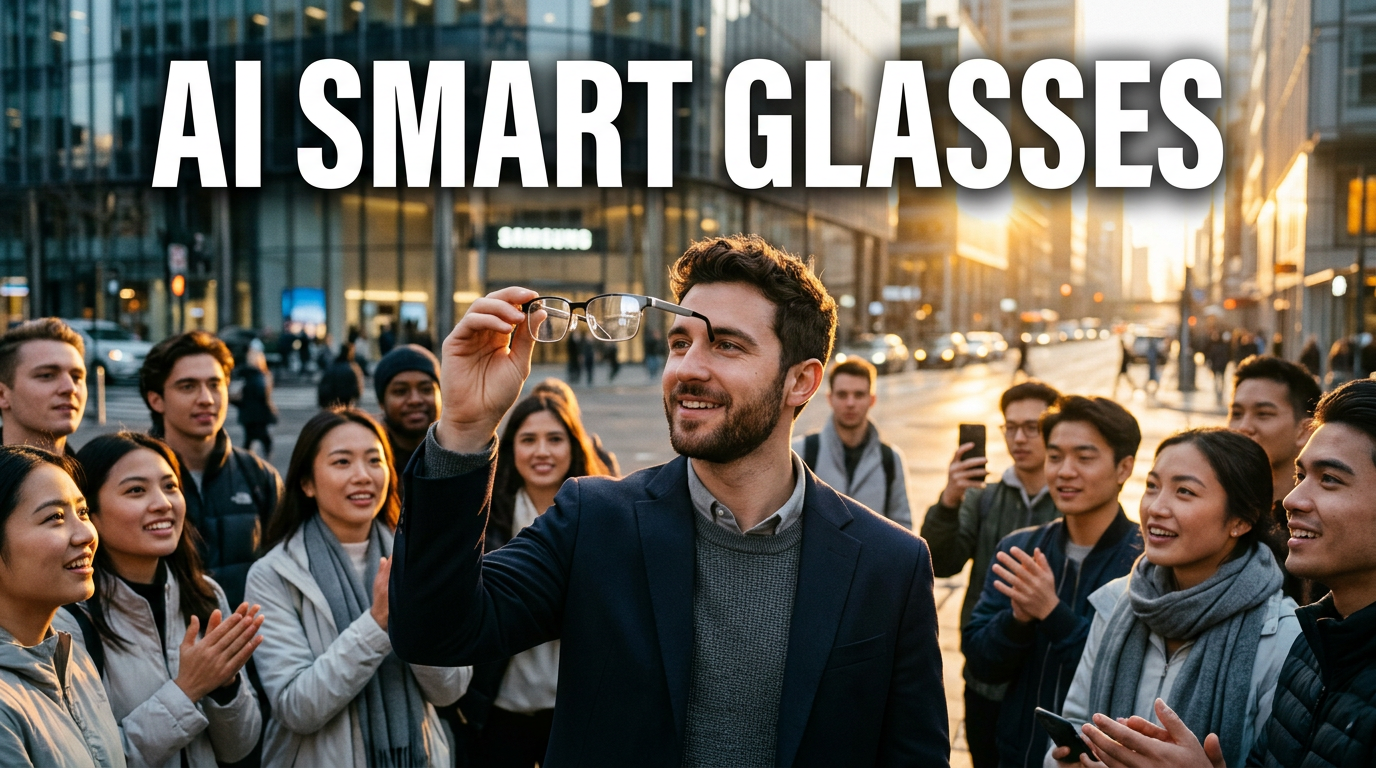

● AI Glass War Begins
Samsung AI Glasses Revealed, and the “next smartphone form factor” is becoming reality
At Google I/O 2026, the most eye-catching announcement was not just a new technology launch, but the fact that AI is beginning to leave the smartphone and attach itself to the real world.
The Android XR-based AI glasses unveiled jointly by Samsung Electronics and Google are significant because they are not a heavy headset like the existing Galaxy XR, but rather a wearable AI device that you can use like ordinary glasses.
With Meta also officially announcing the Korea launch of Ray-Ban Meta and Oakley Meta, the market has moved beyond simple product competition and into a full-fledged battle for leadership in the AI smart glasses market.
In this article, we will take a comprehensive look at the core features of Samsung AI glasses, how they differ from Meta, why the display was removed, and how they may affect the global economy, the fourth industrial revolution, and AI trends.
1. Google I/O 2026 key takeaway: AI is moving from “inside the phone” to “the world in front of us”
At this event, Google introduced its new Gemini features along with the Android XR-based AI glasses.
The core point is not the technology itself, but the shift in how AI is used.
Until now, AI has often operated inside smartphone apps, but now it is evolving toward a direction where it can process seeing, hearing, and speaking in real time through glasses-shaped wearables.
2. The biggest significance of Samsung AI glasses: the “companion device” position
The product Samsung revealed this time is different from the Galaxy XR headset.
While the headset is closer to an immersive experience, AI glasses are closer to an everyday assistant device.
Samsung introduced this product as a companion device that supports Galaxy AI smartphones.
In other words, rather than replacing the smartphone, it serves to extend smartphone AI functions into the real world.
3. It looks like ordinary glasses on the outside, but inside it contains the key hardware of AI
Although it looks like a regular pair of glasses or sunglasses, it includes a camera, speaker, microphone, and battery inside.
This structure matters because it allows users to call AI instantly with just their gaze and voice, without taking out a device or operating it manually.
This is not just a wearable device, but something closer to an “always-on personal AI interface”.
4. What Samsung AI glasses can do: focused on the things people need most in daily life
The point of this product is not to show off “amazing features all at once,” but to handle the tasks people commonly need in the real world right away.
4-1. Call Gemini by voice
You can directly handle requests such as “Give me directions,” “Recommend a nearby cafe,” or “Help me place an order for a drink” through voice.
4-2. Real-time translation
It can translate text on menus, signs, and notices in real time and speak the translation aloud, making it highly useful for overseas travel, business trips, and foreign language learning.
4-3. Voice translation for conversations
The function that translates the other person’s speech goes beyond simple interpretation and may work as a life-oriented AI that lowers language barriers.
4-4. Message summarization and schedule registration
The ability to summarize long messages or register them directly into a schedule is especially practical for office workers.
4-5. Capturing the scene in front of you
The device also includes a function that lets users capture what they are looking at right away, making recording and sharing more intuitive.
5. Why AI glasses now: the market wants “lightweight and fast AI”
The reason AI glasses are drawing attention is surprisingly simple.
People want AI that is light, fast, and immediately responsive rather than complex devices.
Smartphones are familiar, but they still require the process of opening the screen, launching an app, and typing every time.
By contrast, AI glasses have the advantage of instant responsiveness, working with just a spoken command and a glance.
In the end, this creates a difference in user experience (UX) and could further accelerate digital transformation.
6. The difference between Meta and Samsung·Google: same AI glasses, different philosophies
What is interesting in this competitive landscape is that although the products look similar on the surface, their approaches are different.
6-1. Meta’s strategy: standalone AI glasses
Meta is focusing on creating an entirely new user experience through Ray-Ban Meta and Oakley Meta.
In Korea, the products will officially launch on the 25th, strengthening both everyday and sports-oriented lineups.
Ray-Ban Meta emphasizes fashion and everyday usability with various frames such as Wayfarer, Skyler, and Headliner.
Oakley Meta targets sports, outdoor activities, and active lifestyles with the Vanguard and HSTN models.
6-2. Samsung·Google’s strategy: expanding the Galaxy AI and XR ecosystem
Samsung and Google are less focused on a standalone product and more on an auxiliary device that expands the Galaxy AI and Android XR ecosystem.
In other words, their strategy is closer to a platform approach that connects smartphones, XR headsets, cloud AI, and app ecosystems rather than selling AI glasses on their own.
7. Why remove the display: more important than a screen are “lightness and endurance”
Most of Samsung·Google’s AI glasses and Meta’s main products have chosen a screenless design.
This choice is not simply a lack of technology, but a realistic judgment about the current market.
7-1. Weight problem
Adding a display increases weight and worsens comfort.
7-2. Battery problem
A constantly active screen consumes a lot of power, making it difficult to create a device that can be worn all day.
7-3. Heat dissipation problem
When computation and display are packed into a small frame, managing heat becomes difficult.
7-4. Comfort problem
In the end, consumers choose not just “technologically impressive products,” but products they actually want to wear for long periods.
That is why, for now, the market is moving first toward lightweight, natural, and long-wearable forms rather than adding a screen.
8. Why this news matters economically: a new hardware replacement cycle may open up
AI glasses are not just another consumer electronic device; they could become a device that creates new hardware replacement demand.
They are connected to smartphones, semiconductors, communications, cloud services, content, design, batteries, and sensor industries.
8-1. Relationship with the smartphone market
Even if they do not replace smartphones right away, if they establish themselves as a companion device that reduces smartphone dependence, usage patterns will change.
8-2. Increased demand for semiconductors and sensors
Because they require cameras, microphones, low-power AI chips, sensors, and communication modules, they could also have a chain effect on the semiconductor industry.
8-3. Opportunities for batteries and materials industries
Since miniaturization, low power consumption, and lightweight design are essential, battery and materials industries will face even fiercer technological competition.
8-4. Changes in the content and advertising markets
If AI glasses become part of everyday life, search, maps, translation, shopping, reservations, and recommendation services may be reorganized into voice-centered personalized experiences.
9. From the perspective of the fourth industrial revolution: “AI + XR + wearables” are being combined into one
This announcement should be viewed not as a simple product release, but as part of the trend where fourth industrial revolution technologies are expanding their points of contact through lifestyle interfaces.
AI makes decisions, XR connects the real and digital worlds, and wearables attach themselves to the human body.
When these three come together, the way people and machines interact itself changes.
10. A core point that other news often misses: AI glasses are not the end of search, but a change in the form of search
When many people see AI glasses, they ask only, “Will they replace smartphones?”
But more important is the fact that the way we search and access information is changing.
In the future, searching by typing keywords may be replaced by a more natural way in which AI understands the scene I am looking at and answers immediately.
In other words, AI glasses do not mean the end of search engines, but rather the evolution of the search interface.
11. Another key point: AI glasses are a battle of ecosystems, not just hardware
On the surface, this looks like a competition in eyewear design, but in reality it is a battle over who can attach AI to everyday habits first.
Meta is trying to lead user habits through standalone experiences, while Samsung and Google are aiming for expansion through the Galaxy AI and XR ecosystem.
In the end, the winner will not be determined by the device itself, but by how well apps, services, communications, cloud, payments, translation, and search are connected.
12. Key points for investors and industry players
AI glasses are still in the early stages of mainstream adoption, but the direction is clear.
12-1. Short term
At first, adoption is likely to spread among early adopters, travel, interpretation, foreign language use, and content capture.
12-2. Mid term
If Galaxy AI, Android XR, and the Meta ecosystem become connected, the smart wearable market could grow rapidly.
12-3. Long term
Once AI glasses become widely adopted, industries such as search, commerce, advertising, education, remote support, and healthcare could all be transformed.
13. In one sentence
The launch of Samsung AI glasses is not just a new product announcement, but should be seen as the first mainstream stage of AI moving from smartphones into the real world.
And as Meta’s Korea launch overlaps with this moment, this is clearly the beginning of the AI smart glasses war.
What will matter going forward is not “who adds more features,” but who becomes more naturally embedded in everyday life.
< Summary >
Samsung and Google unveiled Android XR-based AI glasses, while Meta officially launched Ray-Ban Meta and Oakley Meta in the Korean market, making the competition in AI smart glasses official and intense.
The core point is that AI is no longer operating only inside smartphones, but has entered the real world through glasses-shaped wearables.
These products prioritize lightness, battery life, comfort, and practicality over displays, and focus on everyday functions such as translation, navigation, message summarization, and schedule registration.
Economically, they may mark the start of a new hardware replacement cycle that could affect the smartphone, semiconductor, sensor, battery, and XR ecosystem industries as a whole.
The real competitive point is not the device itself, but who can attach AI to everyday habits first.
[Related article…]
The AI glasses war: Samsung and Meta competition structure explained
Google Gemini: analysis of everyday AI platform expansion strategy
*Source: 전자신문 etnews