● AI Takeover
Samsung Electronics DX officially adopts external generative AI… workplace innovation now moves in a “in-house AI + external AI” two-track model
Samsung Electronics will officially introduce external generative AI services for employees in its DX (Device eXperience) division starting next month.
The core point is simple.
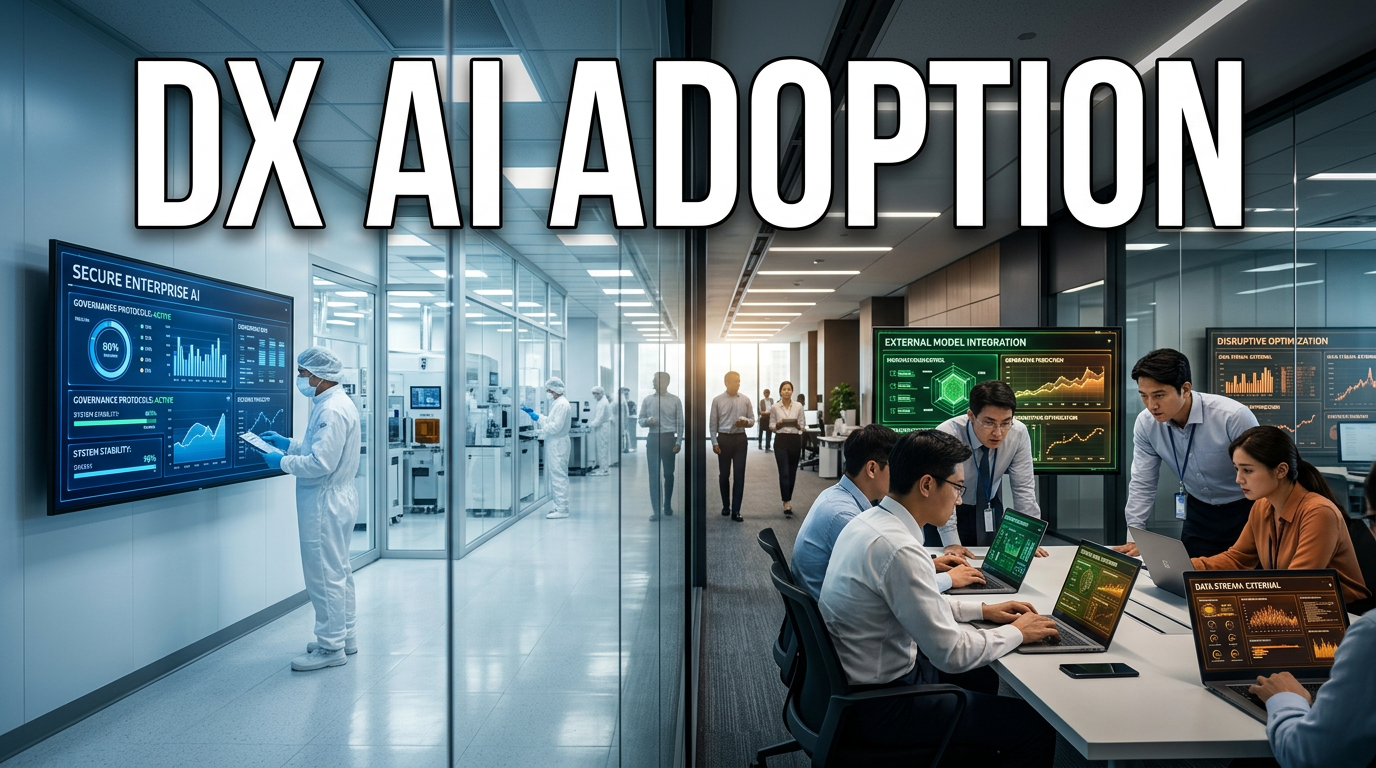
In addition to its existing in-house AI, “Samsung Gauss,” it will now fully integrate external AI tools such as Gemini, ChatGPT, and Claude into work processes to boost productivity and global competitiveness at the same time.
This trend is not just an internal perk or experiment.
It is a meaningful signal that connects AI-driven workplace innovation, digital transformation, the semiconductor supercycle, global business competitiveness, and the spread of AI agents all at once.
1. Key news at a glance
Samsung Electronics plans to officially allow DX division employees to use external generative AI starting in June 2026.
The target services are Gemini, ChatGPT, and Claude.
It has already conducted a field verification (PoC) with 2,500 employees and has completed security training, usage authorization, and operating policy establishment.
In other words, the stage has moved beyond “Can we use it?” to “How do we use it safely, where do we use it, and how do we maximize efficiency?”
Samsung Electronics’ direction is clear.
It aims to speed up product planning in the global market, strengthen marketing and communication capabilities, and process multilingual tasks faster.
2. Why this news matters
On the surface, it may look like “a large company adopted an AI tool.”
But the real meaning is much bigger.
The key point is that Samsung Electronics is no longer insisting only on its own internal AI and has now formally incorporated external generative AI into its work systems.
This also means that the AI strategy of major Korean corporations is shifting from a “closed internal development” model to a “hybrid open strategy.”
Put simply, the AI race is no longer about who built the model, but who can mix tools better and turn them into business results.
This trend will also affect the AI semiconductor, cloud, security, SaaS, and enterprise software markets as a whole.
3. Samsung’s approach: combining internal AI and external AI
Samsung Electronics has been operating its in-house generative AI, “Samsung Gauss.”
This time, it is adding external AI on top of that.
In other words, it is not a one-sided structure, but a method that uses internal and external AI in parallel depending on the work purpose.
The reason this combination matters is clear.
Internal AI is strong in security and control, while external AI offers broader usability, the latest features, and greater flexibility.
Samsung Electronics is trying to maximize work efficiency by using both together.
In the enterprise AI market, this kind of strategy is likely to become the standard.
4. Which services were verified in the PoC?
Samsung Electronics tested three services—Gemini, ChatGPT, and Claude—with 2,500 employees in a field validation.
This process is not simply about seeing “which one is more famous.”
It checks how well the tools work in real work environments, which tools employees prefer, whether there are security issues, and how efficiency differs by organization.
Conducting this PoC means Samsung Electronics is treating AI adoption as an operating system, not an event.
Ultimately, the real battle in enterprise AI adoption is decided less by model performance and more by how well it fits actual work.
5. Security is the key gate: the real hurdle for introducing external AI
The most sensitive issue when introducing external generative AI into a company is security.
This is because employees may carelessly enter confidential information, customer data, or product roadmaps.
Samsung Electronics addressed this by granting usage rights only to employees who completed security training.
It also established separate service operating policies and completed inspection procedures.
In other words, this is not unconditional openness but “controlled openness.”
This is likely to become the model that all major corporations follow in the future.
More important than the speed of AI adoption is AI governance.
6. Why external AI fits the DX division especially well
The DX division centers on consumer products, service experiences, and global communication.
That is exactly where the strengths of external generative AI stand out.
For example, it is useful for quickly organizing market reactions during product planning, handling multilingual communication with overseas subsidiaries, and refining global marketing copy.
Work becomes faster, and idea review time becomes shorter.
Ultimately, what Samsung Electronics is pursuing is not “a company that uses AI,” but “a company that operates through AI.”
7. Samsung’s AX innovation has already expanded to the manufacturing floor
This news is not just about office work.
Samsung Electronics’ AX (AI Transformation) is already expanding into manufacturing sites.
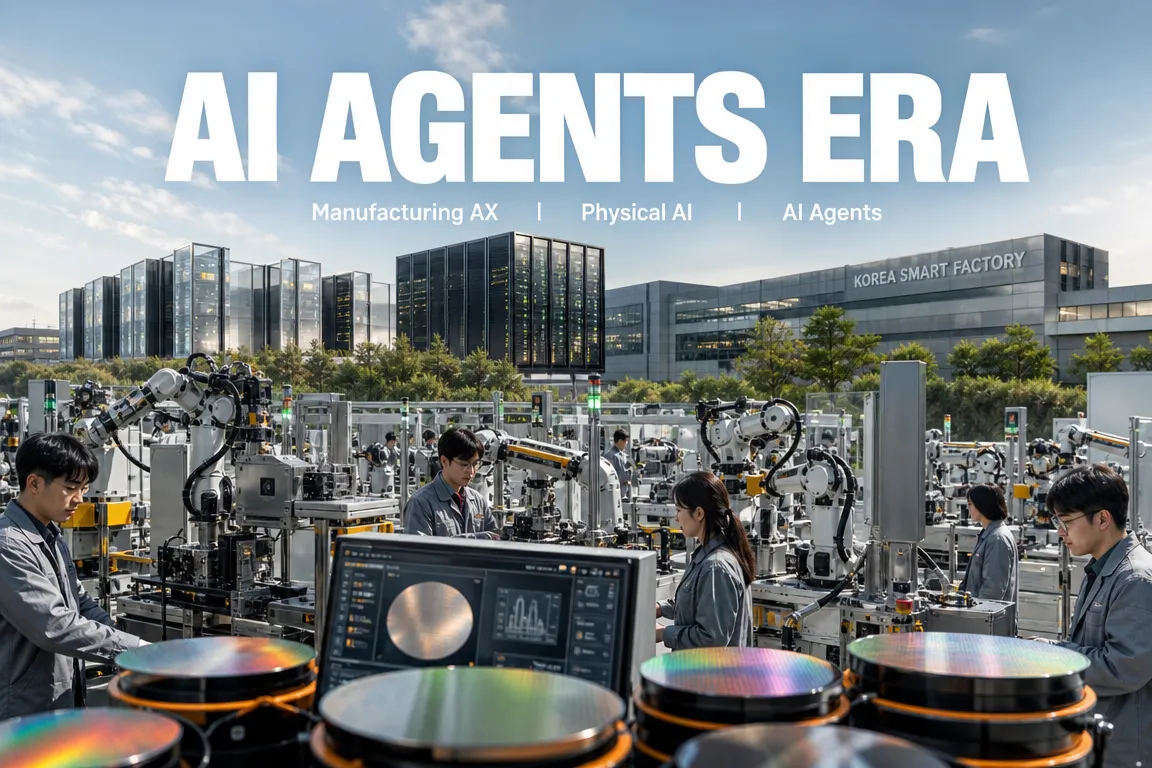
Samsung Electronics has announced a plan to convert all domestic and overseas production plants into “AI autonomous factories” by 2030.
The core is to apply digital twin-based simulation to every process from materials intake to production and shipment.
On top of that, AI agents in quality, production, and logistics are being added to strengthen data analysis and pre-verification.
Simply put, the goal is to transform factories into systems where AI assists prediction and decision-making instead of relying on human experience.
8. Humanoid manufacturing robots are also being pursued
Samsung Electronics is also gradually reviewing the introduction of humanoid manufacturing robots across the production process.
It is also considering forms such as operating robots that serve as operators and logistics robots that handle material transport.
This is not just automation.
It is an industrial structural transformation that changes productivity, workforce structure, and process stability at the same time.
Going forward, manufacturing competitiveness is likely to be determined less by factory size and more by AI utilization and robot integration capabilities.
9. The AX vision emphasized by President TM Roh is becoming reality
This external AI adoption is a concrete example of the AX vision emphasized by TM Roh, head of the DX division and CEO.
Mr. Roh has said that AX is not just a tool, but a process that fundamentally changes thinking and work processes.
He has also stressed that AI must be organically integrated into the entire device and service ecosystem of the DX division.
This message is quite important.
It means Samsung Electronics sees AI not as a simple feature addition, but as an organizational operating transformation.
10. What to watch from a global economic perspective
This news does not end as an internal Samsung issue.
Right now, the global economy is moving through AI productivity competition, supply chain restructuring, manufacturing reshoring, and increased investment in enterprise software.
Samsung Electronics’ move is an example of how a leading Korean manufacturing and IT company is positioning itself within this trend.
In particular, improved AI productivity can ultimately lead to lower costs, faster development, expanded overseas sales, and better profitability.
That is why the market is likely to interpret this not just as news, but as a signal of improved earnings.
11. Hidden points investors and industry players should watch
There is one point that is often missed in other reports.
The issue is not AI adoption itself, but the fact that Samsung Electronics has built an AI operating system.
A company does not finish the job just by adopting AI.
Policies, security, permissions, training, field application, and organization-specific optimization all have to work together for real results to emerge.
Samsung Electronics is putting this puzzle together one piece at a time.
Another important point is that external AI adoption starting in the DX division may later expand into manufacturing, R&D, and customer service.
In other words, this move is more of a starting point.
12. The most important point that other YouTube channels or news reports often miss
The most important issue is not whether Samsung Electronics uses AI or not.
What matters now is that competitiveness depends on which AI is deployed, for which tasks, and under what control structure.
And Samsung Electronics is not treating internal AI and external AI as opposites, but rather as tools to be used in parallel.
This is a realistic solution that global mega-corporations are likely to adopt.
Another point is that external AI adoption is not limited to office productivity improvements, but is also connected to manufacturing autonomy and robotics transformation.
In other words, this news should be seen not as a “work AI” story, but as a story about the AI-ization of the entire enterprise operation.
13. SEO keywords to consider together from an economic and industrial perspective
When understanding this trend, it is useful to look at generative AI, AI transformation, digital transformation, smart factories, and global economic outlook together.
If you add the semiconductor industry, enterprise AI, AI agents, digital twin, and manufacturing robots, the full picture becomes visible.
In particular, Samsung Electronics’ move is also tied to Korea’s economic growth rate, IT investment cycle, AI semiconductor demand, and expectations for improved corporate productivity.
In short, this news is a technology story, an industry story, and on a larger scale, an economic story.
Samsung Electronics will officially introduce external generative AI such as Gemini, ChatGPT, and Claude for DX division employees.
The core point is a two-track strategy that uses internal AI, “Samsung Gauss,” alongside external AI.
With security training and access controls in place, the company aims to improve global productivity, marketing, and multilingual communication capabilities.
This decision is a signal that Samsung’s AI transformation is expanding beyond office work into AI autonomous factories, digital twins, and manufacturing robots.
In other words, this is not just a tool adoption story, but a sign that the AI-ization of the entire enterprise operation is accelerating.
[Related articles…]
- Key takeaways on how the spread of generative AI is changing enterprise work innovation
- Investment points where the semiconductor supercycle and AI transformation intersect
*Source: https://n.news.naver.com/article/008/0005362741?sid=101&type=journalists&cds=news_edit