● Stocks-Rally, Chips-Surge, Iran-Noise, Lilly-MAAs
US Equities Surge; Semiconductor Rally Reignites; Middle East Risk Repriced; Eli Lilly’s Large-Scale M&A in Focus
US markets advanced broadly, but sector-level flows were more concentrated than index performance suggests. Strength in the Nasdaq and S&P 500, a sharp move in Micron, renewed inflows into AI semiconductor infrastructure, limited market sensitivity to Iran-related headlines, and reports of Eli Lilly acquiring three vaccine developers collectively highlighted where global capital is being allocated.
The common thread is valuation preference: markets are paying a premium for structural growth and visibility of cash flows over macro fear.
1. Key US Market Takeaways: Indices Rose; Capital Rotation Was More Explicit
On the 26th, US equities closed higher:
- Nasdaq: up ~1%+
- S&P 500: up high single-digit basis points, near record levels
- Dow: positive
- Russell 2000: strong gains, indicating participation beyond mega-cap tech
Despite broad index strength, leadership remained clear:
- Semiconductors and AI infrastructure
- Semiconductor ETFs outperformed
- Micron led a renewed memory rally
- Energy, nuclear, and AI infrastructure names also advanced
This price action reflects concentrated allocation into a limited set of growth clusters rather than a broad-based “risk-off reversal.”
2. Why Semiconductors Led Again: Not Just Sentiment, but Structural Re-Rating
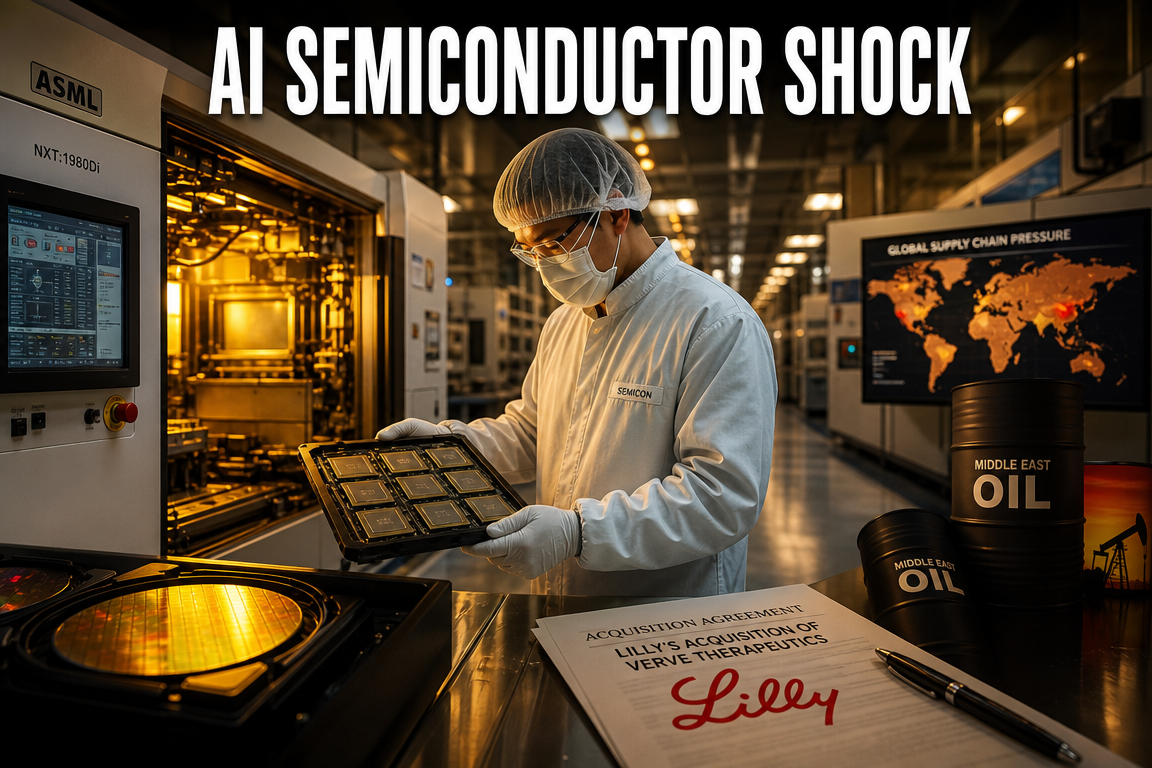
Micron posted an intraday double-digit surge. Broad strength followed across major semiconductor names (Broadcom, AMD, Qualcomm, Nvidia, SanDisk, among others).
2-1. Core Drivers Behind Micron’s Move
A key catalyst was a bullish UBS report arguing that valuation frameworks should incorporate multi-year demand visibility supported by long-term supply agreements and AI-driven memory demand.
Key points:
- Hyperscalers are pre-booking server DDR5 and HBM volumes
- Long-term supply agreements (up to ~5 years) increase earnings visibility
- Memory is being re-rated from a highly cyclical business toward a more predictable cash-flow profile
The implication is a potential structural change in perceived earnings durability, not merely a near-term cycle upswing.
2-2. US Supply-Chain Reconfiguration as a Tailwind for Micron
Geopolitics and supply-chain strategy may reinforce Micron’s premium:
- AI data-center capex raises the cost of over-reliance on Asian memory supply chains
- US onshore capacity expansion and policy support can benefit US-based producers
- “Resilient supply” is increasingly valued as a risk-mitigation attribute
Summary drivers:
- AI memory demand growth
- Long-term contracting increases stability
- Potential policy support tied to domestic capacity
- Strategic value as a supply-chain de-risking lever
2-3. Why Samsung Electronics, SK Hynix, and Micron Should Be Viewed Together
The memory rally has rotated across Korea, Taiwan, and the US, with TSMC, Samsung Electronics, SK Hynix, and Micron functioning as a single AI memory/foundry-linked chain.
On NAND-related data, Samsung Electronics and Micron show strong revenue growth, while SK Hynix may appear less dynamic on the surface. A different interpretation is plausible:
- SK Hynix’s high-end AI server SSD and HBM capacity is already tight
- Supply constraints can shift incremental demand to Samsung Electronics and Micron
- Net effect: sustained strength across the broader memory complex
This is less a zero-sum competitive narrative and more an ecosystem-wide uplift driven by AI infrastructure investment.
3. Middle East Risk and Oil: Headlines Intensified; Markets Reacted Less
Iran’s foreign ministry claimed the US violated a ceasefire agreement, and regional tension remained elevated, including concerns related to the Strait of Hormuz.
Market reaction was comparatively contained:
- Political statements were aggressive
- Reports of clashes persisted
- However, shipping flows were recovering
- Iran’s equity market continued operating normally
Brent was volatile, WTI was comparatively stable, and the VIX did not spike materially. Markets appeared to price the situation as elevated tension without a near-term, systemic disruption scenario.
3-1. Why Markets Favored Observable Flow Data Over War Rhetoric
The primary driver was the gap between rhetoric and real-economy signals (shipping and financial market function). Price discovery favored measurable indicators over worst-case narratives.
3-2. Key Variable Is Not Oil Alone, but Rates and Growth-Stock Discounting
For US equities, the critical transmission channel is oil’s impact on inflation expectations and rates. Recent AI-led earnings expectations and capex narratives appear to be limiting the immediate valuation damage from short-term energy volatility.
Investment focus should therefore be on whether geopolitical risk meaningfully pushes discount rates higher, rather than on headline risk alone.
4. Eli Lilly: Reported Acquisition of Three Vaccine Developers (Up to ~$4B)
A major corporate catalyst was reporting that Eli Lilly is pursuing the acquisition of three vaccine developers, with total consideration cited up to approximately $4 billion.
4-1. Where Obesity-Drug Cash Flows Are Being Deployed
Eli Lilly’s obesity and diabetes franchises are generating substantial cash flows. The strategic emphasis appears to be reinvestment into future pipeline breadth rather than prioritizing pure shareholder return.
Reported target categories include:
- Adult shingles vaccine assets
- EBV vaccine development
- Bacterial infection prevention vaccines
This indicates a pipeline-forward approach aimed at securing the next multi-year growth engine.
4-2. Market-Critical Detail: Likely Milestone-Based Deal Structure
The reported structure implies upfront payments plus contingent milestones tied to clinical progress and regulatory approvals, which can reduce biotech-specific binary risk:
- Limited upfront burden
- Reduced loss severity in failure scenarios
- Capital concentrated into higher-probability assets as milestones are met
This supports the view of disciplined capital allocation rather than indiscriminate acquisition.
4-3. Why Mega-Cap Healthcare Remains a Key Allocation Bucket
US equity flows appear concentrated in two primary directions:
- AI infrastructure and semiconductors
- Mega-cap healthcare with durable cash generation
Large, profitable pharma platforms that convert current cash flow into pipeline optionality may continue to command premium valuations relative to smaller, cash-burning biotech.
5. SpaceX and Tesla Funding: Liquidity Competition Outside Public Mega-Caps
Barron’s noted potential concerns about large capital movements involving Tesla in relation to SpaceX funding.
This matters because late-stage private mega-deals and prospective IPO supply can absorb significant liquidity (e.g., OpenAI, Anthropic, SpaceX). As a result, capital may rotate away from less differentiated public equities:
- Mid-tier software with unclear growth durability
- Undifferentiated mid-cap tech
- Theme-driven names with weak earnings quality
The market’s narrowing leadership can be interpreted as a function of liquidity competition and a preference for clearer structural winners.
5-1. What Tesla Investors Should Monitor
Tesla retains multiple growth narratives (EVs, energy storage, robotaxi, AI, Optimus). However, market tolerance for narrative without execution has declined. If funding requirements rise across affiliated ventures, capital allocation decisions and external liquidity needs may become a more material variable alongside Tesla’s operating fundamentals.
6. Nuclear and Energy Infrastructure: A Secondary Beneficiary Theme
Nuclear-related equities also strengthened (Oklo, NuScale Power, Constellation Energy).
Key drivers:
- Rapid growth in data-center power demand
- Expectations tied to US Department of Energy-related programs
- Fuel transition and evolving regulatory frameworks for next-generation reactors
As AI scales, enabling infrastructure (power, cooling, grid buildout) becomes a parallel growth track.
7. Weekly Checklist: GDP, PCE, Salesforce, Costco
Key catalysts include:
- Q1 GDP growth
- April PCE inflation
- Durable goods orders
- New home sales
- Salesforce earnings
- Costco earnings
PCE remains central to Fed policy expectations. Recent market behavior suggests that moderate macro volatility has not consistently broken AI-led leadership, implying structural growth narratives are currently dominating the risk premium.
8. Global Equity Signals: Taiwan, Japan, and the US Point to the Same Theme
Taiwan’s equity market reportedly surpassed India to become the world’s fifth-largest by capitalization, driven largely by TSMC. Japan remains supported by SoftBank/Arm and AI-related expectations. The US continues to be led by Nvidia and AI infrastructure.
Across regions, capital markets appear to be converging on a single theme: AI semiconductors and next-generation infrastructure.
9. Most Important Under-Discussed Point
9-1. Markets Are Responding Less to “Good News” and More to Capital Allocation Clarity
The more material signal is where capital is leaving and where it is concentrating. The current environment resembles a selective rally rather than broad participation.
Capital is compressing into four clusters:
- Semiconductors
- AI infrastructure
- Power and nuclear
- Cash-generative mega-cap pharma
9-2. Supply Chains and Earnings Visibility Are Gaining Weight Versus Macro Variables
Compared with prior regimes where oil, rates, and geopolitical risk dominated, markets are increasingly rewarding:
- Supply-chain resilience
- Long-term contracting
- Policy support
- Observable cash-flow durability
Micron exemplifies this re-framing from cycle exposure to AI-driven contracted visibility.
9-3. A Key Risk Is Opportunity Cost, Not Only Downside Shocks
A dominant behavioral risk appears to be opportunity cost (FOMO). The primary requirement is discrimination between:
- Sectors with structural tailwinds and improving visibility, and
- Names that may be pressured by liquidity competition despite superficially stable narratives
10. Investor Positioning: Practical Takeaways
10-1. US Equities
- Semiconductor and AI infrastructure leadership remains intact
- Micron, Nvidia, Broadcom: potential near-term overheating debates aside, still aligned with structural demand
- Cash-generative mega-cap healthcare (e.g., Eli Lilly) remains a core allocation area
- “Middle” growth equities may underperform as liquidity is absorbed by large private deals and concentrated public winners
10-2. Implications for Korea-Based Investors
- Samsung Electronics and SK Hynix remain central to the global AI memory cycle
- Evaluate within a global supply-chain framework rather than a purely domestic equity lens
- Prioritize capacity, customer mix, and positioning in HBM/SSD over short-term volatility
10-3. Macro Monitoring
- Whether oil re-accelerates and lifts inflation expectations
- Whether PCE materially shifts rate-cut expectations
- Whether Middle East risk translates into actual logistics disruption
- Whether AI capex continues to convert into measurable earnings outcomes
11. Conclusion: Markets Are Pricing “Growth Structure” Over “War Headlines”
Despite elevated geopolitical headlines and oil volatility, equities advanced and semiconductors led. Markets are currently assigning higher value to structural growth, supply-chain reconfiguration, AI investment expansion, and durable cash generation than to near-term macro fear.
The key question is not which headline appeared, but whether it altered observable capital flows. In this session, flows remained concentrated in high-conviction growth clusters.
< Summary >
US equities rose led by the Nasdaq and S&P 500; market leadership remained semiconductors and AI infrastructure. Micron’s surge reflected a structural re-rating driven by long-term supply agreements and US supply-chain considerations. Despite Iran-related escalation rhetoric, markets focused on shipping and financial flow data that did not indicate severe disruption. Eli Lilly’s reported acquisitions signal reinvestment of obesity-drug cash flows into vaccine pipeline assets, likely via milestone-based structures. Going forward, AI capex, rates, inflation, supply-chain reconfiguration, and liquidity concentration into large-scale growth assets remain the key variables.
[Related Posts…]
- AI Semiconductor Supercycle: Why the Market Is Buying Semiconductors Again (https://NextGenInsight.net?s=semiconductors)
- Reassessing US Rates and Inflation: Key Variables for Global Equities in 2H (https://NextGenInsight.net?s=rates)
*Source: [ Maeil Business Newspaper ]
– 이란 외무부 “미국 휴전 합의 명백 위반”ㅣ일라이릴리, 백신 개발사 3개 동시 인수 보도ㅣ배런스 “스페이스X, 테슬라서 대규모 자금유출 우려”ㅣ홍키자의 매일뉴욕