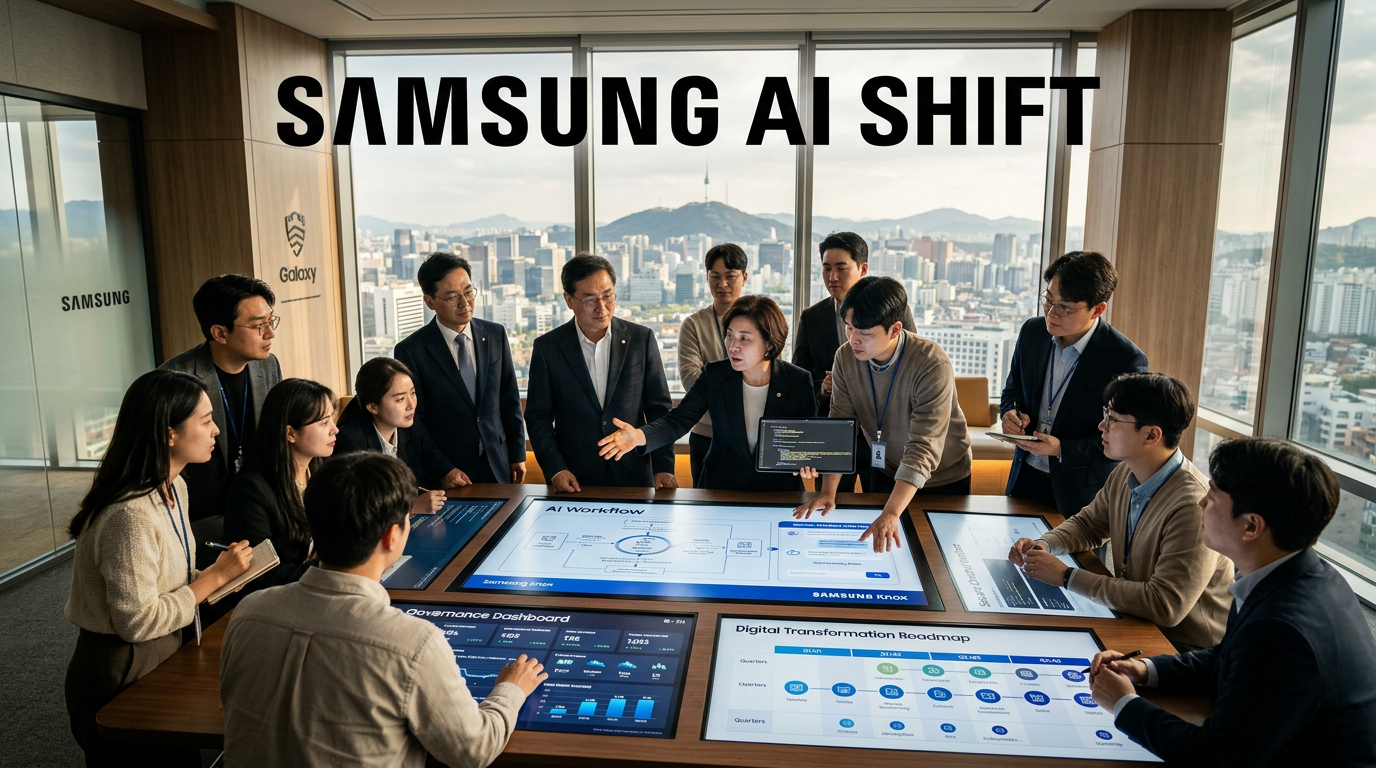
● Samsung Unleashes AI
Samsung reverses course with a full-scale adoption of external generative AI…It’s now moving from “blocking AI” to “using AI”
This issue is not simply about Samsung employees being allowed to use ChatGPT, Gemini, and Claude.
From the perspective of global economic outlook and AI trends, the key takeaway is that the AI adoption approach of large corporations is shifting from “experimentation” to “enterprise-wide operating systems”.
In particular, the fact that Samsung, a manufacturing and IT giant highly sensitive to security, has officially allowed external generative AI is likely to have ripple effects across the enterprise AI market, AI productivity innovation, digital transformation, cloud computing, and AI governance.
Below, we will summarize the core points of this announcement, why companies are making this move, and the truly important points that other articles often fail to cover, in a news-style format.
1. Core news: Samsung overturns its ban on external generative AI after 3 years
Samsung Electronics has officially allowed DX division employees to use external generative AI services such as ChatGPT, Gemini, and Claude.
This is the complete opposite of its stance just three years ago, when it strongly restricted the use of external AI following internal source code leakage concerns related to ChatGPT.
This change is not just a policy revision; it should be read as a turning point in transforming AI from a support tool into 업무 infrastructure.
Why now?
The biggest background factor is Chairman Lee Jae-yong’s company-wide “AX” strategy, or AI transformation.
Samsung is now moving beyond a model where only a few teams test AI, toward a structure that embeds AI across the entire value chain—from R&D to production, marketing, and support functions.
In other words, AI is no longer optional; it has become a condition for maintaining competitiveness.
What changes?
Previously, the focus was on in-house AI models, but now Samsung is also using external generative AI from global big tech companies.
Samsung has adopted ChatGPT, Gemini, and Claude so that employees can choose the most suitable tool for each task.
This approach is far more flexible than standardizing on a single AI tool, and it is likely to deliver better real-world productivity.
2. Samsung’s real strategy: It is not just adopting AI, it is changing the organization’s DNA
The most noteworthy point in this announcement is that Samsung’s goal is not simply to improve work efficiency.
Samsung is clearly saying that it will redesign the way the organization works around AI.
Key changes in organizational operations
- Improving individual productivity
- Accelerating decision-making
- Strengthening execution capabilities
- Embedding AI into work processes
- Reorganizing organizational culture around AI
This is not just a tool rollout.
It is about changing the basic grammar of corporate operations.
Going forward, the question will be less about who works longer and more about who can attach AI more effectively and execute faster.
The meaning behind Samsung’s approach
Samsung tested the effects with around 2,500 employees before selecting external AI services.
That means large corporations now believe that “controlled use” is more realistic than a total ban.
This shift is also extremely important from a global economic perspective.
As corporate AI demand moves from experimental budgets to core budgets and operating expenses, the entire AI software, cloud infrastructure, security, and data management industries will grow alongside it.
3. Another key point inside Samsung: executive training comes first
Samsung is starting AI transformation with executive training before employee training.
This is a far more important message than it may seem.
The meaning of AX Boot Camp
Samsung is launching “AX Boot Camp,” an intensive AI training program for about 50 executives.
It then plans to expand the training to around 2,300 executives across the entire Samsung Group.
Remaining employee training is scheduled to be completed by the end of 2026.
The important point here is that Samsung is tying the success of AI transformation to the AI literacy of CEOs and executives.
In other words, this is not about telling frontline employees to “try it out,” but about ensuring that management understands AI first and incorporates it into work design.
Why this matters
Many companies fail to adopt AI not because of technology, but because of leadership.
At the working level, employees may want to use AI, but if decision-makers do not understand it, adoption stalls.
On the other hand, if executives personally experience AI and lead the redesign of workflows, AI shifts from a simple experiment to a management system.
4. Is the security concern over? No—it has become more sophisticated
Samsung opening external generative AI does not mean security concerns have disappeared.
In fact, the hidden key takeaway of this announcement is that Samsung intends to pursue both expansion and control at the same time.
What Samsung is building together
- Establishing a company-wide AI task force
- Improving the data operating system
- Creating model operations management systems
- Strengthening the security framework
- Building an AI talent development system
This structure is very realistic.
Companies cannot afford to ignore AI, but if they use it recklessly, the risks of data leakage and regulatory exposure rise.
So in the future, the question will be less about whether to use AI and more about what kind of control system it operates under.
The core point other articles often miss
The most important thing in Samsung’s case is not actually generative AI itself.
AI governance has become part of corporate competitiveness is the more important takeaway.
The companies that win will not simply be the ones that adopt AI quickly, but the ones that design security, data, training, and workflows together.
5. From a global economic outlook perspective: what Samsung’s choice signals to the market
Samsung’s move is not just news for Korean companies.
It is a powerful signal that the standard for AI adoption is changing across global corporations.
Five market impacts
- Expansion of the enterprise AI market: Demand for B2B services such as ChatGPT, Gemini, and Claude is likely to grow
- Increased cloud computing investment: Company-wide AI usage requires infrastructure
- Acceleration of digital transformation: Workflow automation and decision-making sophistication will advance together
- Greater importance of data management: AI performance ultimately depends on data quality
- Growth in the security industry: As AI usage expands, demand for data leakage prevention will also rise
In other words, this may be a decision by one company, but its ripple effects are substantial.
If other large corporations follow this trend, AI adoption budgets are likely to become a fixed business expense rather than a simple R&D cost starting next year.
The economic point to read carefully
AI is no longer just a productivity tool; it is becoming an economic variable that changes labor costs, operating costs, and decision-making structures.
That means corporate profitability, workforce structures, and workflow design could all change.
Especially for large corporations that combine manufacturing and IT, AI adoption is likely to translate into financial performance more quickly.
6. AI trend perspective: the market is moving toward “multi-AI + task-specific optimization”
Samsung’s simultaneous adoption of ChatGPT, Gemini, and Claude is highly symbolic.
It suggests that the idea of “one AI solving everything” is coming to an end.
Future AI trends
- Multi-model usage instead of single-model dominance
- Task-specific optimization instead of general-purpose AI
- Strengthening organizational execution instead of just individual productivity
- Internalizing operational systems instead of merely adopting technology
- AI governance and security becoming more important than AI features
For companies, the question is no longer “which AI is the best?” but “what combination fits our work best?”
This trend is likely to become the basic framework for generative AI, the AI industry, corporate innovation, and IT strategy going forward.
7. Conclusion: Samsung is not just adopting AI; it is changing how companies operate in the AI era
Samsung’s decision has meaning far beyond merely allowing external generative AI.
The core point is that a company that once blocked AI is now redesigning its organization and security around AI.
And at the center of that are executive training, company-wide organizational restructuring, a security framework, and a data operating system.
Ultimately, the future competition will not be about whether to use AI, but about how to embed AI throughout the entire organization.
Companies that embrace this shift earlier are more likely to stay ahead in digital transformation and AI productivity innovation.
< Summary >
Samsung Electronics has ended its anti-AI stance by rolling out external generative AI such as ChatGPT, Gemini, and Claude across the company.
The core point is not simply adding a new tool, but transforming the organization’s way of working and DNA around AI through an AX strategy.
With executive training, security systems, and a dedicated task force all moving together, this is expected to have a major impact on the enterprise AI market and digital transformation trends.
Going forward, competitiveness will likely depend less on whether AI is used, and more on how safely and systematically it is embedded into the organization.
[Related Articles…]
Salesforce Accelerates Enterprise AI Expansion with Agentic AI Acquisition
Anthropic Tightens Enterprise Access After Regulatory Pressure, Signaling Stronger AI Governance
*Source: https://www.cio.com/article/4184660/samsung-which-previously-blocked-chatgpt-is-now-fully-adopting-three-generative-ai-models-and-accelerating-its-ax-initiative.html