● DeepSeek Enters Copilot
“DeepSeek into Microsoft Copilot?” 3 core points that are changing the game
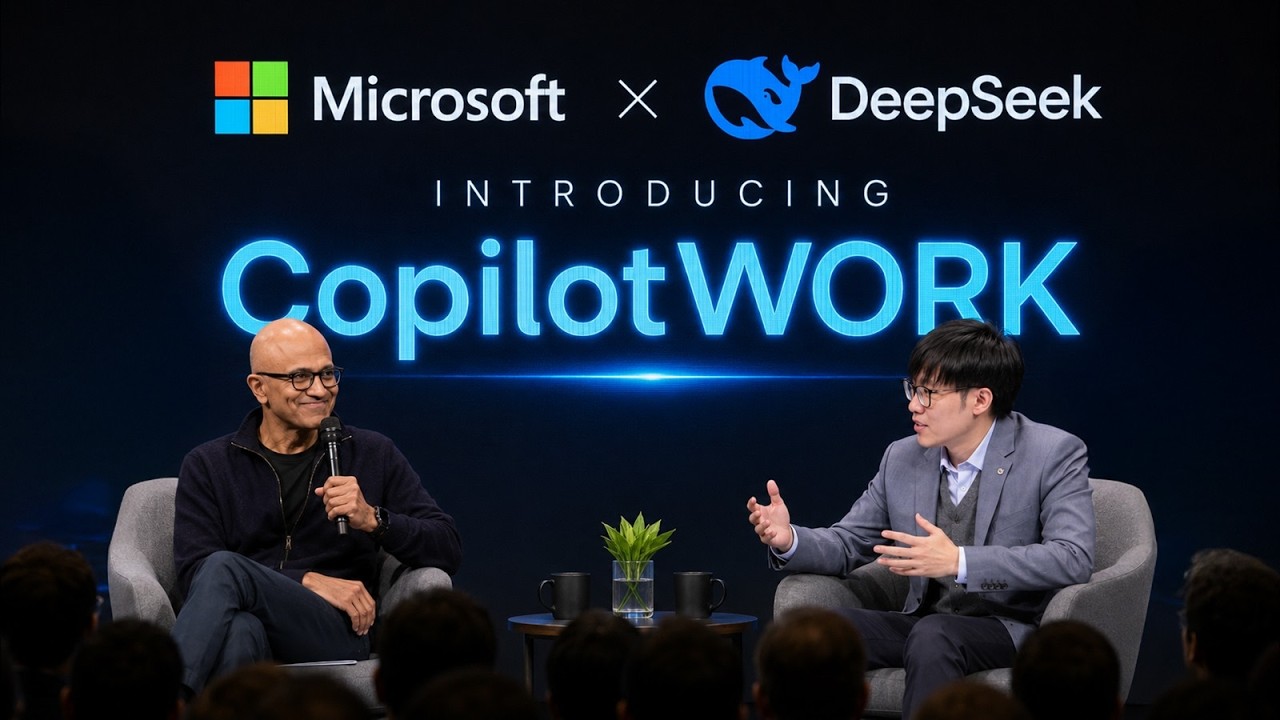
The core point of today’s news is exactly this. 1) Microsoft is turning Copilot from a ‘single chatbot’ into a ‘multi-model agent platform’, 2) in the process, it is directly tackling the ‘agent cost’ problem with usage-based pricing, 3) and as a cost-saving option, it is also reviewing hosting models like DeepSeek on Azure through verification.
What’s truly important here isn’t “adding one more model,” but rather, the structure in which corporate work actually moves across multiple models and runs automatically is becoming real. And this flow could grow to a level that rewrites the rules of the global AI race (quality/cost/security/geopolitics).
1. Official launch of Microsoft Copilot “Cowork” (global availability) + usage-based billing
[News] Microsoft is providing Copilot Cowork to the world as general availability (GA).
✅ After a 3-month preview (Frontier), the rollout has been expanded, and Microsoft says that more than half of Fortune 500 companies already used it during the preview period. They also mentioned enterprise case studies such as Accenture, Avanod, Advanced Local, Capital Group, LTM, Ordo, Qatar, and Zurich Insurance.
✅ The nature of Cowork: “not Q&A, but completion of work”
If general Copilot feels like it produces one-off results such as email drafts or meeting summaries, Cowork breaks down and executes long-running tasks based on an agent (Agent) approach.
– Brings in work (sets job objectives) – Decomposes into steps (plan) – Uses company data (document/file/system integration) – Calls tools (edit spreadsheets, generate charts, perform analyses, etc.) – Continues running in the cloud – Returns the deliverable in a completed form
✅ What customers have already done (representative cases)
- Safely edits batch-job spreadsheets and generates dependency flowcharts with each change
- Compares nearly 4,000 files across two product versions (replacing weeks of work)
- Analyzes a stalled sales pipeline to identify a ‘risk opportunity’ priority list and also specifies cold follow-up actions
2. Agent AI is a “the more you use it, the more expensive it gets” structure → so it shifts to usage-based billing
[News] Microsoft is changing the billing approach for Cowork to usage-based.
There was one very real practical problem. Agent-style AI usually isn’t something that finishes with a single prompt; instead, it requires repeated model calls (multiple times), pulls in retrieval and search context, calls tools, and can run for a long runtime.
In other words, the more useful it becomes, the more people assign tasks → the longer the agent runs → and compute costs explode. According to an Axios report and explanations from Microsoft officials, during testing some users ran hundreds of tasks per week and found the costs were not manageable.
✅ What exactly gets billed and how (core point)
- Cowork requires a Microsoft 365 Copilot user subscription license
- Tasks are measured by usage using “Copilot credits”
- Pricing varies based on 4 factors
- Model use
- Context retrieval
- Tool calls
- Runtime
- With general availability, PGO is at about 1 cent/credit per task
- As an alternative, P3 (pre-committed usage) option is provided → a discount structure
✅ Making it possible for companies to estimate costs via “task/user categorization”
- Three task tiers
- Light: few knowledge sources, limited reasoning, 1 or fewer outputs
- Medium: multiple sources, structured reasoning, 2 or more outputs
- Heavy: broad aggregation, deeper reasoning, multiple outputs
- Four user personas
- Enterprise knowledge workers
- Managers/C-suite leaders
- Customer-facing knowledge workers
- Technical workers
Why this matters is simple. In enterprise adoption, the hardest part isn’t whether it has good features—it’s whether the budget can be controlled. As Microsoft enters the agent market in earnest, it has effectively laid down a billing/forecasting framework as well.
3. DeepSeek is being considered not as a “default inclusion,” but as a “low-cost option” (intense multi-model competition)
[News] According to Axios, Microsoft is exploring ways to include either a model fine-tuned from DeepSeek V4 in Cowork or an open-source model as a lower-cost option.
✅ What models does Cowork use right now
- For general availability (BAU/GA): mainly Anthropic models (e.g., Opus 4.8, Sonnet 4.6)
- Frontier program: uses GPT 5.5
- And a Microsoft proprietary model called “Cowork 1” is also scheduled for release
✅ Cowork 1’s position: lower costs and strong performance for real-use tasks
- Microsoft security fine-tuned models
- Post-training aimed at achieving a substantially lower cost for agent tasks
- As mentioned: especially strong as an option for everyday work and cost-sensitive workloads
✅ If DeepSeek is added, then what? (the truly important conditions)
- Not automatically enabled by default (customers choose)
- Fully hosted on Azure
- Customer data stays inside Microsoft’s cloud
- Applies Azure enterprise security/data residency compliance requirements
- Microsoft adds fine-tuning and safety measures
One more thing. This isn’t a claim that it will “replace OpenAI.” There’s only one key viewing point. That Microsoft Copilot evolves into a form that ‘routes between multiple models’ rather than relying on a single model.
– Some tasks use Opus – Some tasks use Sonnet – Frontier/specific contexts use the GPT family – Cost-sensitive everyday tasks use Cowork 1 – And in some cases, low-cost options like DeepSeek
When this structure takes root in enterprise environments, the center of gravity in the enterprise AI competition shifts from “a single best-performance model” to “an optimized combination of models per task + cost/security/quality control”. This is the biggest change point in this news.
4. China business: Microsoft, which sold Western models to China… is it turning back to ‘China models’ as its own product option?
[News] According to a Bloomberg report, Microsoft has greatly expanded its AI model selling business to Chinese companies, and in the process, there has been observed a flow where Chinese models like DeepSeek are being considered as options for its Copilot product.
✅ The scale of AI consumption within China
- BiteDance as a flagship customer of Microsoft AI in China (the largest pillar in recent years)
- There are views that annual AI/cloud service spending could reach over $1 billion
- Ant Group, Meituan, Tencent, and others also spend heavily on AI model usage via Azure
Important context: OpenAI/Anthropic may face restrictions on direct sales in China, but Microsoft can provide them via Azure using its own policies due to the partnership structure with OpenAI.
✅ However, the constraints are also significant (geopolitics/security/IP)
- Observed that OpenAI models are not directly hosted on China server farms (concerns about IP theft)
- Instead, access is via the internet through external facilities such as Singapore
- Also, there are concerns about “model distillation and improvements to proprietary models”
- Even though they try to reduce risk with automatic monitoring, complete control is difficult
Here, the picture gets curious. Microsoft sells Western models to Chinese enterprises, while also at the same time considering putting a Chinese model (DeepSeek) inside its Western enterprise Copilot as a cost option. This goes beyond a simple pricing issue— it reads as a signal that as the AI ecosystem becomes more multi-model, geopolitical complexity increases further.
5. Microsoft “Web IQ”: directly taking control of the agent grounding/search + evidence layer
[News] Microsoft recently introduced an agent grounding system called “Web IQ” built on Bing.
✅ Traditional search is human-centered, while Web IQ is agent-centered
- General search: focuses on links/ranking/snippets/images/videos/ads (for human use)
- Agent search:
- Runs multiple queries
- Extracts from pages
- Compares sources
- Expands the topic (fan-out)
- Search again (iterate)
Aligned with this flow, Web IQ provides “latest web data” in a format that machines can read well.
✅ Performance claims
- Claims to be about 2.5x faster compared to the next alternative
✅ But the market is already crowded
- Competition exists such as Perplexity, Brave Search API, Google-related tools, Tavily, Exa, open-source retrievers, and others
- In agent workflows, bottlenecks are often not “search latency” but LLM reasoning, tool orchestration, memory, reasoning, and output generation
- At present, early access is provided to some Azure users, so the performance edge could be even bigger within Azure
Still, there’s only one reason it matters a lot. It’s because Microsoft appears to be pursuing a strategy to capture not just models, but the entire agent stack (search grounding/memory/tools/security/billing/cloud runtime).
6. “Copilot Cowork = an enterprise agent platform” final wrap-up
[One-line takeaway] Copilot Cowork is no longer clearly heading toward a mere “upgrade to Copilot,” but rather toward building an enterprise agent platform.
Structurally, the following are combined.
- Runs agents in the cloud
- Uses Web IQ/grounding so the agent reasons and verifies with the latest information
- Integrates with Work IQ to access company data
- Complies with Microsoft 365 security rules
- Supports multi-model (routing per task)
- Administrators control budget/user/limit policies
They also said that features like plugins, edge browsing, reporting, audit logs, search/compliance, and data loss prevention (DLP) will be expanded later. In other words, this is a step where “not a chatbot,” but “outsourcing work automation” is packaged in an enterprise manner.
“The single most important thing” summarized separately in this article
The core point is that Microsoft is transforming Copilot from a single AI into a routing platform that bundles the ‘best model per task + cost + security + execution runtime’.
And among those routing options, it has been raised that low-cost models like DeepSeek could enter in the form of “choices.” If this combination becomes reality, then going forward, enterprises will care more about what kind of cost structure and what kind of work the agent can complete than about which LLM to use. That’s a signal that the battlefield of enterprise AI competition is changing.
Core SEO keywords (naturally inserted)
If you compress this trend into one sentence, generative AI agents are being rapidly productized around AI cost optimization and multimodal AI, enterprise security compliance, and cloud-based automation.
< Summary >
– Microsoft has made Copilot Cowork generally available (GA) worldwide. – Cowork is not just chat; it is an “agent” that decomposes tasks, calls company data/tools, runs for a long time in the cloud, and completes the results. – Because agents can cause costs to spike due to repeated model calls and long runtimes, they are shifting to usage-based billing (credits). – Cowork is evolving into a multi-model form, and it was reported that DeepSeek is being reviewed for Azure hosting as a low-cost option rather than being default-included. – In China, while selling Western models, there is talk that China models could also be added as options in its own product, which could further complicate geopolitical/security/IP issues. – Web IQ is a web grounding layer for agents, showing a strategy where Microsoft tries to take control of the entire agent stack (models + search + security + runtime).
[Related Articles…]
*Source: [ AI Revolution ]
– Microsoft And DeepSeek Are Launching New AI Together