● Hormuz Shock, Oil Surge, Market Panic
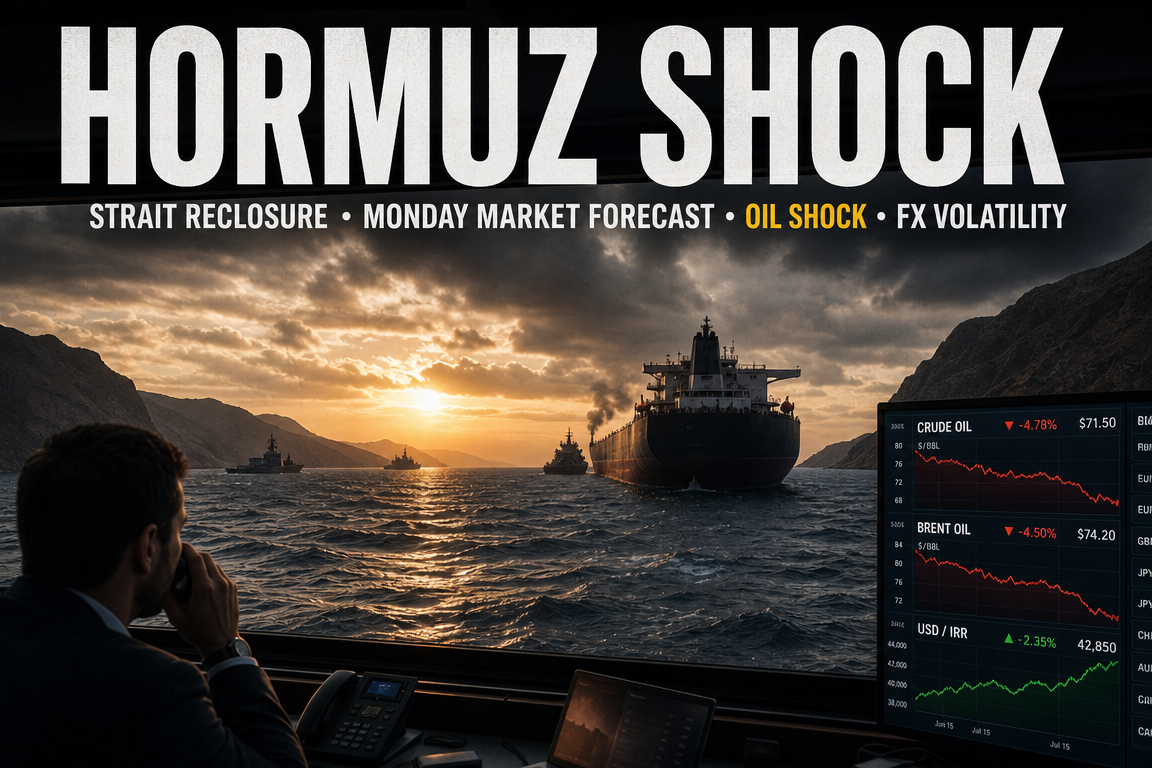
Breaking Update: Strait of Hormuz Re-Closure — Comprehensive Monday Market Outlook: Oil Spike, FX Volatility, and the Core Middle East Risk Factors
This is not a routine geopolitical headline. It is a cross-asset event that may affect Monday’s Korea equity open, U.S. equities, commodities, FX, rates, and 2H asset allocation.
This report focuses on (i) why a Strait of Hormuz re-closure is not only an oil story, (ii) how the political calendars of Trump, Netanyahu, and Iran can amplify market pressure, (iii) which Korean sectors may react first, and (iv) the key risk points investors should prioritize.
1. Headline Driver: Why the Strait of Hormuz Re-Closure Triggers an Outsized Market Response
The Strait of Hormuz is a critical global oil shipping chokepoint. Disruption risks can reintroduce supply-chain stress beyond incremental price moves.
The central issue is less the exact duration of any restriction and more the market’s renewed pricing-in of a higher risk premium. Even brief disruption risk can lift the expected average oil price level for a period, impacting crude, USD, gold, defense, refining, shipping, and FX simultaneously.
2. Why This Is Not a Simple Clash: U.S., Israel, and Iran Have Divergent Incentives
The event is complex because the main actors’ objectives are not aligned.
2-1. U.S. Objective: Escalation Containment and Negotiation Management
A broad regional war is not a preferred U.S. scenario. Higher oil prices can re-ignite inflation concerns and weaken expectations for Federal Reserve rate cuts, creating domestic political costs. The U.S. therefore has incentives to limit energy-market instability through negotiation channels.
2-2. Iran Objective: Sanctions Relief and Regime Stability
For Iran, returning to negotiations can be economically and politically beneficial. Potential unfreezing of funds, sanctions easing, and improved prospects for oil exports can strengthen fiscal capacity. Iran may use elevated military tension as leverage to improve negotiating terms.
2-3. Israel Objective: Iran Containment and Domestic Political Dynamics
Israel is likely to oppose outcomes that increase Iranian funding capacity, given implications for regional proxies, military sustainment, and renewed focus on nuclear-related risks. Domestic political considerations can also favor a more hawkish posture over diplomatic outcomes.
3. Monday Market Reaction: Most Likely Initial Scenario
Monday sessions typically begin with rapid risk repricing. Early trading may reflect:
3-1. Upward Pressure on Crude
Hormuz-related headlines usually move crude first. If markets had anchored a perceived floor near the USD 70–75 range, the shock can reinforce that floor and push the expected trading range higher, not only a short-lived spike.
3-2. Higher Volatility in Korean Equities
KOSPI/KOSDAQ may open weaker under risk-off positioning. Foreign flows often respond first via FX and large caps. Semiconductor and other mega-cap growth names can face near-term profit-taking regardless of long-term fundamentals.
3-3. KRW Depreciation Risk (USD/KRW Upward Pressure)
Geopolitical stress can strengthen the USD through safe-haven demand. A weaker KRW can add pressure via foreign selling and funding conditions, making FX monitoring essential.
3-4. Potential Strength in Gold and Defense
Gold typically attracts demand during geopolitical stress. Defense equities can see short-term inflows driven by headlines rather than fundamentals, increasing gap-up and intraday reversal risk.
4. Korean Equity Sector Focus: Likely Beneficiaries vs. Likely Headwinds
4-1. Sectors That May Benefit
Refiners are the most direct beneficiaries, as inventory valuation gains can be rapidly priced in during crude rallies. If crude rises excessively, margin compression narratives can re-emerge, requiring disciplined positioning.
Energy-linked names (upstream exposure, LNG, storage, transport) may be re-rated on renewed supply-risk focus.
Defense often receives tactical flows during heightened geopolitical risk, but headline-driven moves can be unstable.
Gold-related assets and gold ETFs may also attract incremental allocation.
4-2. Sectors That May Face Pressure
Airlines are highly sensitive to fuel costs; rising crude and softer travel sentiment can compound downside.
Chemicals may face raw-material cost pressure.
Consumer segments may see margin concerns if energy and FX move higher simultaneously.
High-multiple technology can be vulnerable if risk-off positioning and rate expectations shift.
5. Key Point: Political Timelines May Be More Market-Relevant Than Oil Itself
Investors should not assess this solely by military intensity. Political constraints and incentives (Israel elections, U.S. electoral dynamics, leadership signaling, Iran’s negotiating leverage) can make resolution structurally difficult.
Markets discount uncertainty more than direction. A fast resolution can stabilize pricing; prolonged bargaining and repeated brinkmanship can extend volatility.
6. Under-Discussed Core Issues
6-1. Even a Negotiation “Breakthrough” May Not Reduce Risk
Markets may rally on “progress” headlines, but the terms of any deal can be politically unacceptable for one party, increasing incentives for disruption as an agreement nears. Progress is not equivalent to de-risking.
6-2. Higher Oil Can Shift Inflation and Rate-Cut Expectations
A crude rally can lift inflation expectations, pushing out anticipated Fed easing. This can pressure U.S. growth equities and broaden the impact beyond energy.
6-3. Korea’s Macro Sensitivity: Energy Import Exposure + FX
As an energy importer, Korea can face a combined hit from higher crude and KRW weakness. The transmission can extend to manufacturing margins, trade balance, consumption sentiment, and inflation trajectories.
7. Monday Positioning: Prioritize Portfolio Stress-Testing Over Momentum Chasing
The highest tactical risk is one-directional positioning driven by a single headline. Chasing gap-ups in refiners, defense, or gold-linked names increases drawdown risk.
7-1. Top Monitoring Checklist
1) Crude futures: spike-and-fade vs. sustained strength
2) USD/KRW direction and volatility
3) Foreign futures positioning and flow signals
Concurrent moves in all three can materially raise intraday equity volatility.
7-2. Tactical Ideas
Near term, energy/refining/defense may see stronger flows, while airlines/chemicals and select consumer names may underperform. Use staged entries due to profit-taking risk after pre-pricing.
7-3. Medium-Term Considerations
If the shock persists, the sequence may be: inflation re-acceleration risk → delayed rate-cut expectations → pressure on growth duration. Portfolio construction may benefit from partial defensive exposure, higher cash buffers, and selective commodity hedges.
8. Linkage to AI Trends
8-1. AI Data Centers and Power Costs
AI is power- and infrastructure-intensive. Higher energy prices can increase operating costs and capex burdens for data centers, potentially pressuring near-term profitability expectations even if long-term demand remains intact.
8-2. Supply-Chain Risk Repricing
Heightened Middle East risk can lift shipping costs, insurance premiums, and logistics friction. This can indirectly affect semiconductor equipment, server components, and industrial material supply chains.
8-3. Areas That May Gain Structural Attention
Energy efficiency, smart grids, industrial automation, defense AI, satellite surveillance, and cybersecurity may attract incremental interest under elevated geopolitical instability.
9. Key Variables and Upcoming Watchpoints
- Duration and enforceability of any Strait of Hormuz restriction
- Resumption of U.S.–Iran backchannel negotiations
- Probability of additional Israeli military actions
- Escalation risk involving Lebanon/Hezbollah
- Whether crude stabilizes above USD 80
- Shifts in U.S. inflation expectations and the Fed policy stance
- USD/KRW trajectory and foreign flow direction
10. Conclusion: The Market Focus Is Not Fear, but Persistence
Monday may reflect an initial shock repricing. The critical question is whether the event is a one-day risk premium spike or the start of a multi-week volatility regime.
The dominant driver may be the political structure that complicates rapid settlement. Strategy should emphasize integrated monitoring of oil, FX, rates, and sector rotation, with risk management and hedging prioritized over aggressive directional bets.
11. News-Style Key Takeaways
First, the Strait of Hormuz re-closure narrative simultaneously lifts crude risk premium and risk-off positioning.
Second, misaligned U.S.–Israel–Iran incentives imply limited visibility on rapid resolution.
Third, Korean equities may initially favor refining/energy/defense while pressuring airlines/chemicals and raising volatility in technology.
Fourth, the transmission runs through FX, rates, inflation expectations, and U.S. equity valuation, not only energy.
Fifth, AI exposure exists via power costs, supply-chain repricing, and defense/security-linked technology themes.
12. Core Point (Most Important)
The primary risk is not the restriction itself, but a negotiation structure where a deal can be beneficial for one party and politically damaging for another. As agreement probability rises, incentives for disruption may also rise. Investors should treat “positive negotiation” headlines as conditional rather than definitive de-risking signals.
< Summary >
The Strait of Hormuz re-closure risk is a major catalyst affecting crude prices, FX volatility, and Korean equity dispersion. Monday trading may see relative strength in refining/energy/defense and weakness in airlines/chemicals, with broader pressure on select high-duration equities. The key risk is prolonged uncertainty driven by conflicting political incentives. Higher oil can shift inflation and rate expectations, impacting U.S. equities and global financial conditions. Current positioning should favor diversified risk controls and hedging over momentum chasing.
[Related Articles…]
- Oil Market Risk Premium: Key Indicators to Track During Supply Shocks
- AI Data Centers: Power Costs, Capex Cycles, and the Next Efficiency Trade
*Source: [ Jun’s economy lab ]
– [속보] 호르무즈해협 재봉쇄, 월요일 증시는 어떻게 될까(ft.네타냐후)